Tag Archives: winter

Deer Island Jaunt!

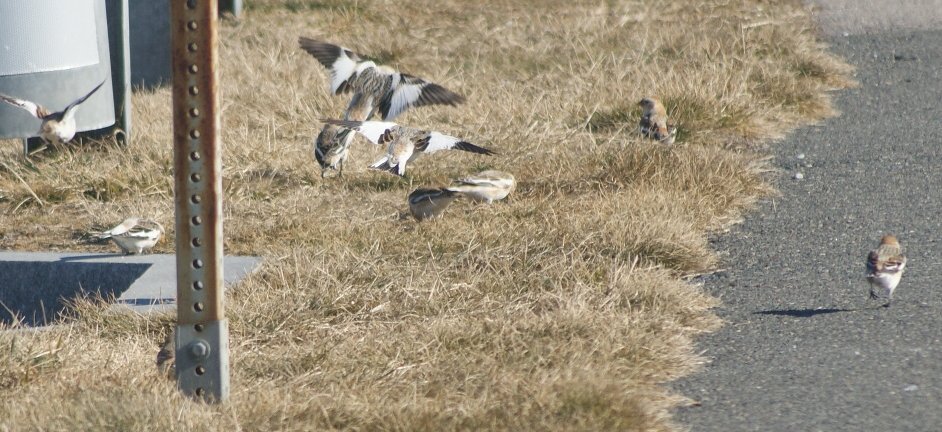
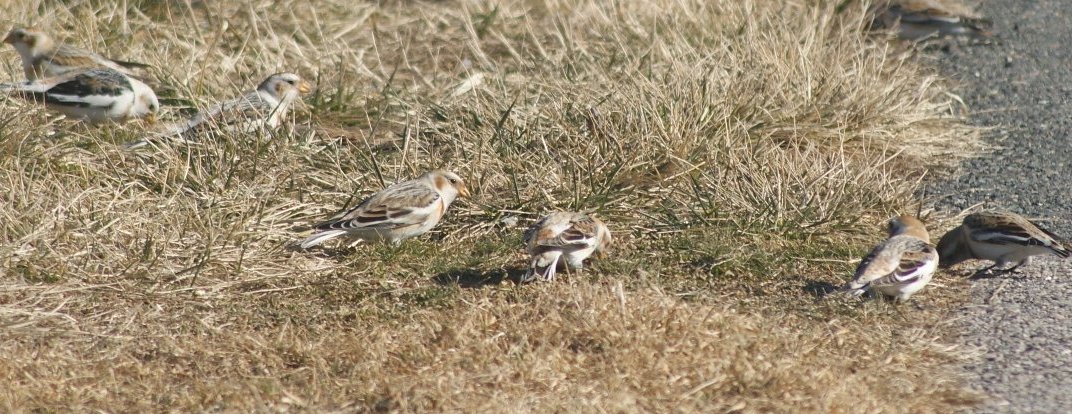
One of the FB birding groups to which I belong mentioned the presence of snow Buntings on Deer Island.  These cute guys were birds that I had never seen close up, but I’d always wanted to.  So, Yang and I took a jaunt out one weekday early afternoon and had quite a treat on our long walk around the island.  It’s about a 2 1/2 mile circular trail around the island on a paved path, so the going is easy.  It was a gorgeous day – and the views matched the weather.

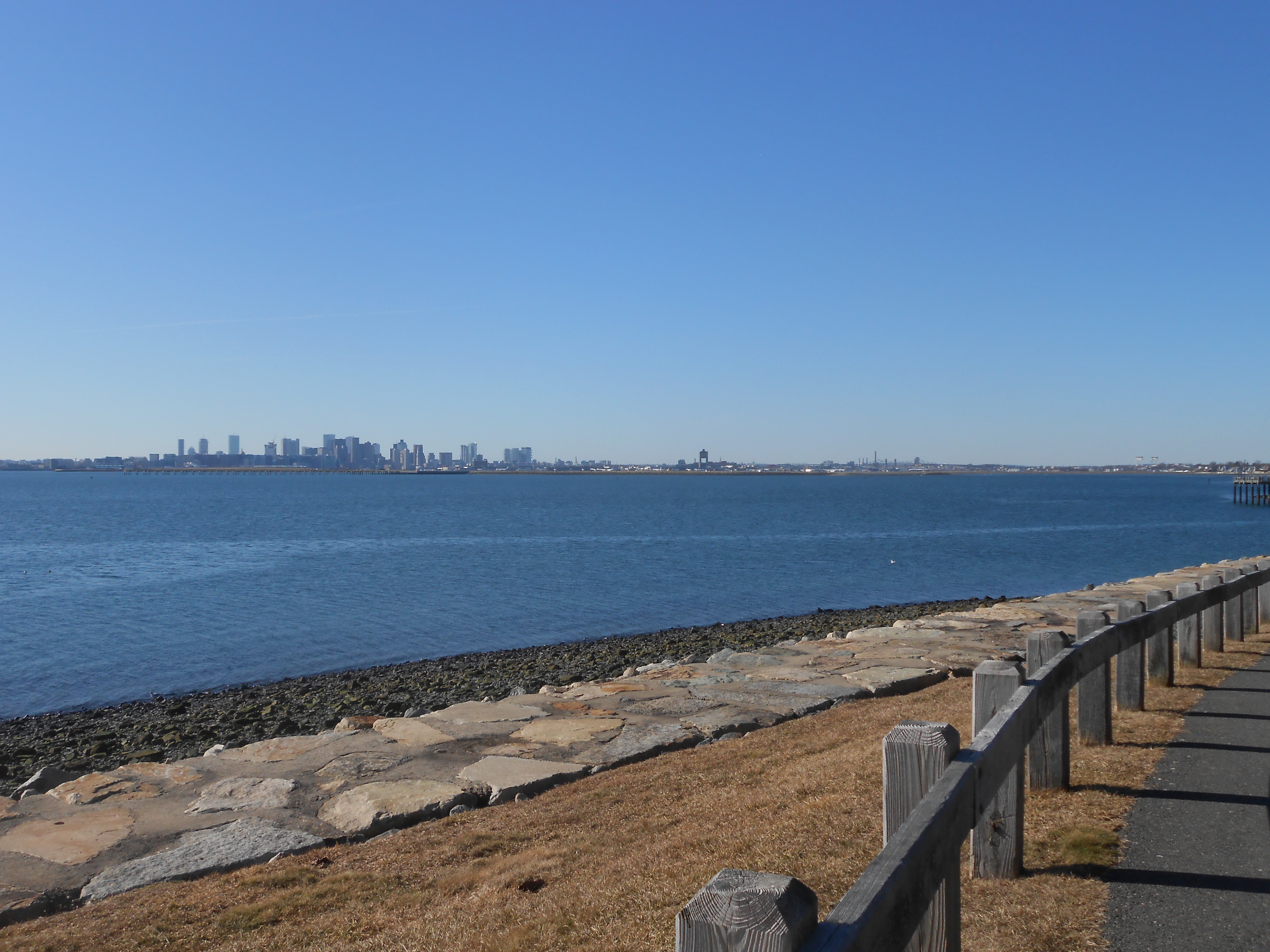
There are some wonderful views of
Boston Harbor. You can also see that I have this really neat white hat on, given me for Christmas by my good friend Kathy Pender Phaneuf.  This hat has kept my noggin warm on many a seaside trek to scope out the water fowl.  Thank you, Kathy – and dig these views!


On the far side of the island:


There was, indeed, quite a bit to view in the fine-feathered-friend department.  I got to see my Snow Buntings!  You should click on the images to get a really good look at these guys.


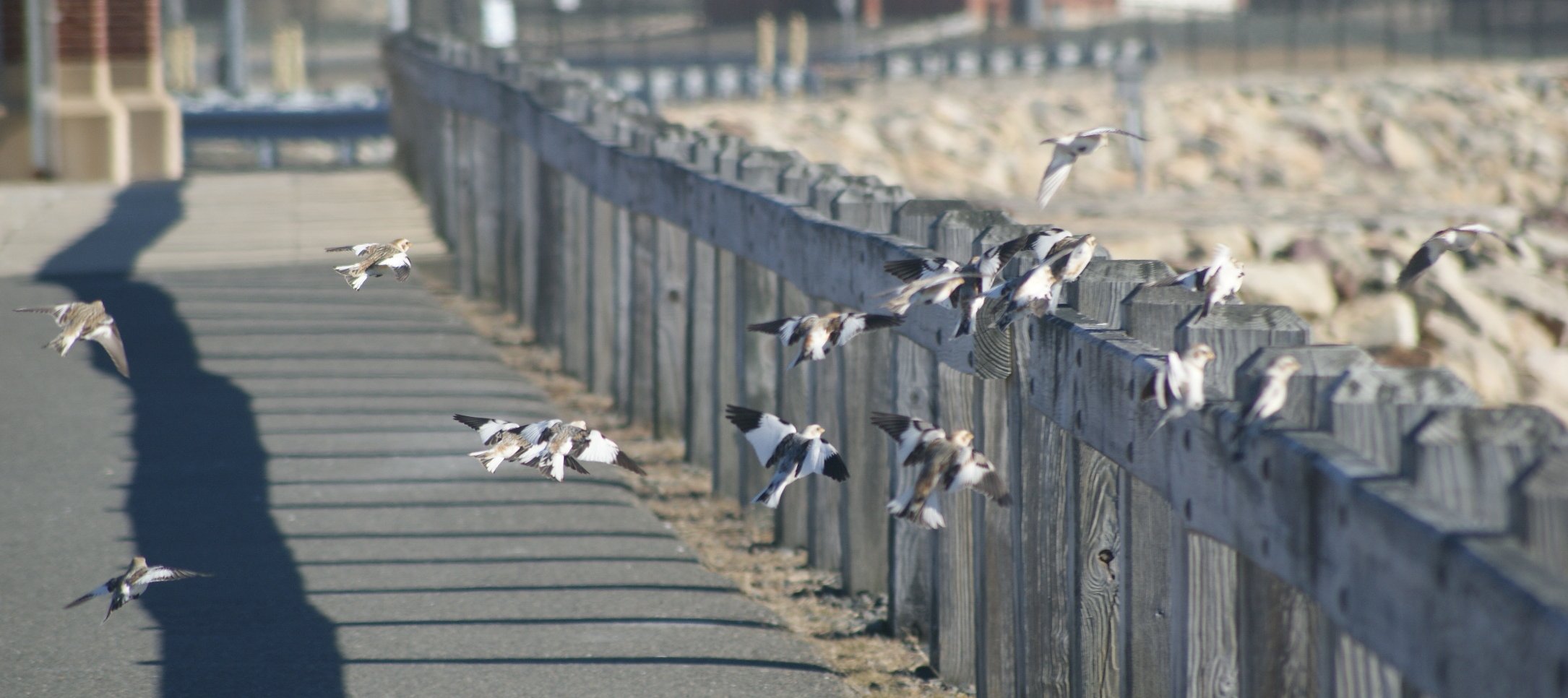
I first heard them somewhere on the beach, but couldn’t see them.  I walked along the wall next to the trail, looking at the ground to watch my step, when all of a sudden, Yang called, “Stop!  Look in front of you!” There they were – and what fun they were to watch.  If you creep up very slowly and quietly, you can get a good look at them, but you have to be careful.  These birds are extremely timid and spook easily.  Then the flock is in the air, flying in precision formation, but often circling back  nearly to where they started.  When they fly, you can see white and black chevrons on their wings that are beautiful!


Here are a few closeups.  I love that gorgeous white on their tummies.


There were even more birds IN the water than out of it!  We had been to the Cape looking for Eider Ducks recently, but hadn’t seen many.  Now we know where to find them – along with Scoters of all kinds, Scaups, Buffleheads – you name it!


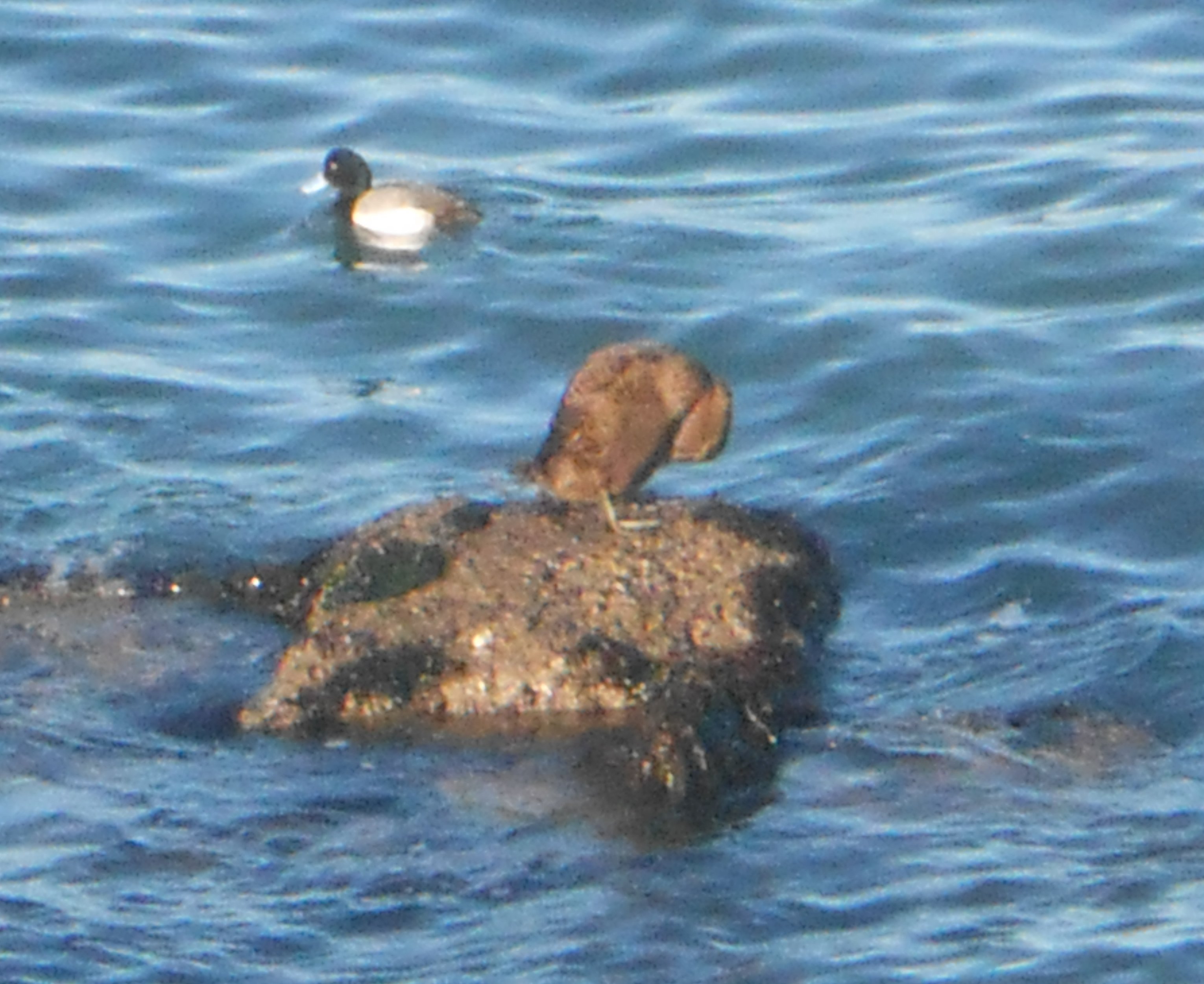
Here are some close ups of the Scaups, and it looks like a female Bufflehead.


There were lots of Eider Ducks.  We got a special kick out of this lady who was have a fine time for herself out of the water on her own personal rock – with a special guest shot by a Scaup.


Then, she has to get down with her bad self in this next picture.

We did see  and hear some Song Sparrows. I wonder if in the spring some interesting song birds will return to sing in the brush or atop this Celtic Cross?

Christmas Beauty at Hammond Castle

Since we’re still in the middle of the twelve days of Christmas, how about a blog where you can see the cheery holiday decorations at one of my favorite spots, Hammond Castle?  I hadn’t been there for years, but I remembered how they did up the castle right for Christmas one of the times I was there many moons back.  So, Yang and I decided to celebrate the season by visiting once again.  We were not disappointed.

John Hammond built this castle early in the 1900s, funding it by the sale of his patents for all kinds of applications to navigation, radar, radio, etc.  In fact, I believe he holds the record for the largest number of patents awarded in this country.  He did come from a prominent and wealthy family, but they disowned him for marrying an older divorced woman – with whom he shared a long and happy marriage – so there Mom and Pop Hammond!
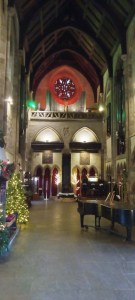
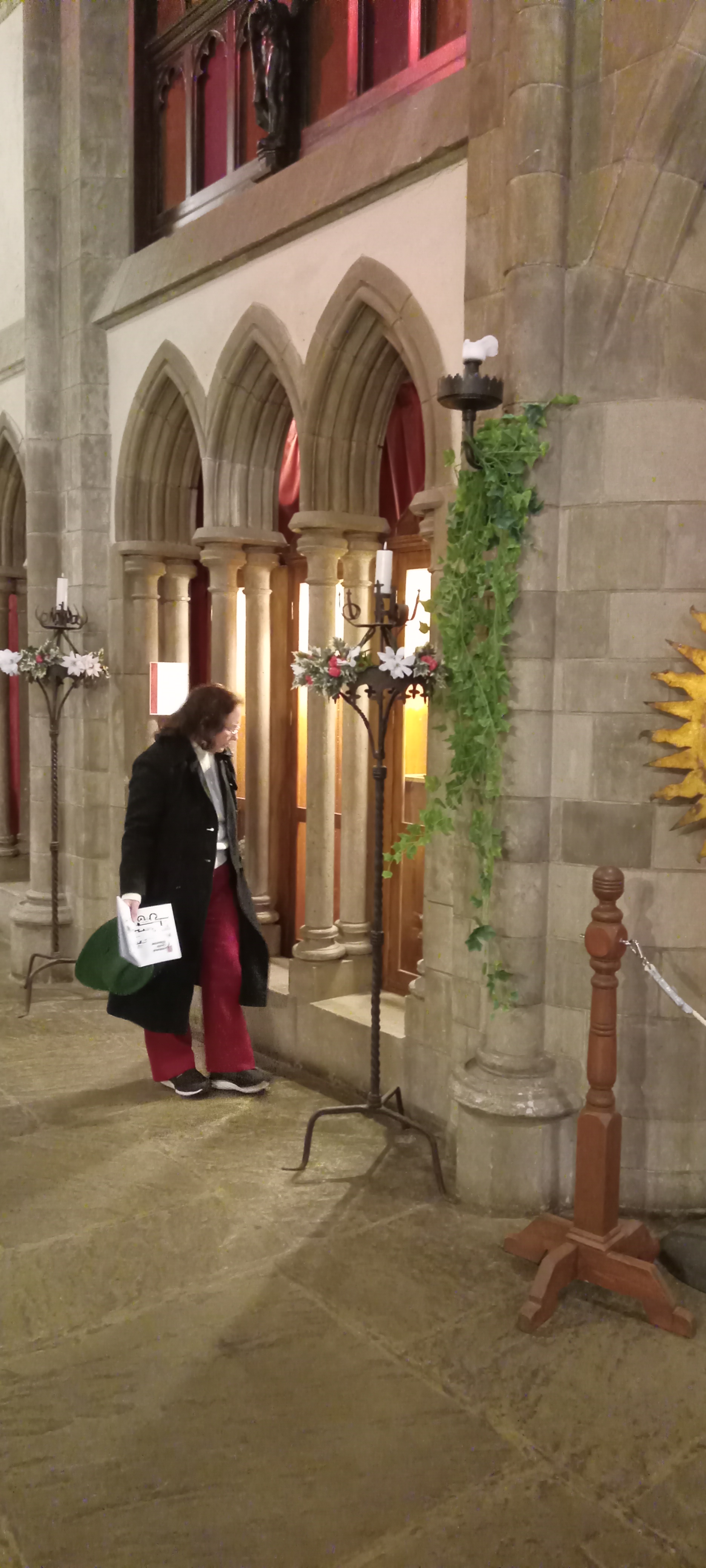
The main shots we have here are of the Great Hall and the Courtyard.  Yang took some really neat shots of the Great Hall.  Hammond would have large family and friend gatherings here in his day, including lots of famous film political, and business figures. I remember back in the 1980s and later when I came here, I attended concerts on the pipe organ and by smaller consorts.  I also got to watch silent films in the Great Hall. It was the perfect setting to enjoy Lon Chaney’s The Phantom of the Opera.  In this photo, you can get an idea of the length of the hall.  You can also see the beautiful rose window.


You can also observe some of the alcoves off the main hall  in these photos.  I wish we’d had a chance to take pictures in the dining room and the library off the Great Hall, facing the ocean, but the light was not great for photographing — too much sun coming in.  Natasha would have liked it, though!  Some of the decor were skillful reproductions of classical, medieval, and renaissance art; however, much was also pieces that had been rescued from ruins or antique dealers.


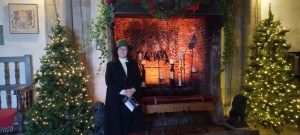
How about this huge hearth?  Would it keep the entire hall warm?  Well, maybe you ought to remove the Christmas decorations first!
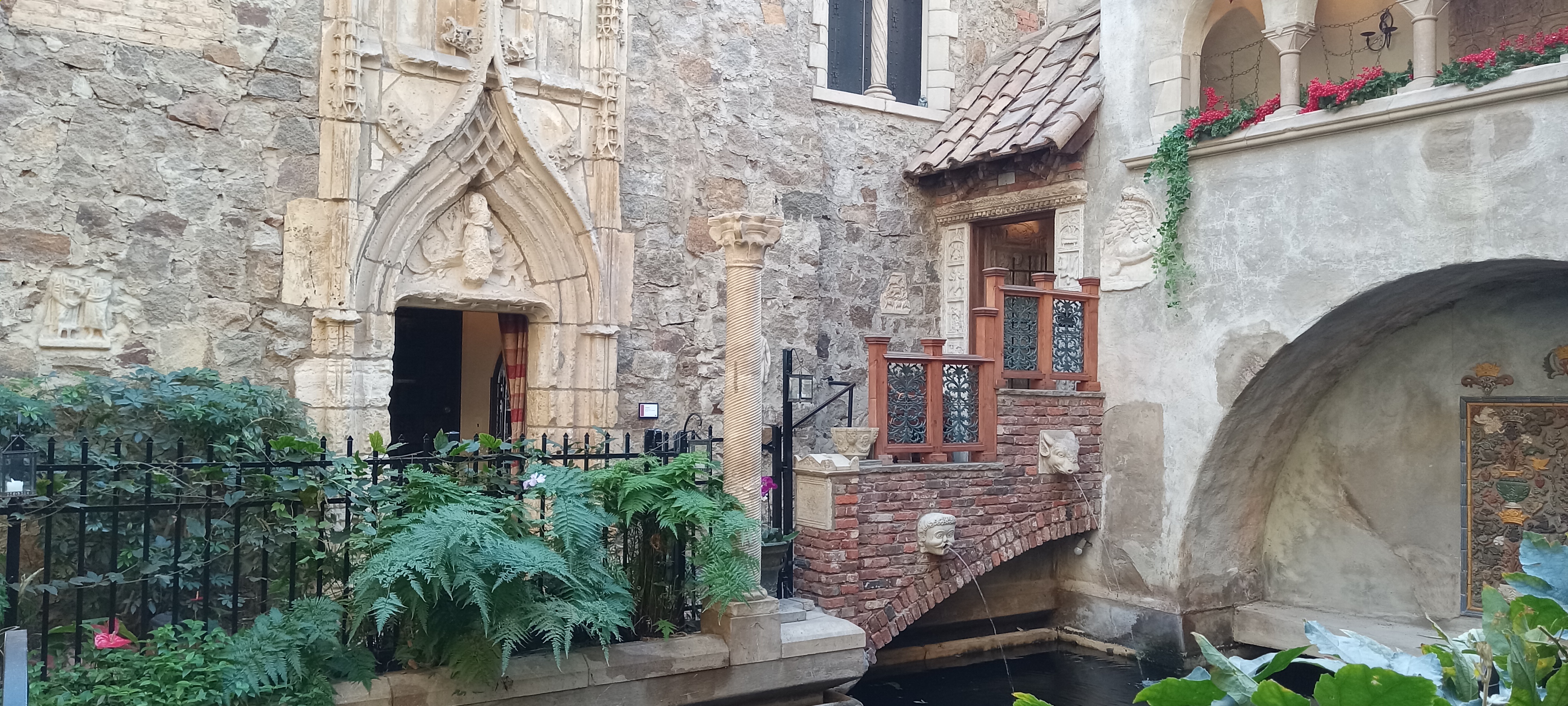
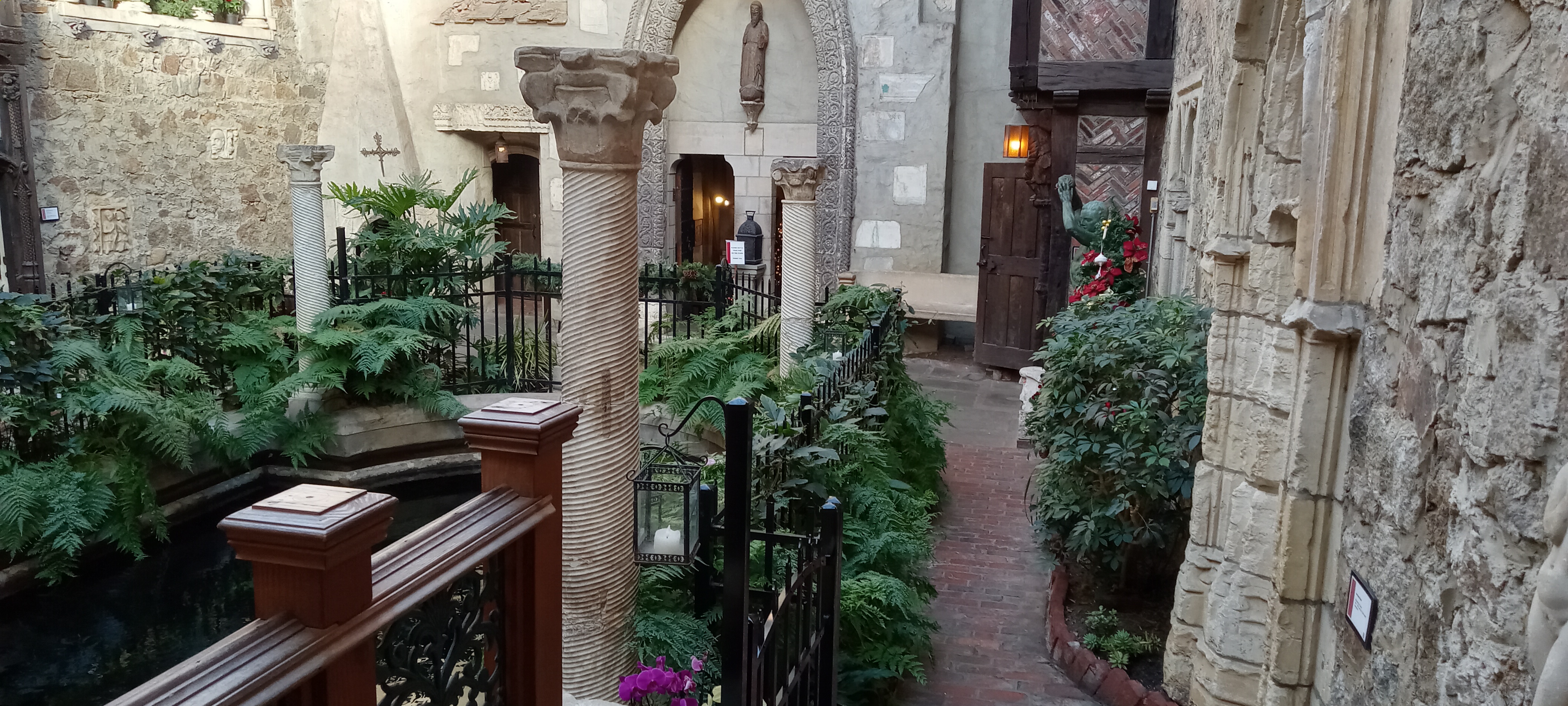
The courtyard was a real treat!  Recreations or imports of medieval and renaissance shop fronts were integrated into the walls, leading into various rooms.  The courtyard was roofed with glass skylighting, allowing for the growing of all kinds of plants that surrounded a long, eight-foot deep pool.   Here is a view from the balcony to one end of the courtyard from which Mr. Hammond enjoyed diving off  into the pool for a swim – but I think he changed into his trunks first. How would you like to jump in from here?

We were lucky enough to meet two of the guides there who took our picture.  We had a great chat with them about the castle and ruins, castles, mansions, and other haunted spots in new England.  If we go back for a guided tour, I know that they would do a great job.  they helped make our day!
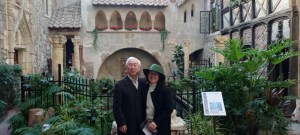
Anyway, here are some more shots of the courtyard.


Looking at these photos, you can see how Hammond integrated reliefs, tombstones, storefronts, etc, into the construction of the hall.  It’s eclectic, but it works!
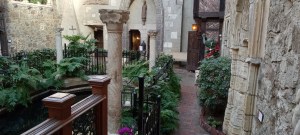
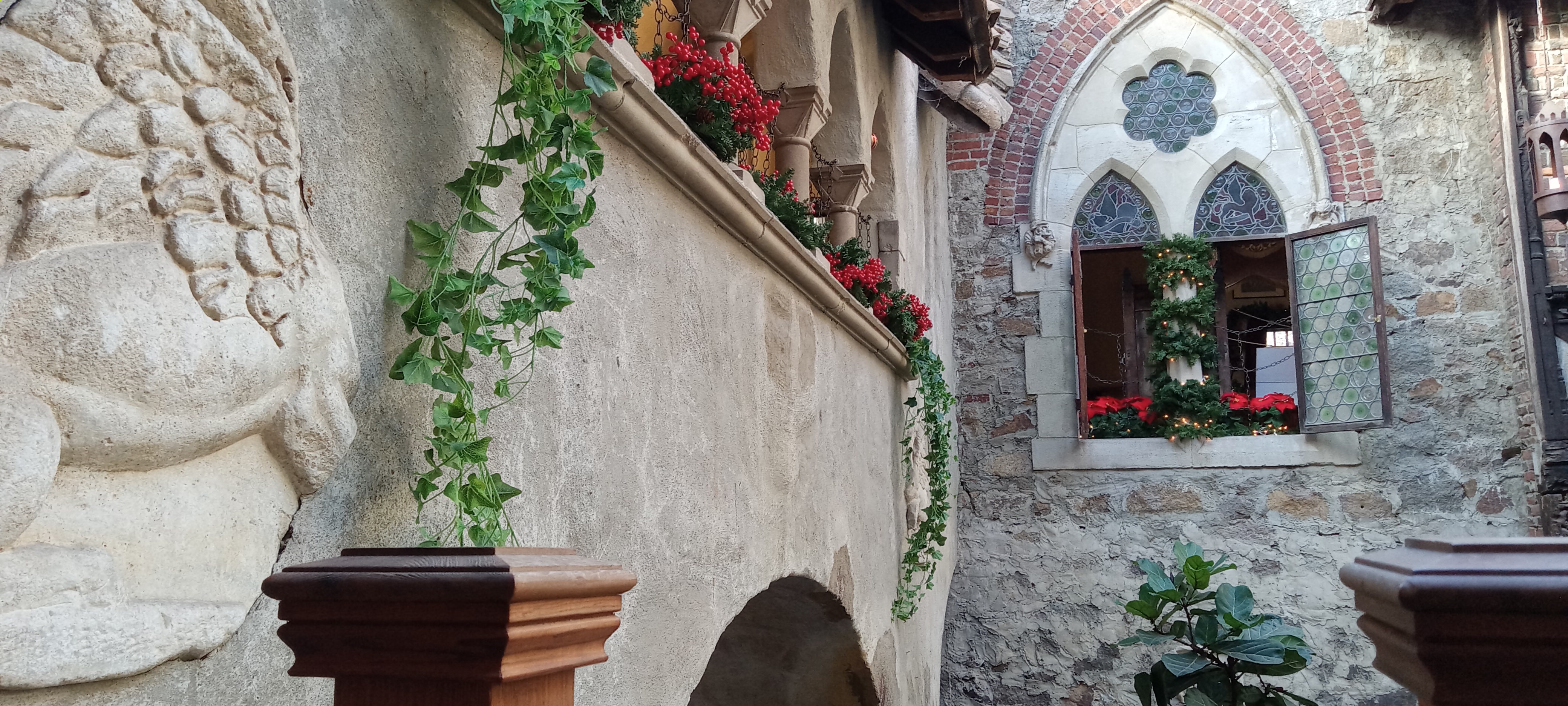
The Christmastide greenery adds seasonal beauty and cheer to the castle.

We don’t have photos of the bedrooms or the kitchen or Hammond’s workrooms.  Maybe that’s for another day – or for you to find on your own trip to the castle.

Finally, the outside is also a pleasure to enjoy.  For one thing, there’s a draw bridge.  An interesting story connects here.  Apparently, Hammond also built a covered bridge for the cats to leave the castle near here as well – but they didn’t deign to use it.  I think they were busy chilling in the boxes in which some of the antiquities arrived.
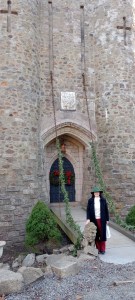


Of course, we can’t forget to include picture of the person to whom we can credit the majority of these photographs.


I love these Gothic arches framing the view of the Atlantic on this sunny winter’s day.

For your final delectation, below is a video that reveals the glory of the Great Hall in panorama.  If you want to enjoy Hammond castle for yourself, here’s a link to their web site. Their “Deck the Halls” tours are open until December 30th.


Halibut Point Feathered Friends

Two Fridays back, Yang and I happened to be on the North Shore, so we stayed overnight in order to make an early visit to Halibut Point State Park.  We’d been meaning to get there since November, after hearing about all the cool water fowl hanging out there.  Unfortunately, the opportunity hadn’t come up before this.  So, after our breakfast of bagels and cream cheese (yum!), we headed out to the state park.  We were not disappointed.  In the quarry, we spotted a Scaup, Black Ducks, and Mallards.  When we headed for the ocean, we got an even bigger treat.  Here you see me peering out at the ocean’s wonderland – or wonderwater- of ducks. Isn’t that point beautiful?

At first, we  saw only a couple of pairs of Harlequin Ducks, looking absolutely adorable.  All the FB bird groups to which I belonged extolled the plenitude of Harlequins out here.  So, we were happy to spot this couple chilling along.


Mrs. Harley seems to be finding a snack while her husband looks on.

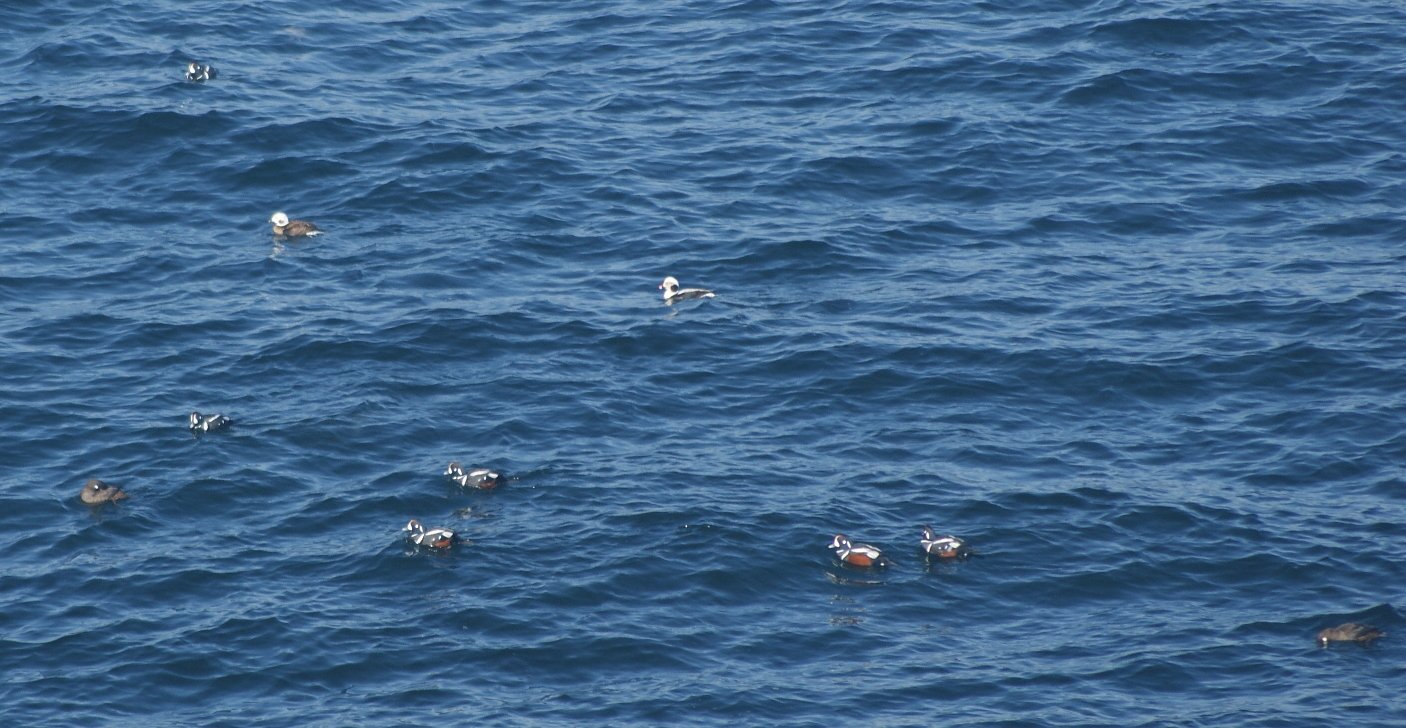
Neat as this sighting was, things got MUCH better.  Looking all around and out to sea, we saw flocks of Harlequins diving, chilling, and looking good.  There were so many that we couldn’t always get them all in one picture.  I would say we saw several flocks ranging from 9-15 Harlequins.  And that’s not counting the friendly-neighbor Long-tail Ducks who joined the party.  Counting the ducks was never easy, because, all of a sudden, the whole kit and kaboodle would take a dive on a hunt for food.  So, Yang had to time his shots carefully to catch them.  I guess it’s true that these ducks love rough waters, because that’s exactly what they got here and in the other place we saw them, Sachuest Point, RI.  This was the biggest contingent of Harleys that I had seen. Though the ducks are hard to pick out in these pictures, if you just click on them you will get a better look.

Then we saw this Loon way off above the group of Harlequins.  It’s the white figure in the upper left corner.

Wouldn’t you know, we also saw plenty of flocks of Scoters. 


Here’s a closeup of a female Scoter.  I believe these are all Black Scoters.


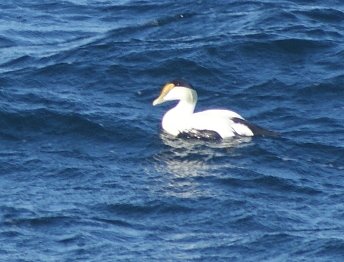
When we moved onto the harbor at Rockport, Yang also got a shot of a male Eider Duck.  Usually we see big flocks of these guys, especially at Cape Cod (check out this older blog).  Today, we saw this guy all by his lonesome.


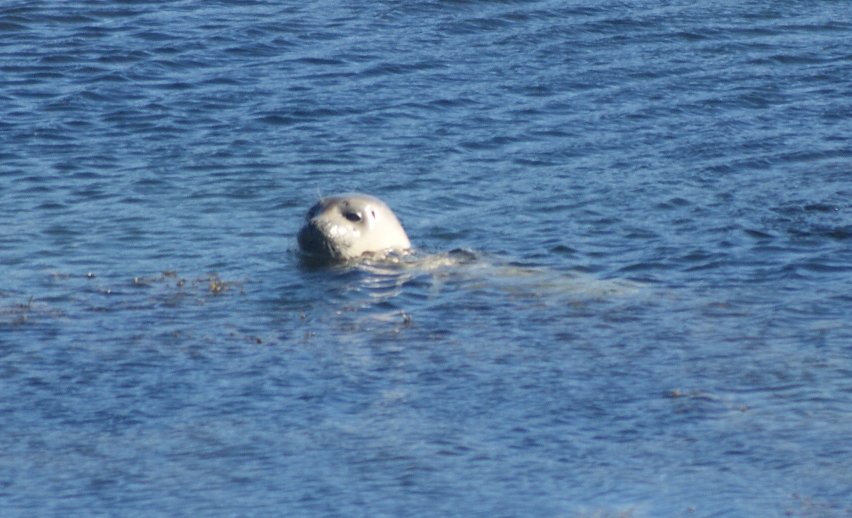
Then, finally, what should we espy on the other side of the point in the harbor in Rockport?  We thought we it was a brown female eider – except, Yang said that once the critter dived  he could see her  walking under water.  Huh?  Then “she” came up.


Yup, a seal!  So I hope this critter can be a “seal” of approval for today’s blog.


Out of the Fog: Long-Tailed Ducks!

We had planned last week to take a trip to Gooseberry Neck Beach on that Wednesday, since the day was supposed to be relatively warm (40s).  We didn’t plan on a fog that could make Londoners get lost.  Undaunted, we started out, first heading for Shastea in Providence for lunch.  Our hopes rose, as the fog seemed to dissipate into just a cloudy day once we got there.  So, would Gooseberry Beach be equally clear?  Nope!

The closer we drove to the ocean, the deeper the grey nothingness became.  We couldn’t even see the ocean! Nevertheless, when we pulled up at the beginning of the causeway to park, I had hopes that we might be able to see some critters swimming close to shore.  Bingo!

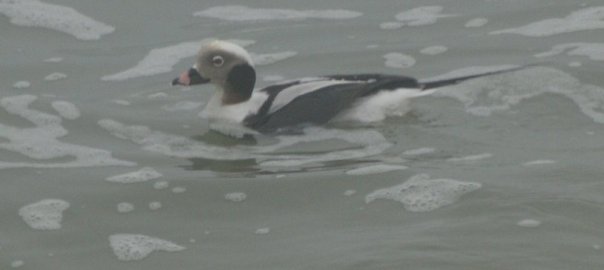
I got so excited, seeing this guy swimming around, taking a dive or two.  It was almost a year to the day that I’d seen my first Longtail last year at Silver Sands Beach in Ct.  Now, here was my second sighting.  Then, as my eyes adjusted to the fog, I realized that Mr. Longtail wasn’t alone.  Mrs. Longtail was also on hand in the rough and crashing seas, and she was definitely no slouch when it came to hunting. Yang took this cool picture of her arching up to dive deep for some seafood take out – which she’d be taking out herself.  You’ll have to forgive the fogginess of some of these pictures.  As I said, it was a pea souper!  I don’t know how the ducks were able to see each other!

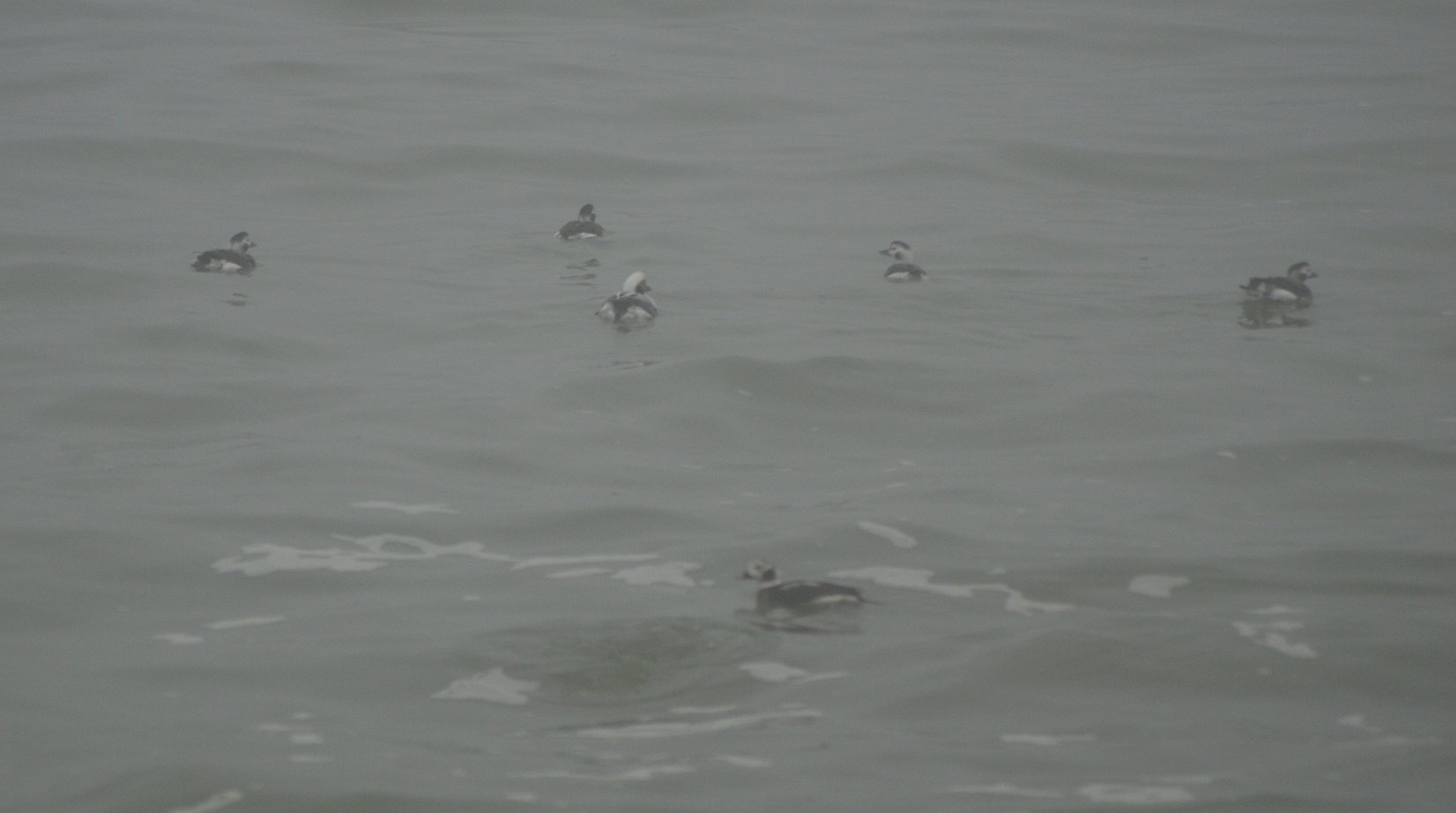
I apologize for the fogginess of the photos – it was foggy.  If you click on the photos to enlarge them, they are clearer.

I wonder what she said to provoke THIS reaction?

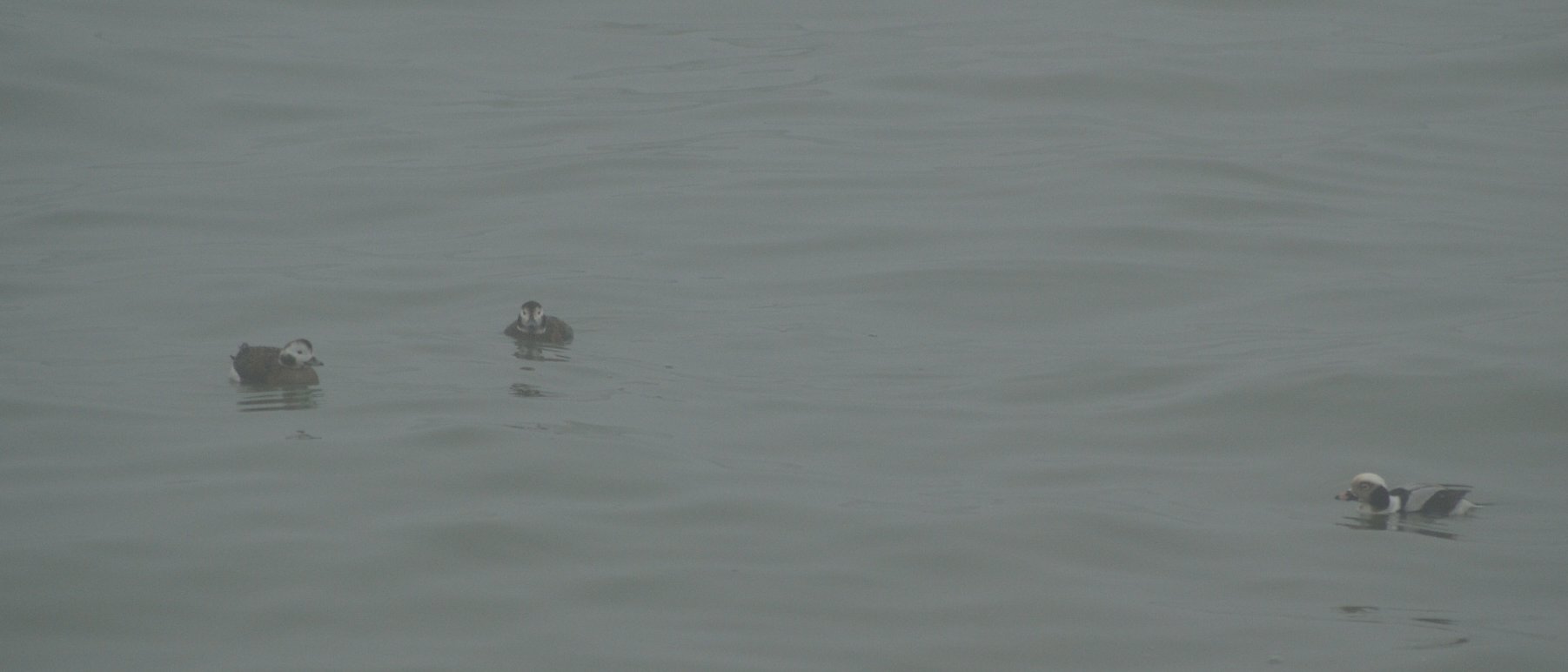
Could anything be more exciting?  Yes!  as Yang and I walked  along the causeway, we came across more and more Longtails!  These guys were riding the roughest of seas.  It was fascinating to watch them crest some of those  rough swells. All told, we finally saw about three flocks of Longtailed ducks, males and females.  There must have been thirty ducks riding the rough waves, diving for food, chilling in the fog! Again, I apologize for the, literal, fogginess of the photos.  However, if you click on the picture, the enlarged version is reasonably clear.

I thought these two little ladies looked rather sweet.


I think this guy is starring in the duck version of I Had Two Wives.


Speaking of the moving image, how about Yang’s film clip of a diving Longtail?


And that’s the end of my duck tail!


Happy Harlequin Hunting: Only Shooting with a Camera!

For the past month, I’ve been seeing nothing but posts about all the Harlequin Ducks flocking down the coast of Massachusetts from Plum Island to Westhaven.  Never having seen one, I was eager to make a sighting.  Three trips to the coastal waters, and I was still a Harlequin virgin.  That is until Yang and I visited Sachuest (don’t ask me to pronounce it) in Rhode Island.  Of course, my prayers for a sighting weren’t answered at once.

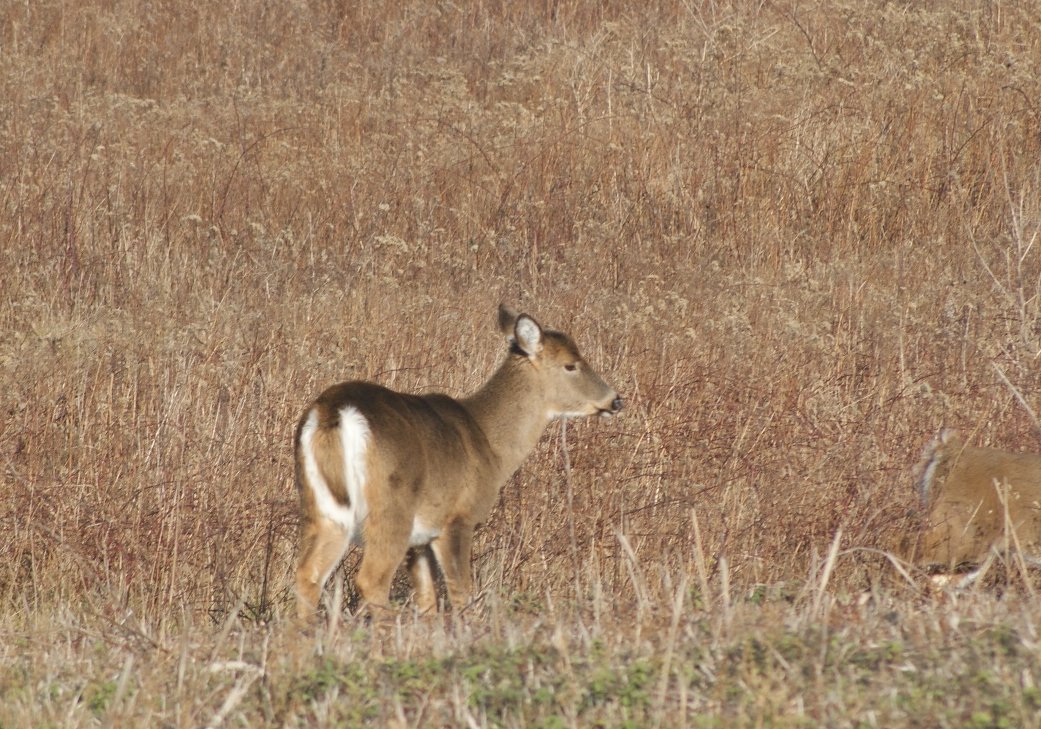
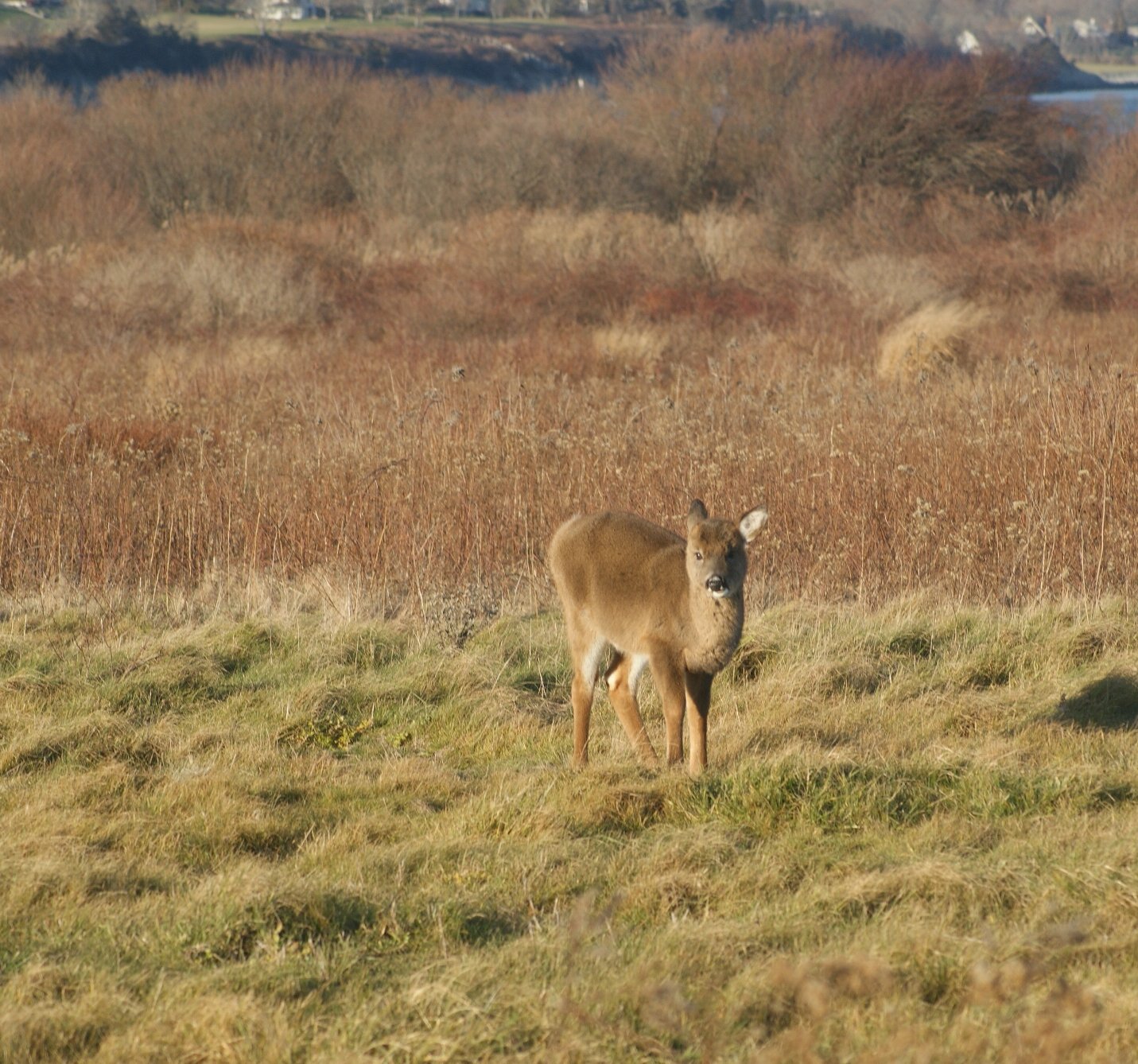
We went down to a cove and saw two huge flocks of Buffleheads bobbing and diving in the waves.  They are adorable with their big white spots on the sides of their heads that look like ear muffs.  But no Harleys!  Then, coming back to the parking lot, to start the trail leading around the other side of the point, we saw four deer grazing nonchalantly in the marsh field.  Beautiful in their heavy winter coats – but not ducks.


We later even found a family of Eider Ducks, one adult male, one juvenile male and two females – joined by a Bufflehead, who popped up out of nowhere – but no Harlequins.

So, we made our way down onto a rocky beach after we spied some Lesser Scaups ( a first sighting, ever!),  some Surf Scoters, and a female Redbreasted Merganser, but no …wait!  What’s that black and white thing bobbing and diving out there? 

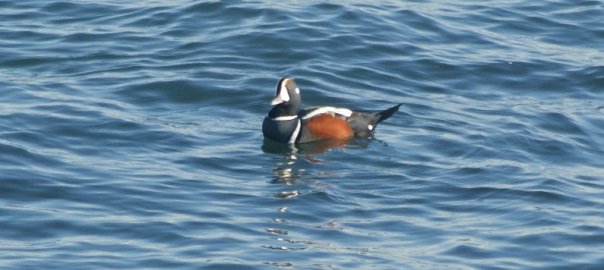
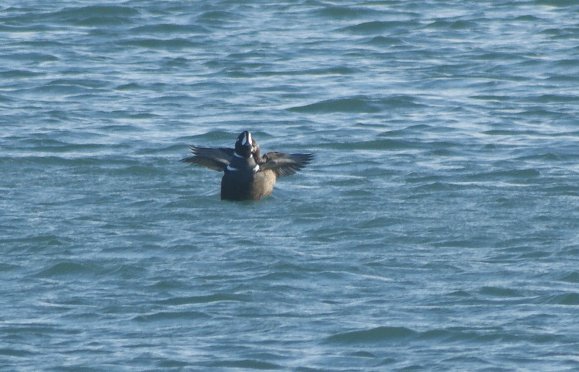
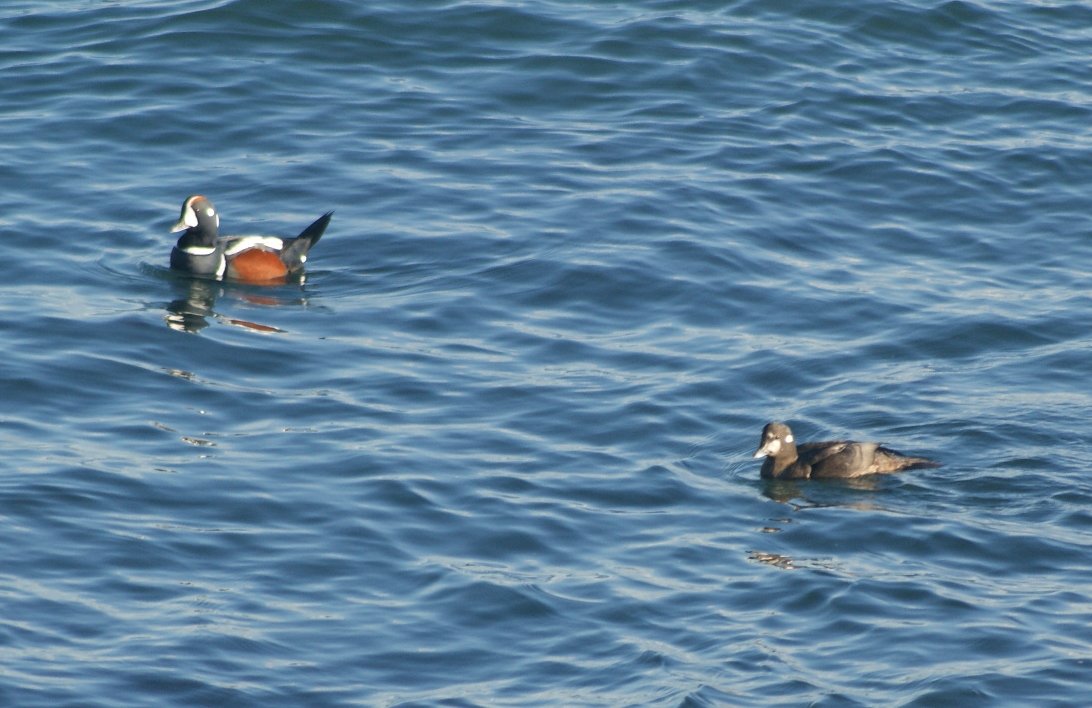
See the tiny white and black thing in the middle of the screen?  It was clearer and bigger with the binoculars.  I said to Yang, “It’s, wait , I think it’s, yes!  It’s a male Harlequin.”  Now before you say, “Hey, I can’t see a darned thing, wait, big deal,” it gets better.  After watching this guy and some Redbreasted Mergansers for a while, we moved on  – and came across another Harlequin chilling with some Scaups.  A little later, we came across a lone pair of Harlequins.  These shots are better, but not our top prizes.  I just love this one of the male flapping at us.  Camera shy or a show off?  You judge.


It’s really interesting to me that when the males look at you head on, with the light colored beak and the white stripe on their face, they appear more white-faced than they actually are.  When we got to another spot, Yang got some gorgeous shots that show off all their glorious markings. So, here you go with a set of photos of another  Harley pair from much closer up.

Here’s the male by himself.  Take a gander at that gorgeous splash of chestnut on his side, the way the white stripes demarcate the patches of black, and look carefully for that line of chestnut down the back of his head.


Here is the pair together.    Sometimes they point those short but sharp tails upward. Notice how the female has those lovely three white spots on the side of her head.  


I think they must have had an argument.  Yang and I noticed that the female did most of the diving/hunting.  Maybe she got sick of her hubbie posing for the papparazzi when she was doing all the work. Anyway, they briefly went separate ways.

Well, deers, er, dears, that’s all for now.

Adventures with Waterfowl at Silver Sands Beach

Yang and I went to the beach last week when we had some warm weather– in New England, in winter,  you can call 40 degrees warm. It started out as a trip to Tea with Tracey in Connecticut for tea (obviously), but since the day was so sunny and “warm,” Yang suggested that after tea, we head to nearby Silver Sands Beach to see what birds might be visiting.  I think he felt bad for me because we were the only people at Plum Island the week before who didn’t see a Snow Owl. Anyway, once we got there, we were NOT disappointed, with a special guest star appearing that neither of us had ever seen before!
As we approached where the waves broke on the shore, we were delighted to see Herring Gulls mixing and mingling with Brant Geese.  The gulls I’d seen many times before.  However, I’d only seen Brants twice previously.  They were not afraid of us and let Yang take lots of photographs.  Here are some neat ones we saw of them along the shore.
When the Brants took to the water, they proceeded in well-ordered convoy fashion.  You’d almost think they were heading to Britain with Lend-Lease weaponry, on the watch for Nazi U-Boats.
Maybe they had air support from the Herring and Great Black-backed Gulls.  I think some gulls might even have been acting as the Armed Guard.

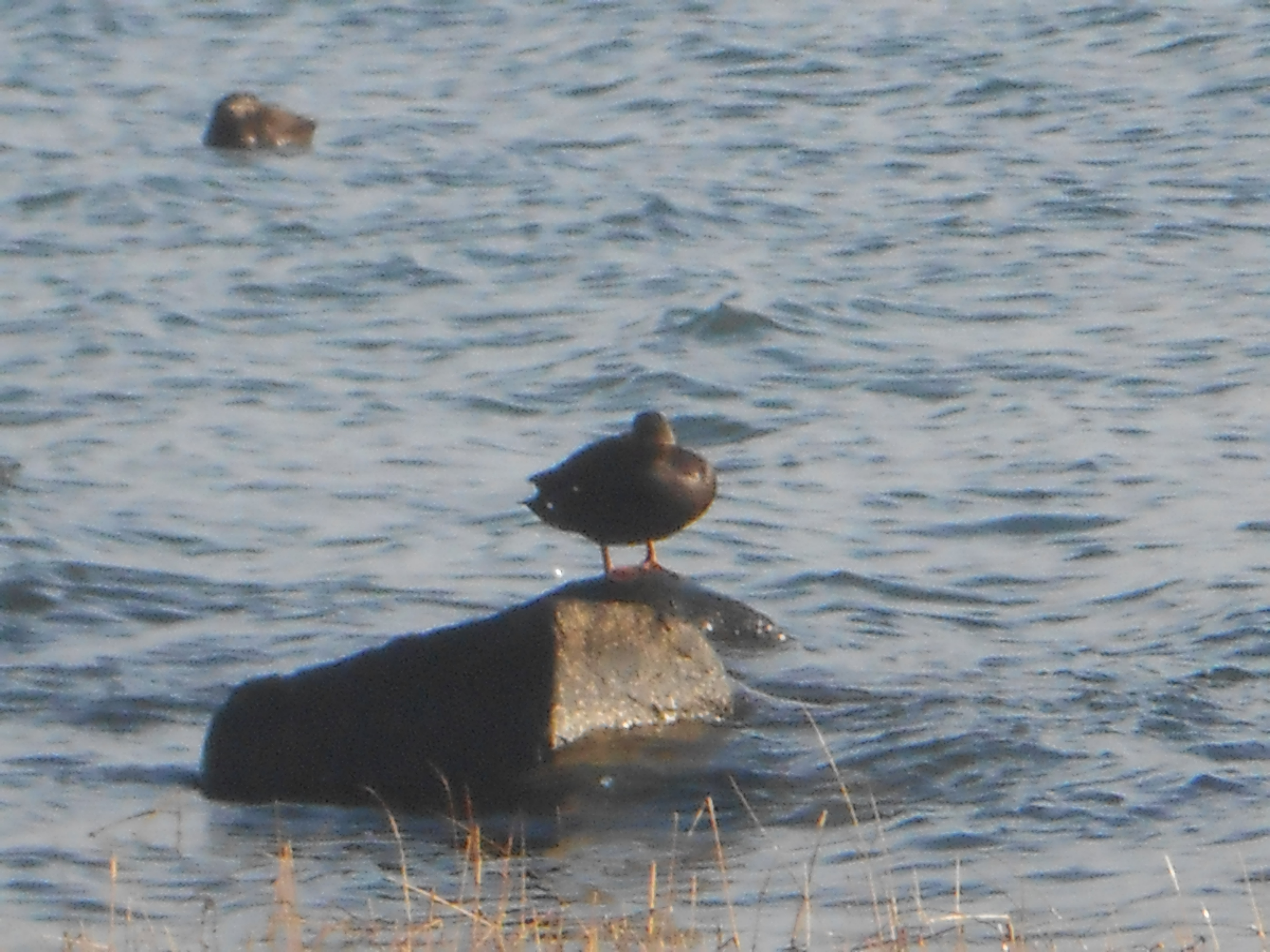
We also saw some old favorites, American Black Ducks.  Here are two in conference.


Over here is another guy just chillin’ on a rock.  Maybe he felt he’d be chillin’ too much, literally, if he joined his pals in the ocean.  What do you think?
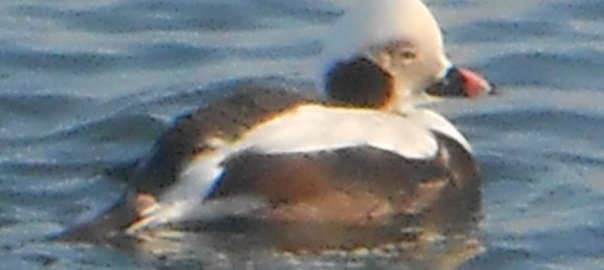
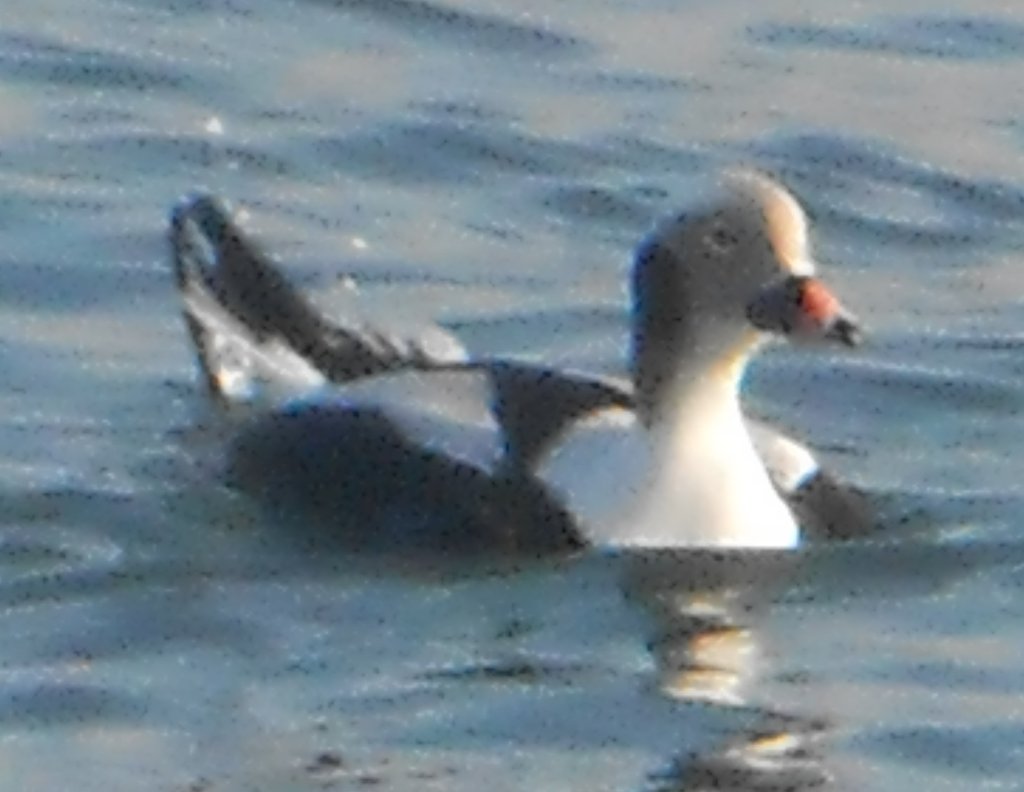
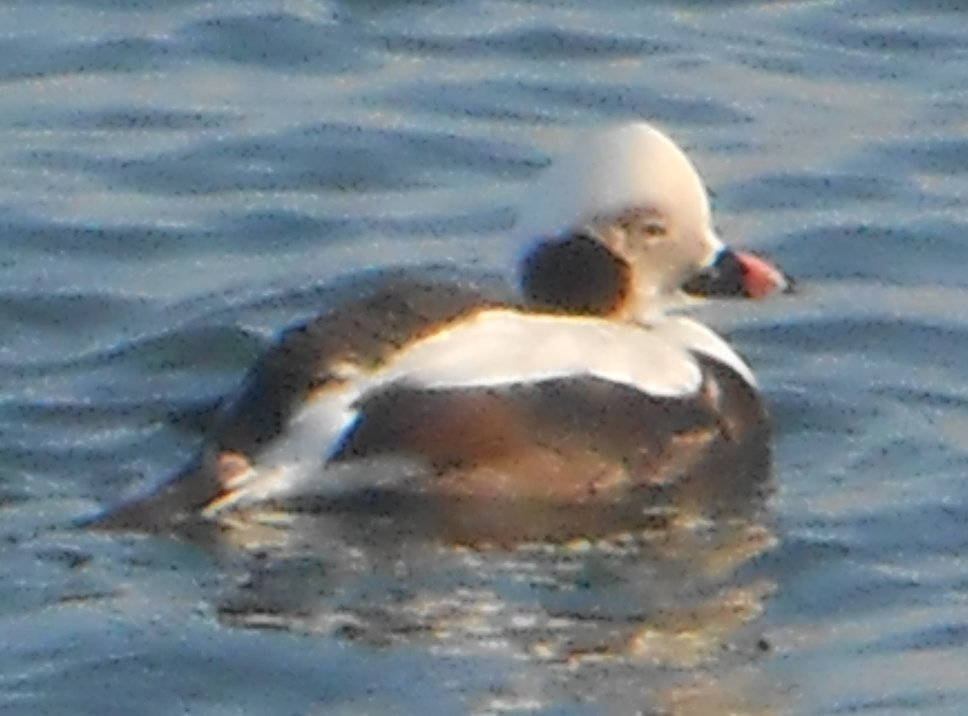
Then, there was this lonesome stranger.  Yang and I spotted a white dot in the ocean.  We almost dismissed it as yet another Hooded Merganser, but Yang had second thoughts and trained his binoculars on this guy.  Well, what do you know?  A duck that neither of us had ever seen before.  He was a study in art decco black and white, with a whitish Presley pompadour swept and puffed up off his forehead. His yellow eyes contrasted with a black pupil.  Even his pink beak had symmetric black patches on either side! Then, when he dived, there was that long, slim tail flipping up.

What could he be?  A Harlequin Duck?  A funky Woodduck? A pintail of some kind? My guess was an Oldsquaw – and darned if a peek in my Peterson’s and a look on-line didn’t prove me right.  Now, some people don’t like the term “squaw” in his name, feeling it’s offensive.  So, considering that yellowish white pompadour, could we rename him an OldElvis?  Too soon?
Anyway, like our new friend, I’m going to take a dive and say, “so long!”


Hillside Cemetery, A Dunwich Kind of Place

Well, here I go trying to create a new blog with WordPress’s Godawful new editor.  Forgive me if this comes out crappy.  It’s taken me forever to figure out how to switch back and forth between html editor and visual-nothing is clearly labeled or explained.  I know this format is much uglier than the one I had previously.  We’re all at the mercy of tasteless, unimaginative, homogenizing forces.
DSCN5809Anyway, let’s move on to a more enjoyable descent into darkness.   Here’s a DSCN5834last gasp at wintry images with Part 2 of my report on the Hillside Cemetery of North Adams.  Across the street from the original portion of the graveyard, lonely mountains rise up to close you you in and the rest of the world out on this grey day.

DSCN5843

This is the newer portion of Hillside, and much more on an actualDSCN5812 hillside.  With the rolling slopes here, the graves, mostly 19th century,  tilt and are almost upended  as the ground has settled and shifted over the years-or is someone or something trying to push out?

DSCN5867

DSCN5841
DSCN5865And those slopes are pretty darned high, too, with gravestones and monuments, bleakly, implacably towering upward from an earth  both browned by autumn and frosted by snow.

DSCN5845

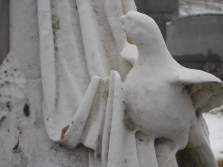
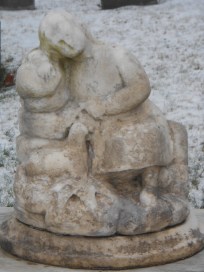
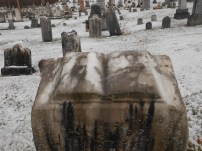
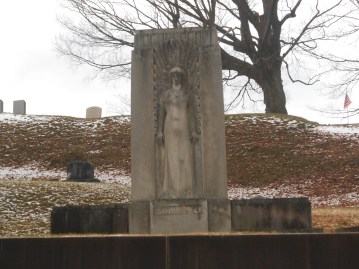
This cemetery has it’s share of intriguing, impressive statuary, but theDSCN5850 brutal western Massachusetts winds, rain,DSCN5826 and snow have not been kind to them, gradually wearing them down to softened blurs in many cases.  The dove embracing this shrouded cross has lost its distinctive features and  now softly merges into the cross’s drapery.  The child and the lamb, representing her innocence, have melted into the seat of broken rocks symbolizing her life cut too short, too soon.    A DSCN5819relief that should have preserved a woman’s identity in endurable stone for eternity has blurred her features into  gentle vagueness.  Even her identity in the form of name, family, and birth and death dates have been smoothed away to soft whiteness.    A book of life’s secrets DSCN5830has subsumed its truths into a creamy blank of pages melted together, marked only by the stain of mold and decay.  Or might this be an edition of the Necronomicon?
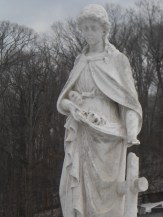
DSCN5832Of course there are also still striking images of angels and symbolic broken columns, some standing relentless against nature’s assault by winds, weather, and  devouring by lichen and mold.  DSCN5854
Some are  less successful than others in resisting the assaulting elements, but are no less beautiful.DSCN5859
There was only one large mausoleum in this portion of the cemetery-butDSCN5837 it is impressive, especially for the art deco angel guarding the resting bodies of the family beneath.  There’s a wonderful starkness in its rising near the crest of the rolling hill, the dark tree grasping hungry branches at the sky beyond it.
And here is a closeup of the angel.  Regard the myriad layers of feathers creating a shield of wings behind its head, seeming both like a peacock’s tail in full extension and a wall of tongues of flames.

DSCN5839

The day had been cold, but not bitterly so.  The ground betrayed the tracks of deer, racoon, and perhaps more predatory mammals.  It was an isolated spot where no human seemed to have ventured to grieve or pay veneration for a very long time.  In fact, this day this cemetery seemed like a place lost to time, to  human connections.  Thank goodness I saw this cute guy and not some colour out of space.

DSCN5827

Continue reading Hillside Cemetery, A Dunwich Kind of Place

Celtic Crosses, Funerary Statues in a Winter Cemetery

As winter, we hope, is wrapping up and March approaches, I thought I’d post a couple of last minute winter visits to some of the local cemeteries to show you some of their lovely funerary work.  Last December, when we were first treated to snow-and when snow still seemed like a treat-, I took some neat shots in St. John’s Catholic Cemetery in Worcester.  I was particularly struck by not only the statuary but some reliefs and some Celtic crosses.
First, check out some of the neat  reliefs.  This one is graced with a stone head of Christ looking lovingly down at a stone chalice of His blood.  The Celtic cross also has the austere yet graceful petals of flowers carved upon it.  The vivid French blue of the winter sky bespeaks the crispness of the day.


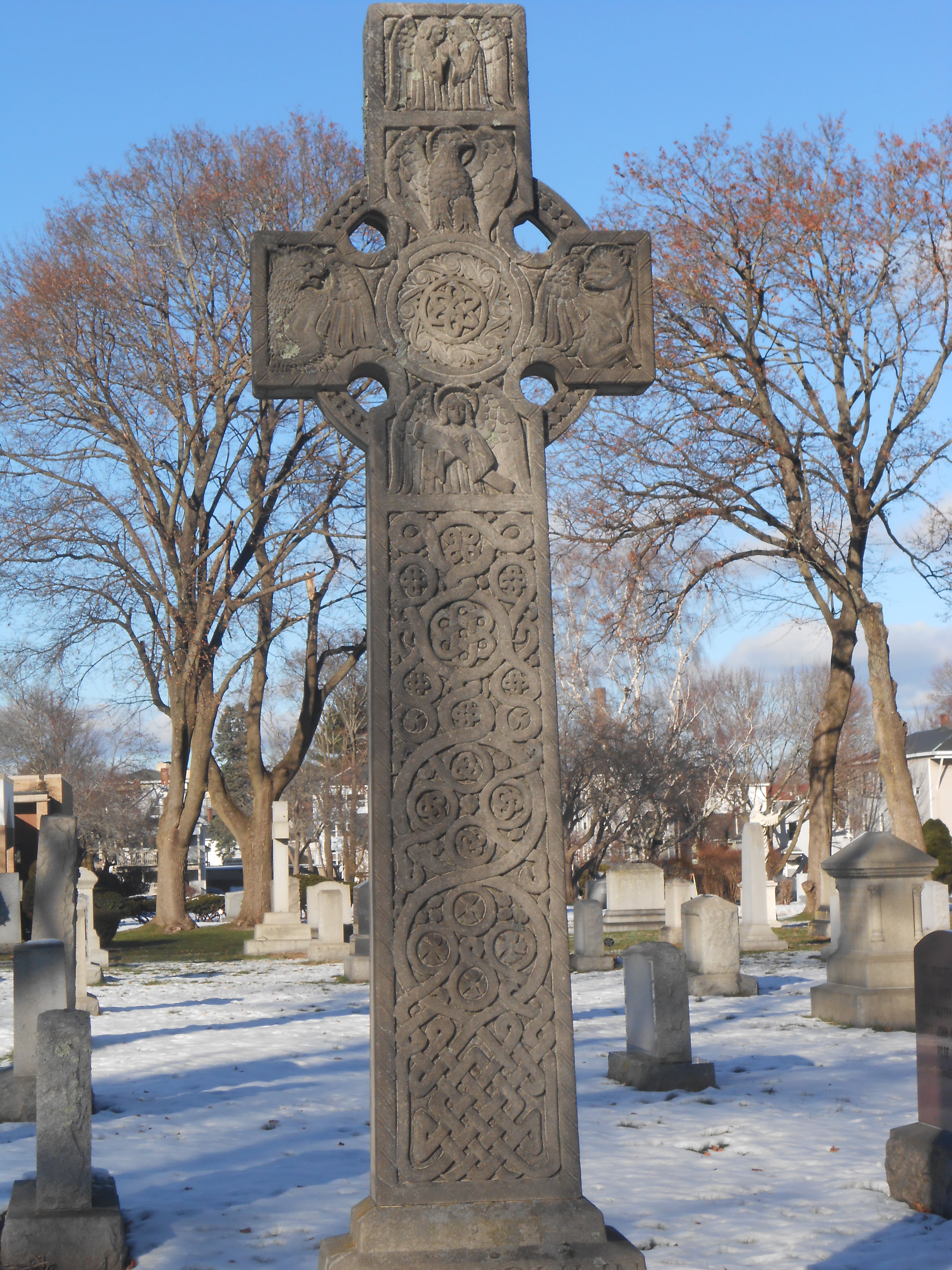
There are many styles of Celtic Crosses rising out of the snow and winter-browned grass of this cemetery.  Many also are adorned with striking, symbolic carvings.  Others may  hold statuary.  This Celtic cross particularly caught my eyes, with it’s intricate  interlocking designs along its body and its distinctive symbolic figures at the top.  The snow beautifully reflects the cool purity of the sky’s winter blue.


A closer study of the figures in the upper central section of the cross reveals the creatures symbolizing the four gospel writers on each branch of the cross, with the knot of eternity and the Infinite in the center and praying angels at the very top,  From the top and moving clockwise, you have the winged ox/calf (Luke), the man (Matthew), the griffin/lion (Mark), and the eagle (John)- their wings and halos signifying their divine nature.

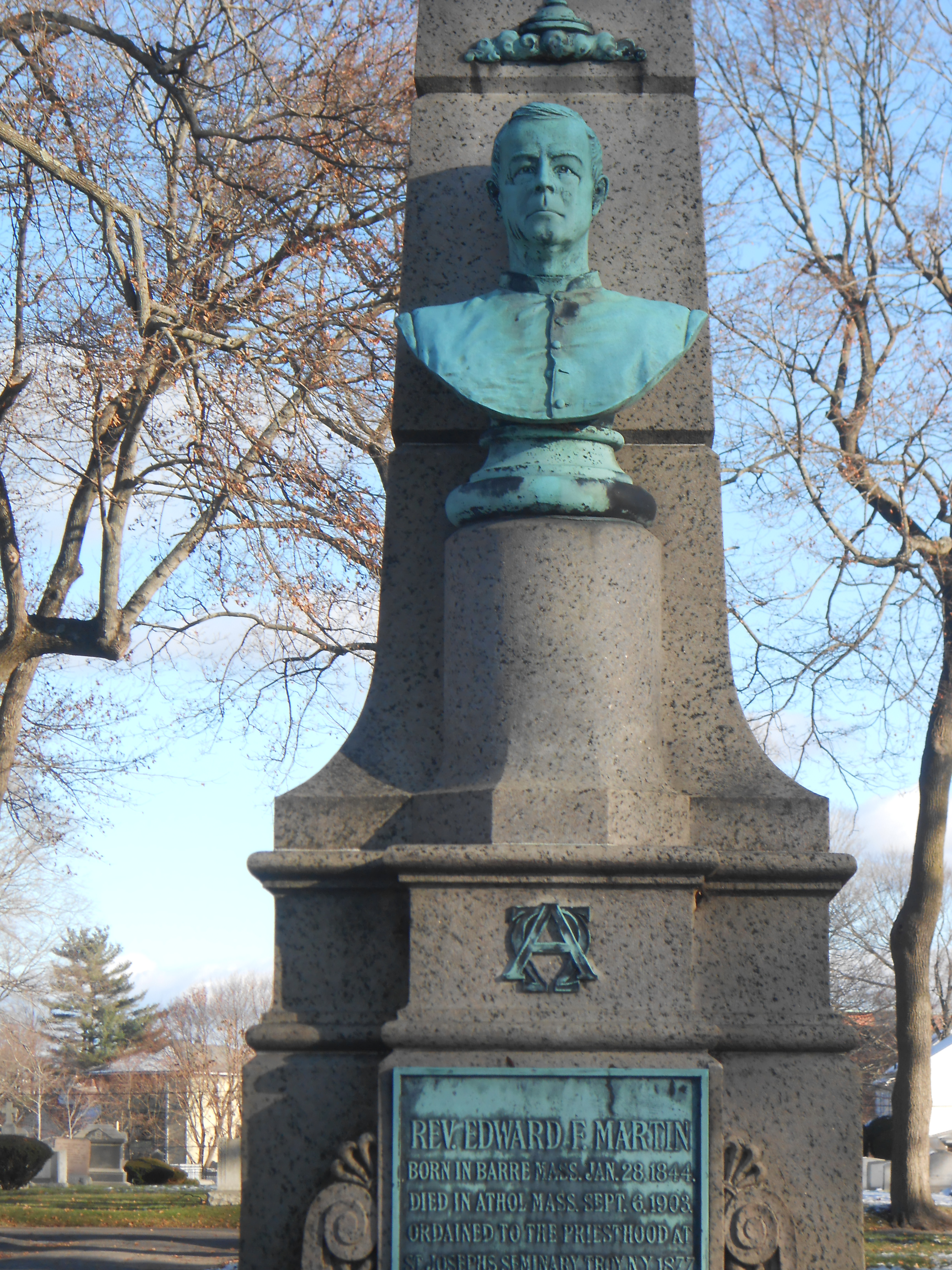
You can additionally see Celtic crosses and other monuments honoring priests in the cemetery.


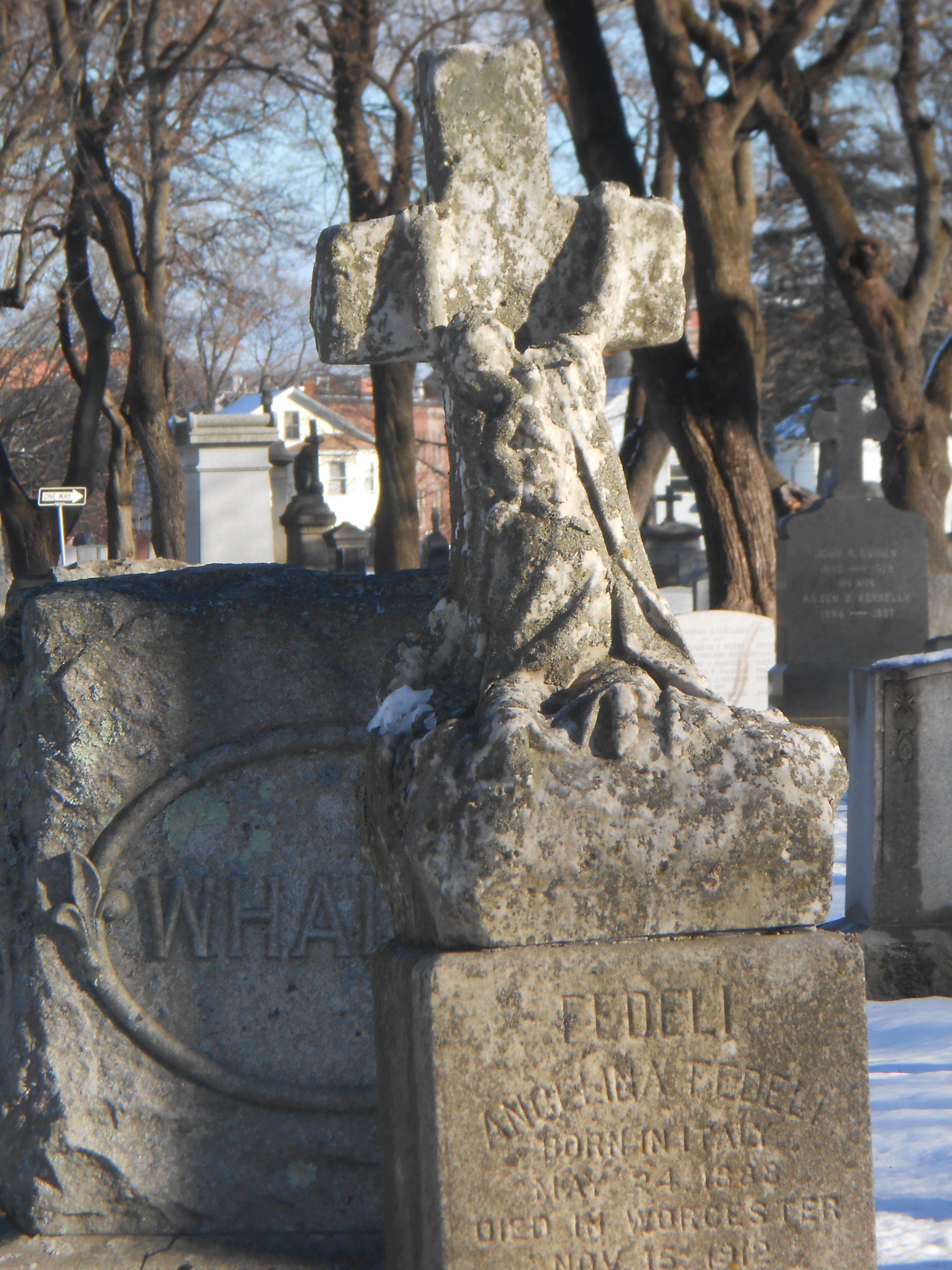
The statuary is also quite striking in the winter light.  Here, a woman clings to a cross for salvation or for comfort at her losses.  The stone is weathered smooth, the statue almost featureless.  Perhaps a comment on the  transitoriness of life.


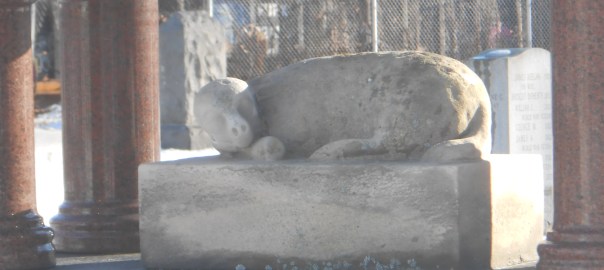
A time-smoothed lamb, couched within the limited protection of this monument further testifies to the relentless passage of time over even the young whom parents see as embodying a kind of immortality. It’s posture is not even terribly peaceful, seeming to indicate tightening oneself up in fear or cold.  Maybe both.


Then, there is this triumphant angel-who seems to be wearing a bustle in the height of 1880s fashion.  Her broken wing unintentionally testifies to the limits of human commemorations.


Still, when I tried to capture her face with  a shot from the front, the glow of the sun created this divine image that perhaps suggests that true immortality and enlightenment come from beyond this earth, transcending the capability of our mortal vision.  Ya think?


Winter Birds at Chez Yang

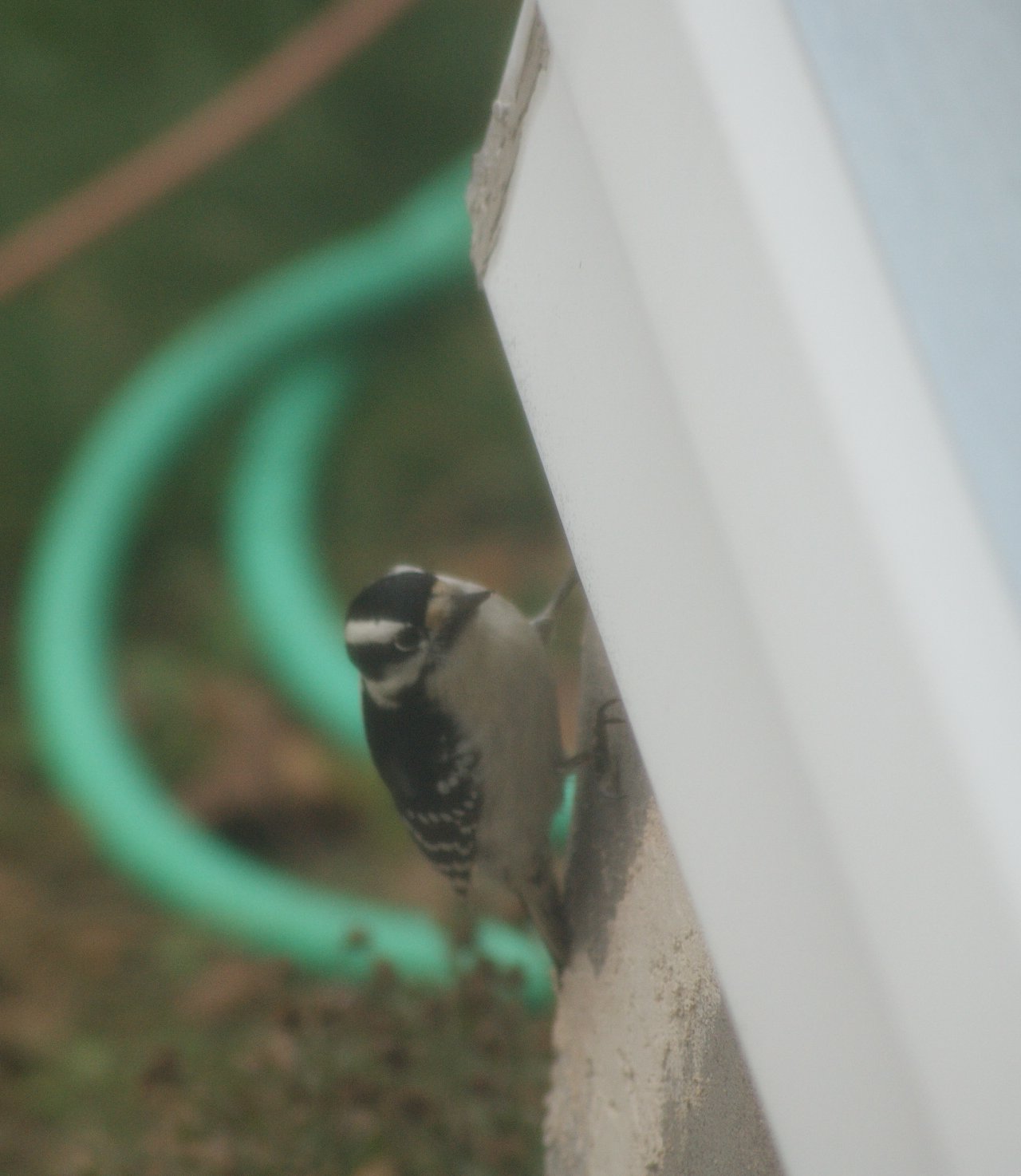
We’ve been seeing some wonderful birds this winter in our yard at our feeders.  Let me share some of them with you, starting from December.  This first set of pictures were taken that month, before and after the snow started.  I have  pictures here of some old friends and some new-like this Downy Woodpecker.  Do you think someone should tell her that bugs don’t live in concrete or vinyl siding-or does she know something that I don’t?
We also see plenty of our old standbys, the Chickadees and the Titmice.  They like to come and dine about 9:30 in the morning and about 4-5:00 in the afternoon-with an occasional snack or two throughout the day.  The Titmice are one of Yang’s favorites, and he likes to call them “little faces.”  With their big, expressive eyes, you can understand why. In this picture we have one of the cute chickadees.
One of my favorite birds is one of the first signs of winter:  the Slate-Colored Junco.  That’s the name they went by when I was first birding; however, I’ve noticed them now called “Dark-Eyed Juncos.”  Maybe they all invested in brown contacts.  I love their blue-grey coloring (though some are more brownish) and  their white tails that flash when the fly away, as they give a call that sounds like castanets.  We have large numbers of them in my yard, which it just fine with me.
These two Juncos don’t look to happy to meet.
“Who You lookin’ at?”
“No, who YOU lookin’ at?!”
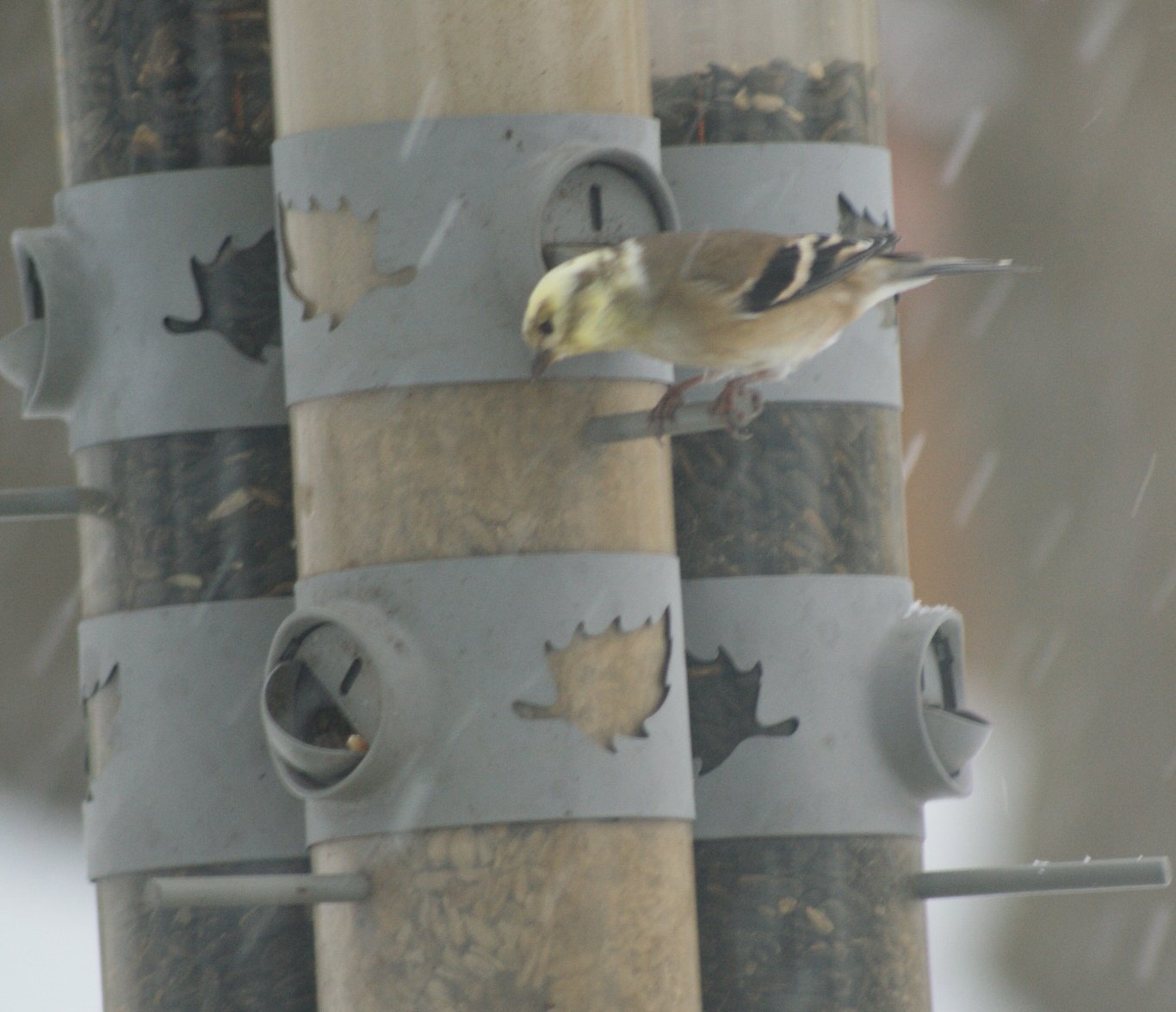
The Goldfinches haven’t flown away until the spring.  They’ve just changed their sprightly spring plumage for heavy winter coats.  One fellow appeared to have a white cap of feathers, even with his winter color.  So, I dubbed him Whitecap.  Original, aren’t I?  However, closer viewing of him through these photos shows that his cap is more light yellow than white.  Nevertheless, he’s staying “Whitecap,” as Slightly Light Yellow Cap” is way too much of a mouthful.
Here’s another nice shot of Whitecap, with a Goldfinch pal (in the upper left corner) who apparently thinks he’s a bat.  I’ve got to stop watching Forever Knight when these guys are in the windows.

Here’s another one of Snowcap, after he was reading up on Edward Taylor and thought he ought to go out and starting preaching to Juncos.  Of course, if Snowie believes in predestination, that suggests that even other species can be saved.


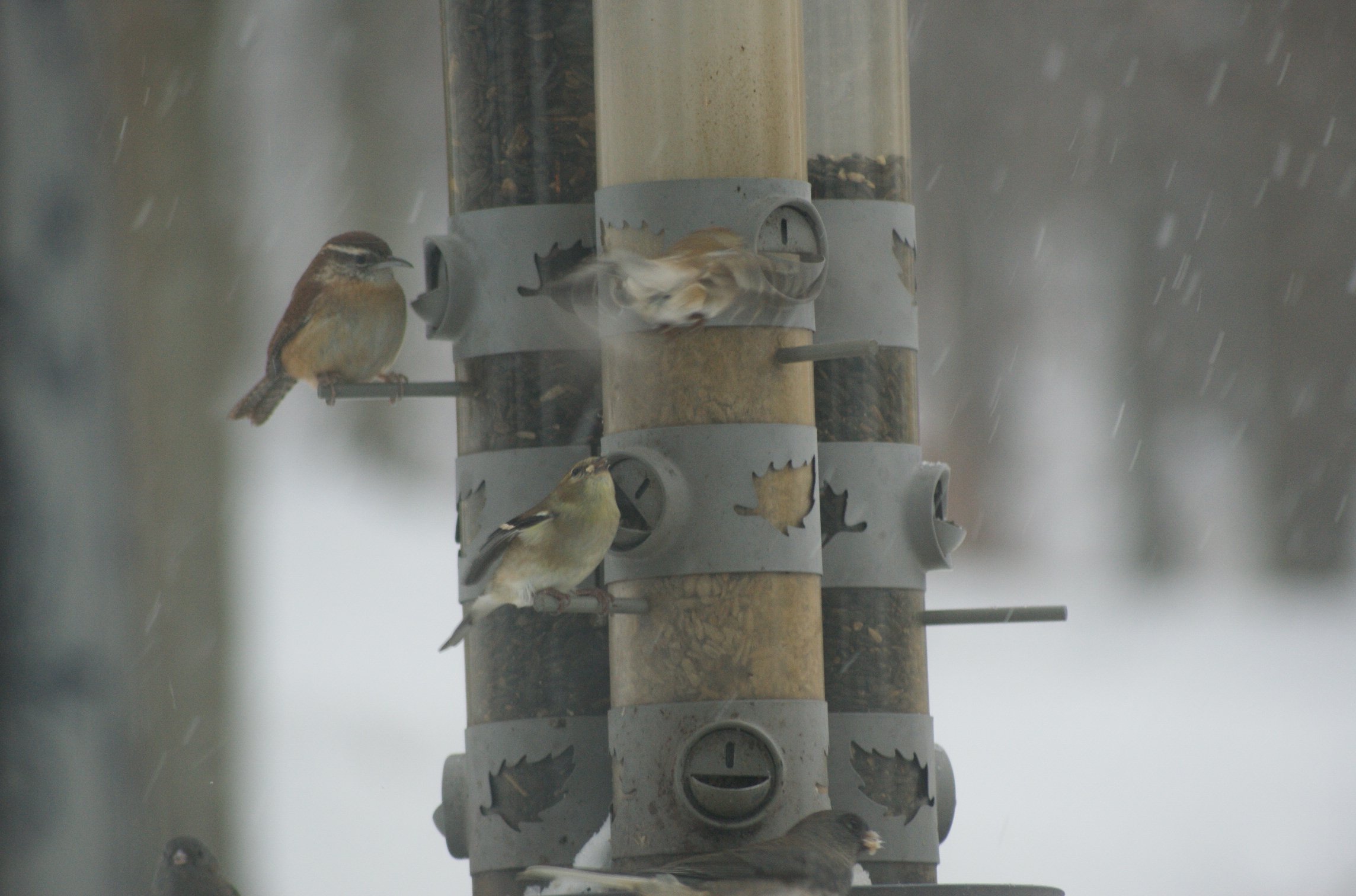
I particularly like this picture because it includes so many:  Juncos, Goldfinches, and another of my favorites, the Carolina Wren, on the left.  She doesn’t quite look like a wren because she doesn’t have her little bum cocked in the air, but her long beak and white eye-stripe give her away. We have at least one pair who come to my feeders.  They’ve been around the house for several years, but it’s only the past three or four that I’ve seen them year round, and so frequently in the winter.  I often hear them in the trees of the woods behind my house and across the street.  I named this pair, Carolina and Carey.  Additionally, note the Goldfinch coming in out of inter-dimensional travel in the upper middle of the photo.
We also had an unexpected visitor on our suet feeder.  Regard this handsome Mockingbird.  Usually I don’t see them in the winter.  However, I  was informed that they don’t travel south, but hide out in deep woods during the cold months.  Apparently this guy didn’t get the memo about hiding out. He or she comes to see us just about every day to chow down on the suet.  I know these birds tend to be highly aggressive, but this one really doesn’t seem to mind sharing.


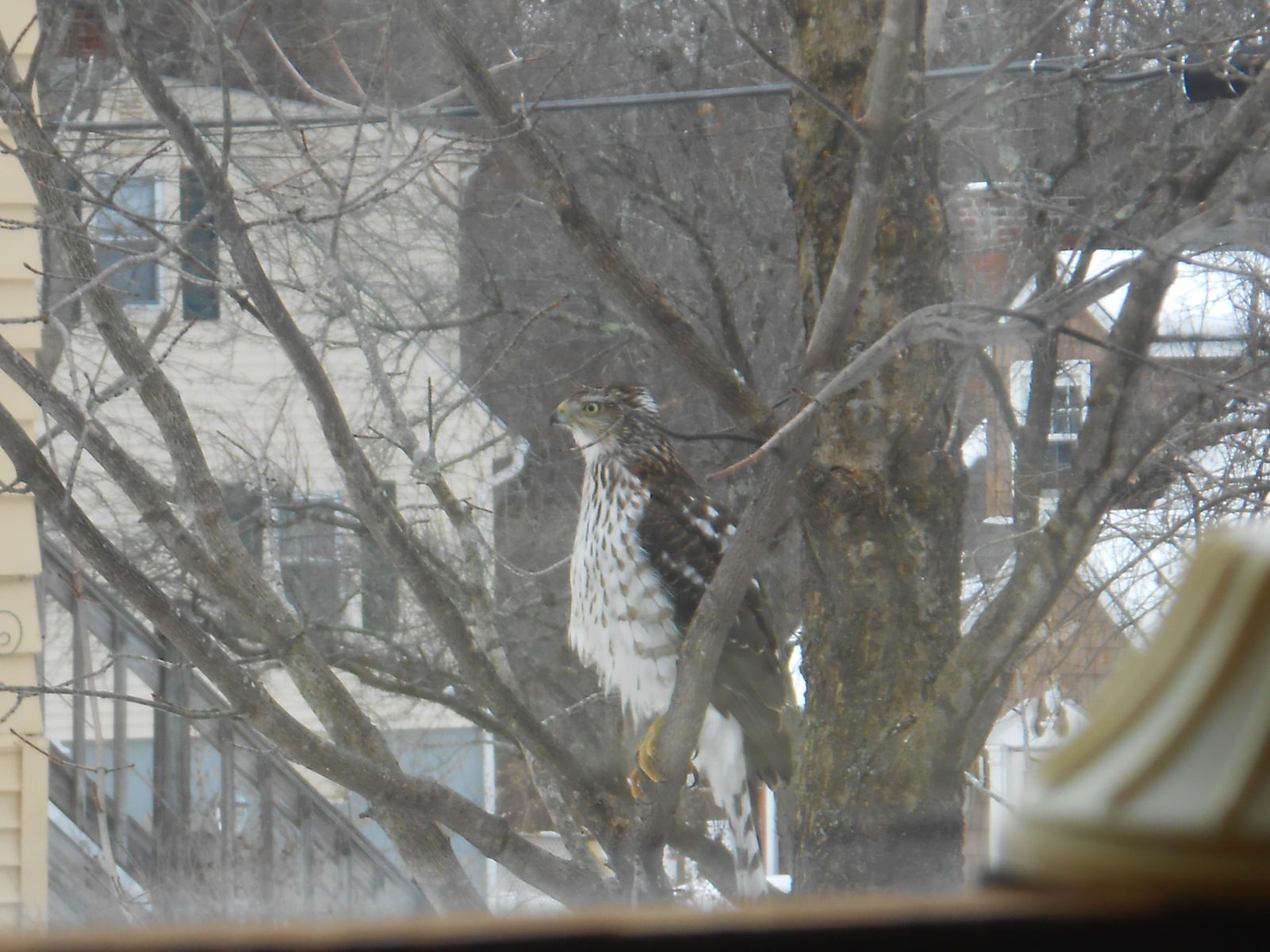
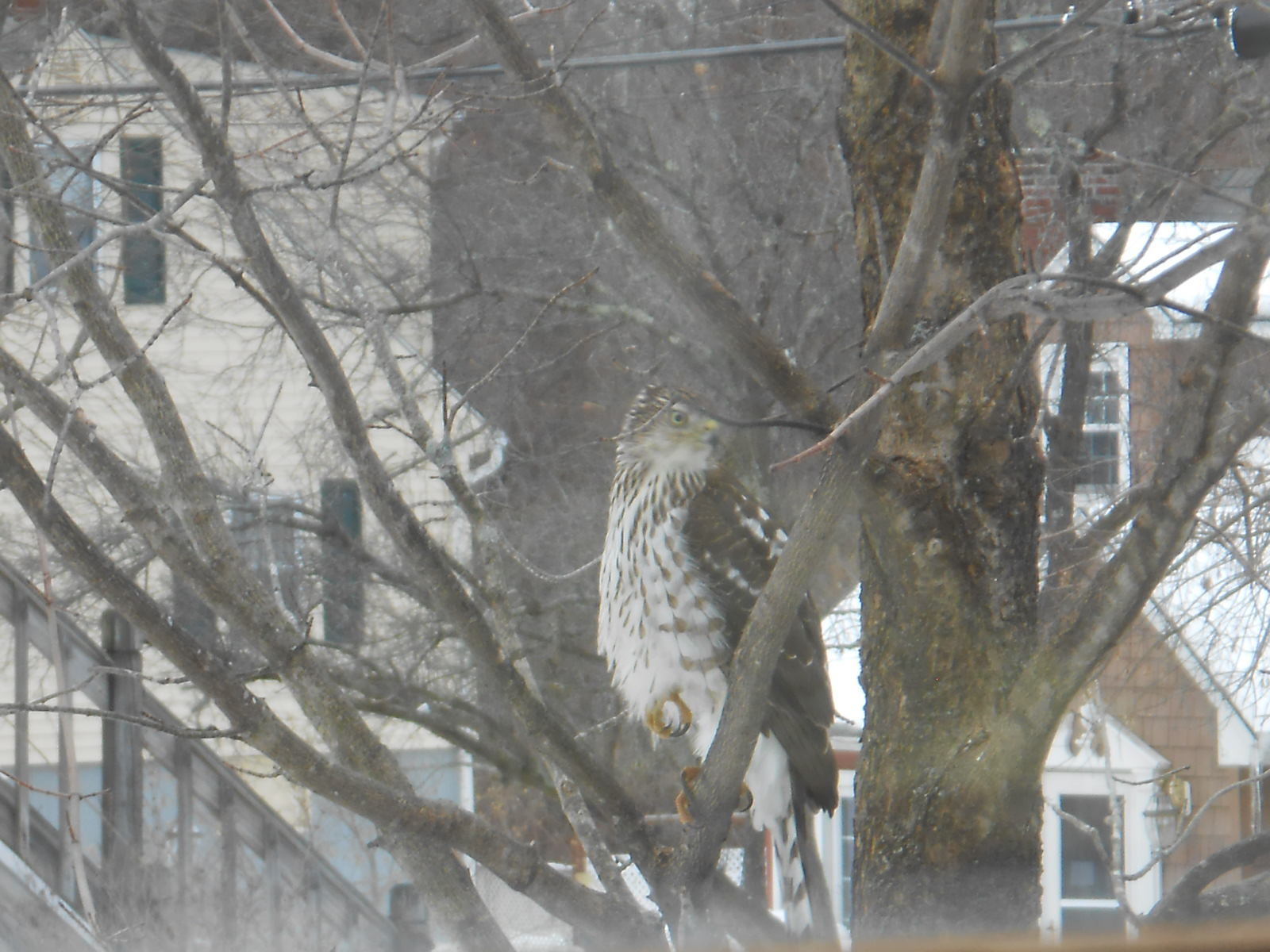
Now, there’s one last interesting addition to our flocks:  Mr. Cooper, as in Cooper’s Hawk.  This guy showed up low on the Canadian Maple in our back yard, right outside my living room window.  The first time I saw him was in mid-January, when I couldn’t get any good shots.  Then, this week, he popped by and I was lucky, getting these three pix.  Now I definitely know what caused the splash of blood and feathers on the snow near the tree last week.  Still, he does leave alone the little birds-hardly worth consideration as hors d’ouevres?  Anyway, click on the photos to get a good look at him-or her.
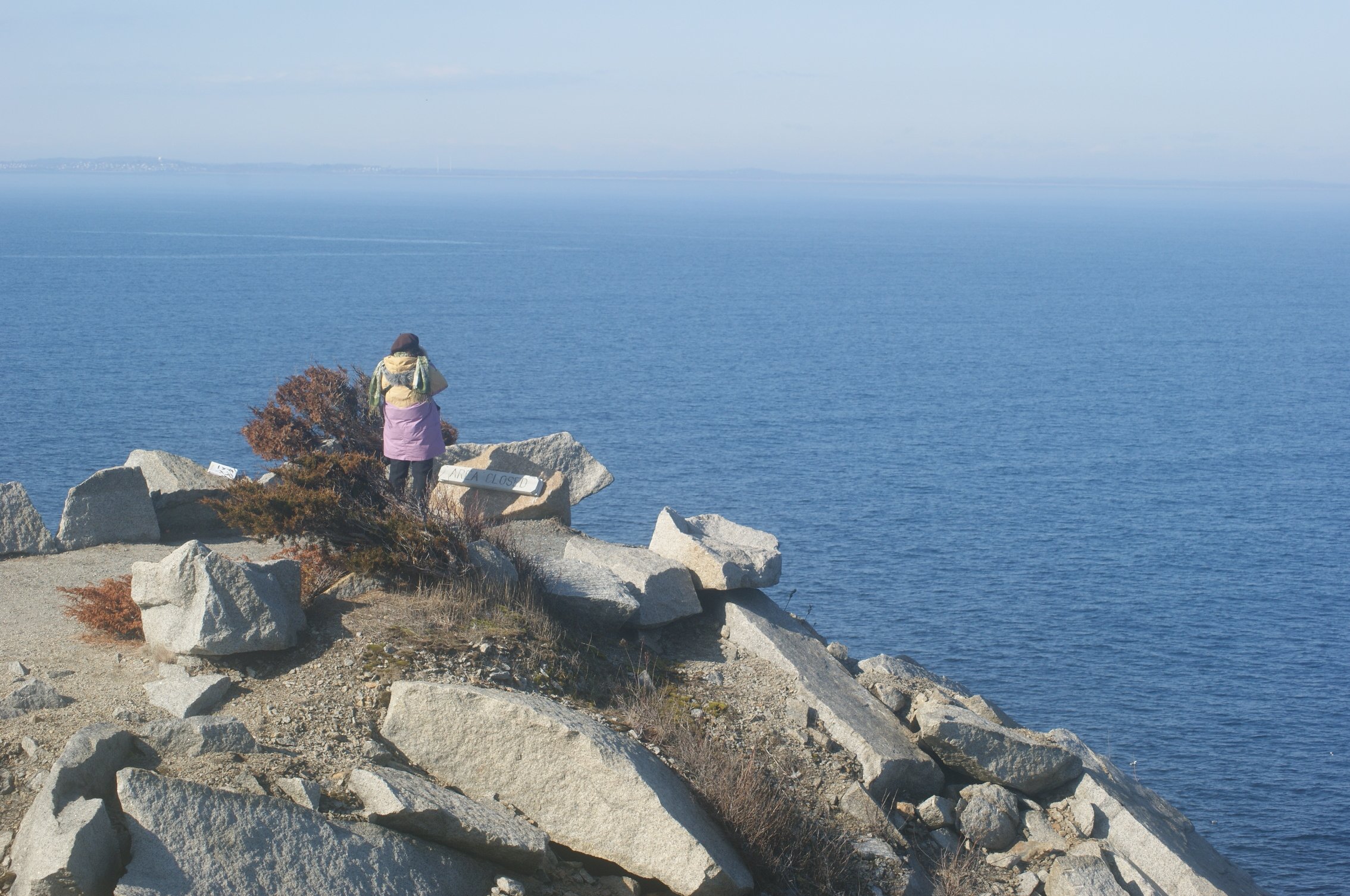
Anyway, now I think I understand  why White Ears (named for these white tufts in his ears) has been keeping a low profile recently.


In the Bleak Midwinter: Hillside Cemetery

Just before the New Year, after a late December snow, Yang and I seized the occasion of some slightly warmer weather to take a walk in the Hillside Cemetery of North Adams, Mass. This cemetery is notable for more than one reason. First, it is split in half by Route 2. Second, its sloping grounds (more on one side than the other) create an eerie, desolate, even Lovecraftian, ambience. Those grounds are dotted with beautiful, if weather-worn, monuments. There is so much to remark, that I intend to split my blog into two parts: one for each side of Route 2.
This first blog focuses on the older section, which, though clearly on a hillside, presents far fewer and less abrupt rolling hills. It’s also the smaller of the two. Nevertheless, this shot reveals your legs will get a more than adequate workout hiking up these slopes. No matter which side of the highway you’re on, you see that you are encompassed by the Berkshires.
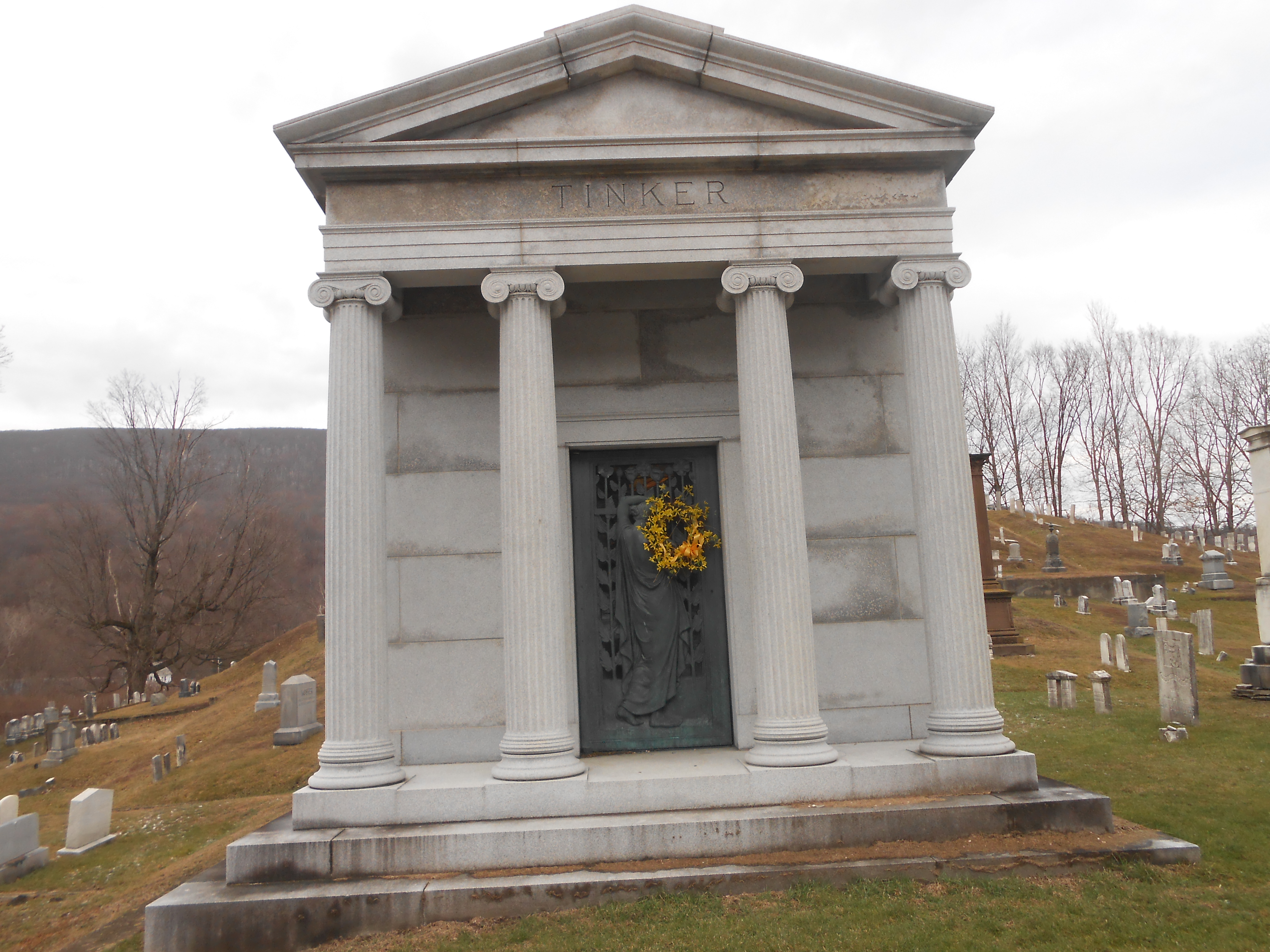
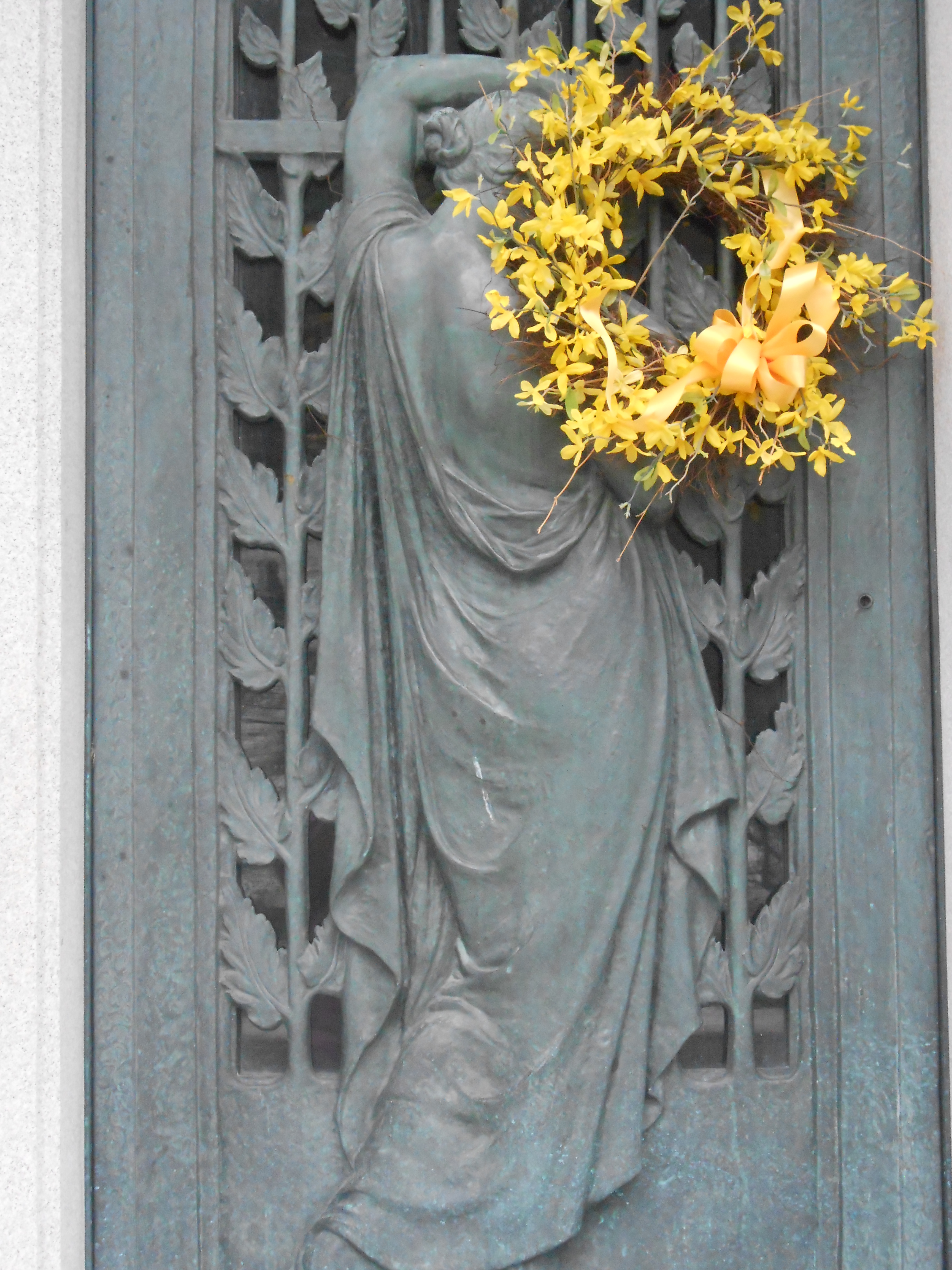
This white, colonaded mausoleum  is particularly interesting. You can see that it belongs to a family who must have been rather important in the town, perhaps even into the twentieth century. If you come closer, you can perceive the ironwork gate to the building has been sculpted into the graceful form of a woman. She faces away from this world into the next, for which the the mausoleum proves a portal,  Her form clings to the door and is curved with sorrow. The forsythia wreath wrapped over her right hand suggests that members of that family are still in the town, or at least are close enough to visit the grave. I was also struck by the beautiful Tiffany window that was part of the mausoleum.


Interestingly, the natural and the artistic worlds came to mirror each other in this portion of the Hillside Cemetery. I was much taken with this hewn from stone monument of the traditional broken tree, symbolizing growing life cut off. Age and weathering had buffed and grey-whitened this monument into a kind of soft purity. The burnt green and tawny grass, though muted colors, still provided a notable contrast to the stone. And then nature offered it’s own version of this monument in the blasted yet weather smoothed form of this ancient dead tree, its edges also rising  jaggedly toward the sky. Yet perhaps the actual tree was not quite such a symbol of life cut off, for it would be the perfect place for owls, woodpeckers, and squirrels to make home-though not all together! While all around the mountains hold us in.


There were  plenty of other intriguing monuments and carvings. I loved this contemplative, if not quite grieving, woman set on high. Bitter western Massachusetts winters had softened her sorrowing expression, but her posture, the thoughtful cock of her head, told the tale of her loss and reflections on it.


The relief on this tombstone of an anchor perhaps reveals that an adventurer on the seas had retired to the inner realms of New England to find his final rest. Check out the picture of the tomb itself and then the closeup of the relief.


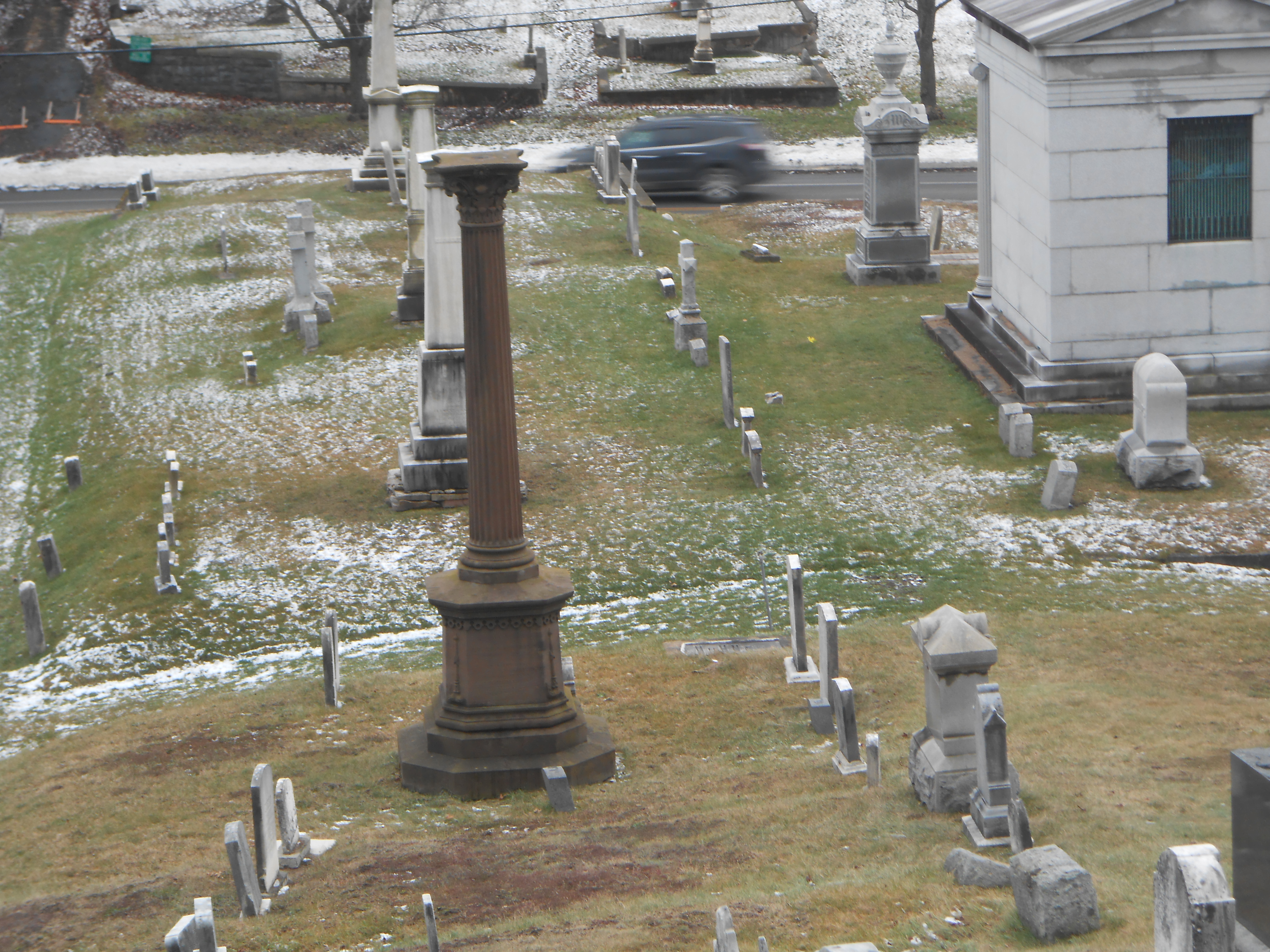
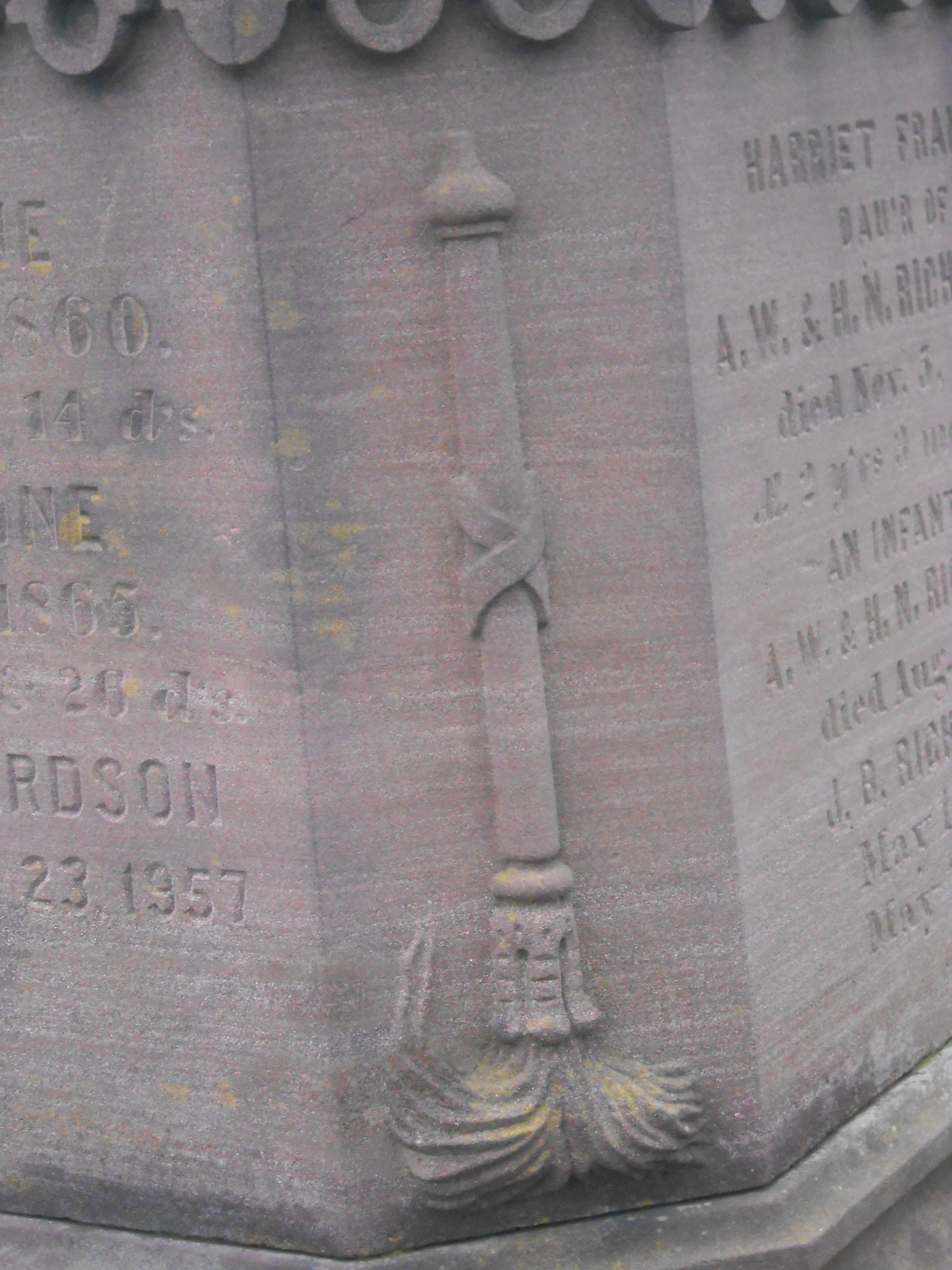
This red rock column fascinated me, as well: so graceful and predominant on the slope. And those slopes were rolling to say the least! I’m glad we didn’t roll back down them. A close up also reveals a significant relief on the column: the inverted torch symbolizing death.


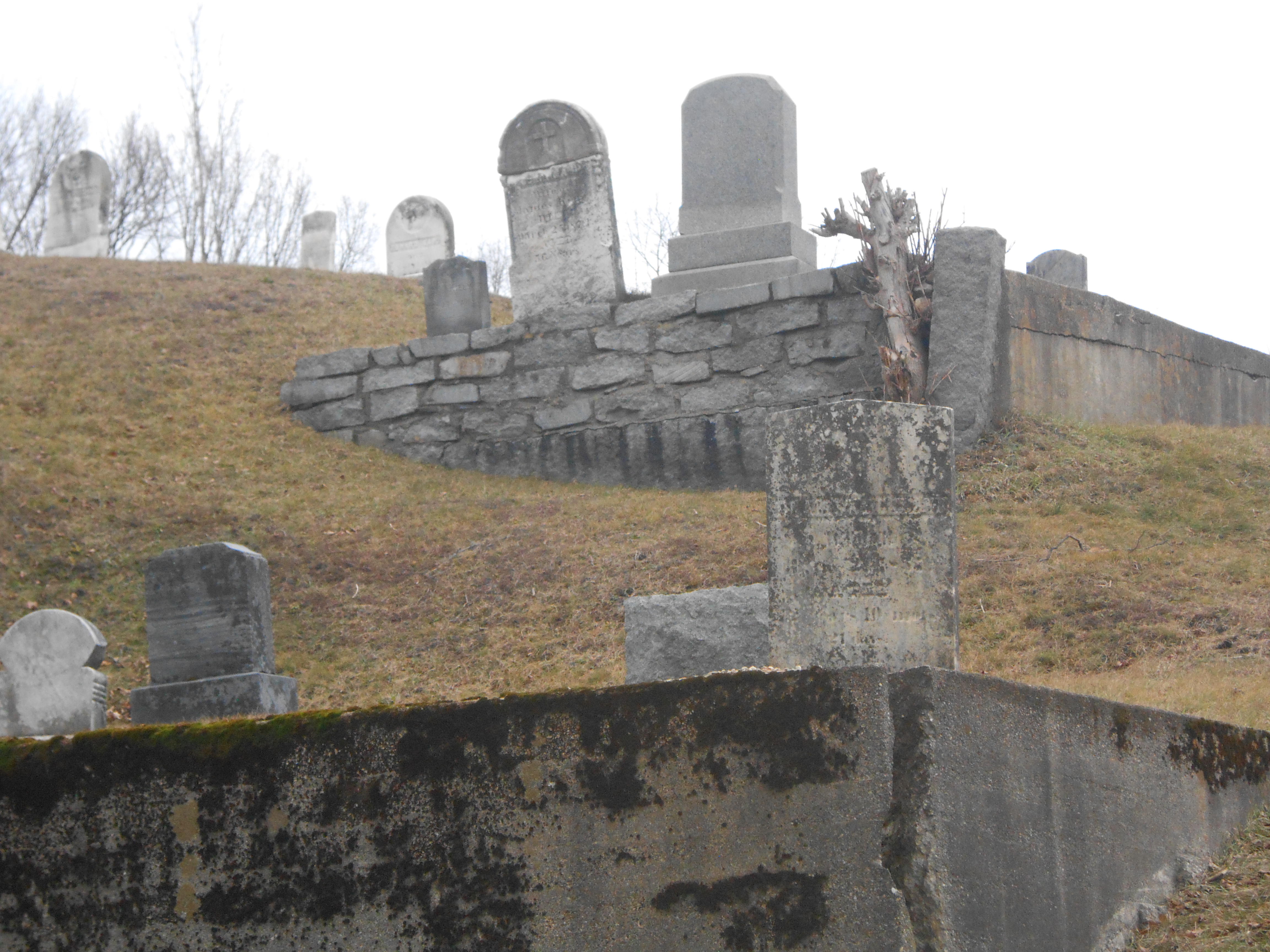
Here are more pictures to give you a sense of the sometimes steep, sometimes rolling grounds, all encompassed by the greys and faded browns of wintry Berkshires before snow would come to predominate. It’s an old place, a deserted place (even with Route 2 running by). An apt setting for a Lovecraft novel or short story-but not quite as apt as the part of the graveyard across the road. That photo blog is for another day!