Category Archives: goldfinches

The Summer of ’24

Well, you might not know it from this week’s temperature, but summer should be moving into autumn now that it’s September.  So, perhaps my late developing pumpkins and veggies may come to full bloom after all.  Earlier in the season, we did dine deliciously a couple of times on our own eggplants.  And there are more growing! We also have had a few meals flavored by our home grown peppers.  Here’s a shot of one harvest.  Don’t you just love the deliciously spicy and fresh smell when you slice open a  garden pepper?

We haven’t had such good luck with our tomatoes and pumpkins this year – although  we did get a few fresh tomatoes for Yang to add to his omelettes and stir fries.  The beans are just now coming into form.  We had one serving earlier, and we’re planing on harvesting some of these beauties soon.


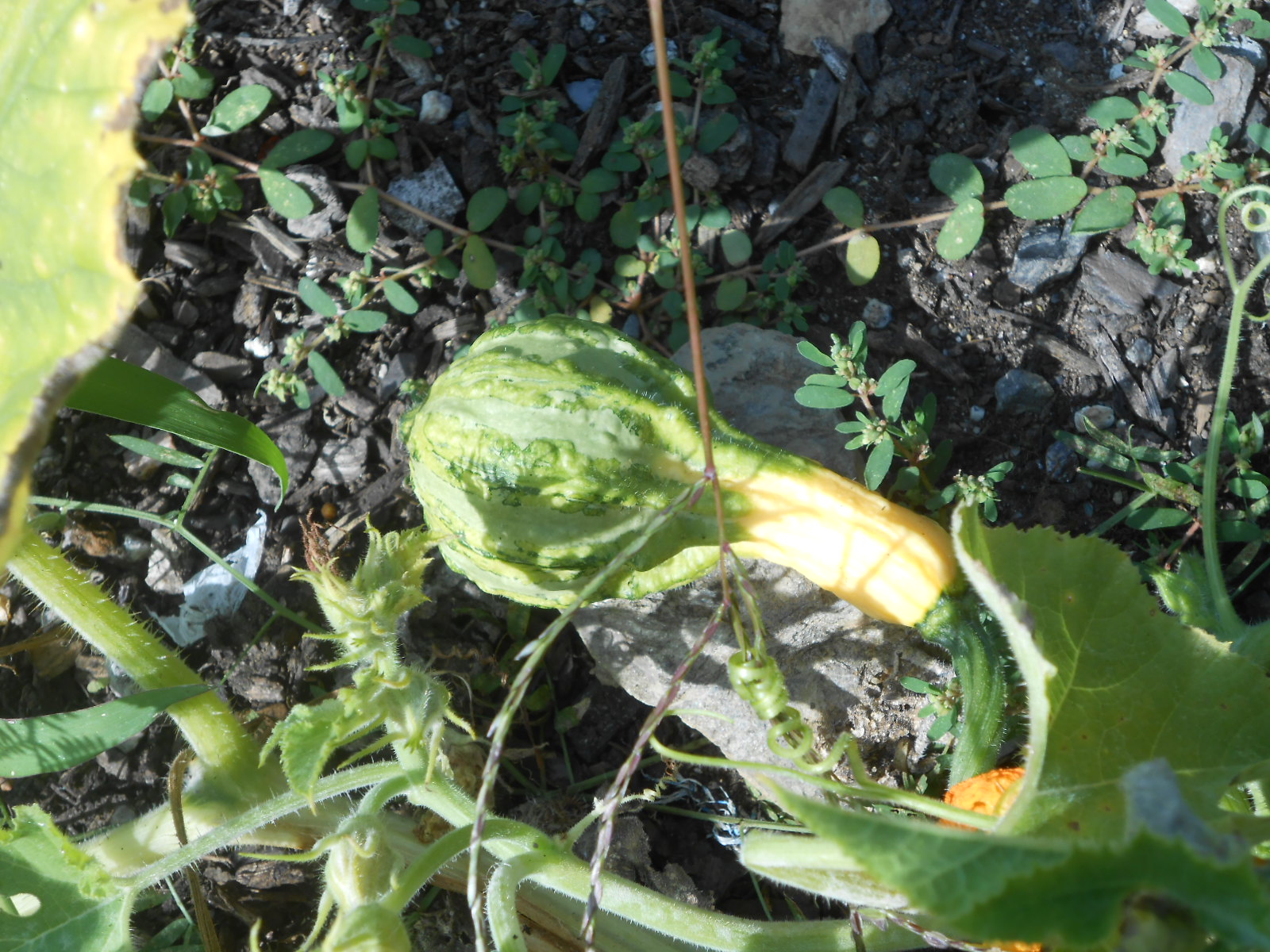
I’m also hoping that though these pumpkin and gourd embryos are late comers, they may still grow and ripen with the hot autumn we’ve been having.


We didn’t have the best of luck with our sunflowers, as some form of insect (we think beetles) brutalized the plants grown from seeds planted directly into the garden.  However, after a daily spraying of tabasco sauce in water to drive off the insects, most of the sunflowers recovered.  Some even grew  up to full height and even better than the ones we’d protected by growing them as seedlings in cups before planting.


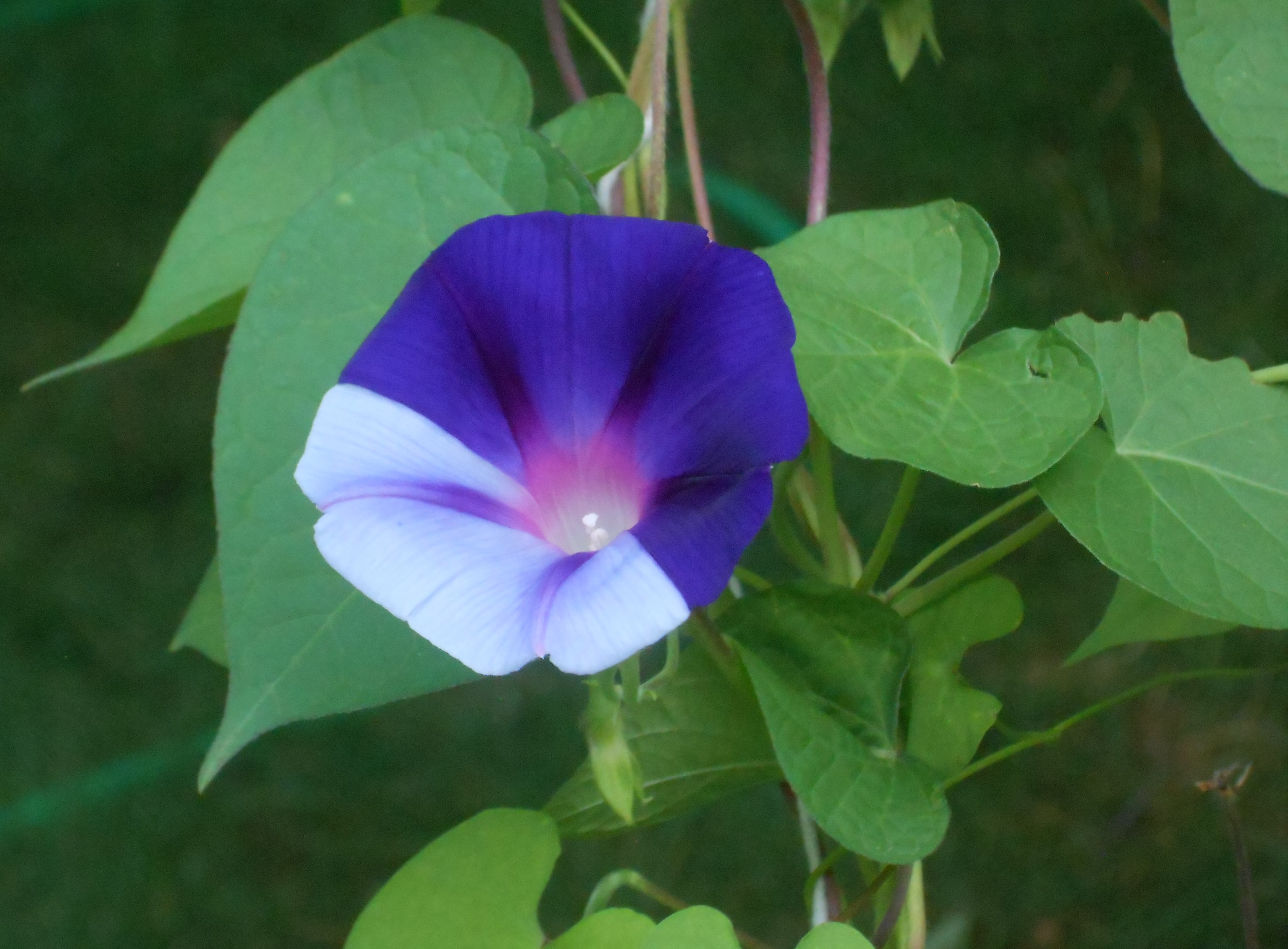
The Morning Glories had been growing full throttle, vines creeping up the trellis, until chipmunks tunneled out of the wood retaining wall on which the flower’s boxes were located and munched them silly.  It’s a jungle out there! Again, tabasco spritzing did its job and some managed to recover and grow.  I especially like the orchid colored ones.

Did you notice the  two-toned orchid and purple one?  Those hybrids pop up every year.  If you look at the seeds, they are even half black (purple flower) and half cream-colored (orchid flower).  I save the seeds every year and replant, so I sometimes even get pink instead of orchid.  I guess that’s the orchid and magenta hybrid.


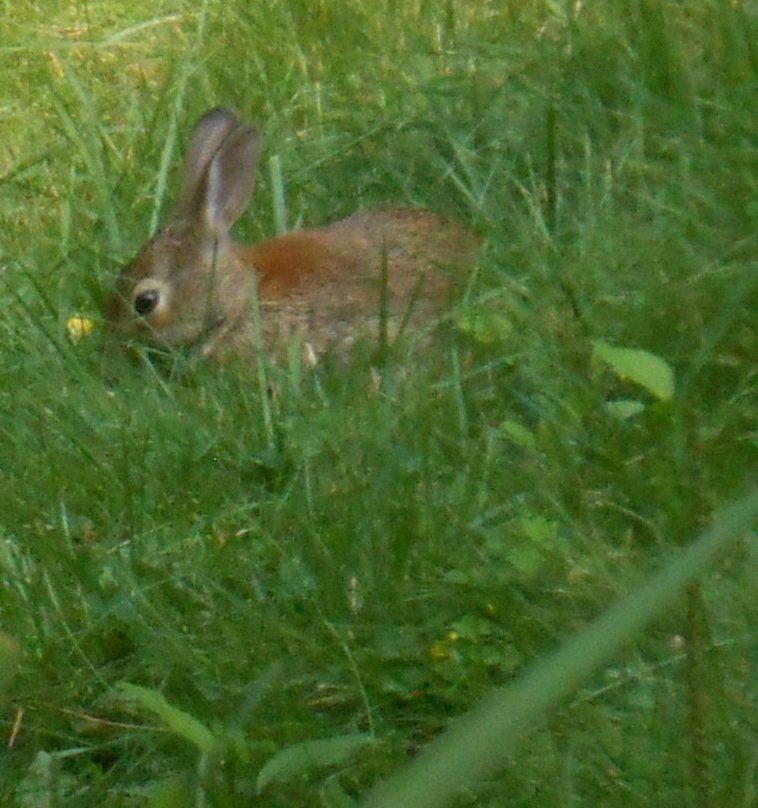
We’ve had interesting fauna as well as flora this year.  First, let me introduce you to Bunzie.  A very young and small rabbit showed up at the beginning of the summer.  He has since grown!  Best of all, he seems to  eat only clover and grass – well he did devour much of a dying petunia.  However, that petunia regrouped and has a lovely deep pink flower now.  So, I guess he was just dead heading for me.  He’s actually not too afraid of Yang and me, but we don’t bother him, either.  One night, he triggered the motion-detector light outside the sun porch and we got to watch him dash hither and yon while two skunks patiently waddled about that stretch of yard looking for grubs.

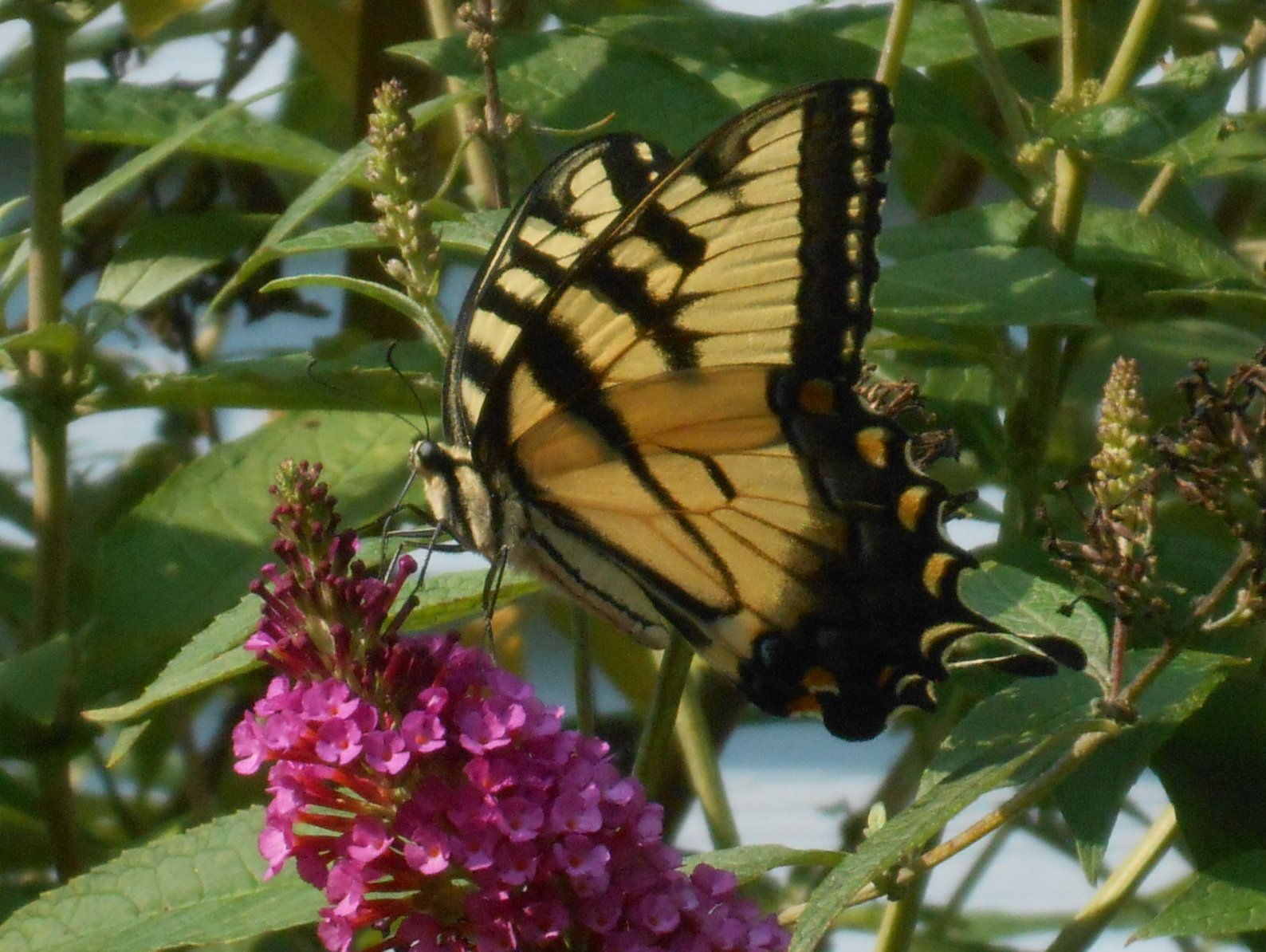
I only saw one Monarch Butterfly this year, yesterday.  Unfortunately, I didn’t have a camera with me – and I scared Bunzie when I rushed over to the butterfly bush to see it.  We have had at least two regular visitors to the butterfly bushes, these Tiger Swallowtails.  I love how you can see the same yellow and black patterns on the insect’s body that you can see on his wings.  I was so surprised that these guys let me get close enough to watch and take these pictures.  They also love to dine on the nectar of flox and Rose of Sharon flowers.

Another critter who loves butterfly bushes, flox, and Rose of Sharon would be the Hummingbird – or birds.  We had at least two, though usually only one showed up at a time.  When there were two, feathers flew, so to speak.  Yang got some great shots.  It’s fun to watch him , the bird not Yang, come in for a landing, wings a-whirl!  I’m sure that you can understand why the pictures are a little blurry!  Once he/she landed, the little guy enjoyed our nectar – as well as taking sips from all the flowers.

Sometimes, he just liked to sit majestically atop the feeder and survey his domain.  Other times he enjoyed parking his tuffett on the structure on which the Morning Glories grew – he thought they were tasty, too.  If you’re wondering what that contraption is atop the feeder, it’s a moat that Yang created to keep ants from climbing down into the feeder.  Yang saw some designs for sale on line, figured he could make one for much cheaper – and did it!

Sometimes the Hummer just stared at our window with a “Who you lookin’ at?” attitude.

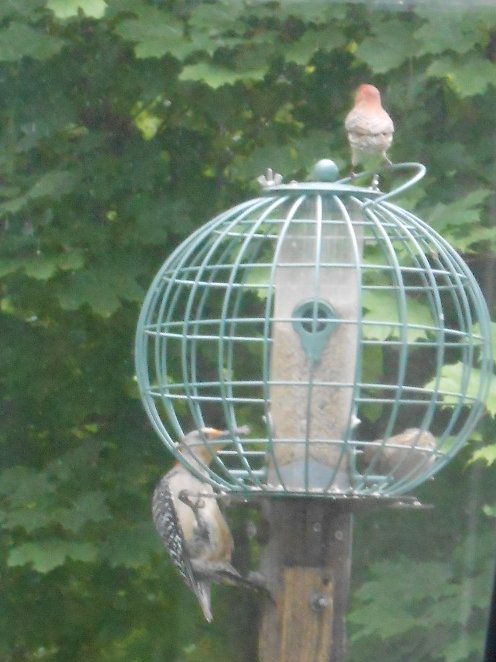
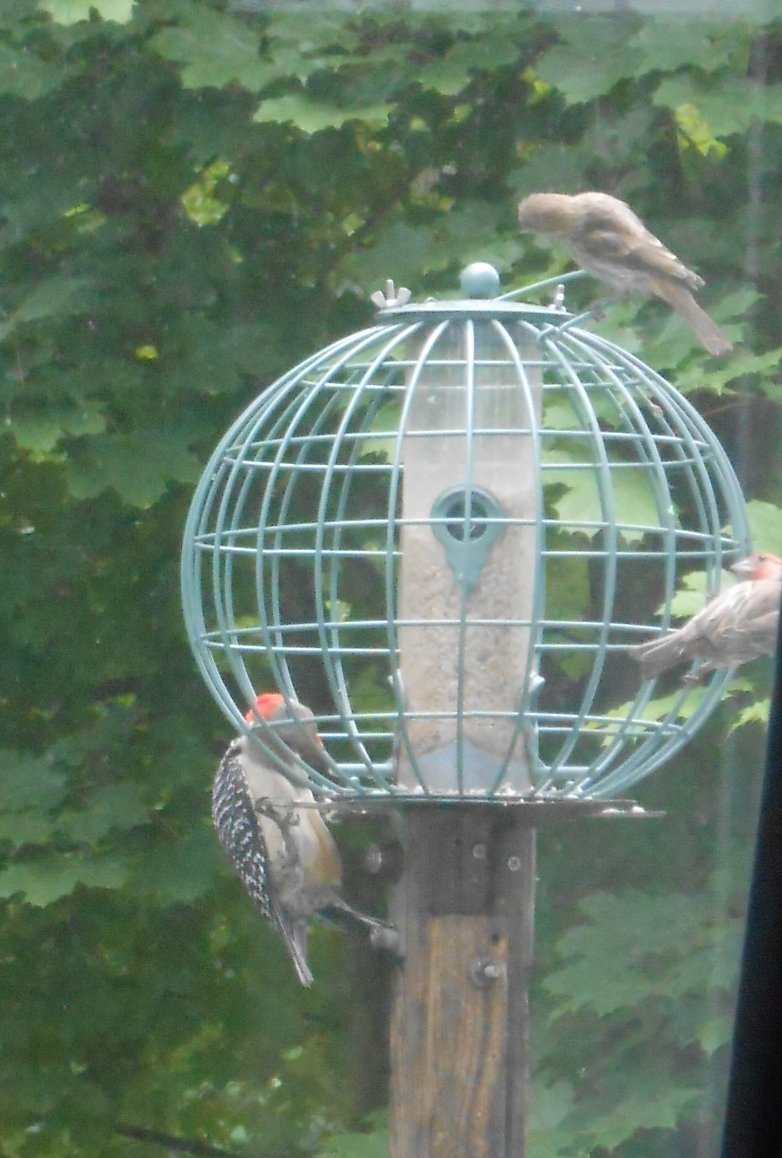
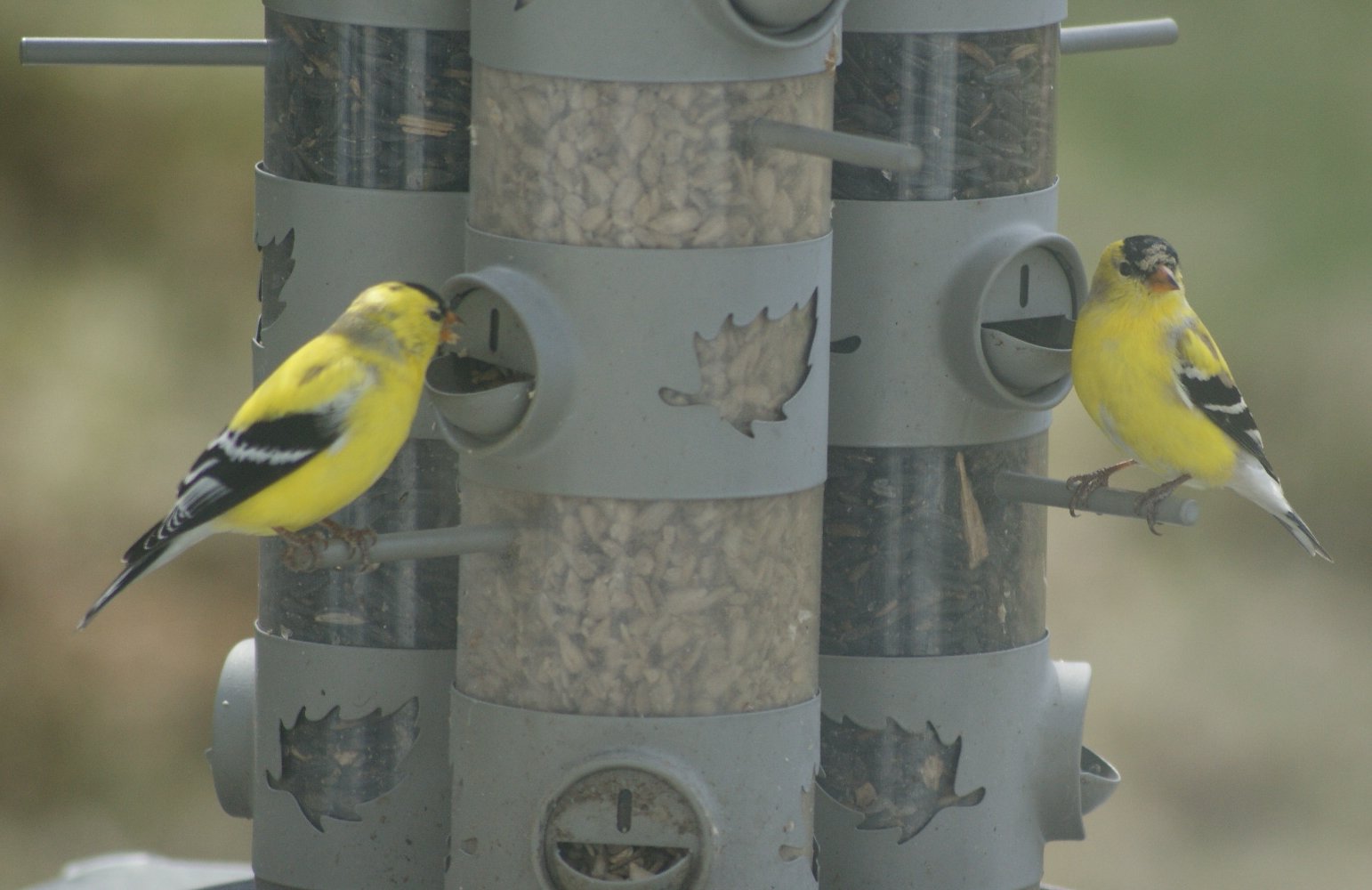
Of course, we also had some of the other usual suspects this summer.  The Goldfinches pretty much dominated the two globe feeders, though the Redbellied Woodpecker wasn’t above shooting his long tongue through the bars to steal some sunflower hearts.

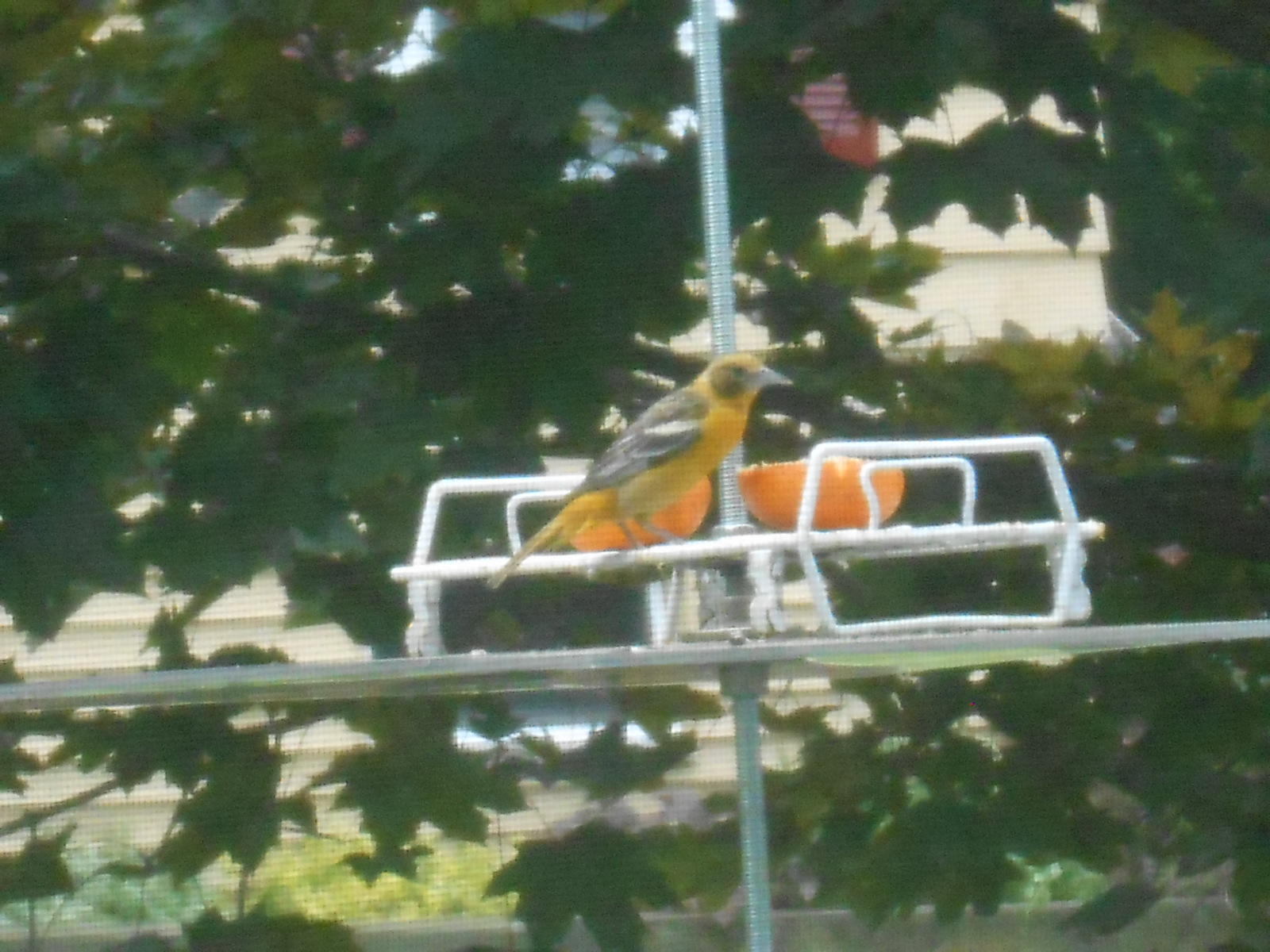
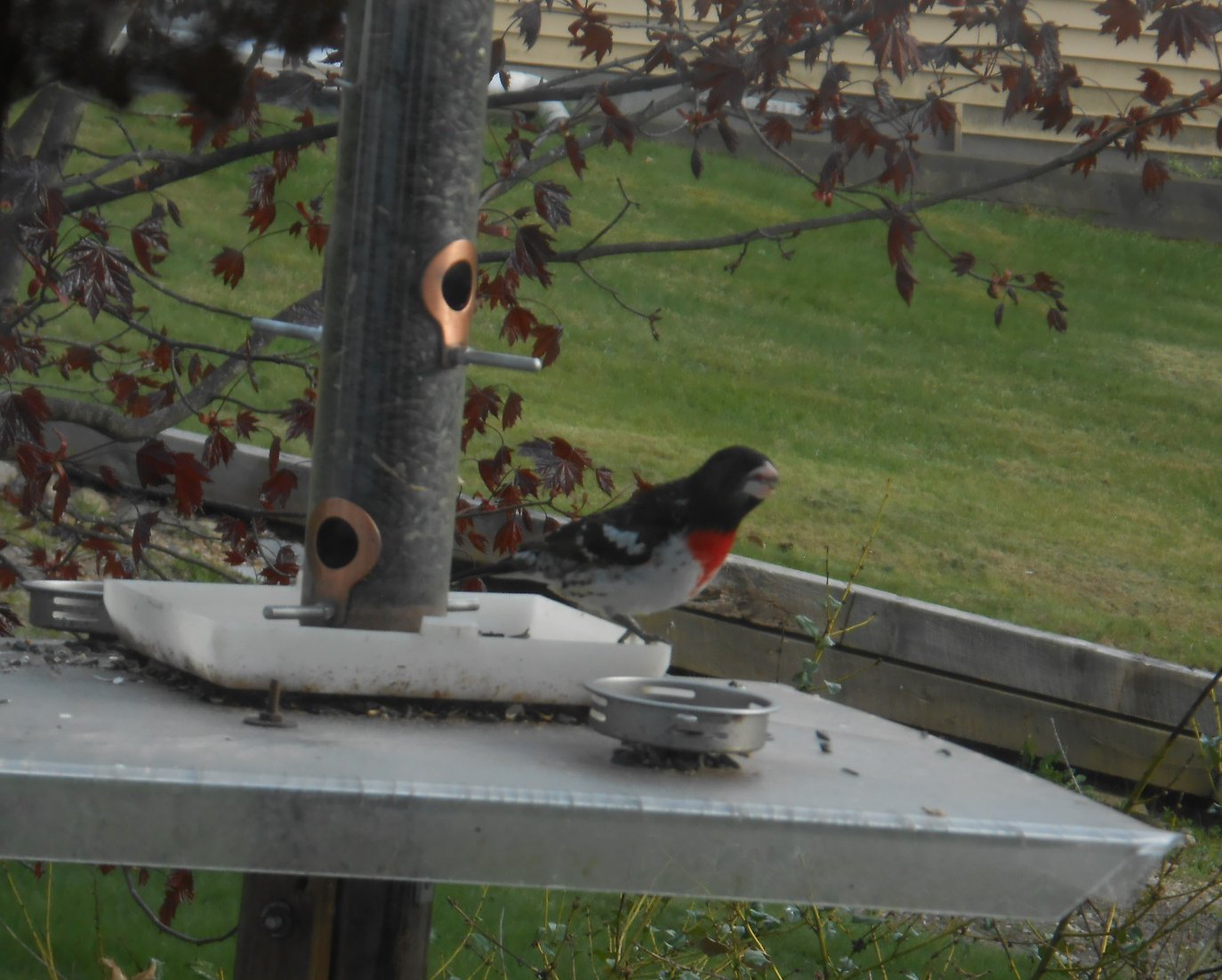
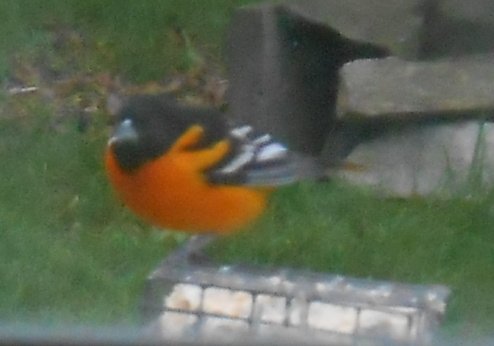
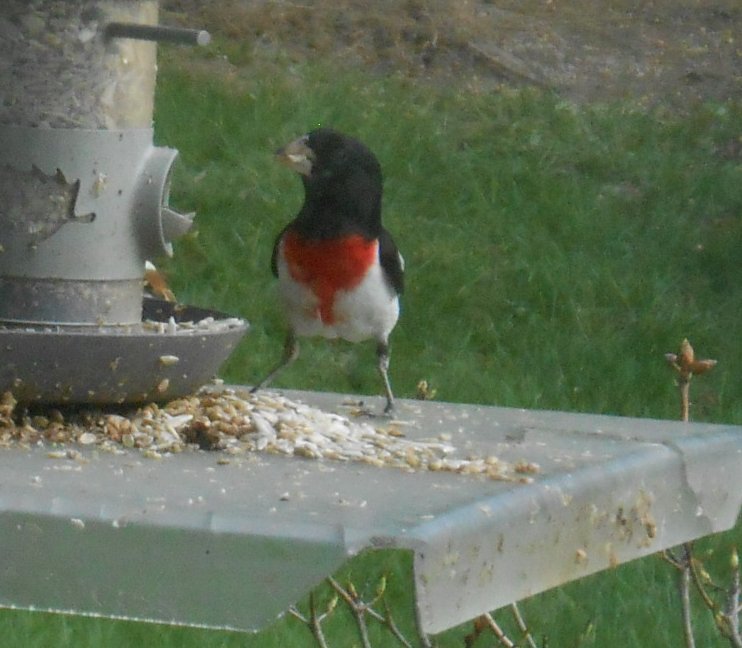
The Rosebreasted Grosbeaks were back as well.  I saw as many as three males at once one time!  I also saw the females and some juvenile males as well.  Unfortunately, though we kept putting out oranges, we only saw an Oriole here twice.  My neighbor said he saw the Oriole quite a bit, though on the feeder.


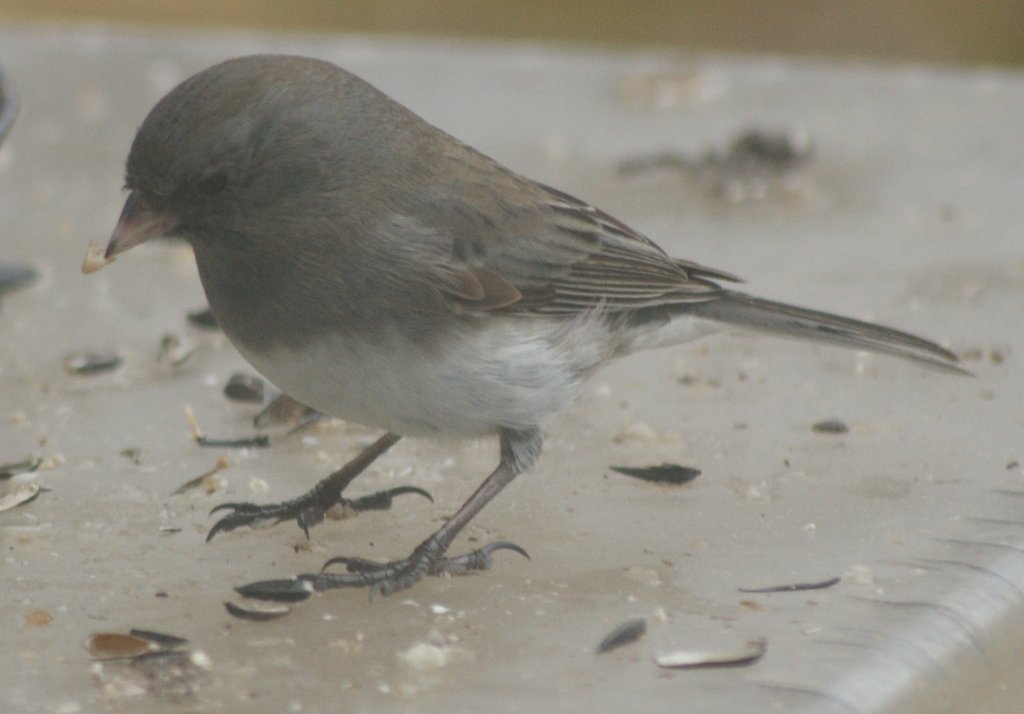
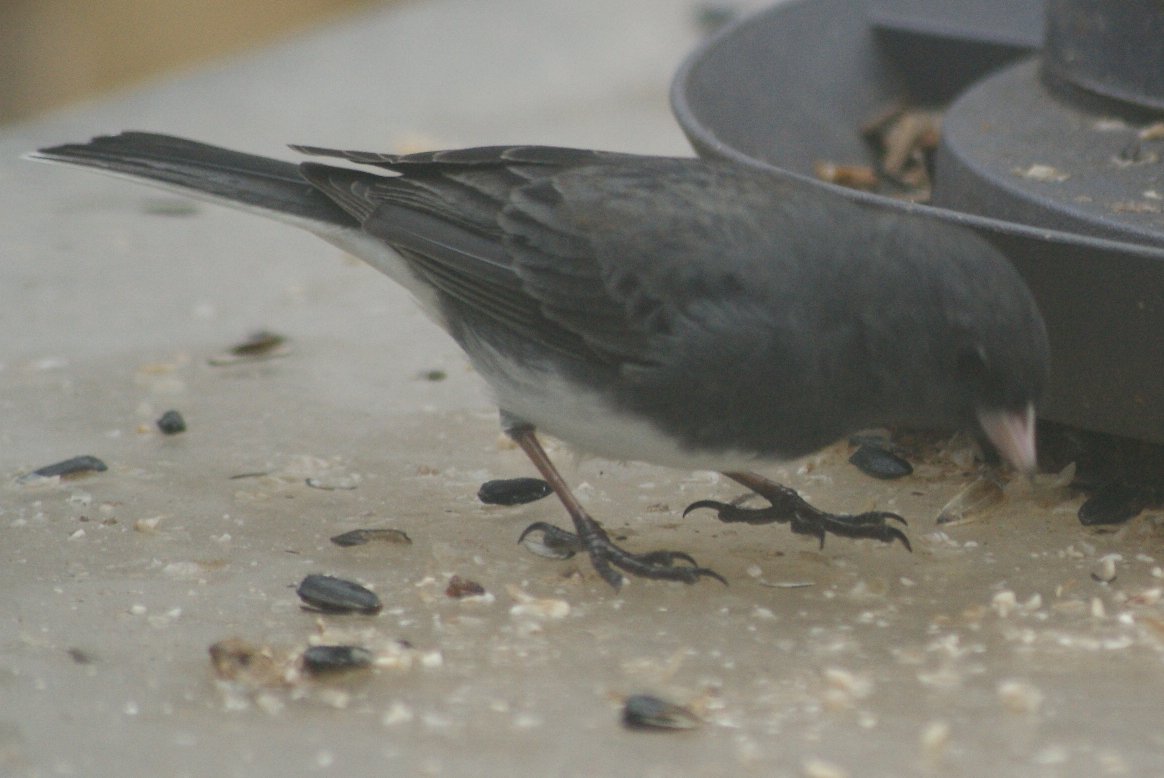
One visitor to the feeders who was rather unique for the summer was this chap.

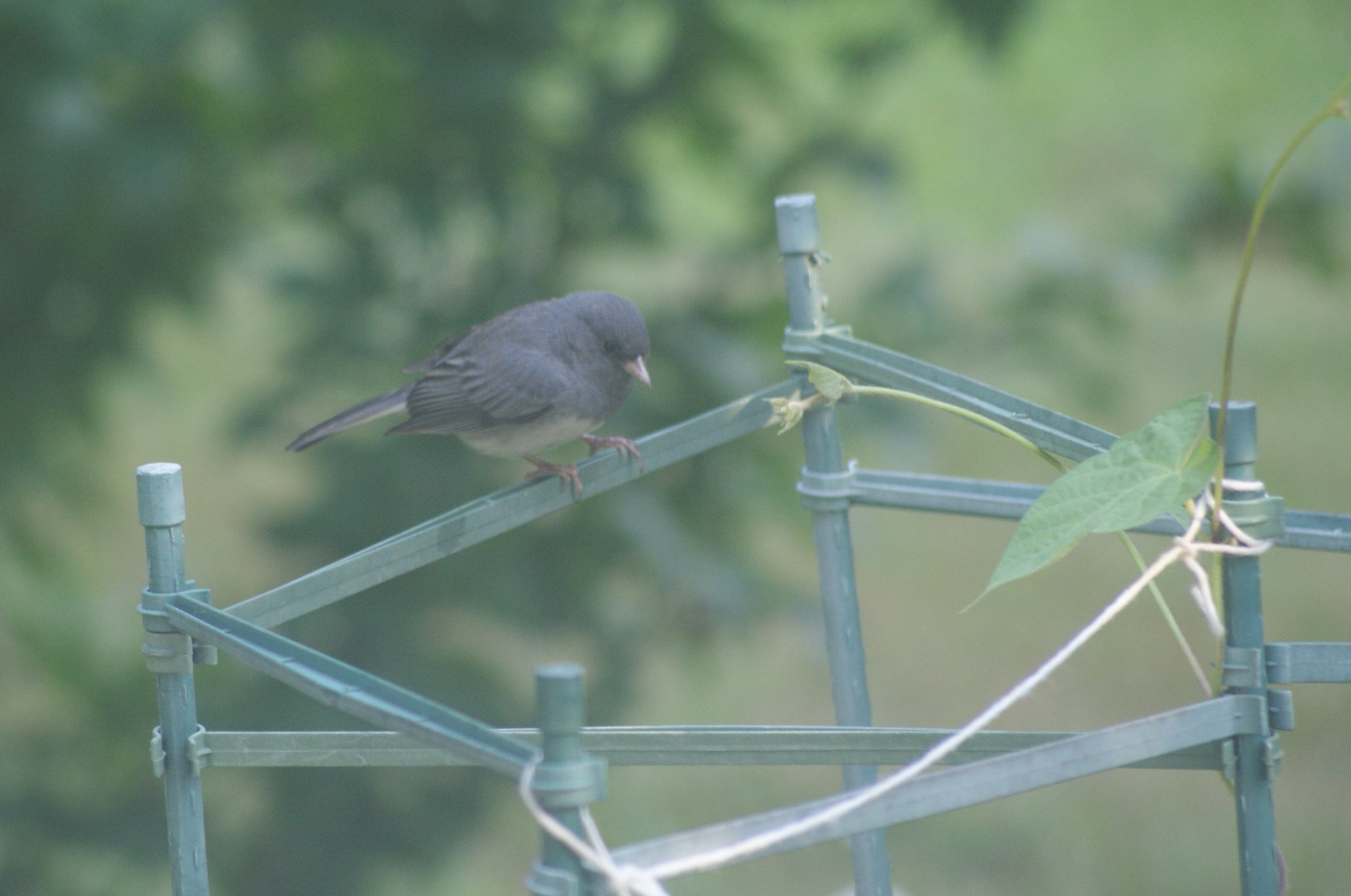
Now how often do you see a Slate Colored Junco in new England in the middle of July?  He stayed around well into August, then I haven’t seen him since.  Someone got his GPS all fowled (ahem) up!  Now, will he be back this autumn?  Stay tuned!

November December Flora and Feathered Fauna

Even as November eased into December, Yang and I have still enjoyed the creatures and plantation around the Yang Manse.  Would you believe that we still had morning glories toward the middle of November?  Gallantly battling colder, shorter, darker days, these Heavenly Blues waited until the last gasps of autumn to bloom.  Their beauty shown through the dying colors of the late season. They even provided a lovely contrast to the last of autumn’s orange and rust foliage.

Though we had an extremely poor crop of pumpkins and gourds (three fertilized, two surviving long enough to be picked), we did still manage to grow some of the plants to maturity.  Here, is one gourd that started out lovely, but succumbed to cold, too much dampness, and the onslaught of slugs.  You can see how pretty it was before Mother nature went wild on it.


In a happier vein, though, how about a look at the survivors?  This gourd that did make it was a surprise fertilization, which we found peeping under some leaves.  Here it is shortly after discovery.  We try to put a rock or plate under the growing gourds and pumpkins to keep the damp ground from rotting them.


And here is the same gourd all grown up.  Sadly, because it was fertilized, late it never grew very much and then spoiled after only about six weeks.  It was pretty while it lasted!


We also managed to get one pumpkin!  It was fertilized during a short break in the rain for a week or so of sunshine and hot weather.  Here’s our pumpkin a beautiful dark green as it grows slowly but surely, out facing damp and ravenous slugs!


It may not be the biggest pumpkin we’ve ever grown, but like Reba Mcentire, it can sing, “I’m a survivor” – if pumpkins can sing. Now the pumpkin resides in state in the picture window on the sun porch, where we can enjoy viewing it as we watch the birds chowing down at our feeders.


And speaking of birds chowing down on our feeders, we’ve got plenty of the little feathered guys to watch!  We have the usual suspects: Mourning Doves, Blue Jays, Cardinals,  Chickadees, Red Bellied Woodpeckers, Titmice, Downy Woodpeckers, and Nuthatches, for example.


But there are also returning old friends, as well.  The harbingers of winter, the Slate Colored Juncos, are back.  At first, they did their typical feeding off the ground, but now they are returning to old habits of taking lunch at the feeding bar.  It just takes them a little while to remember that they can do that. I love to see them flying away, making the sound of castanets and flashing the white stripes on the fan of their tails.


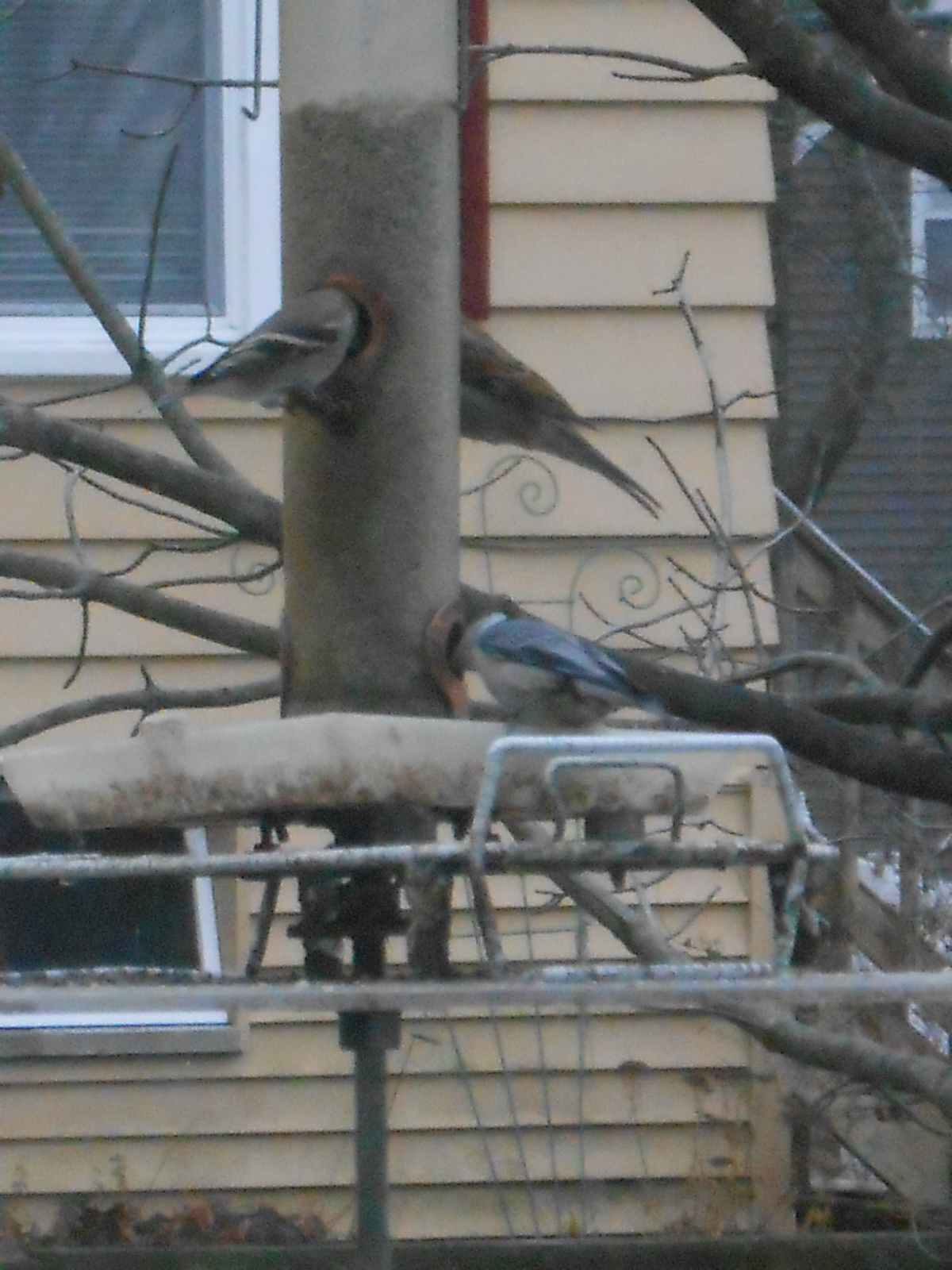
Who else should make a return engagement after a short absence, but the Goldfinches!  As summer ended, these guys disappeared from my feeders for several weeks.  Then, suddenly, they all returned in November, wearing their olive winter coats. They also like to chow down with the other birds, so I have some neat shots of them with their pals, though woe betide the bird who tries to chase one of these aggressive little olive-garbed guys away!  I love this picture with two Goldfinches and a Titmouse (on the right)doing acrobatics.

Here’s another one of the Goldfinch with a Nuthatch.  Isn’t the Nuthatch in picture #1 adorable, just peeking around the corner of the feeder? Don’t you love the gorgeous blue/grey of the Nuthatch’s cloak, more visible in picture #2?


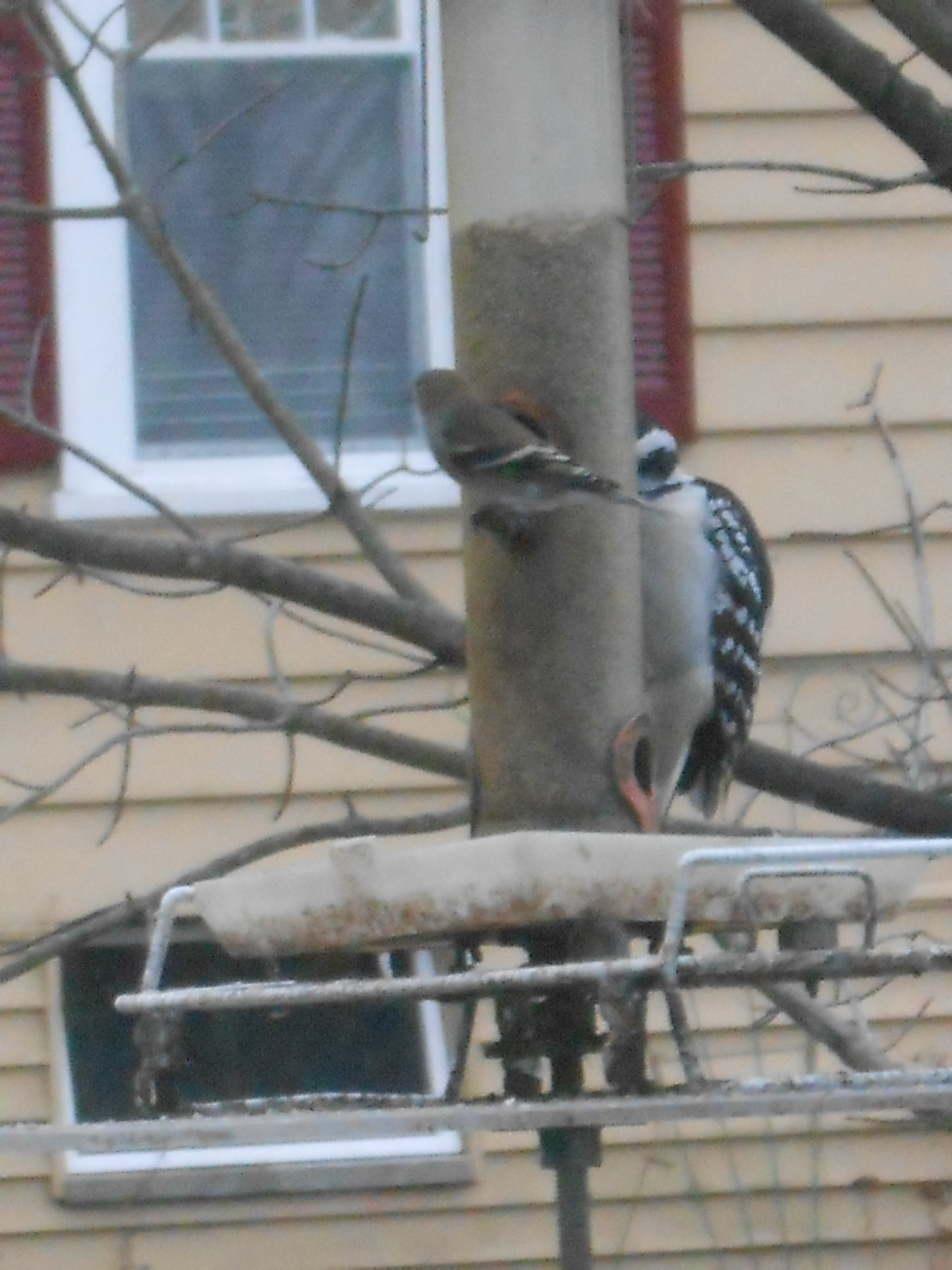
As you can see here, the Goldfinches don’t seem to have trouble getting along with either the Hairy (photo #1) or the Downy Woodpeckers (Photo #2).


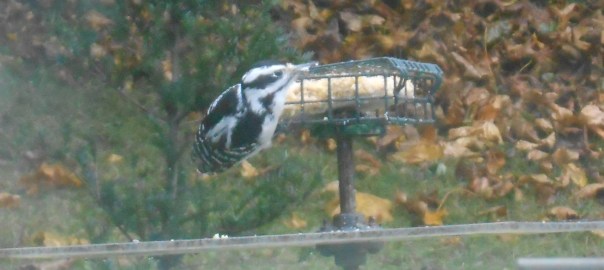
In fact, this summer and fall, I don’t think I’ve seen so many  Hairy Woodpeckers on my feeders.  They certainly do seem to look like Downies on steroids.  Here are some nice shots I got of the female  Hairy.  You can tell the difference because the only the male has a red spot on the back of his head – like in the case of the Downies.

So, I’ll just end with a shot of a Titmouse and a Goldfinch snacking away.

Until the Titmouse turns to me with a definite, “Who you lookin’ at, human!” expression.
 

Adieu, Summer, Adieu

I had planned to do this farewell -to- summer blog much earlier, but since the heat and humidity of the first couple of weeks of September seemed to embody summer hanging on by the claws, I figured I’d better wait.  So, now that crisp fall breezes, pellucid blue skies, and incipient flares of leaf color are taking over, I guess it’s time.

June started us off nicely.  I filled our window boxes and other planters with bright colors that “flowered,” if you will, abundantly.


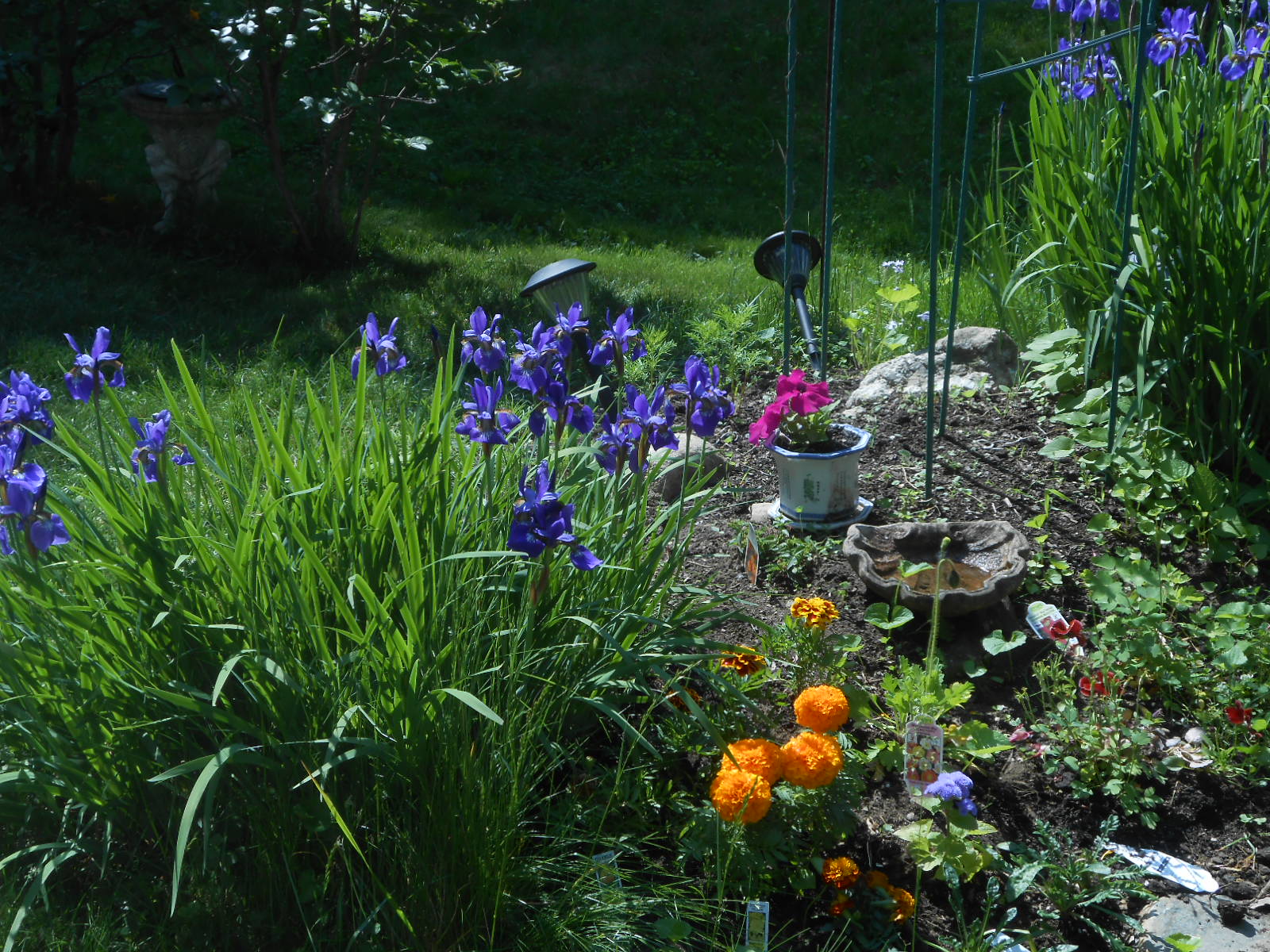
The mound beside the fish pond had gorgeous Irises and Marigolds, beautifully complementing blue with light orange.


We had some nice fancy Irises in the front yard, as well.  Interestingly, we did not have as many blooms as usual.  Perhaps the May frost nipped a few?


The sea-rose bushes in the back yard climbing up the slope had tons of gorgeous pink blossoms.  Here’s a shy little bee hiding among the petals.


July was fun for beasts, birds, and flower.  One morning when I went to rinse out the cat-food cans before putting them in the recyclables, I found this fellow chilling in a bucket that had filled with water.  For a few days, this was his private pool, with the high grass surrounding making up his stomping, rather, hopping grounds.  Yang was careful not to mow around where the frog hung out.


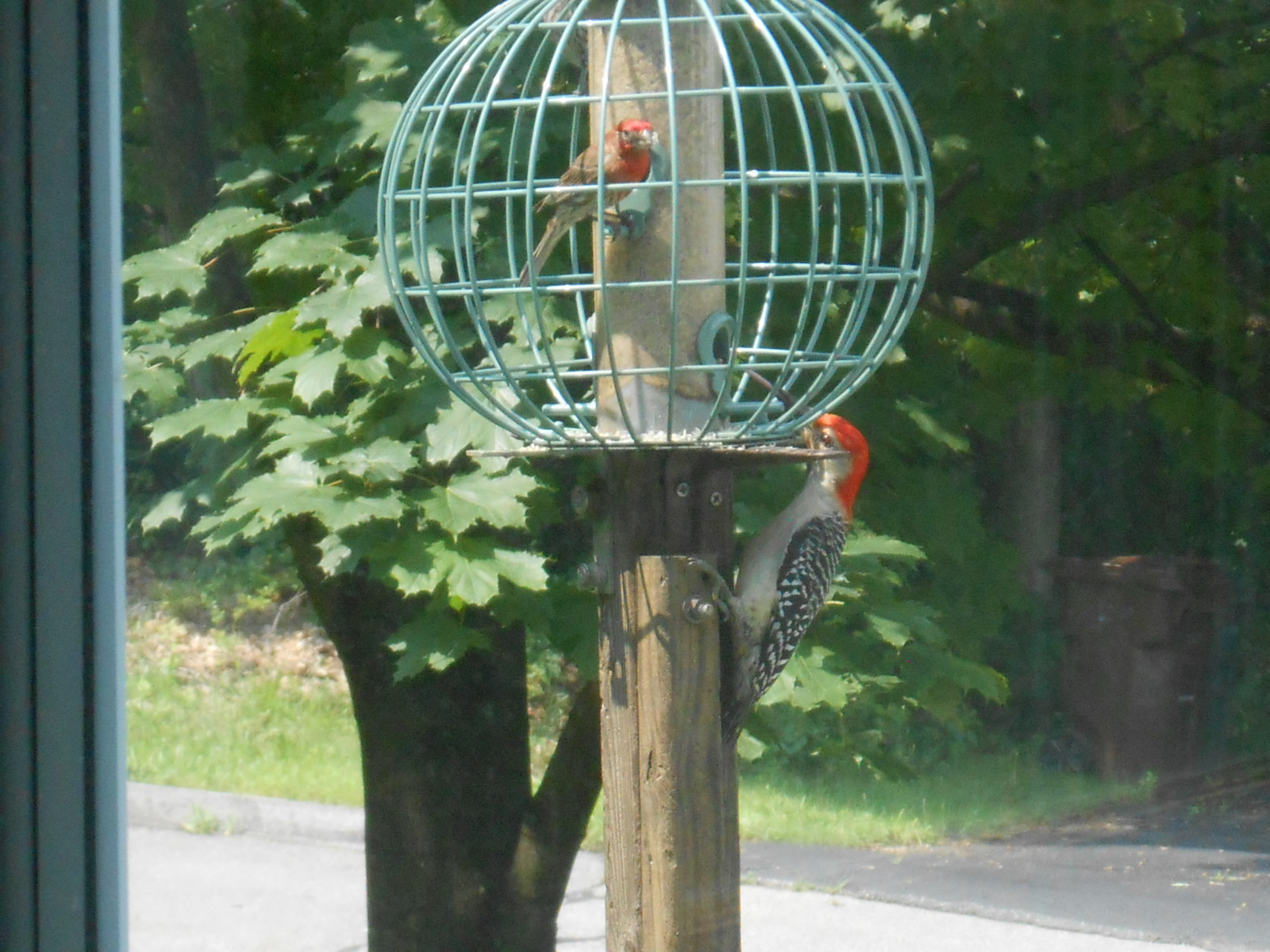
Yang put up a new bird feeder that is sheltered by a globe cage.  The little birds loved it!  Here you can see the Goldfinches mobbing the feeder.  I think that sparrow must have worn a yellow feather to sneak in.  Of course if you’re a larger bird and a Redbellied Woodpecker, you can still grab a snack.  If you click on the photo and look carefully, you can see our friend Red using his looong woodpecker’s tongue to grab some food.


A Rosebreasted Grosbeak was just able to sneak in there, himself – though he and the Orioles faded away unusually early, in later July.


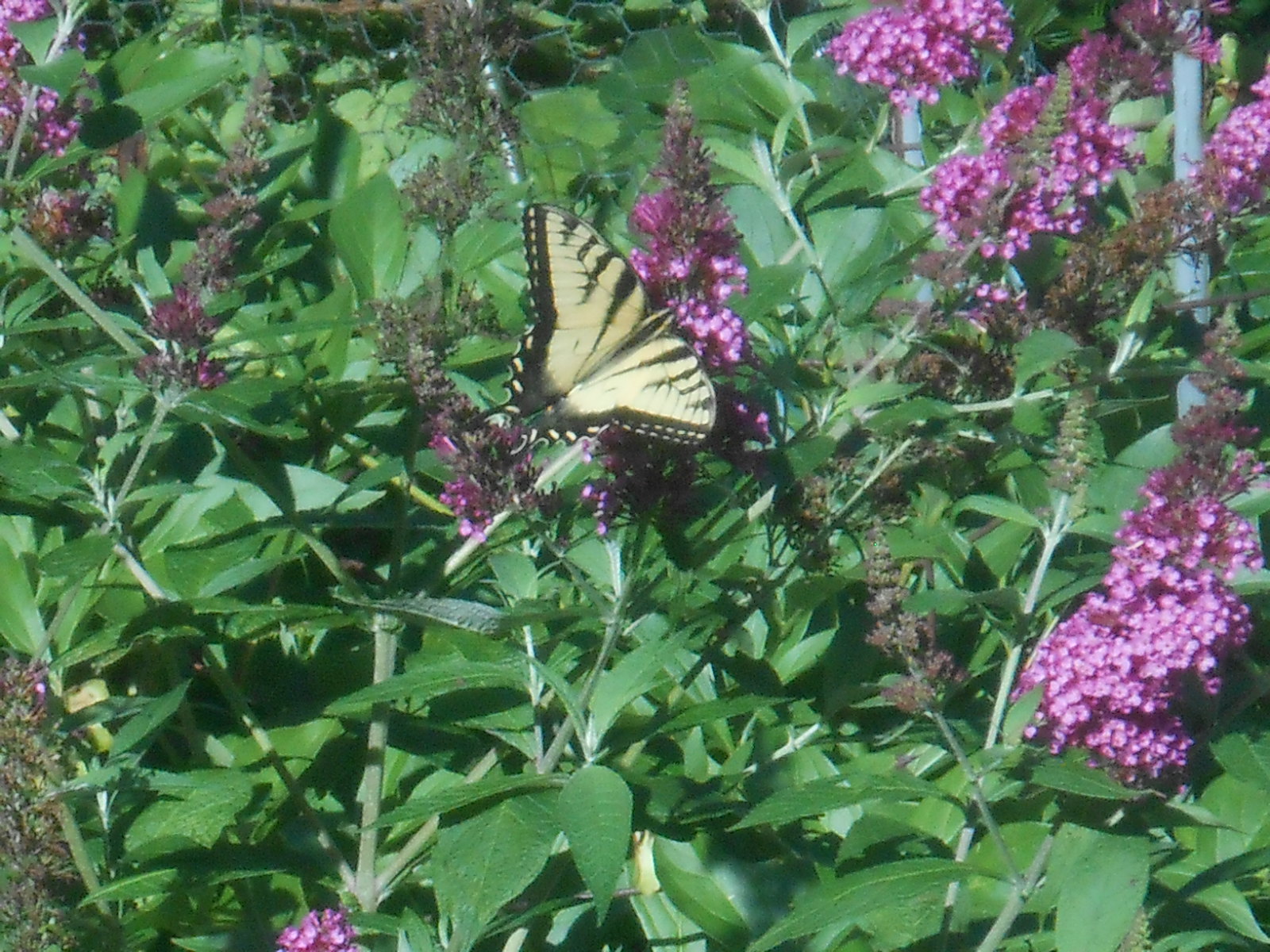
The butterfly bush near the house attracted quite a crew.  Here, you can see one of the several Tiger Swallow Tails who daily dined on the shrub.  We also got some hummingbirds, Wolf Moths, and Bees dropping by for a nectar treat.


Usually, our rose from China only gives us one bloom, but this year it gave us two at the same time.  Neat, huh?


August brought us continued Goldfinch mobbing, and the flowers began to fade a bit.  We had lots of Morning Glories, which I forgot to photograph!  This year, we had orchid, magenta, purple, pink, blue, blue/white, and the white moon flowers.


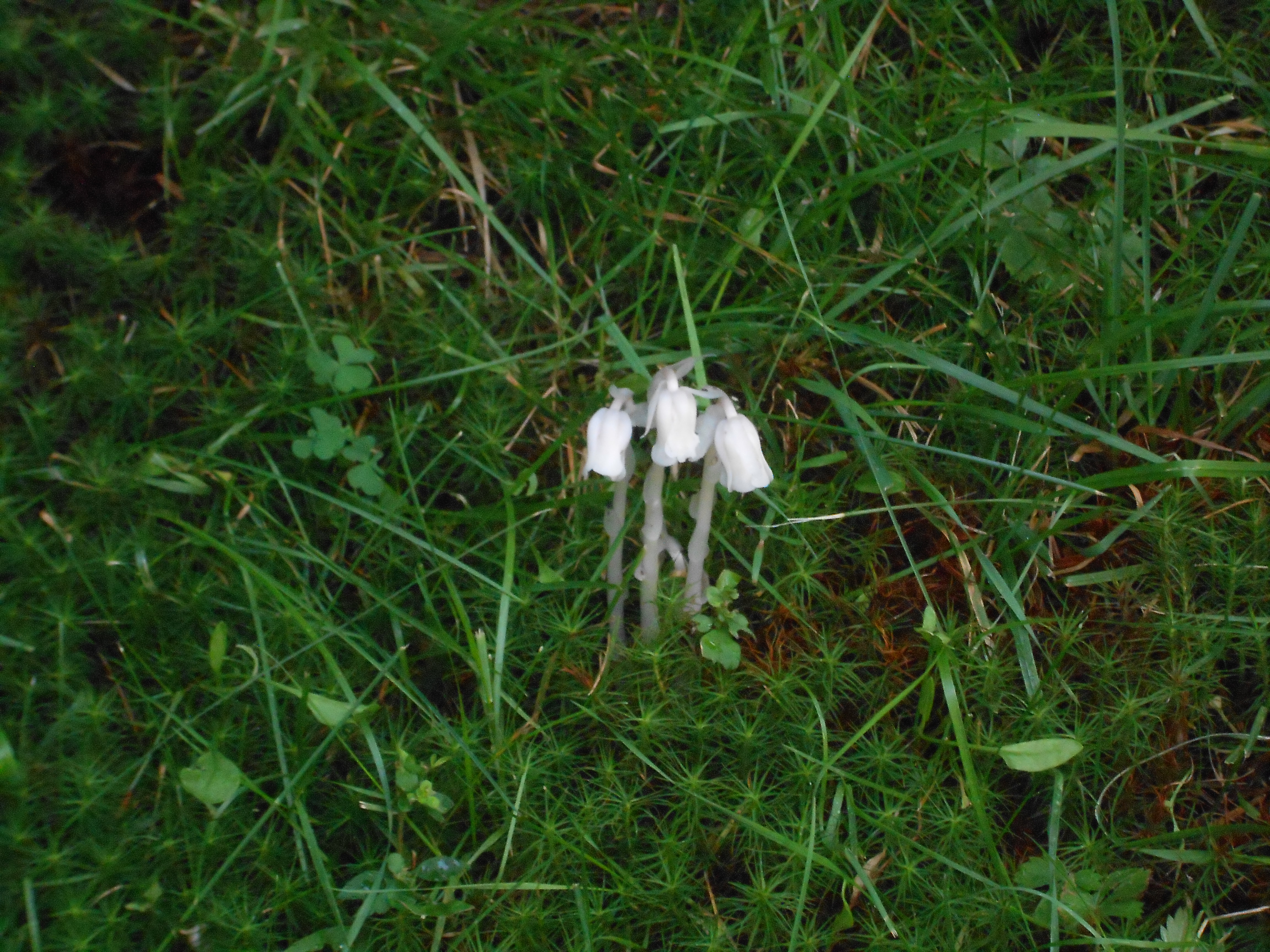
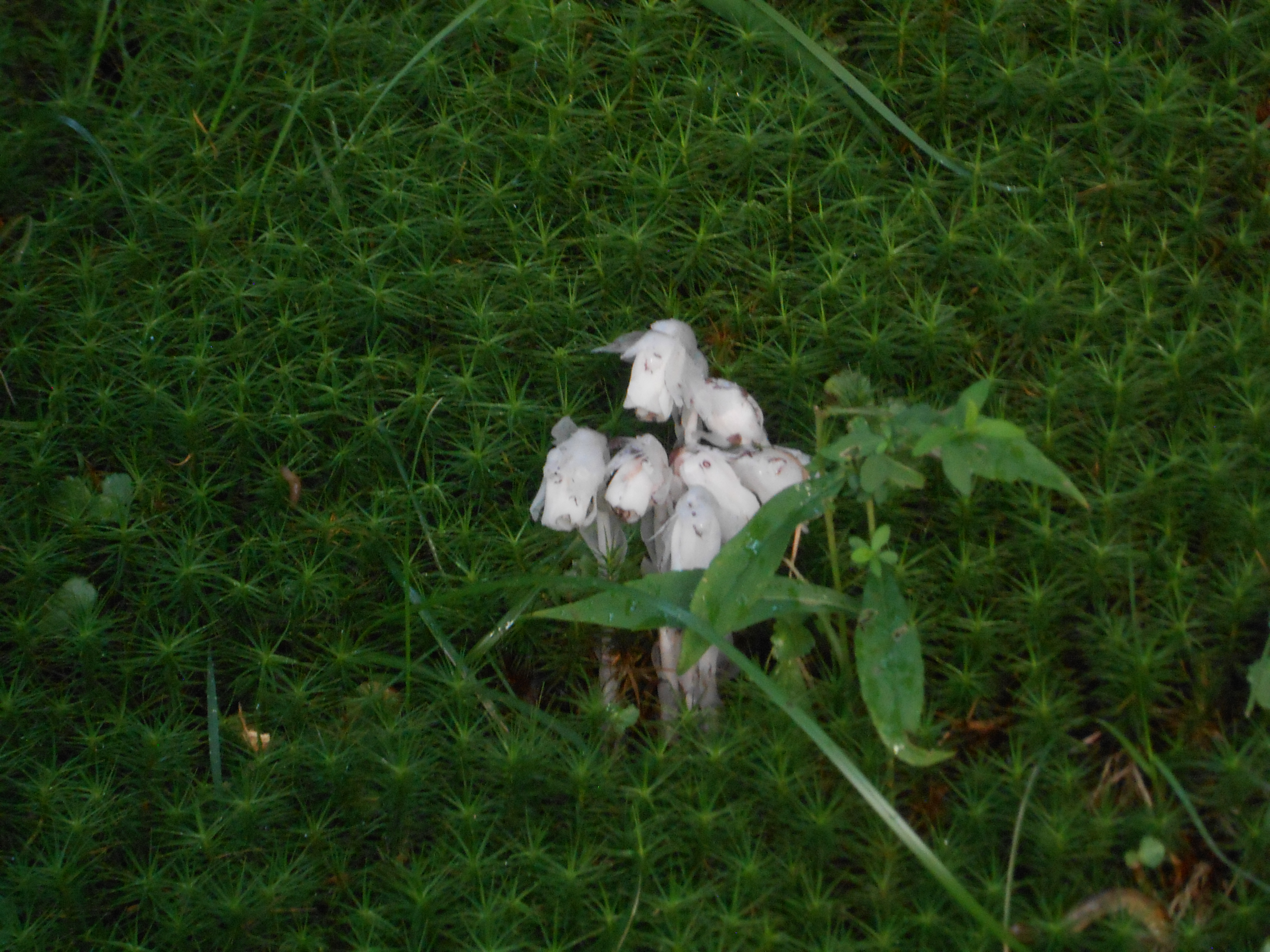
I did remember to photograph the Ghost Pipes that sprang up!  I remembered we had them once before during a rainy summer years back. Consequently, I predicted we might see more this year.  Boy, was I right!  I’ve never had so many!


So, on to Autumn! 

Backyard Birdwatching Is the Best!

As you may have extrapolated from many of my posts, Yang and I are great bird watchers.  We’ve traveled all over the Northeast (and to Canada, China, England, and France in the past) to sight all kinds of befeathered critters.  My count for species this year is now a whopping 93!  However, I can’t help agreeing with him that we often see a greater numbers of birds and species on our bird feeders thnt we do on our trips to woods, fields, rivers, and oceans!  Maybe this blog will lead you to agree.

Many of our regular spring and summer visitors have made their appearances here.  I can report that I’ve seen one Hummingbird, lots of Goldfinches and House Finches, Red-winged Blackbirds (male and female), and Cardinals by the score.  Our Chickadees and Titmice have briefly been on haiatus, brooding their babes, but they are now back at work snagging black-oil sunflower seeds.  It’s also so much fun to see Mommy and Daddy (mostly Daddy) Cardinals bringing their kids to the feeders now that the little tykes can fly.  Unfortunately, I don’t have any pictures of these guys, but I do have quite a few of some of my other feathered favorites.

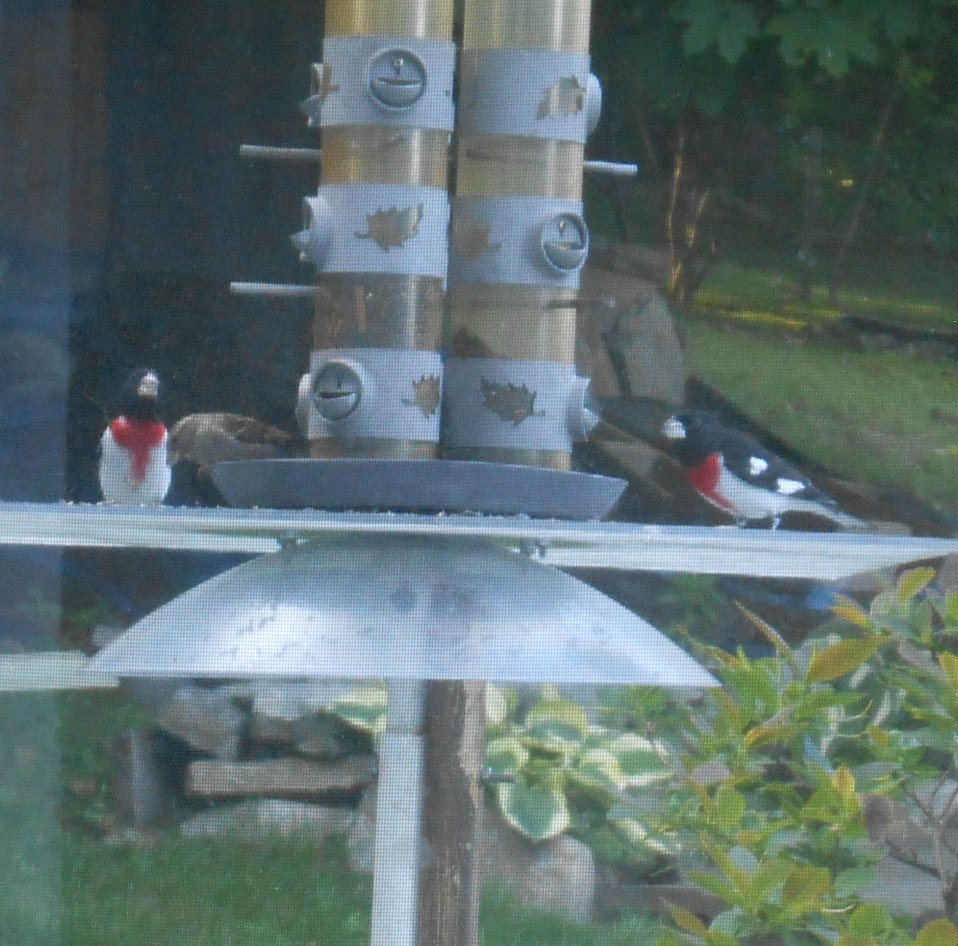
One of my favorite species are the Rosebreasted Grosbeaks.  Usually, we get the females first, then the males; however, it was the opposite this year.  We had at least one male, finally, on a feeder.  Then, tragedy struck:  we found him dead on the ground under a tree.  Yang and I were heartbroken.  These guys were like our pals.  Still, our hearts mended a bit two week later when we found another male chomping on sunflower seeds.  Then we saw a female.  Then we saw two males at the same time!  There could be up to thirty males on that feeder as long as they didn’t all show up together!  By the way, the males are quite aggressive.  They don’t take guff from each other and not from Grackles, Blue Jays, or Mourning Doves.  The females can be tough cookies as well.  Anyway, I’m glad they are back.  Below is a shot of the males in a more pacific mod. I guess they can stand each other when multiple  tubes of seeds separate them.


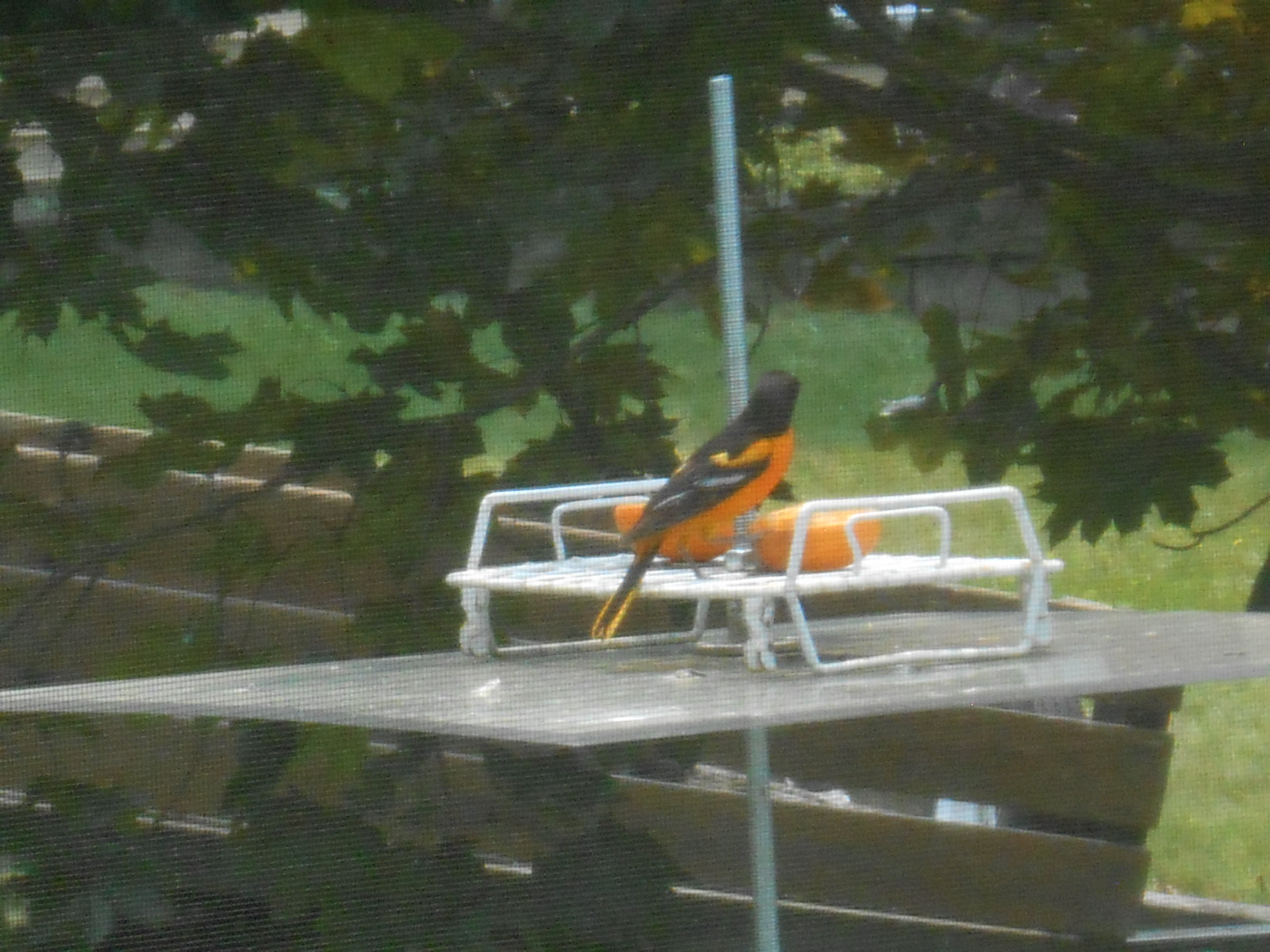
Another of our beloved colorful visitors is the Baltimore Oriole.  After long waiting, we saw one toward the end of May, then nothing!  Many an orange might have withered away if not for other birds. So, we almost gave up hope of seeing another Oriole – until in the middle of June Orioles reappeared!  We saw a male several days in a row, then a female for a couple of days, then a week later:  a juvenile.  It’s been a couple of weeks and – nothing!  Of course, who knows what shows up when Yang and I are away, but we haven’t seen any Orioles since.  I guess this was just a stopover on their way to their real summer grounds.  Well, at least we saw a few of them!  And the oranges did not go to waste.

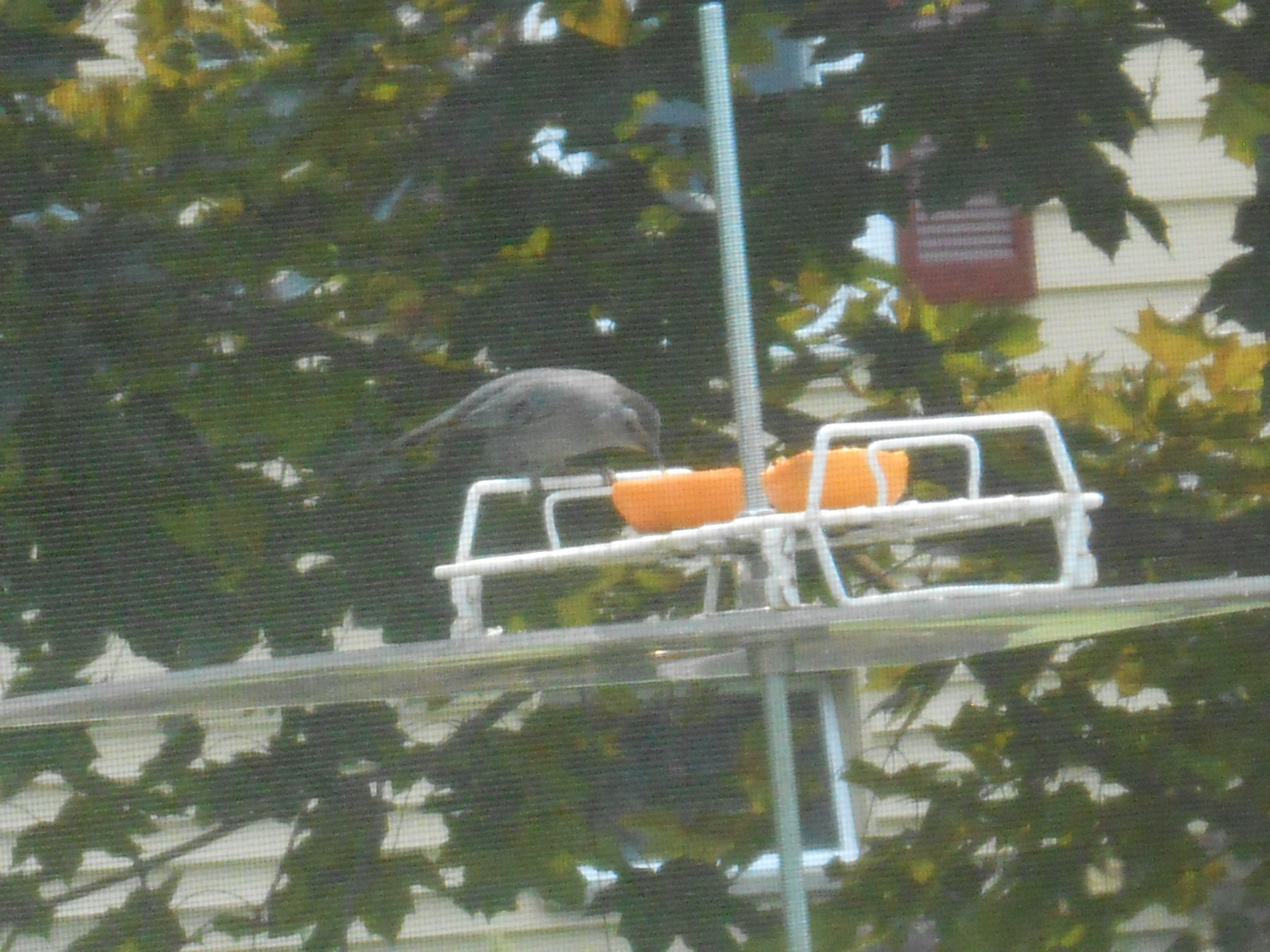
We have discovered that Catbirds adore orange pulp!  When there’s no suet to be had (and even when there is!) our catbird couple come by to snack on the orange halves we have set out.  They must keep up their strength, since they have a nest with babies on our property.

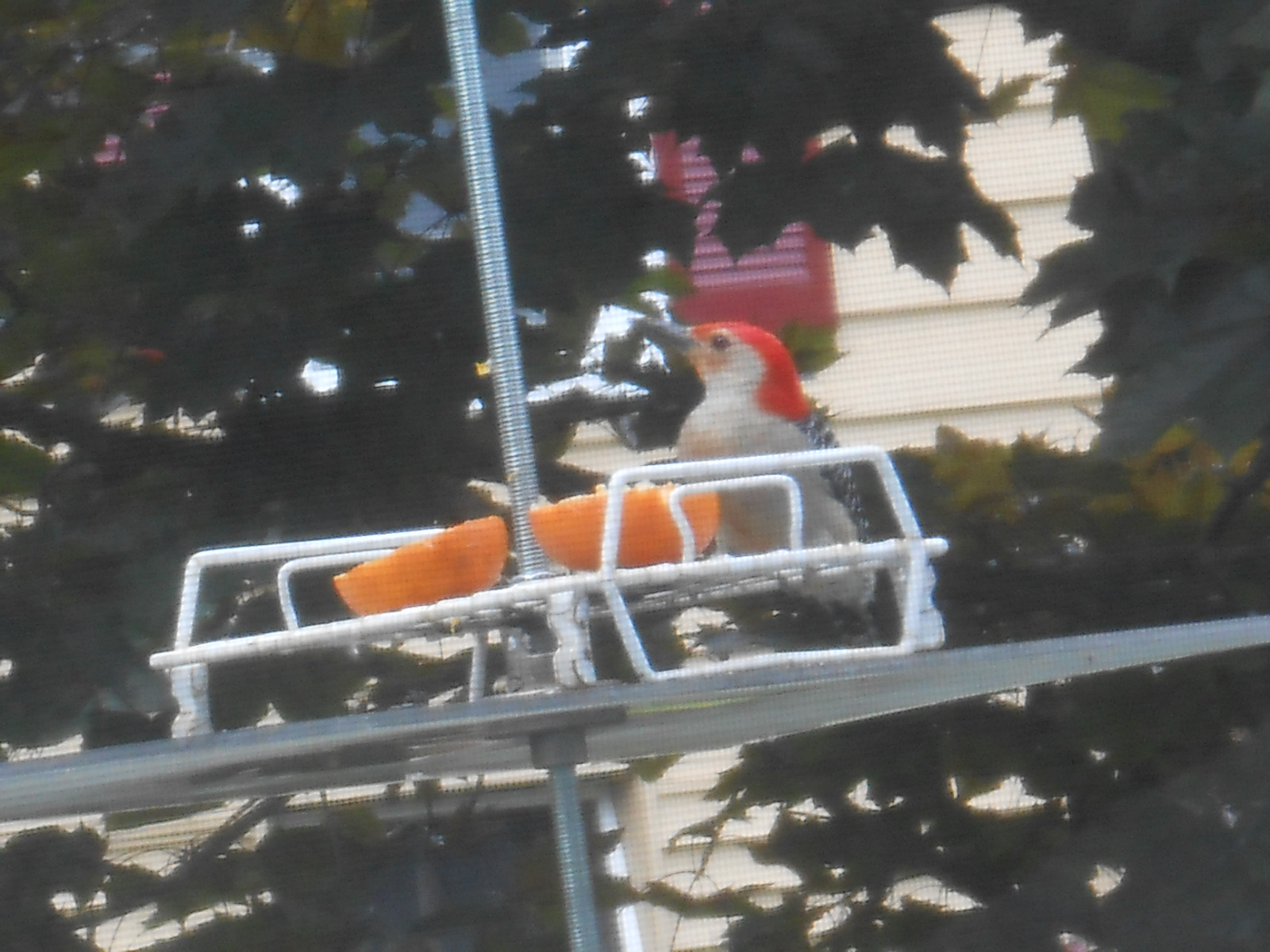
Mr. Redbellied Woodpecker thinks the oranges are pretty cool stuff, too.  You can see him having a grand time chowing down on pulp.  Maybe the Orioles are afraid to go for the oranges with these guys around!

One idea that Yang came up with to thwart the squirrels from stealing food from the birds (and breaking our feeders) was to buy a tube feeder inside a globed cage.  It also had the advantage of preventing the big bully birds like Grackles, Doves, and Jays from keeping the little birds from food.  it works. Of course, medium size birds like the Rosebreasted Grosbeak and the female Redwinged Blackbirds can get in, without being bullies.  Tough luck male Red Wings!  Birds with long beaks also have a shot – like the Redbellied Woodpecker.  The House finches try to out-aggress the Goldfinches, but the latter either hold their own or just wait and dive in when the coast is clear.  Titmice and Chickadees are too fast for anyone to harass them!


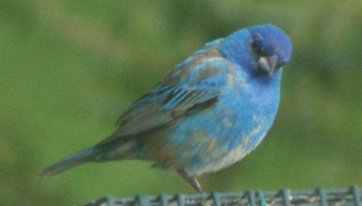
So, you can see, we’ve seen a healthy variety of avian visitors right outside out windows.  Bring on the Scarlet Tanagers, the Pileated Woodpeckers, and the Indigo Buntings!  It wouldn’t be the first time one of them has shown up at chez Yang.


Late Winter Birds, Far and Near

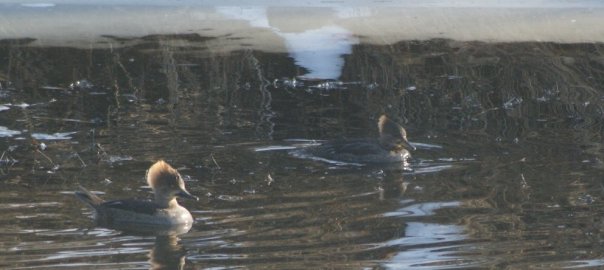
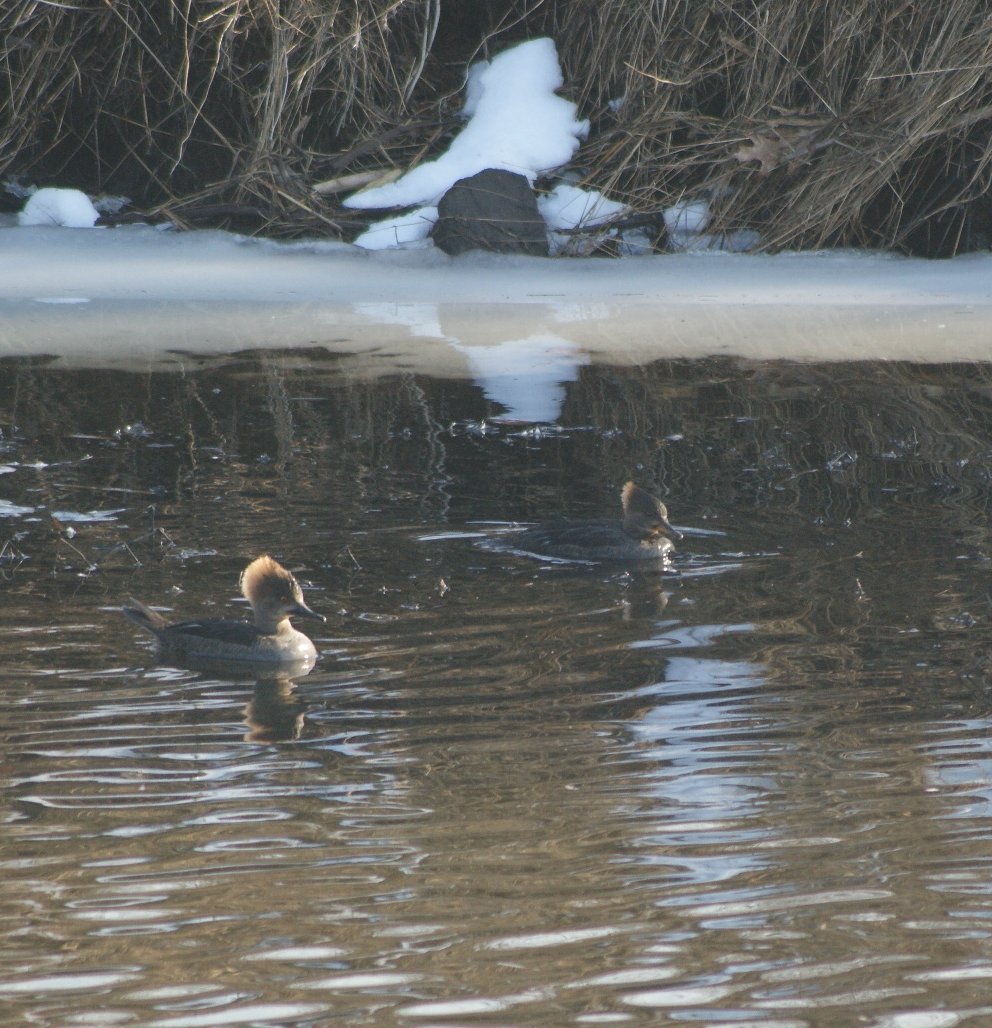
These waning days of winter have given Yang and I some fun bird watching, whether at home or away.  For instance, Yang went for a stroll one day on a canal that runs perpendicular to the Blackstone River and sighted some interesting ducks and the peripatetic Kingfisher.  So, the next day, I had him take me back there. Sure enough we saw some swell birds.  Yang got some really nice shots of a pair of hooded mergansers.  At first we thought they were both females, but I noticed that one had a distinctive long, pointed tail sticking above the water, as well as a fluffier brush of feathers at the back of the head.  I suspect that one was a juvenile male.  We either had a Mom and her teenage son or a Cougar duck.  Who can tell? Enjoy the pictures!


I also got to see the Kingfisher, a male.  I heard his excited chatter way down toward the end where the canal ran into the Blackstone.   I kept my eyes peeled until I saw a blob of white way ahead in a tall tree over the waters.  Training my binoculars confirmed my suspicions, bringing into focus a magnificent male Belted Kingfisher.  Yang came up and got some shots with the binoculars he could attach to his cell phone.  We had a great time watching His Majesty swoop down into the water, skimming along to fly off with his fishy dinner.

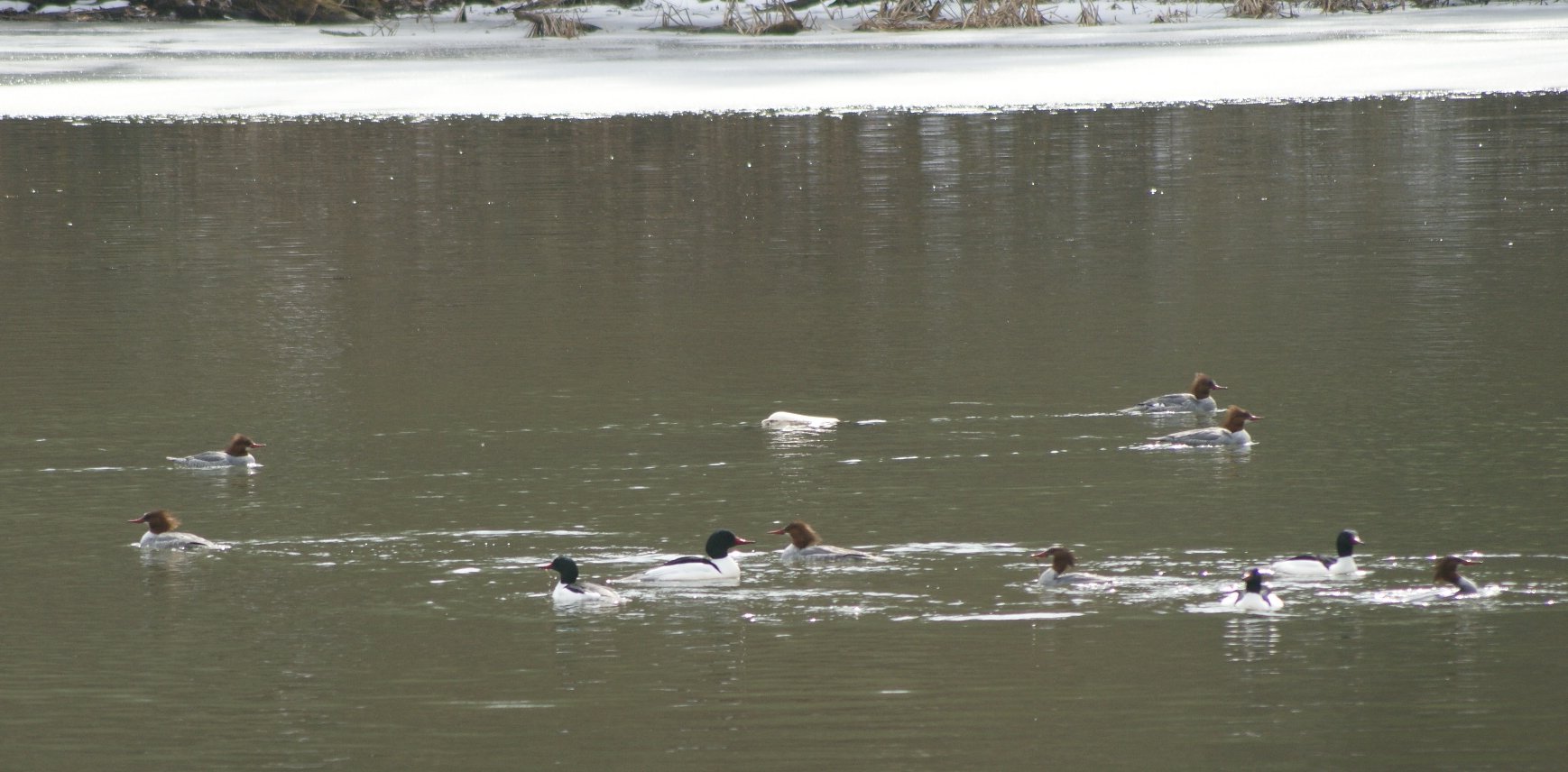
Further from home, we visited Forest Park in Springfield on our way to lunch in Montague.  This turned out to be the mecca for Common Mergansers. We saw tons of them in one of the ponds.  They were shy guys, as whenever we got  close to the shore, they paddled off to the middle of the pond.  Yang did get some nice pictures of them, though.  I love how the males gleam white, their green heads almost black.  Their head feathers in the back are far smoother than those of the male Red Breasted Mergansers.  In both these types of Mergansers, the females are beautiful, with their Rita Hayworth-red locks! Yang loves the ducks’ red beaks.

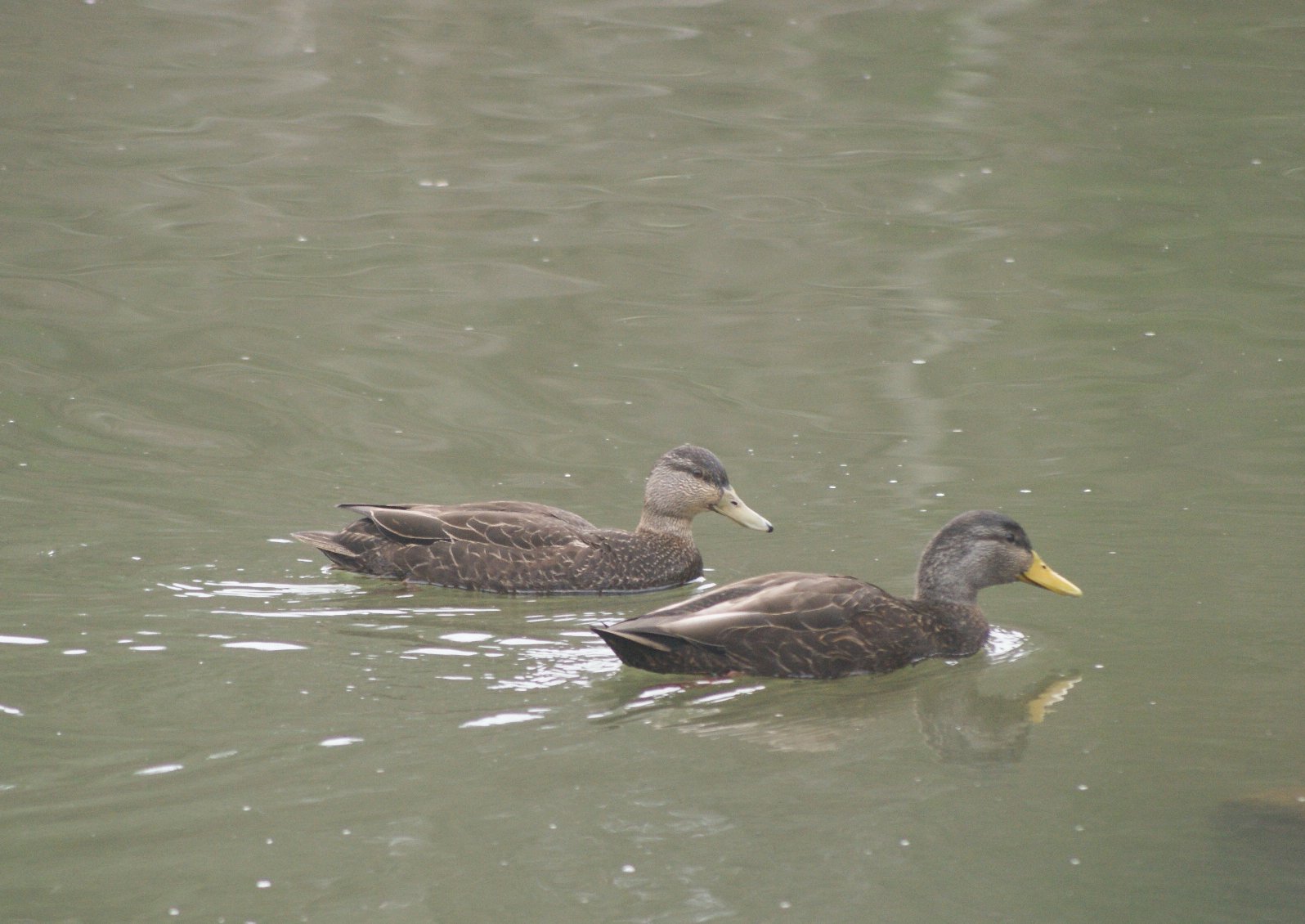
We also found some American Black Ducks enjoying the same pond as well.

Unfortunately, a nice swim almost ended in a trip over the dam! Can’t you just hear his wife yelling, “Dam/n!” Her husband responding, “Don’t you cuss at me . . . Whoa!!!”


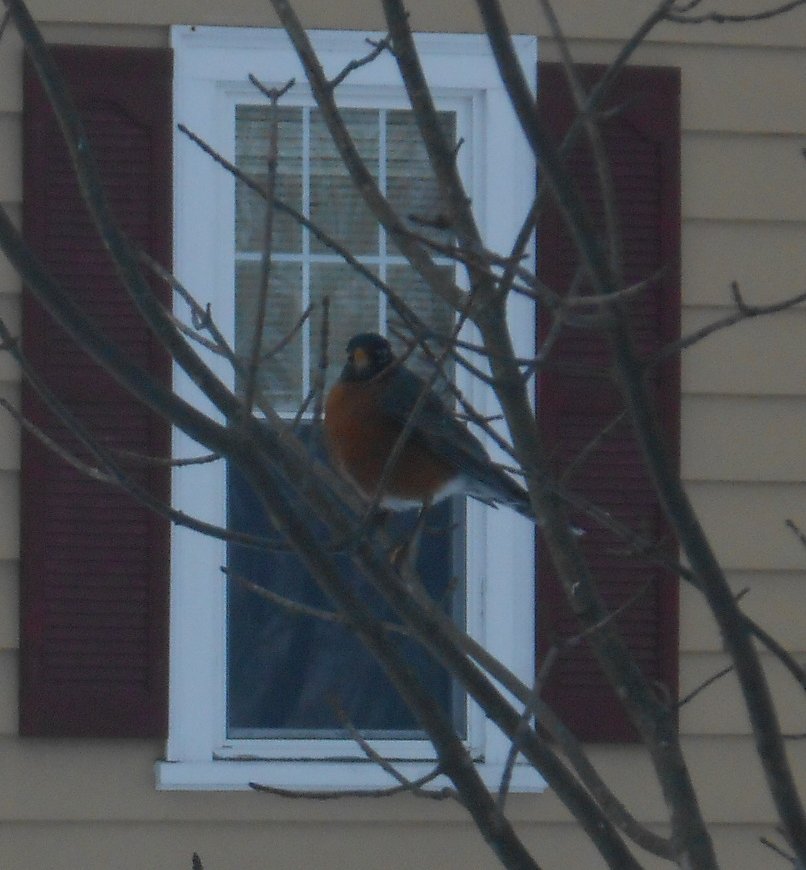
Closer to home – as in  the bird feeders next to my house –  we’ve been seeing some nifty birds, old friends and new.  The Mockingbird and the Redwinged Blackbirds are back.  Would you believe that even in the snow, the Robins have been scooting about for at least two weeks?  Here we have a Robin and a Downy Woodpecker chilling (literally with all the snow)  in a tree outside my sun porch window.

I must say that this Robin loves his/her? suet.
 

We also had the pleasure of this Red Bellied Woodpecker’s company. Since it’s a female, it wouldn’t be the one who was stunned after hit our sun-porch window.  We brought him in in a box and let him warm up for about an hour then set him free. Whoosh!  He was in great shape and off to the races.  We see him and his mate here quite a bit.  They’re also big suet lovers.


Now, here some of our other visitors.  There are cheeky Goldfinches,


caring cardinals,


and perky Downy Woodpeckers.


Bring on the Rose Breasted Grosbeaks!


Winter Birds at Chez Yang

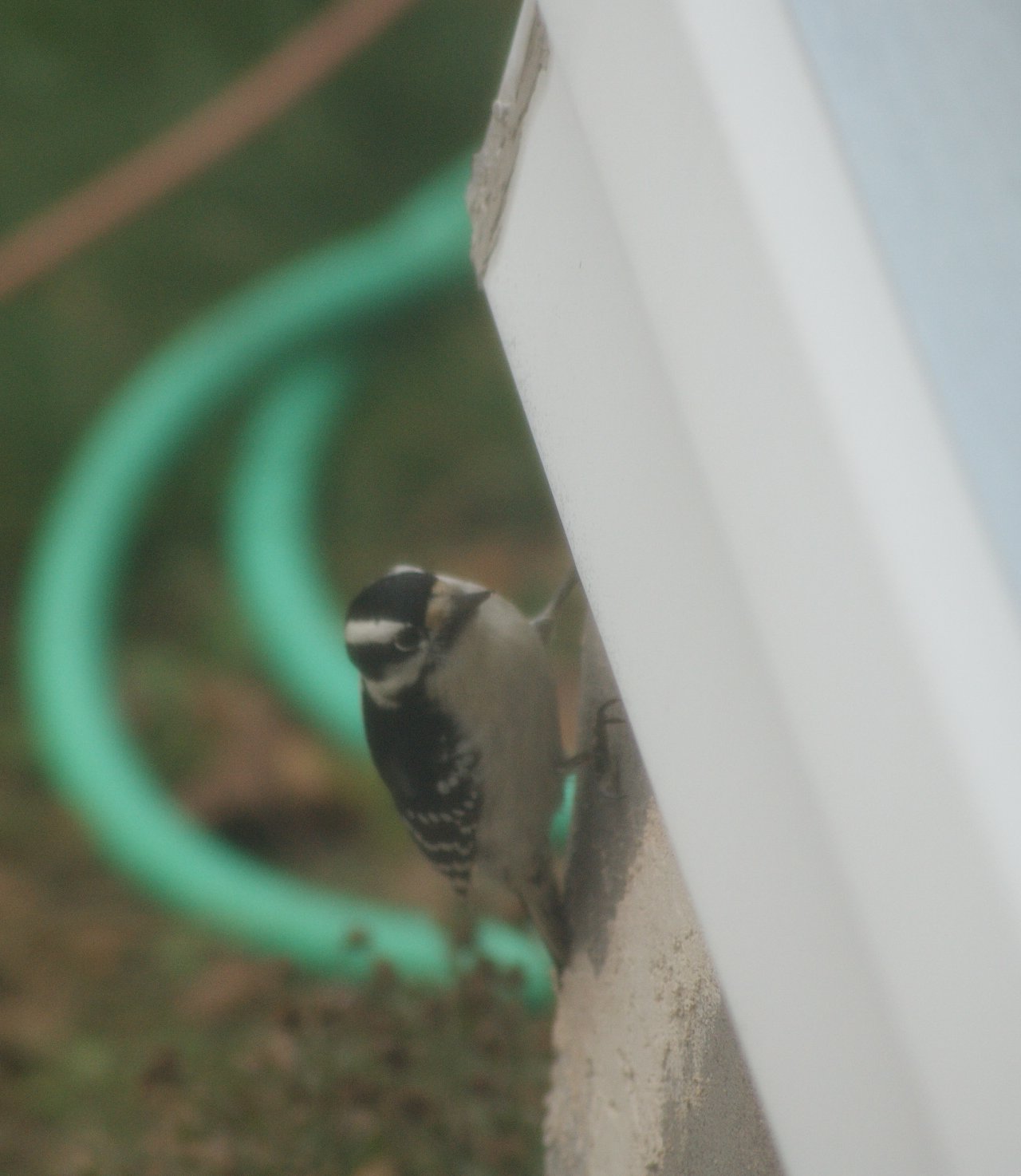
We’ve been seeing some wonderful birds this winter in our yard at our feeders.  Let me share some of them with you, starting from December.  This first set of pictures were taken that month, before and after the snow started.  I have  pictures here of some old friends and some new-like this Downy Woodpecker.  Do you think someone should tell her that bugs don’t live in concrete or vinyl siding-or does she know something that I don’t?
We also see plenty of our old standbys, the Chickadees and the Titmice.  They like to come and dine about 9:30 in the morning and about 4-5:00 in the afternoon-with an occasional snack or two throughout the day.  The Titmice are one of Yang’s favorites, and he likes to call them “little faces.”  With their big, expressive eyes, you can understand why. In this picture we have one of the cute chickadees.
One of my favorite birds is one of the first signs of winter:  the Slate-Colored Junco.  That’s the name they went by when I was first birding; however, I’ve noticed them now called “Dark-Eyed Juncos.”  Maybe they all invested in brown contacts.  I love their blue-grey coloring (though some are more brownish) and  their white tails that flash when the fly away, as they give a call that sounds like castanets.  We have large numbers of them in my yard, which it just fine with me.
These two Juncos don’t look to happy to meet.
“Who You lookin’ at?”
“No, who YOU lookin’ at?!”
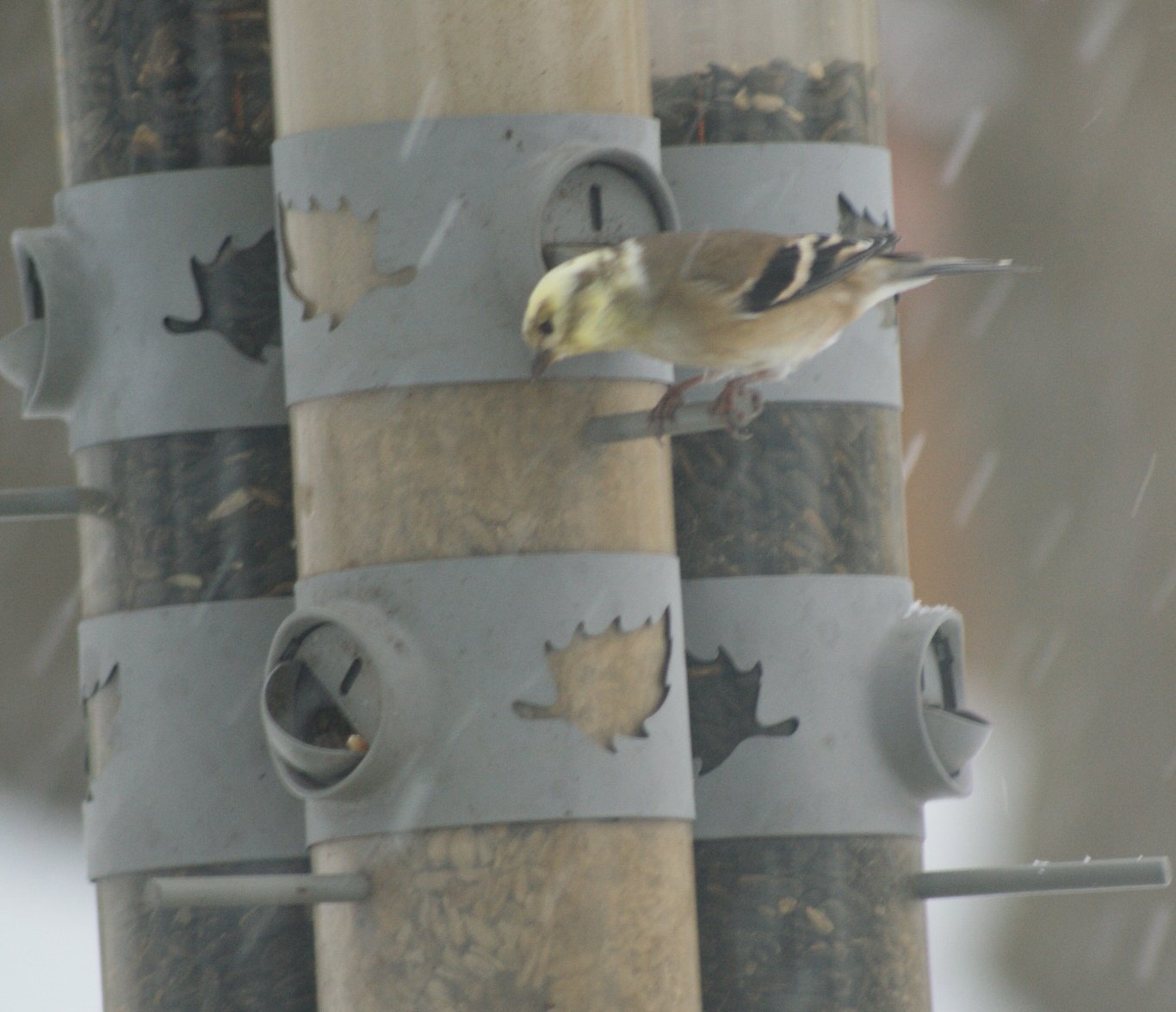
The Goldfinches haven’t flown away until the spring.  They’ve just changed their sprightly spring plumage for heavy winter coats.  One fellow appeared to have a white cap of feathers, even with his winter color.  So, I dubbed him Whitecap.  Original, aren’t I?  However, closer viewing of him through these photos shows that his cap is more light yellow than white.  Nevertheless, he’s staying “Whitecap,” as Slightly Light Yellow Cap” is way too much of a mouthful.
Here’s another nice shot of Whitecap, with a Goldfinch pal (in the upper left corner) who apparently thinks he’s a bat.  I’ve got to stop watching Forever Knight when these guys are in the windows.

Here’s another one of Snowcap, after he was reading up on Edward Taylor and thought he ought to go out and starting preaching to Juncos.  Of course, if Snowie believes in predestination, that suggests that even other species can be saved.


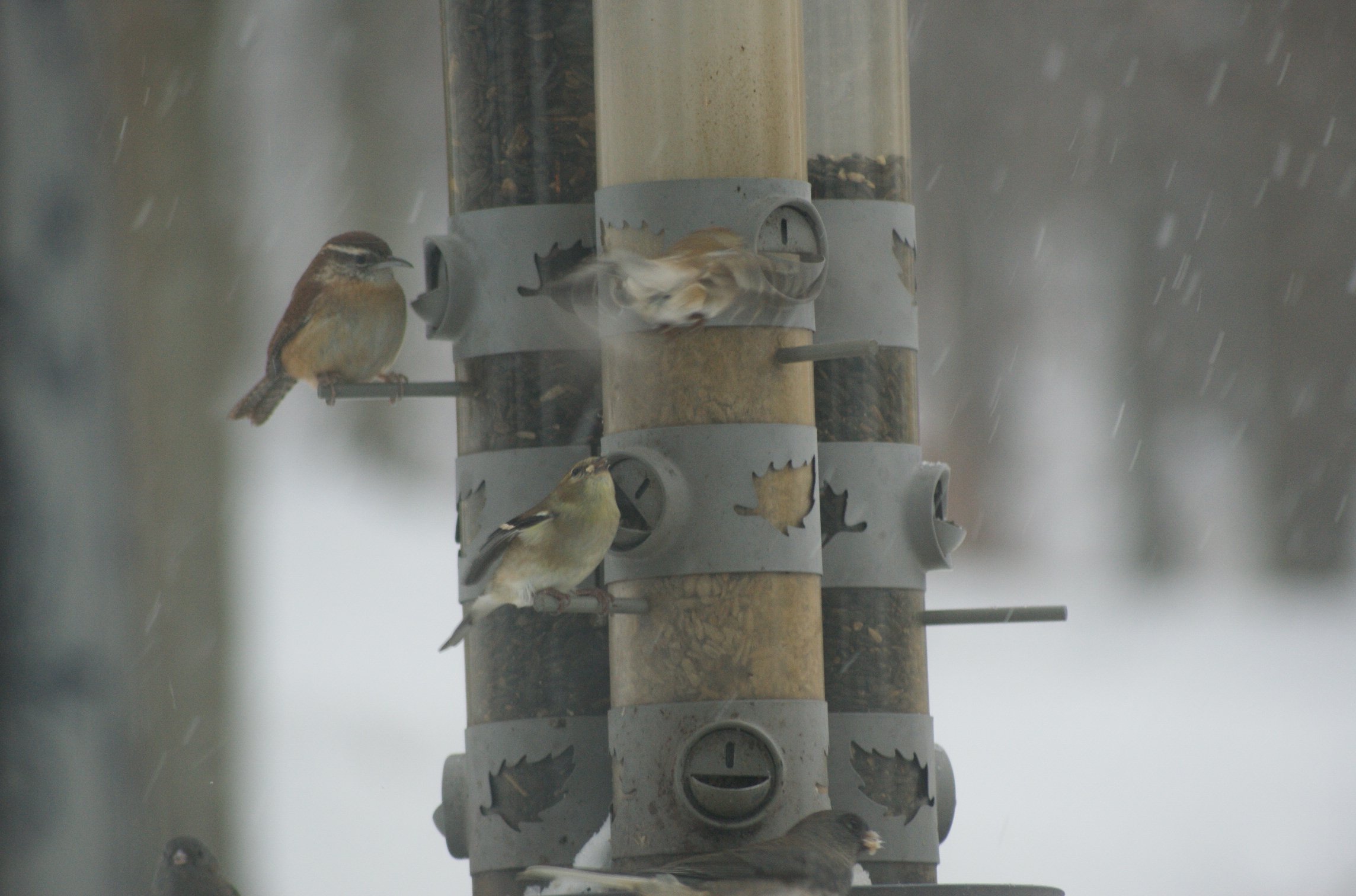
I particularly like this picture because it includes so many:  Juncos, Goldfinches, and another of my favorites, the Carolina Wren, on the left.  She doesn’t quite look like a wren because she doesn’t have her little bum cocked in the air, but her long beak and white eye-stripe give her away. We have at least one pair who come to my feeders.  They’ve been around the house for several years, but it’s only the past three or four that I’ve seen them year round, and so frequently in the winter.  I often hear them in the trees of the woods behind my house and across the street.  I named this pair, Carolina and Carey.  Additionally, note the Goldfinch coming in out of inter-dimensional travel in the upper middle of the photo.
We also had an unexpected visitor on our suet feeder.  Regard this handsome Mockingbird.  Usually I don’t see them in the winter.  However, I  was informed that they don’t travel south, but hide out in deep woods during the cold months.  Apparently this guy didn’t get the memo about hiding out. He or she comes to see us just about every day to chow down on the suet.  I know these birds tend to be highly aggressive, but this one really doesn’t seem to mind sharing.


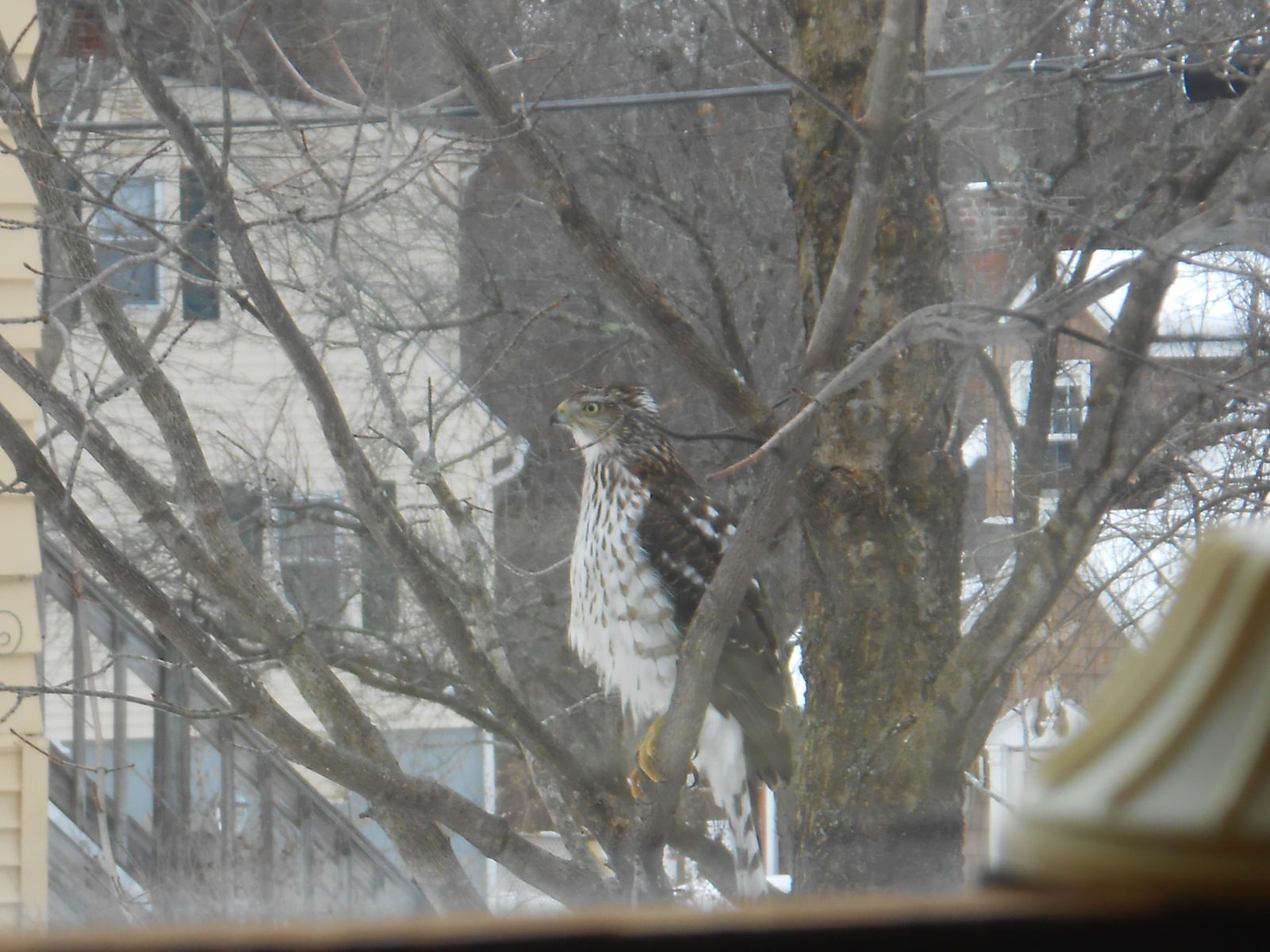
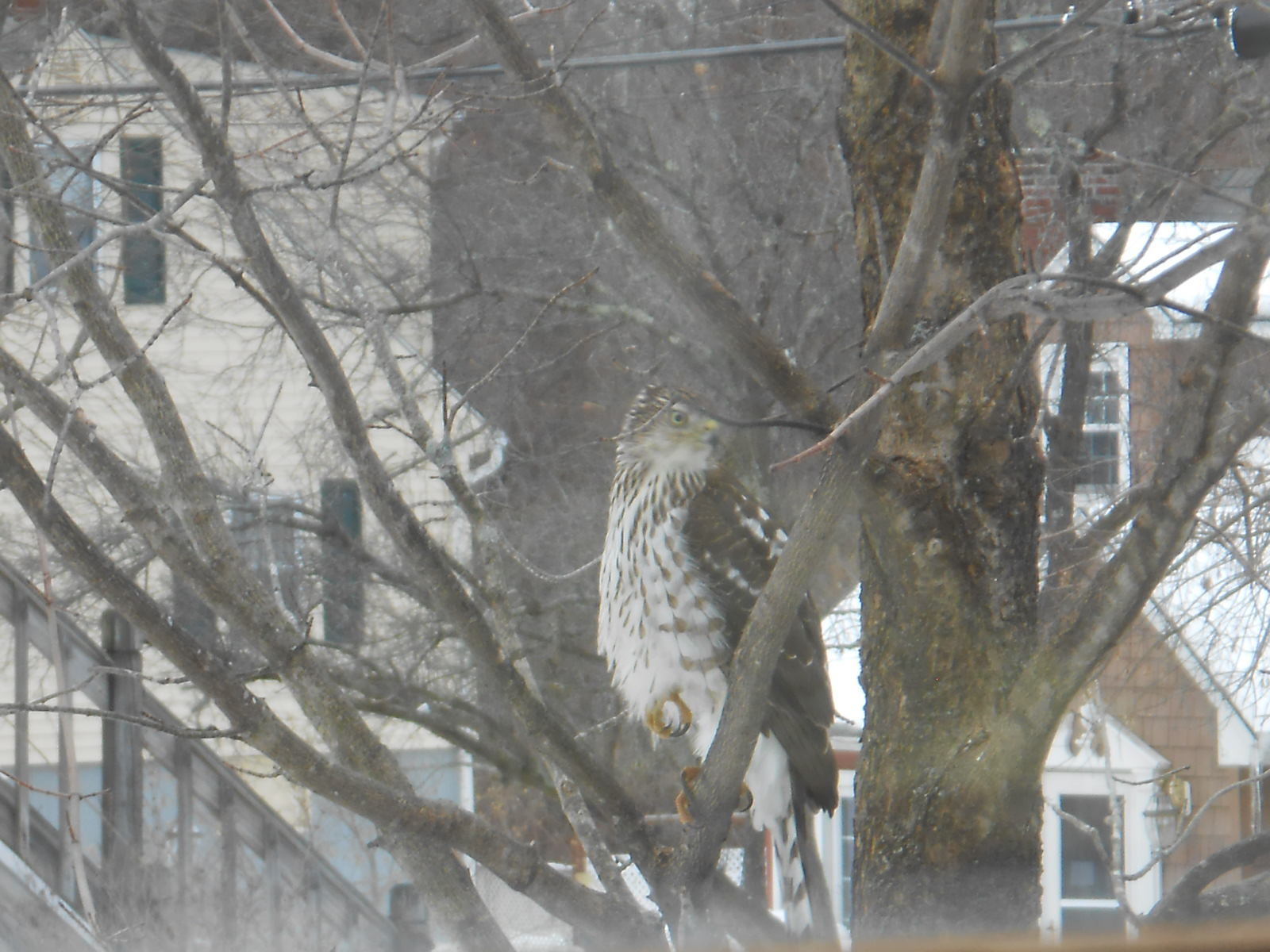
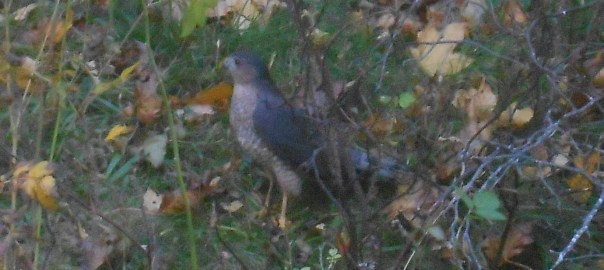
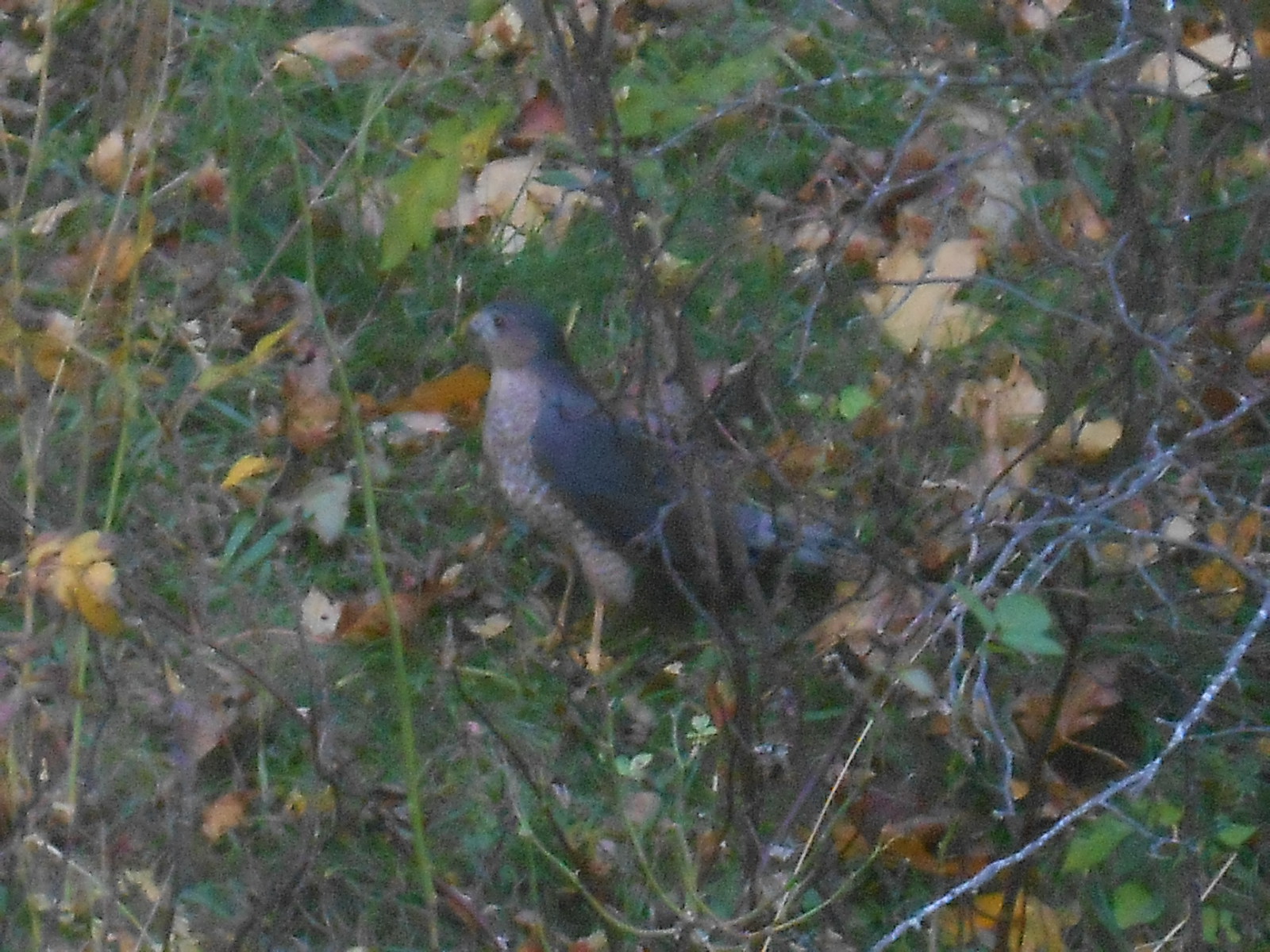
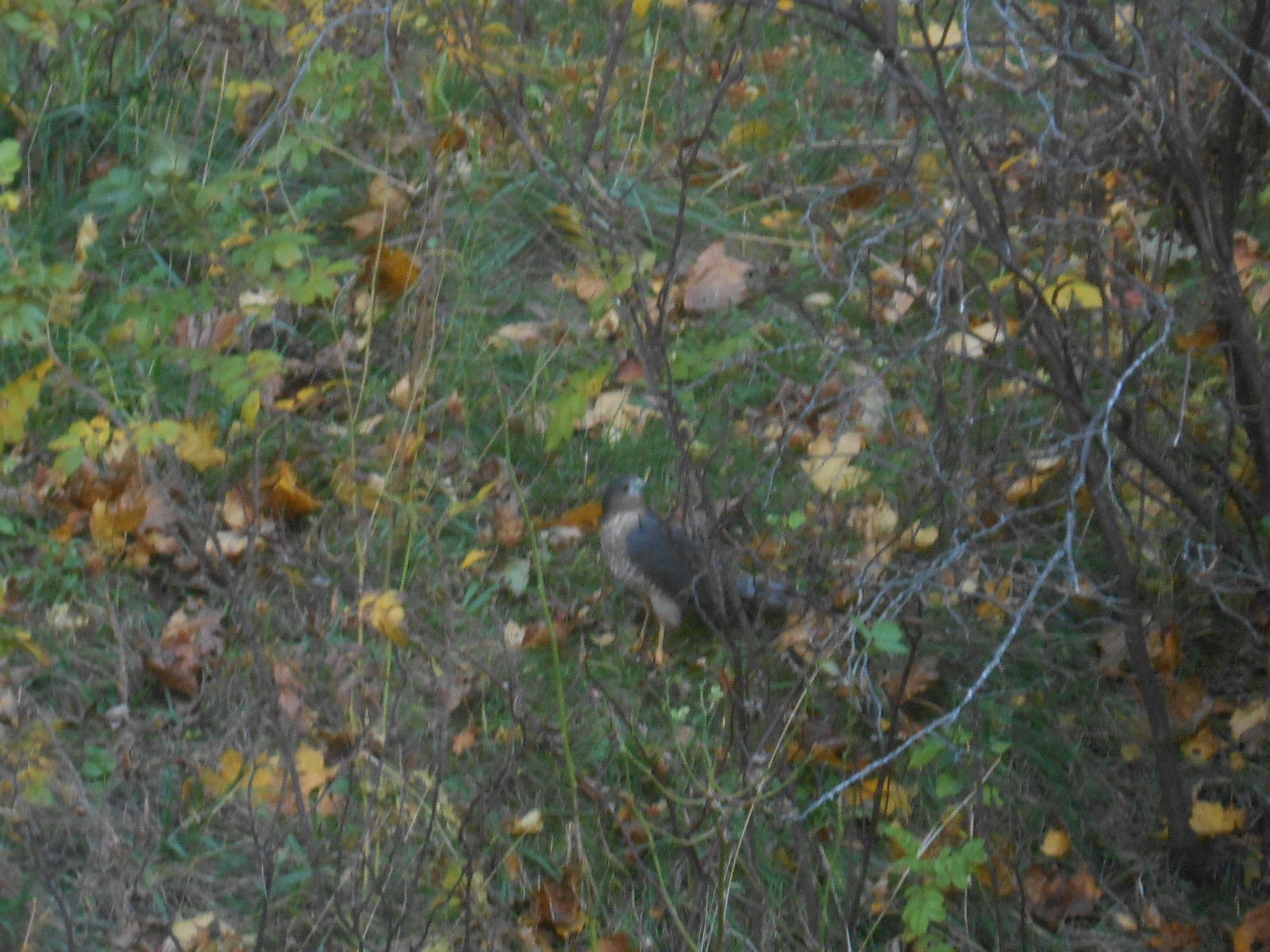
Now, there’s one last interesting addition to our flocks:  Mr. Cooper, as in Cooper’s Hawk.  This guy showed up low on the Canadian Maple in our back yard, right outside my living room window.  The first time I saw him was in mid-January, when I couldn’t get any good shots.  Then, this week, he popped by and I was lucky, getting these three pix.  Now I definitely know what caused the splash of blood and feathers on the snow near the tree last week.  Still, he does leave alone the little birds-hardly worth consideration as hors d’ouevres?  Anyway, click on the photos to get a good look at him-or her.

Anyway, now I think I understand  why White Ears (named for these white tufts in his ears) has been keeping a low profile recently.


Backyard Birds, Part One

Despite the polar vortex heading our way this weekend, spring is trying to sprung on us.  And the feathered visitors to my backyard are showing the way.  Bright new plumage is emerging and old friends are returning from warmer climes, though some winter visitors have lingered on.
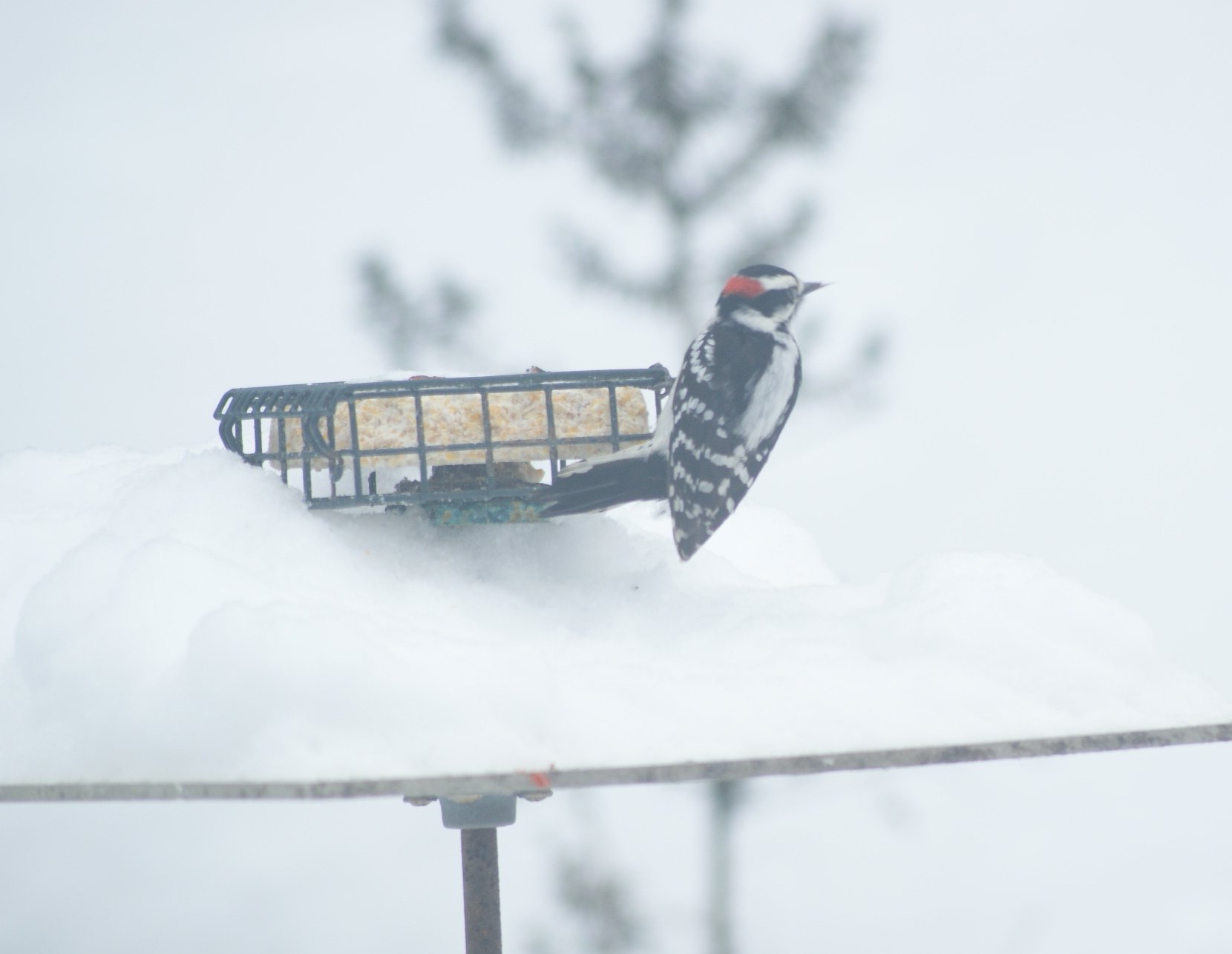
The bird I’ll introduce to you first is a Downy Woodpecker.  We’ve seen these lovelies all winter long, and this spring they’re still pecking away at trees and the wooden poles holding up our feeders, as well as chomping away at suet.  I noticed that they seem to come in different sizes.  I’m not confusing them with Hairy Woodpeckers, who seemed to disappear from my feeders in the winter, only to return in the spring- especially for suet. We also have gotten a few Yellow-Bellied Woodpeckers throughout winter and spring – and a Flicker or two. Unfortunately, so far this year, we’ve only gotten  photos of the Downys.
Bluejays can be real stinkers – one of the biggest bullies at the bird feeder.  We have four who show up together and try to boss the other birds away.  Often they succeed, but we also have some extremely aggressive Cardinals, Chickadees, and Goldfinches who won’t take excremental effluvia from no one.  So, the Bluejays aren’t always the boss of everyone.  Still, they are beauties, aren’t they?
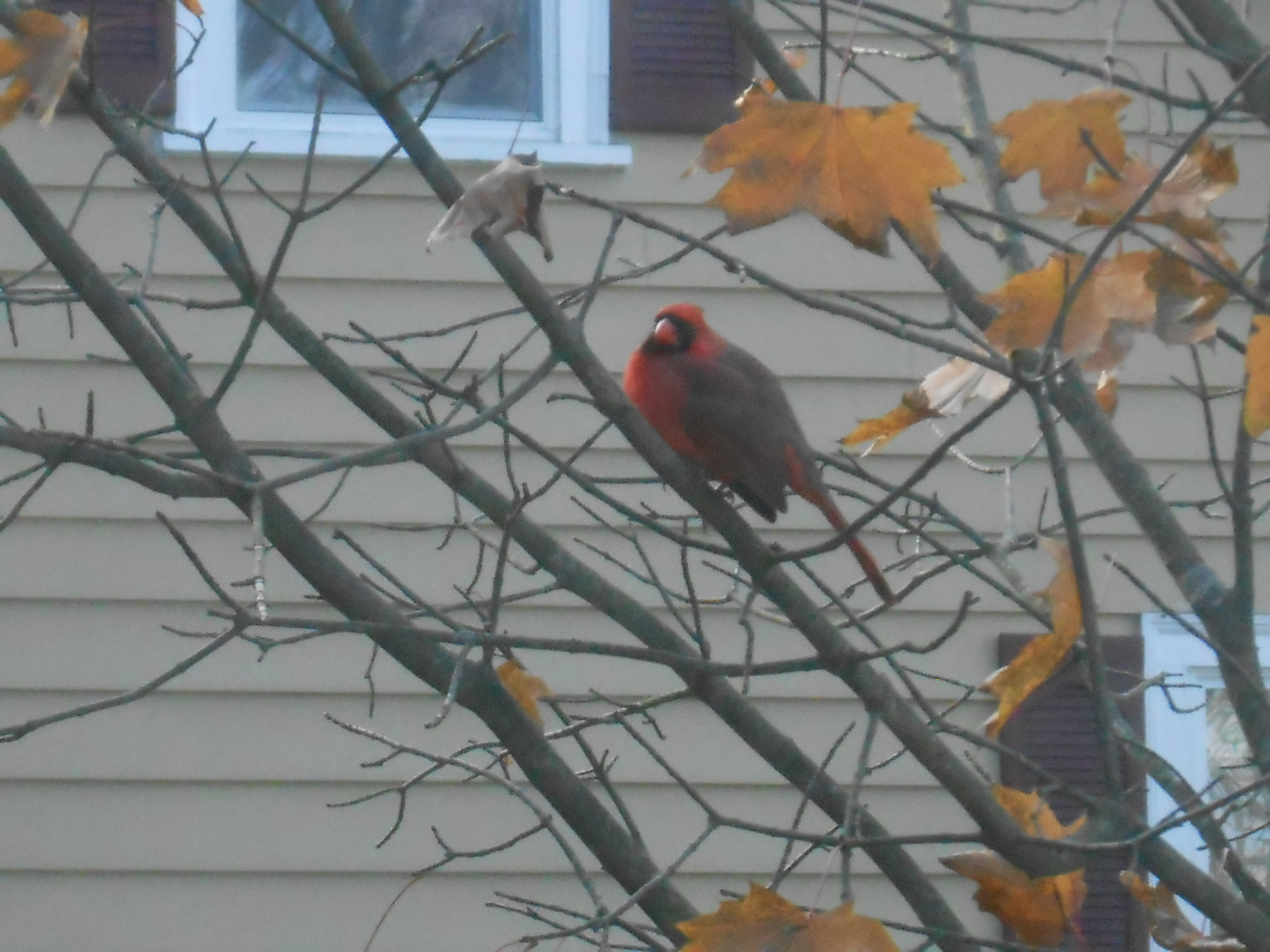
Speaking of Cardinals, we have more than a few pairs visiting.  I suspect the same couples hang out here through the years, and their kids may even take up residence in the yard as well.  The other day, I saw a female feeding a male black-oil sunflower seeds off the feeder.  I guess when you both brood and fledge the kids and take them out to lunch, you split courting and parenting even-steven.
And in these pictures below, you can get a gander (so to speak) at the ‘ttude both Cardinals and Chickadees possess that enables them not to take any guff from Bluejays.

Who you lookin’ at?

Here’s a less belligerent  chickadee.  They have to be one of my favorites!  I love their cheery calls and the way that that bounce through the air in flight.  They seem to disappear in the mid summer and not return in number until almost fall. Then they stay winter through spring.


Juncos always herald the beginning of winter, with their castanet-like calls and the flash of white fanning out in their tales when they take flight.  I haven’t seen any for about two weeks now, but they did seem to linger much later this year.  I love how on some their grey feathers almost shine blue.


Speaking of blue, I adore the soft blue backs of the White-Breasted Nuthatch.  It’s fun to watch them scoot up and down a tree, searching for a snack.  You can always tell they’re around by the ack-ack-ack call they give.  Like the woodpeckers (in that family, right), they go for suet the way my cats go for dental snacks. I used to see Rust-Breasted Nuthatches when I lived in Lowell or in Connecticut, but I can’t remember seeing any in Auburn.


But let’s look at some spring birds.  The Goldfinches never completely left us, even in the winter, but now their numbers have increased.  Better yet, the boys have shed their drab winter coats and put on their bright, yet soft, yellow finery. You can see that the fellas in these pictures have pretty much converted their outfits to suit (ha!) the season. They LOVE sunflower seed hearts the best of all, but real troopers that they are, they will also go for black oil in the shell.  They also will take guff from no one when food is involved.
One of my favorite returnees is the Catbird.  Another suet gobbler, this guy bobs her tale and shoots about with glee. I especially like this picture because you can see the bird has got her cap on.   Like the Mockingbird (a relative), this character has many calls.  My favorite is when she calls my name, “Sharon!”
We don’t yet have pictures of all the return visitors.  The Rose-Breasted Grosbeak has been back for several days, but we haven’t gotten a good picture of him.  I’m waiting hopefully for the Baltimore Oriole, though I did see one on a rail trail yesterday. You can see one of the first harbingers of spring in this group shot:  the Redwinged Blackbird (center). 
Another typical spring sojourner is the grackle.  Mourning Doves are always with us – and pretty greedy, too.
However, we did have some real excitement when we saw this fellow on the ground beneath out feeder this week:  a male Rufus or Rufous Towhee (I have heard it both ways!).  It’s not the best shot because we had to grab it fast from indoors and a little far away.  Still, you can see the wonderful colors.  I haven’t seen one of these guys in like three years – when I was on a rail trail in Millerton, NY.  Thrilling, isn’t it?

So, I guess that’s all for  now.  The end is in sight!


Birding with the Yangs

.
These past few weeks, Yang and I have had some wonderful bird sightings, sometimes, literally, in our own back yard.  Case in point, one Friday, Natasha was meowing at the door all day. Then Rosalind was in the pantry window bird-chattering away, while I worked on my novel in the dining room.  I stopped and suddenly became aware that I’d been hearing a high-pitched hawkish call.  I got up and looked out the window in the dining room, and what did I see in the patch of sea roses, but two Merlins!  One flew away, while the other hung out for some time – before attacking a sparrow who out-smarted him.  I got these pictures through the window because I was afraid going outside would drive my visitor off.  Hence, it’s much blurrier than I’d like.  What do you think of this new guy?  I haven’t seen him since, but I did find an ominous splash of tiny white bird feathers on the nearby back porch.
Our bird feeders have returned to us the usual suspects.  Lots of Titmice and some Chickadees battle four pushy Blue Jays.  We also have two male and one female Cardinal  visiting.  One of the males is pretty aggressive.  While he’s fine with the little birds, he’ll go after the Blue Jays and drive them off!  We also have Nuthatches, Downy Woodpeckers, Goldfinches wearing their winter buff, and even a Yellow-bellied Woodpecker.  One day, a Carolina Wren gave me such a scolding when I came too near the juniper bush!
On a visit with friends on the Cape, we came across one of my favorite, but rarely seen, birds.  At first, seeing the creature head on, I perceived a bird with a brownish head and chest with a white belly forming a “v” into the brown chest.  I claimed I’d never seen such a bird before, until he took flight and I saw the luscious blue.  Bluebirds! A good-sized flock of them!  I noted in my Peterson’s that Bluebirds are usually found year round in New England mainly on the Cape.  How appropriate!  The Bluebird was one of my “must see” birds for the year.  I still need to see an Indigo Bunting, a Piliated Woodpecker, and a Scarlet Tanager.  It’s probably too late in the year for the first and last, but I’m holding onto hope for that Pterodactyl-sized woodpecker.  The Bluebird photos are courtesy of Andrea Krammer.
Today, when we took a morning walk (about 7:00) on the Blackstone River Trail, we saw some interesting birds.  A Great Blue Heron and a black Cormorant were fishing in the same part of the river.  Then, atop a tall dead tree, we saw a bald eagle.  We watched as he sat there majestically for some time before he soared off away from us and the river. We didn’t have the means to get a picture, so I’m borrowing this one below.

I can’t wait to see what the remainder of the year brings!
Source eagle image:  https://commons.wikimedia.org/wiki/File:Eagle_on_roots_-_crop_3_(430008061).jpg


Old Friends Return!

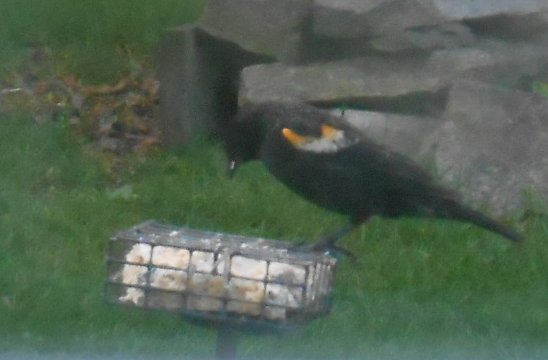
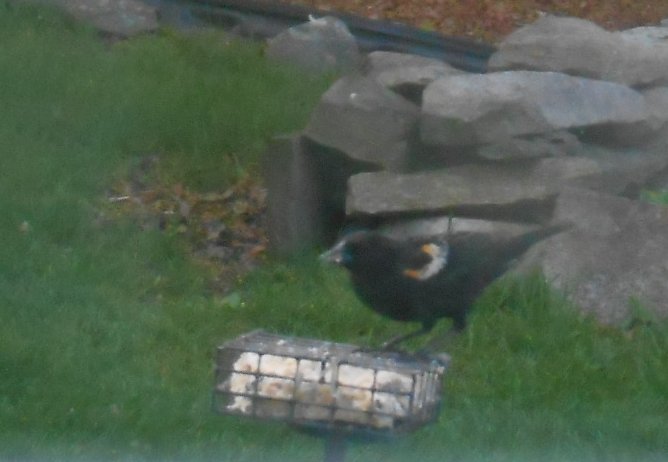
The snow has finally been gone for some time now. Even though it’s raining and chilly today, we’ve had a whole week of sunshine and warm weather with just a touch of rain to treat the thirsty plants. And our spring birds are back! April brought a caravan of wild turkeys, one at a time, through my yard and past my sun porch. Though I was too busy watching them to take a picture, I did get some shots of one of my favorite avian harbingers of spring, the Redwinged Blackbird. He showed up at first on March 3rd, then I gradually saw more males flashing their yellow and red epaulets. They sometimes get resistance from another spring returnee, the Boat-Tailed Grackle, but the Redwings are pretty staunch in defending their places at the feeder. Just over the past week or two, I’ve been seeing the female Red-wings show up as well.
I mustn’t forget to mention the multitude of Gold Finches. They do tend to stay around all year, though the number of their appearances dwindles in the winter. However, in March and April I would see more and more of them. I loved watching their dull winter coats turn gleaming yellow as the spring progressed. I like that they are feisty and don’t let the bigger birds bully them off the feeder.
Another of my favorites is the Catbird. I first spotted one this year on May 5th, but this day I was lucky enough to catch two together, feeding with a Mourning Dove. I love how the Catbirds have such a plethora of different calls, many so musical. For me, it’s fun that one of their calls, though not of the musical variety, is “Sharon!” They’re always looking for me. It’s nice to be wanted!


We really hit the jackpot this week! Shortly after spotting a sleek, coppery fox gamboling in my yard, Rosalind focused my attention on the backyard feeder, and what did I see but a male Rose Breasted Grosbeak (5/8)! The next day, I heard a lovely birdsong (not Cindy) in the trees, and when I investigated, I saw the Grosbeak again! I’ve seen him at least once a day since, usually feeding on suet or black oil sunflower seeds. He’s quite the cheeky fellow, for when I was feeding the fish in our small pond, he sang me a song. When I repeated it back to him, he popped over to the nearby birdfeeder and chowed down for some time. This morning, he finally brought Mrs. Grosbeak to one of the feeders. I’m glad that these Grosbeaks are not easily intimidated by Grackles, Blue Jays, or Mourning Doves.
In the same week, (5/9) Yang called me to look at the backyard feeder, and what did I see but a Baltimore Oriole! He also appeared for a snack on the suet feeder by the side of our house, as well. I haven’t seen him in a few days, but my neighbors usually report on him. Of course for all these birds, I may not be seeing the same one every time, but it is fun to note that they seem to show up at almost the exact same date every year. It’s lovely to see old friends!
Of course, I have lots of help bird watching.

Birds of Spring

 The other day I did a post on the birds of winter.  I still have enough pictures for a Part II; but, right now, let’s accentuate the springitive (so to speak). Many of my favorite warm weather birds have returned.  Even before the snow was gone in March, I caught this shot of a Robin in the Canadian Maple outside my window.  Apparently, the winters are warm enough that most Robins don’t go South for the winter, but stay in the deep woods up here.  Nevertheless, this was one of the first Robins I had seen in quite some time.  Our Robins are quite different from the blue and rust-colored English Robins.  As you can see, this guy is much bigger and is actually grey/black on top.


To me, of the first avian signs of spring is the return of my friend the Redwinged Blackbird.  He’s always at my feeder and showed up for the first time on 3/2.  I had a hard time catching him on film, but I did manage to sneak around the window and get a few pictures.  Yang helped as well.  I’ve also seen a female at the feeder, though I wasn’t able to get a picture of her.  So, it looks as if he brought the Missus.  Of course, there could be a whole bunch of different birds showing up, just one at a time.  Still, I like to think that he is my old-time buddy, as is his wife, who comes back every year to whistle in the spring with his trademark call.


My next favorite harbinger of spring is the Rosebreasted Grosbeak.  For years, I’ve seen either some females, a male, one year two males, or pairs. This year, I saw the female first.  Don’t you love the impish way she peaks through the window here?

Then, not many days later, the male showed up. He only would show me his back at first, the little stinker.  However, before long, I was able to get some shots of that rose breast for which he is known.  Isn’t the pink just like pure liquid color?  And the pristine white proves a gorgeous contrast to the rose and his black feathers. They both love the sunflower-seed hearts.  Already shelled, the seeds don’t require them to put their grosbeaks to work cracking.  I first saw them here on 5/4.  I hope they stay a few weeks.  Maybe they’ll nest and have baby grosbeaks?


Here’s two more shots of the Grosbeaks, just because they’re so fun to see.


My next favorite harbinger of spring is the Catbird.  They are so perky and intelligent. Many a time I’ve sat quietly by the fish pond and one has come over to drink, getting quite close to me. And they have so many delightful calls.  I believe they are related to the Mockingbird, so that would explain their extensive array of  vocalizations.  I think one reason that I’m partial to them is that one of their calls sounds like, “Sharon!”  My name.

They adore suet, so I play bird police and chase away the grackles and starlings when they try to hog the suet block.  Don’t you just love the sassy way Madame Catbird gives a little cock to her tail?


Another favorite pair are the House Finches.  They may occasionally show up in the winter, but I never see too many of them until spring.


All year round, we have Goldfinches.  In the winter, even the males turn a drab olive.  It was neat to watch them gradually change to a more brilliant color as the spring progressed. However, whatever their colors, neither male nor female Goldfinch will abandon our feeders – especially the ones with the sunflower hearts.  They are delightful old friends.


Speaking old friends, the Hairy Woodpeckers had a grand old time going after suet and sunflower seeds.  We also had many Downy Woodpeckers and, from time to time, Flickers and Redbellied Woodpeckers.  The Titmice, chickadees, Cardinals, and Nuthatches have kept us company year round as well.

So, it’s up to Yang and I to keep our avian friends up to their beaks in sunflower seeds and suet.