I recently saw this meme in my feed on FaceBook and said to myself, “Oh, how painfully true!”
 You may plot out the most deliciously intricate and logical outline for your masterpiece. Every piece may seem to interconnect beautifully in your initial set up; but, darn it, not only the devil is in the details but Belial, Beelzebub, Moloch, Asmodeous, Lucifer, and the whole gang are too! You may plot out the most deliciously intricate and logical outline for your masterpiece. Every piece may seem to interconnect beautifully in your initial set up; but, darn it, not only the devil is in the details but Belial, Beelzebub, Moloch, Asmodeous, Lucifer, and the whole gang are too!
Case in point, my current project, a sequel to Surprise! with the ironic working title Memories of You. I knew where I wanted to move my main characters, scene to scene, but creating those scenes,  developing them, dealing with new and tempting possibilities once I got started, that was another kettle of guppies – sometimes sharks, hammerheads! developing them, dealing with new and tempting possibilities once I got started, that was another kettle of guppies – sometimes sharks, hammerheads!
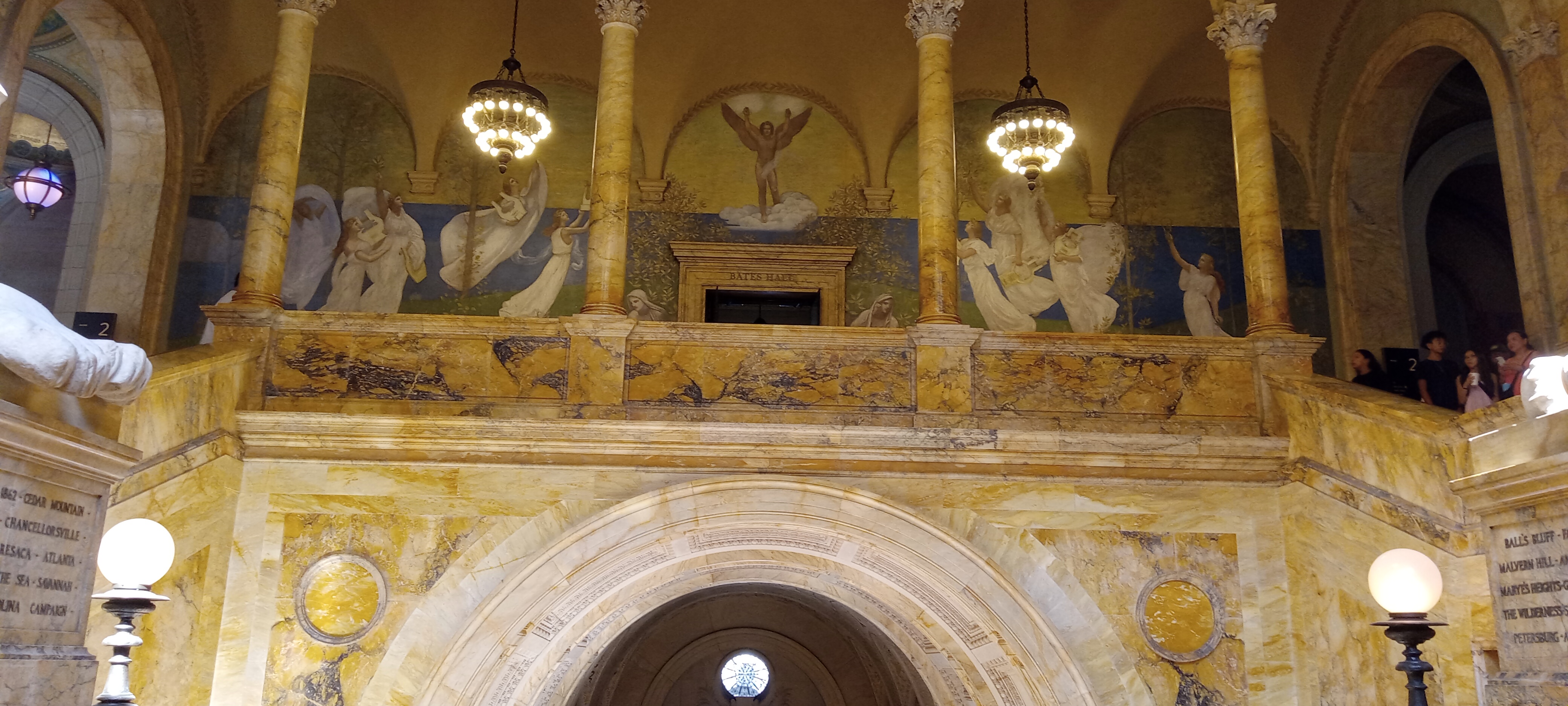
For example, I knew Vicki Westlake would clue in to some important information about a dangerous man from her veteran husband’s past while she was doing research in the Boston Public Library for a new mystery novel that she was planning. Simple, then, kind of. If I plunk her down in the library, I have to describe the library to create a genuine sense of place – except I hadn’t been doing research at the BPL for many years. Field trip!
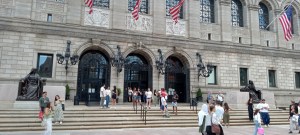
Off Yang and I went to that gorgeous receptacle of knowledge to take  pictures and just drink in the impressive architecture as we explored the layout – part of which led me to a side room that would help me develop a new part of the story. Problem solved. pictures and just drink in the impressive architecture as we explored the layout – part of which led me to a side room that would help me develop a new part of the story. Problem solved.


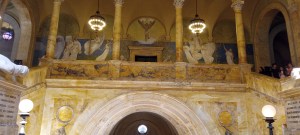
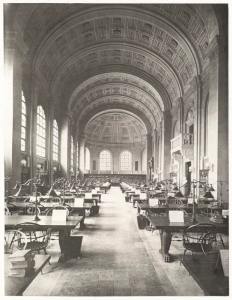
Um, not exactly. I was visiting the library in 2025; my story takes 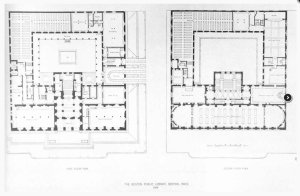 place in 1947. Things change over the years. So, off to the internet to find architectural plans and photos of the library that would work for the time period of Memories. I even found a floor plan of the first and second floors! Side note: I’m now really enjoying the FB group Boston Mass. Vintage. It’s a great site to help me with future mid-century writing projects. place in 1947. Things change over the years. So, off to the internet to find architectural plans and photos of the library that would work for the time period of Memories. I even found a floor plan of the first and second floors! Side note: I’m now really enjoying the FB group Boston Mass. Vintage. It’s a great site to help me with future mid-century writing projects.
Another vital part of my outline hit a little bit of a “roadblock” as I moved to the end of “Memories,” where the two main characters journey to Maine in October 1947 in order to learn vital answers  about the husband’s past in the war from his retired commanding officer. Did you know that 1947 was known as the fall Maine burned, as massive wildfires swept through much of southern Maine, as well as other parts? Can you get any more exciting than having your denouement occur in the midst of devastating, inexorable flames? about the husband’s past in the war from his retired commanding officer. Did you know that 1947 was known as the fall Maine burned, as massive wildfires swept through much of southern Maine, as well as other parts? Can you get any more exciting than having your denouement occur in the midst of devastating, inexorable flames?
Piece of cake to write? Um, no! My heroine and spouse have to travel to a more northern part of Maine, so I have to figure out how they can get through southern Maine without being caught by fire but end up 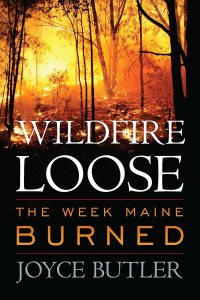 at their destination just as another blaze is heading for them, then be able to get out without being incinerated. Fortunately, I have Joyce Butler’s Wildfire Loose, The Week Maine Burned, a brilliantly thorough and exciting recounting of when and where the fires started, how they progressed with speed and almost omnipotence, how they were fought, and how people escaped by the skin of their teeth (sometimes not). So, in order to time my main characters’ journey from Boston to Maine, I created a chart of where the fire was each day, as well as whipping out a road map of Maine and blocking off in pen the areas where the fires blazed through, based on Butler’s citing the towns affected. I also had to factor in the time their trip would take considering the lower travel speeds of the 1940s, as well the routes available. Fortunately, I passed fourth grade math. at their destination just as another blaze is heading for them, then be able to get out without being incinerated. Fortunately, I have Joyce Butler’s Wildfire Loose, The Week Maine Burned, a brilliantly thorough and exciting recounting of when and where the fires started, how they progressed with speed and almost omnipotence, how they were fought, and how people escaped by the skin of their teeth (sometimes not). So, in order to time my main characters’ journey from Boston to Maine, I created a chart of where the fire was each day, as well as whipping out a road map of Maine and blocking off in pen the areas where the fires blazed through, based on Butler’s citing the towns affected. I also had to factor in the time their trip would take considering the lower travel speeds of the 1940s, as well the routes available. Fortunately, I passed fourth grade math.
 Of course, I also had to use a roadmap to chart my characters’ route from Boston to their destination in Maine, which creates problems of its own. Today, we can shoot straight up Interstate 95 and save scads of time. Unfortunately, no 95 in 1947. I had to look over the routes listed on the map, determine if they were state roads, and find out if they existed in 1947. Joyce Butler’s Of course, I also had to use a roadmap to chart my characters’ route from Boston to their destination in Maine, which creates problems of its own. Today, we can shoot straight up Interstate 95 and save scads of time. Unfortunately, no 95 in 1947. I had to look over the routes listed on the map, determine if they were state roads, and find out if they existed in 1947. Joyce Butler’s 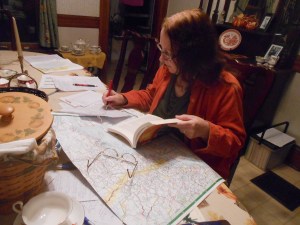 book provides plenty of helpful references to routes in existence, as well as does the internet on history of specific routes. The internet was surprisingly unhelpful in providing road maps from the time period – unless I wanted to shell out to ebay or some other source. Thanks to Yang for looking over routes, sharing research, and discussing driving. book provides plenty of helpful references to routes in existence, as well as does the internet on history of specific routes. The internet was surprisingly unhelpful in providing road maps from the time period – unless I wanted to shell out to ebay or some other source. Thanks to Yang for looking over routes, sharing research, and discussing driving.
So, all I need to do now is pick a town near a fire and away we go – um, not quite. For reasons related to the plot, the town couldn’t be  southern Maine – not isolated enough. Some further north or west? Well, the time frame wouldn’t work. When those fires got going my characters would have been stalled by the big blazes across the southern part of the state. Anson almost made it as guest star town. My solution? The same that many other authors choose: make up your own town and date for its threatening forest fire. Just make it fit the general setting where you locate it. So, southern Maine – not isolated enough. Some further north or west? Well, the time frame wouldn’t work. When those fires got going my characters would have been stalled by the big blazes across the southern part of the state. Anson almost made it as guest star town. My solution? The same that many other authors choose: make up your own town and date for its threatening forest fire. Just make it fit the general setting where you locate it. So,  Amberoid, Maine was born. How do you like the name? An amberoid is actually synthesized gemstone containing crushed amber. It’s also the name of the first horse I picked in the Triple Crown races. He did not run in 1947. I’m not that old. Amberoid, Maine was born. How do you like the name? An amberoid is actually synthesized gemstone containing crushed amber. It’s also the name of the first horse I picked in the Triple Crown races. He did not run in 1947. I’m not that old.
So, anytime you think all a writer has to do is sit down and write – Ho boy, have you got another thing coming!
Intrigued? Well, first, you should read Surprised! Check it out here.
Images: Every effort has been made to ensure there is no copyright infringement in the use of images. These images are for education and entertainment only. If you feel your copy right has been infringed, let me know and I will remove the image. syang@worcester.edu
Hammerhead shark: Hammerhead Shark (28776238172).jpg: Wikki Commons https://commons.wikimedia.org/wiki/File:Scalloped_Hammerhead_Shark_Sphyrna_Lewini_%28226845659%29.jpeg
Modern Photos of BPL: author’s collection
Floor Plan of BPL: The Urban Imagination https://hum54-15.omeka.fas.harvard.edu/items/show/672
Older photos of Bates-Mckim Reading Hall in BPL https://lostnewengland.com/2016/07/bates-hall-boston-public-library/
Image of Maine 1947 fire from https://www.maine.gov/dacf/mfs/forest_protection/1947_fire.html (origin Guy P. Gannett Newsletters in Maine) |







 Sharon Healy-Yang
