Tag Archives: birds

Deer Island Jaunt!

One of the FB birding groups to which I belong mentioned the presence of snow Buntings on Deer Island.  These cute guys were birds that I had never seen close up, but I’d always wanted to.  So, Yang and I took a jaunt out one weekday early afternoon and had quite a treat on our long walk around the island.  It’s about a 2 1/2 mile circular trail around the island on a paved path, so the going is easy.  It was a gorgeous day – and the views matched the weather.

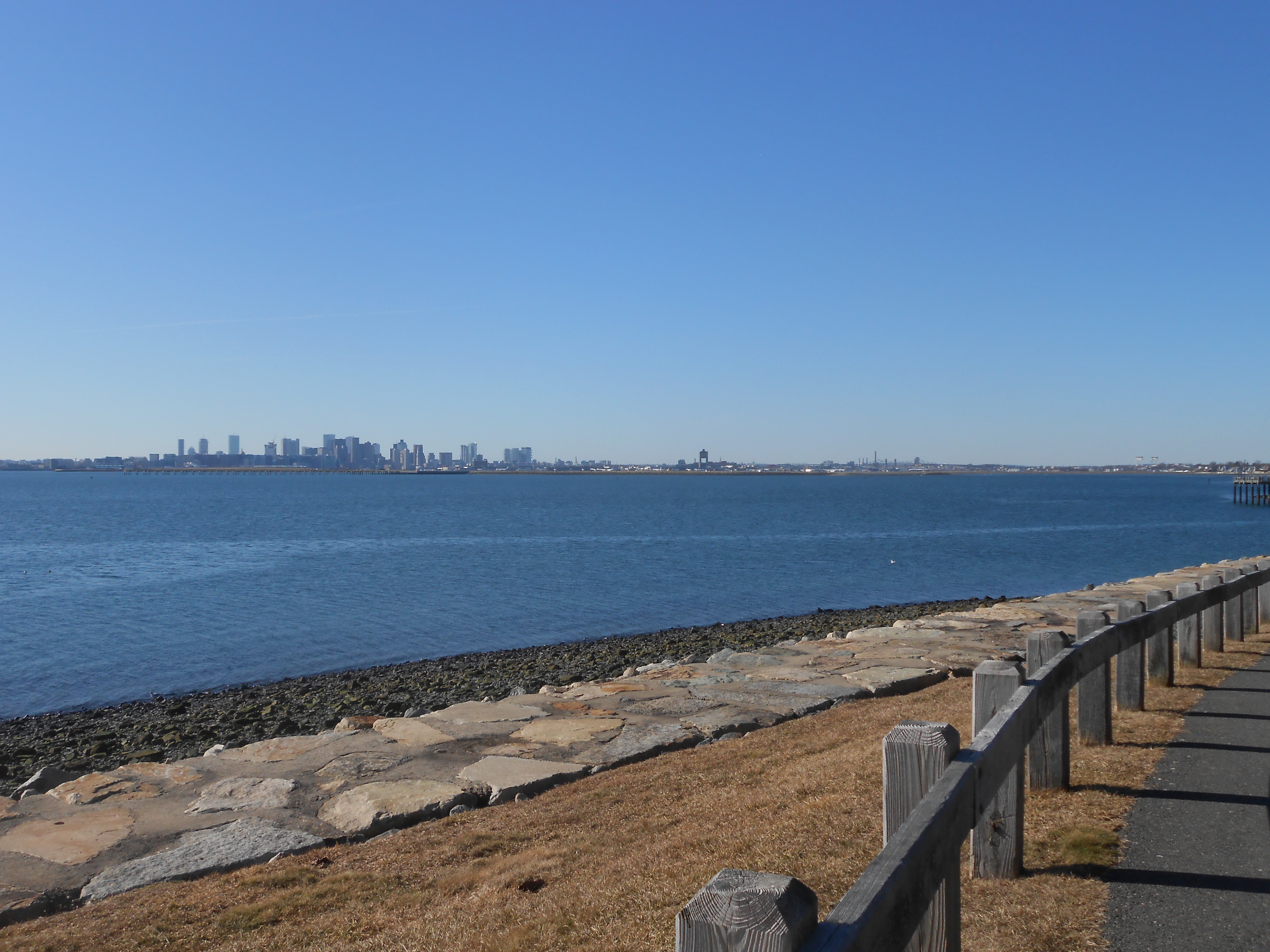
There are some wonderful views of
Boston Harbor. You can also see that I have this really neat white hat on, given me for Christmas by my good friend Kathy Pender Phaneuf.  This hat has kept my noggin warm on many a seaside trek to scope out the water fowl.  Thank you, Kathy – and dig these views!


On the far side of the island:


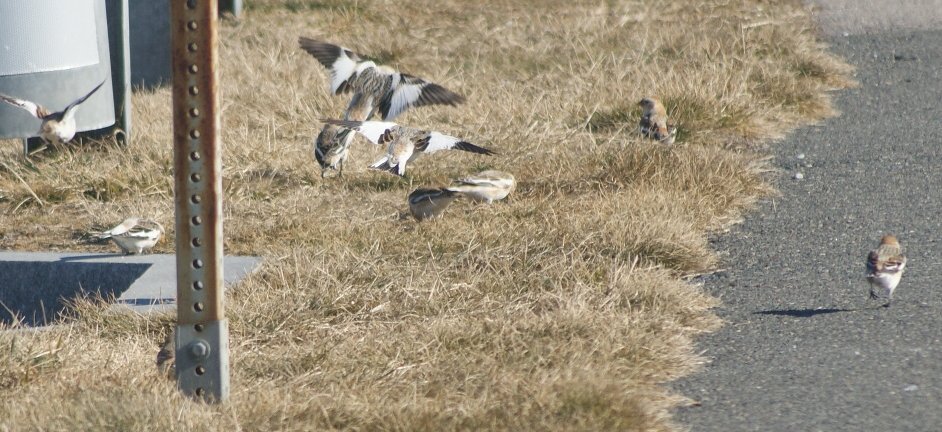
There was, indeed, quite a bit to view in the fine-feathered-friend department.  I got to see my Snow Buntings!  You should click on the images to get a really good look at these guys.


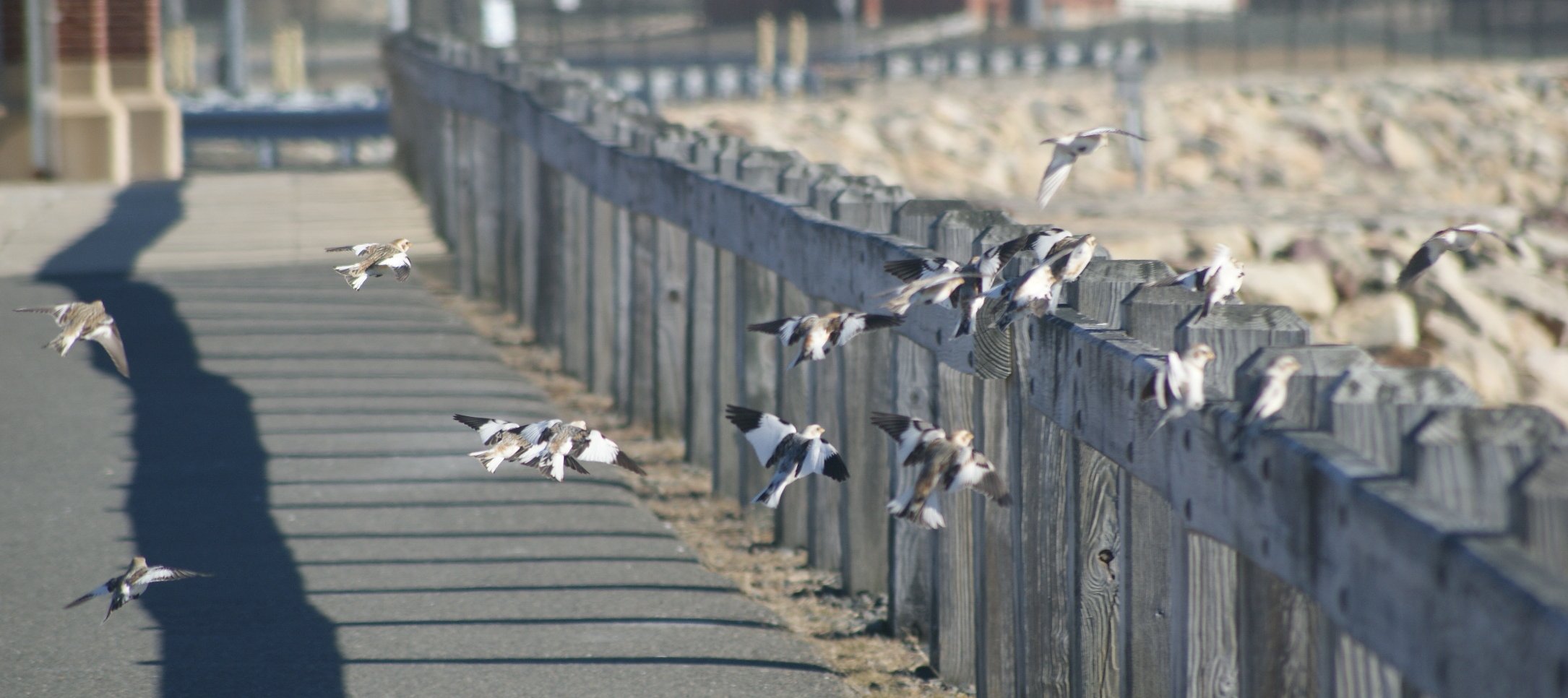
I first heard them somewhere on the beach, but couldn’t see them.  I walked along the wall next to the trail, looking at the ground to watch my step, when all of a sudden, Yang called, “Stop!  Look in front of you!” There they were – and what fun they were to watch.  If you creep up very slowly and quietly, you can get a good look at them, but you have to be careful.  These birds are extremely timid and spook easily.  Then the flock is in the air, flying in precision formation, but often circling back  nearly to where they started.  When they fly, you can see white and black chevrons on their wings that are beautiful!


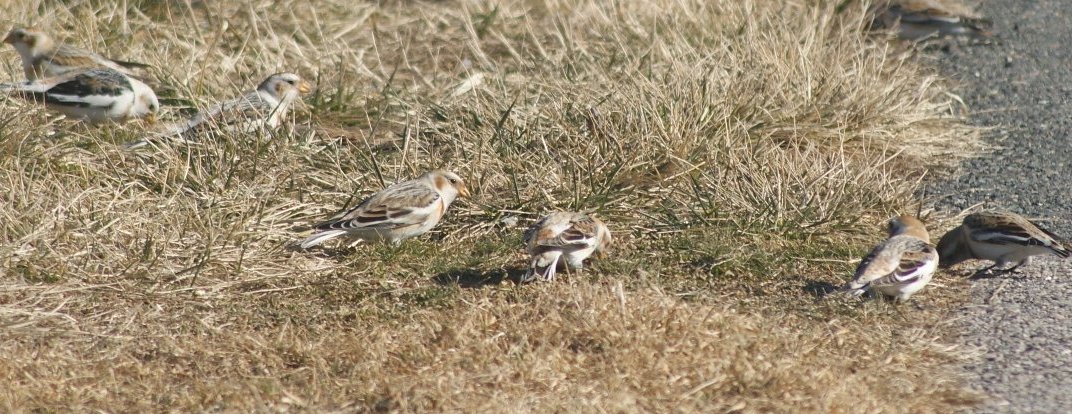
Here are a few closeups.  I love that gorgeous white on their tummies.


There were even more birds IN the water than out of it!  We had been to the Cape looking for Eider Ducks recently, but hadn’t seen many.  Now we know where to find them – along with Scoters of all kinds, Scaups, Buffleheads – you name it!


Here are some close ups of the Scaups, and it looks like a female Bufflehead.


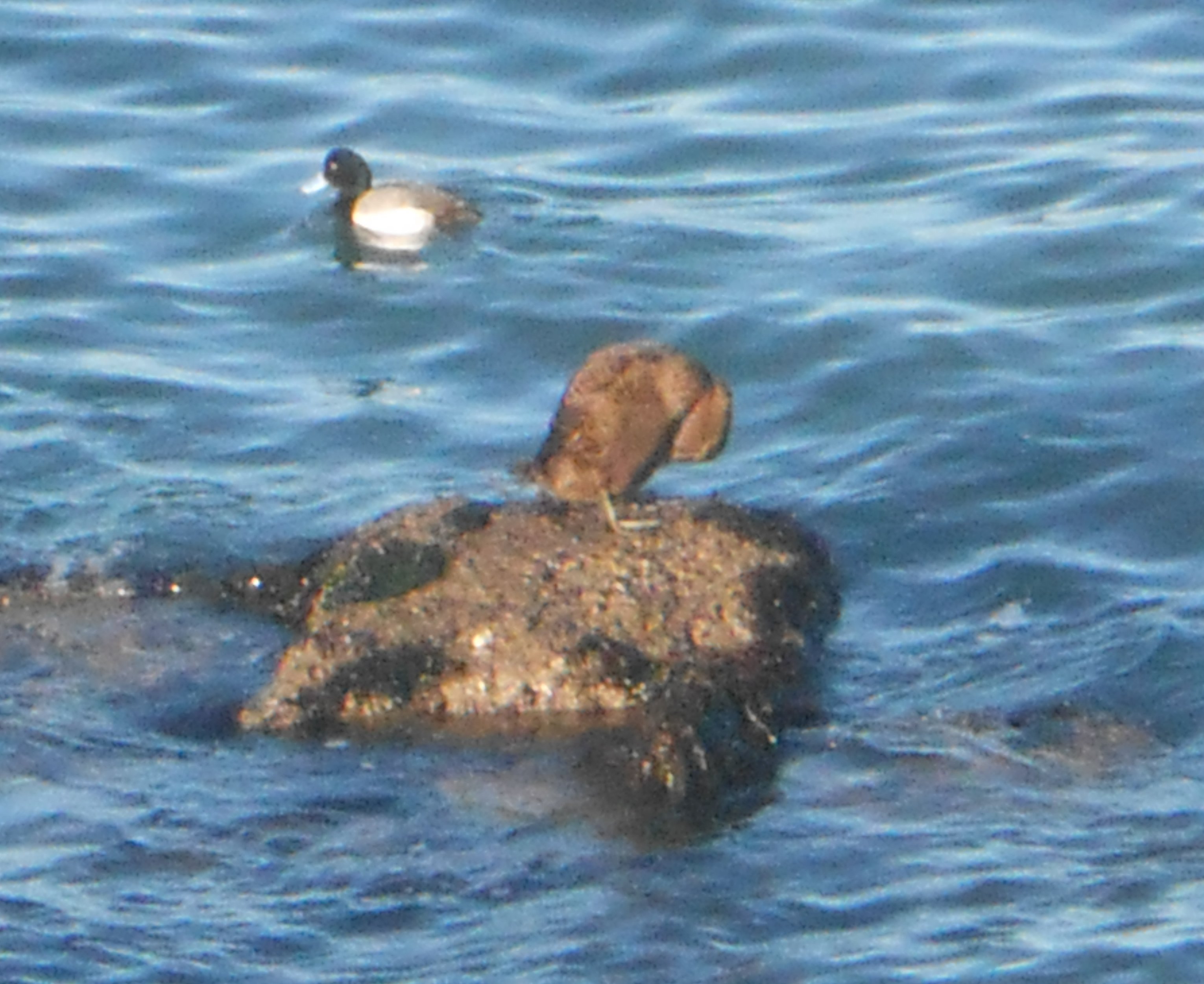
There were lots of Eider Ducks.  We got a special kick out of this lady who was have a fine time for herself out of the water on her own personal rock – with a special guest shot by a Scaup.


Then, she has to get down with her bad self in this next picture.

We did see  and hear some Song Sparrows. I wonder if in the spring some interesting song birds will return to sing in the brush or atop this Celtic Cross?

November December Flora and Feathered Fauna

Even as November eased into December, Yang and I have still enjoyed the creatures and plantation around the Yang Manse.  Would you believe that we still had morning glories toward the middle of November?  Gallantly battling colder, shorter, darker days, these Heavenly Blues waited until the last gasps of autumn to bloom.  Their beauty shown through the dying colors of the late season. They even provided a lovely contrast to the last of autumn’s orange and rust foliage.

Though we had an extremely poor crop of pumpkins and gourds (three fertilized, two surviving long enough to be picked), we did still manage to grow some of the plants to maturity.  Here, is one gourd that started out lovely, but succumbed to cold, too much dampness, and the onslaught of slugs.  You can see how pretty it was before Mother nature went wild on it.


In a happier vein, though, how about a look at the survivors?  This gourd that did make it was a surprise fertilization, which we found peeping under some leaves.  Here it is shortly after discovery.  We try to put a rock or plate under the growing gourds and pumpkins to keep the damp ground from rotting them.
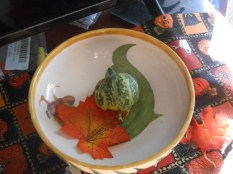


And here is the same gourd all grown up.  Sadly, because it was fertilized, late it never grew very much and then spoiled after only about six weeks.  It was pretty while it lasted!


We also managed to get one pumpkin!  It was fertilized during a short break in the rain for a week or so of sunshine and hot weather.  Here’s our pumpkin a beautiful dark green as it grows slowly but surely, out facing damp and ravenous slugs!


It may not be the biggest pumpkin we’ve ever grown, but like Reba Mcentire, it can sing, “I’m a survivor” – if pumpkins can sing. Now the pumpkin resides in state in the picture window on the sun porch, where we can enjoy viewing it as we watch the birds chowing down at our feeders.


And speaking of birds chowing down on our feeders, we’ve got plenty of the little feathered guys to watch!  We have the usual suspects: Mourning Doves, Blue Jays, Cardinals,  Chickadees, Red Bellied Woodpeckers, Titmice, Downy Woodpeckers, and Nuthatches, for example.


But there are also returning old friends, as well.  The harbingers of winter, the Slate Colored Juncos, are back.  At first, they did their typical feeding off the ground, but now they are returning to old habits of taking lunch at the feeding bar.  It just takes them a little while to remember that they can do that. I love to see them flying away, making the sound of castanets and flashing the white stripes on the fan of their tails.


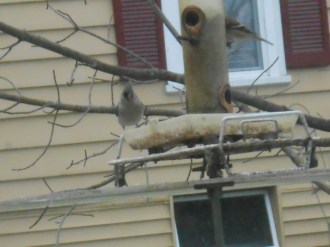
Who else should make a return engagement after a short absence, but the Goldfinches!  As summer ended, these guys disappeared from my feeders for several weeks.  Then, suddenly, they all returned in November, wearing their olive winter coats. They also like to chow down with the other birds, so I have some neat shots of them with their pals, though woe betide the bird who tries to chase one of these aggressive little olive-garbed guys away!  I love this picture with two Goldfinches and a Titmouse (on the right)doing acrobatics.

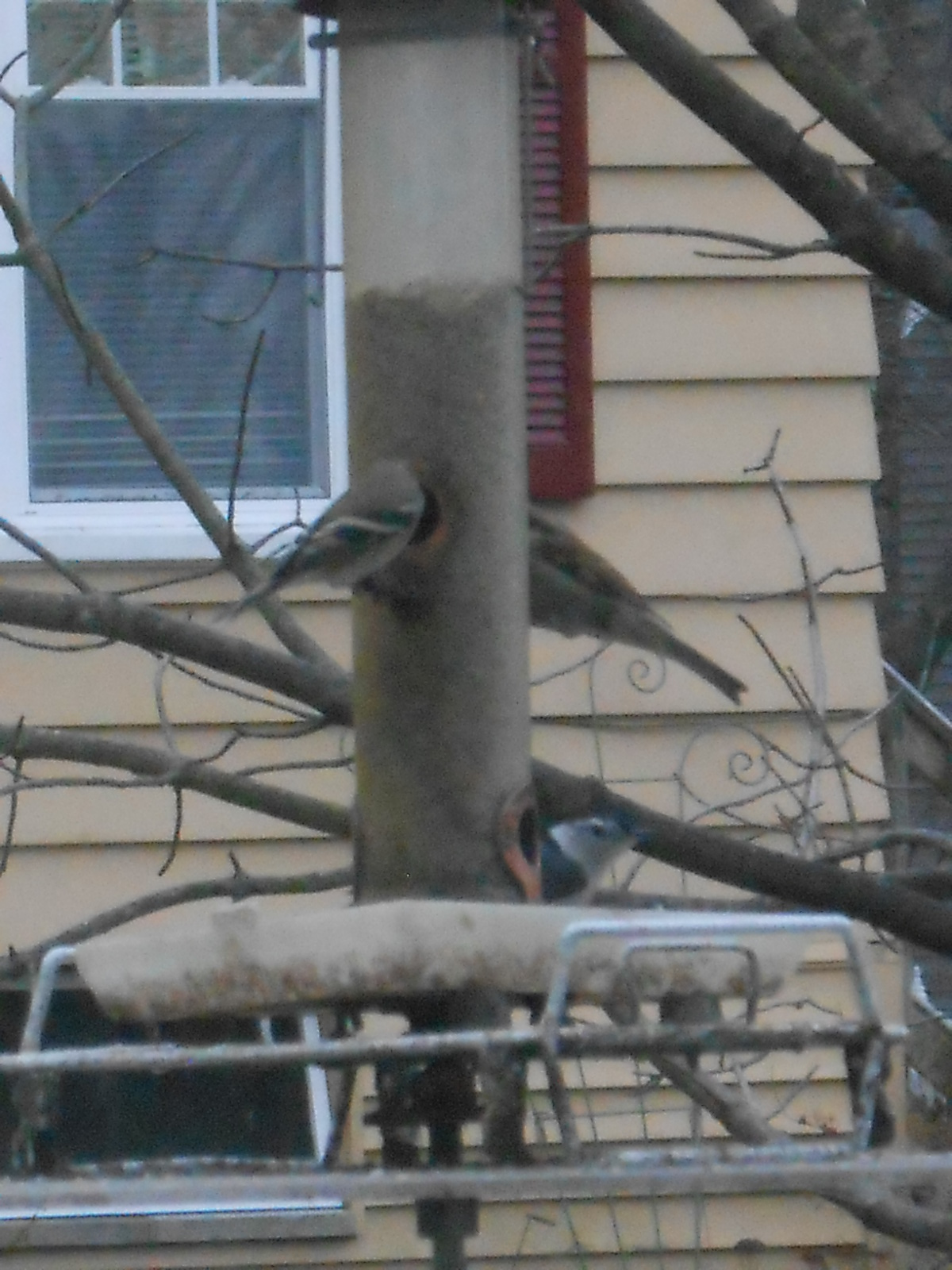
Here’s another one of the Goldfinch with a Nuthatch.  Isn’t the Nuthatch in picture #1 adorable, just peeking around the corner of the feeder? Don’t you love the gorgeous blue/grey of the Nuthatch’s cloak, more visible in picture #2?


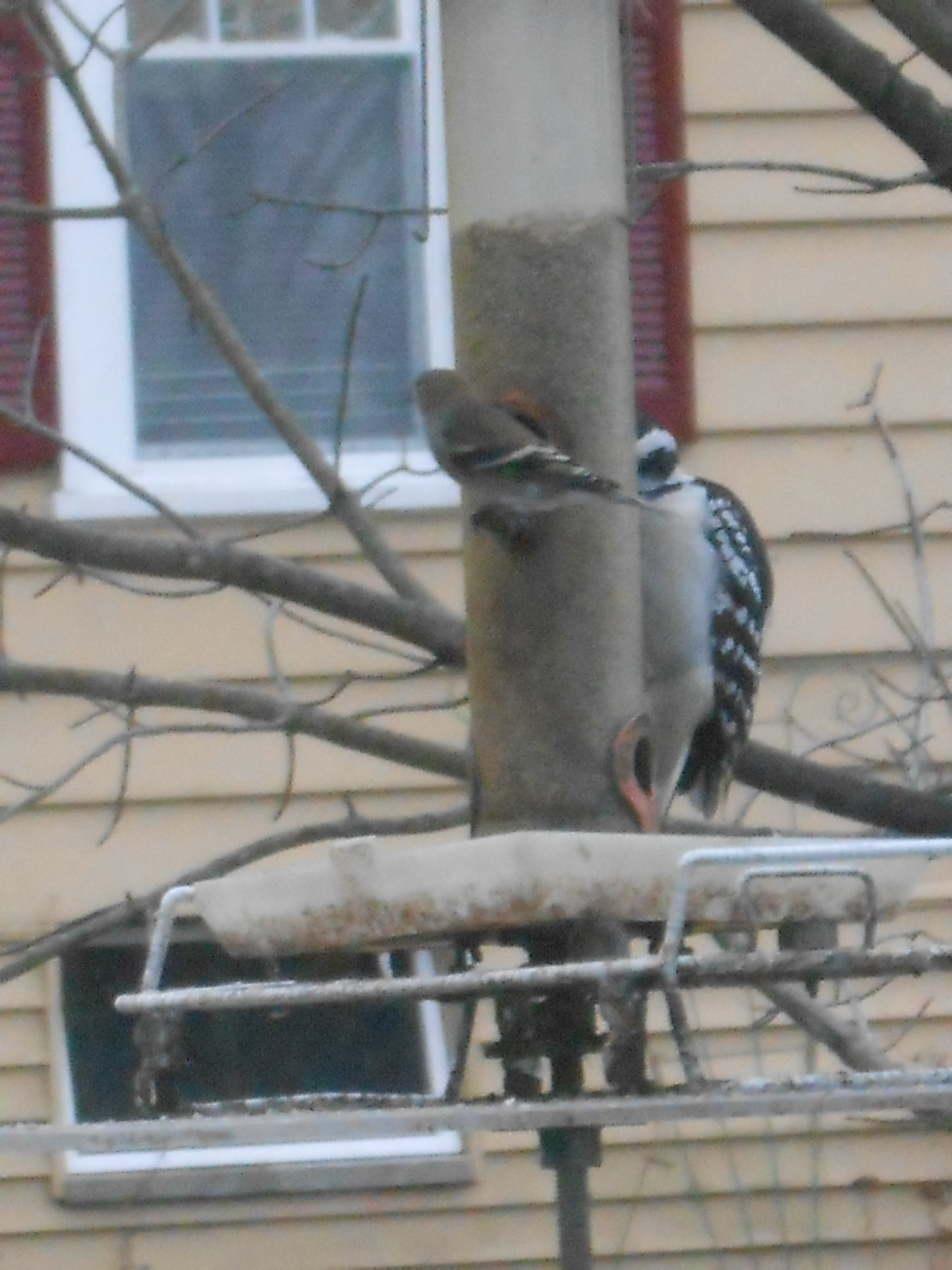
As you can see here, the Goldfinches don’t seem to have trouble getting along with either the Hairy (photo #1) or the Downy Woodpeckers (Photo #2).


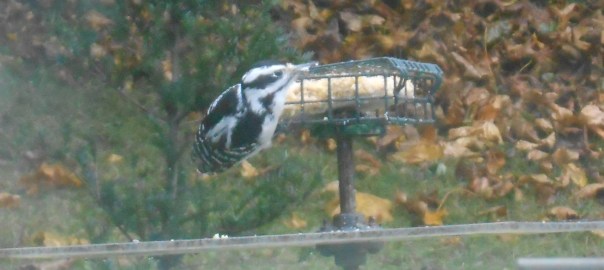
In fact, this summer and fall, I don’t think I’ve seen so many  Hairy Woodpeckers on my feeders.  They certainly do seem to look like Downies on steroids.  Here are some nice shots I got of the female  Hairy.  You can tell the difference because the only the male has a red spot on the back of his head – like in the case of the Downies.

So, I’ll just end with a shot of a Titmouse and a Goldfinch snacking away.

Until the Titmouse turns to me with a definite, “Who you lookin’ at, human!” expression.
 

Autumn’s Last Will and Testament, Part One

All the leaves brown and the sky is grey.  The Mamas and Papas song seems to sum up perfectly the end of November and beginning of December. So, I thought you might enjoy a look back at some of autumn’s leafy glory to tide you over until the soft blues and pristine whites of winter take over.

One new place Yang and I visited was the Albany Rail Trail in New York.  The trail starts on an uphill slope, but once you get to the top, it levels off and is smooth sailing till the end.  We ended up doing 18 miles of beautiful fall scenery along a river and through the woods.


Then, returning, after a flat ride, we sailed downhill at a feisty clip – but not before I stopped a few times to get some gorgeous shots of the brilliant fall colors, especially gorgeous along the sides of the valleys that sloped into the river, with that goldening light of the setting sun.


Here’s your liquid moment of Zen, in video format: 


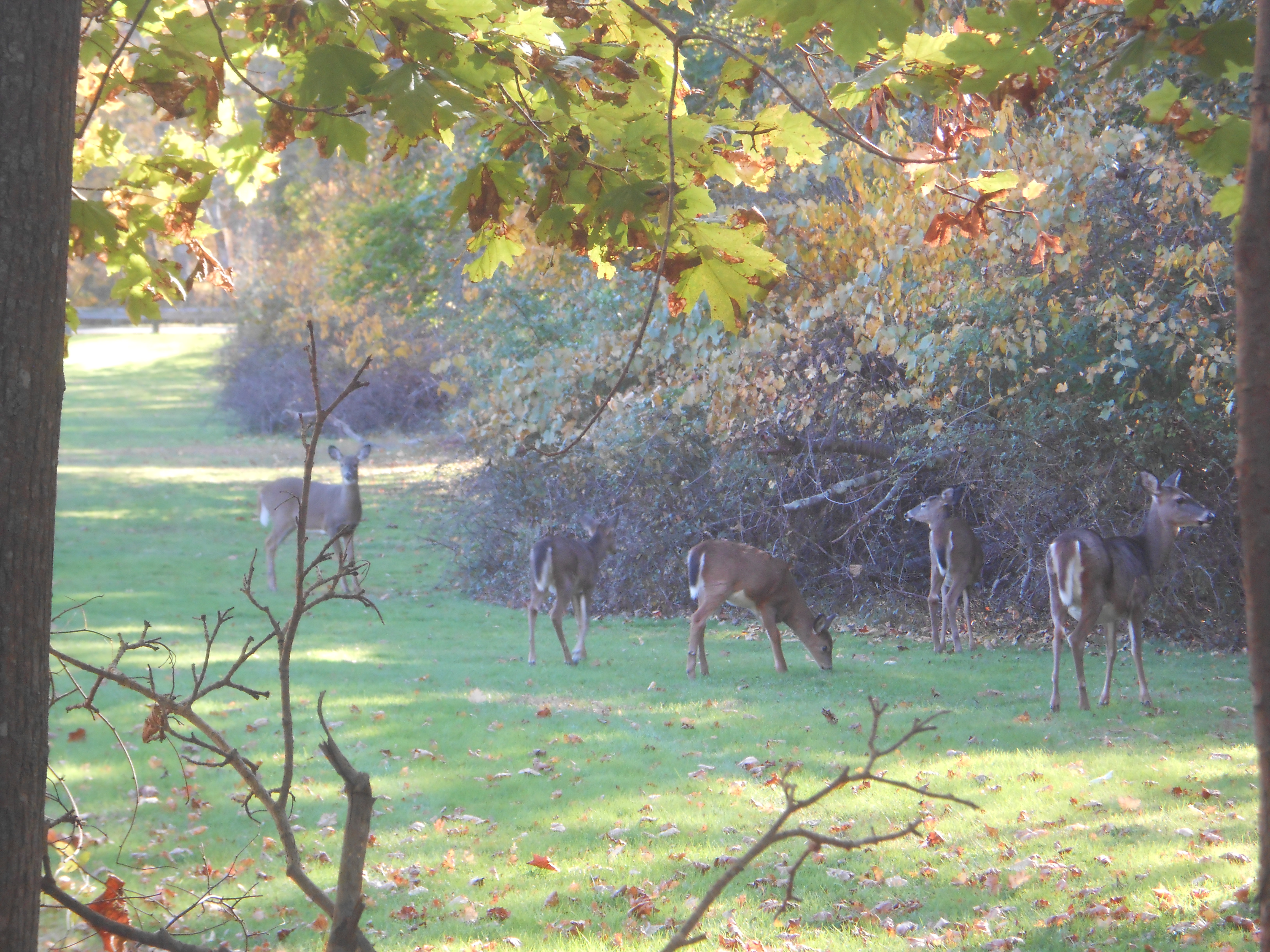
Yang and I also made our autumn pilgrimage to Colt State Park – after lunch at the Beehive in Bristol, RI – Yum, their pumpkin spice latte!  The day was brisk and sunny.  We had the pleasure of all kinds of  fauna.  Walking up a road that cut through the woods and emerged into the open with two large, stone-fenced fields on either side, we caught sight of these guys on our right.  Since we were on foot and not in a car, we had no fear of another fatal collision.  The deer were chill, too.


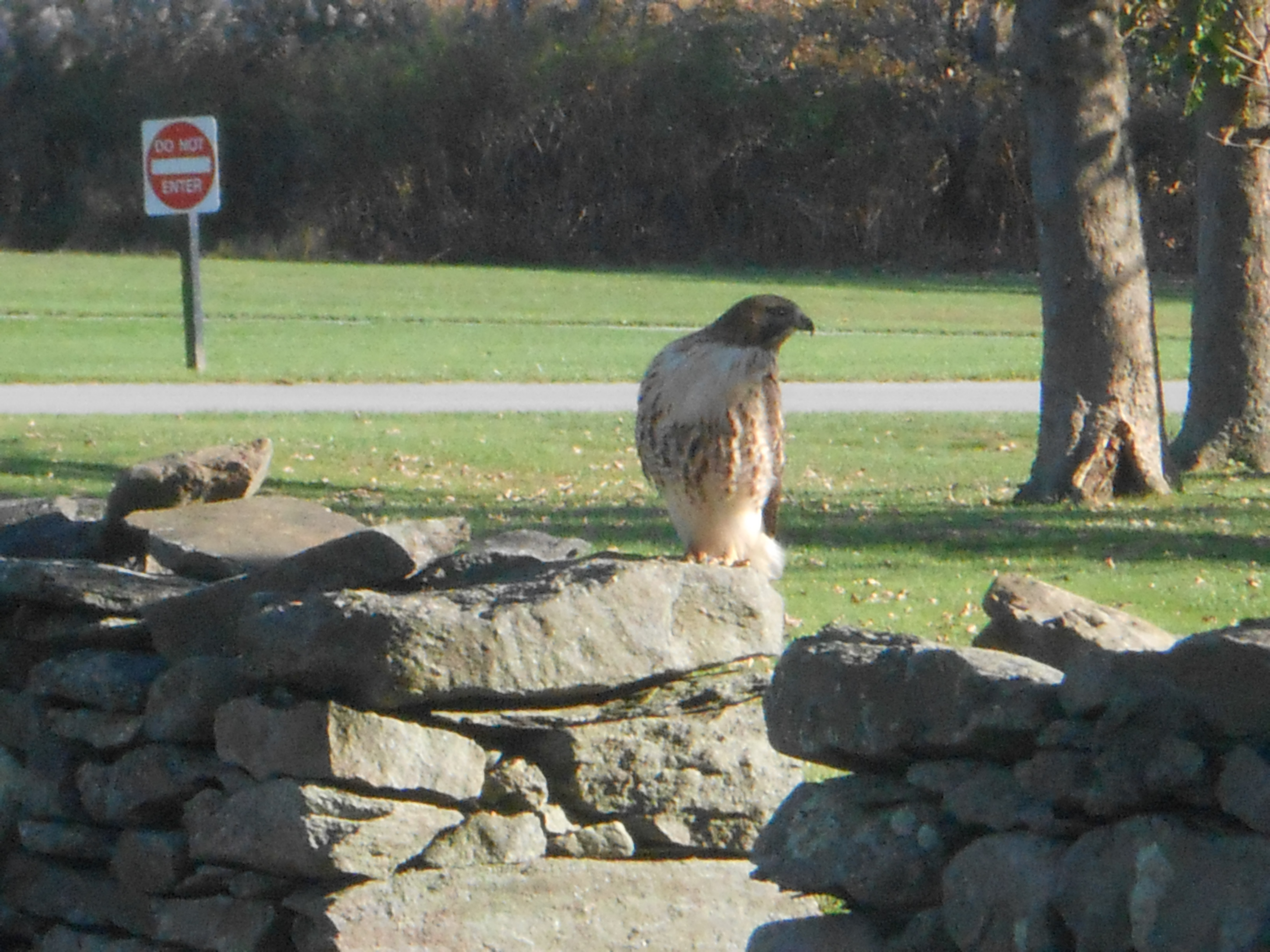
A little further down the road, what should swoop past us to disappear on the other side of the stone wall but a Red Tail Hawk!  Clearly, her eagle, err hawk, eyes had spotted something edible scurrying through the leaves on the far side of that wall.  Unfortunately for her, but fortunate for the mouse, vole, rabbit, or whatever, our hawk hunter emerged and tromped down on the wall with nothing to eat in her claws.  Apparently she was a tad embarrassed because her look here clearly says:  “What are YOU lookin’ at?”


Finally, we also made it out of the woods and onto the shore to make our first sighting of Brant Geese. They kind of look like stocky Canada Geese, but they are quite different.  They also may have a black head, but that’s marked by a white band around their necks, plus, they lack the brown feathers of the Canada Geese. These guys always swim in tight formation and have the most adorable vocalization – not the rowdy honks of their North of the border brethren.


Below is a video where you can hear them almost quacking, rather than honking, but you have to listen carefully!


Adieu, Summer, Adieu

I had planned to do this farewell -to- summer blog much earlier, but since the heat and humidity of the first couple of weeks of September seemed to embody summer hanging on by the claws, I figured I’d better wait.  So, now that crisp fall breezes, pellucid blue skies, and incipient flares of leaf color are taking over, I guess it’s time.

June started us off nicely.  I filled our window boxes and other planters with bright colors that “flowered,” if you will, abundantly.


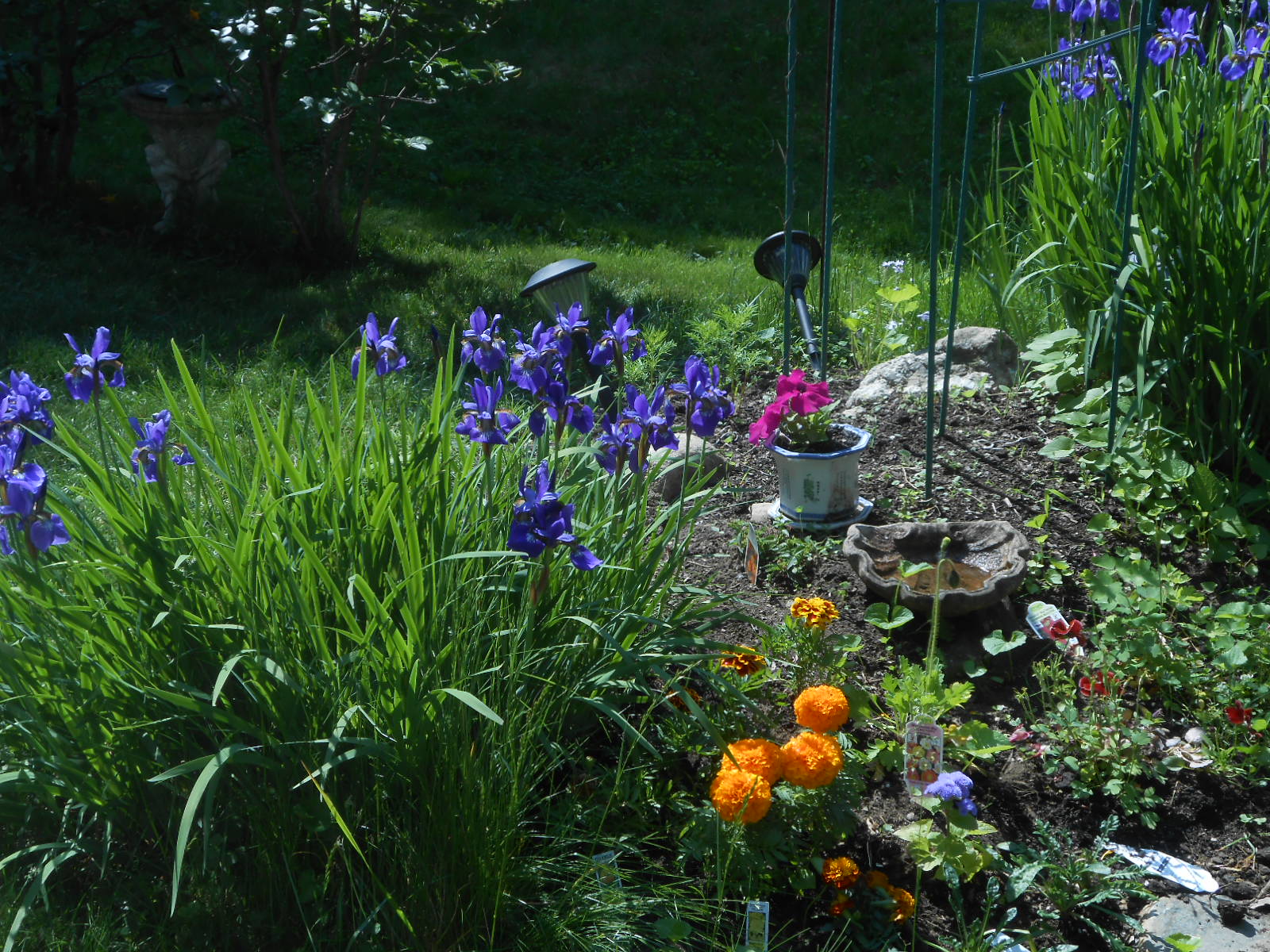
The mound beside the fish pond had gorgeous Irises and Marigolds, beautifully complementing blue with light orange.


We had some nice fancy Irises in the front yard, as well.  Interestingly, we did not have as many blooms as usual.  Perhaps the May frost nipped a few?


The sea-rose bushes in the back yard climbing up the slope had tons of gorgeous pink blossoms.  Here’s a shy little bee hiding among the petals.


July was fun for beasts, birds, and flower.  One morning when I went to rinse out the cat-food cans before putting them in the recyclables, I found this fellow chilling in a bucket that had filled with water.  For a few days, this was his private pool, with the high grass surrounding making up his stomping, rather, hopping grounds.  Yang was careful not to mow around where the frog hung out.


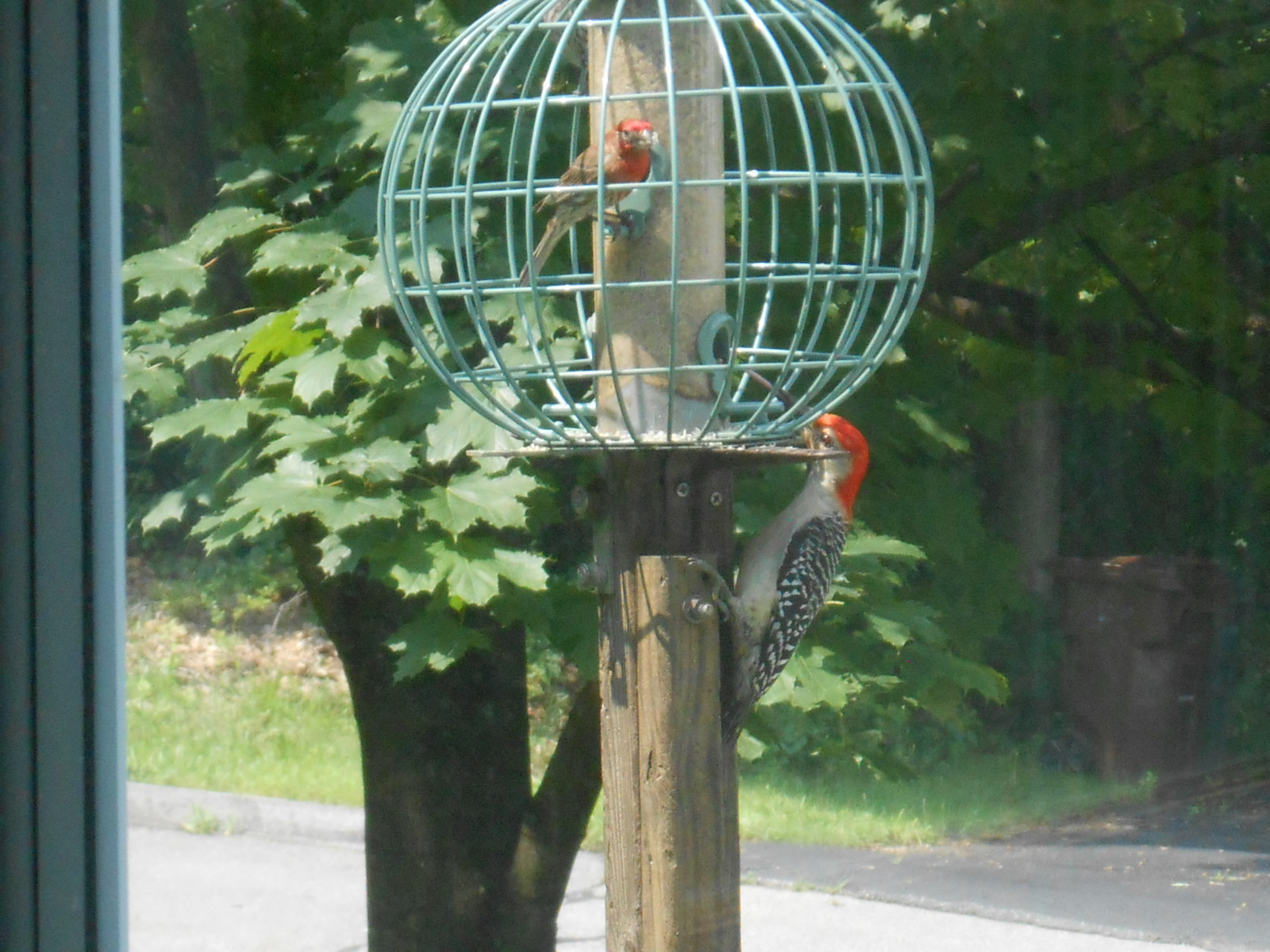
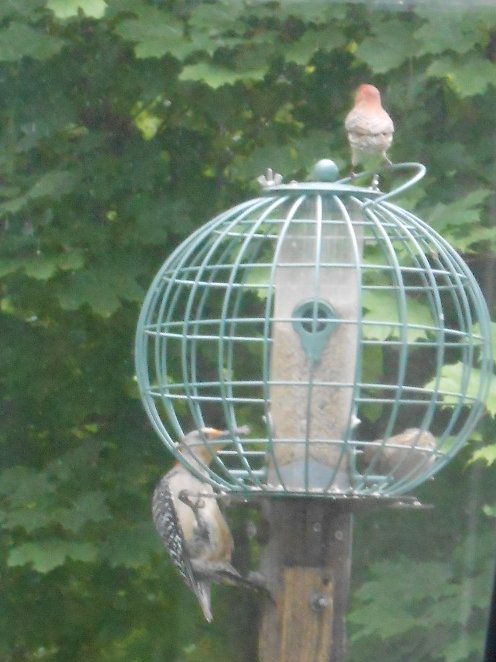
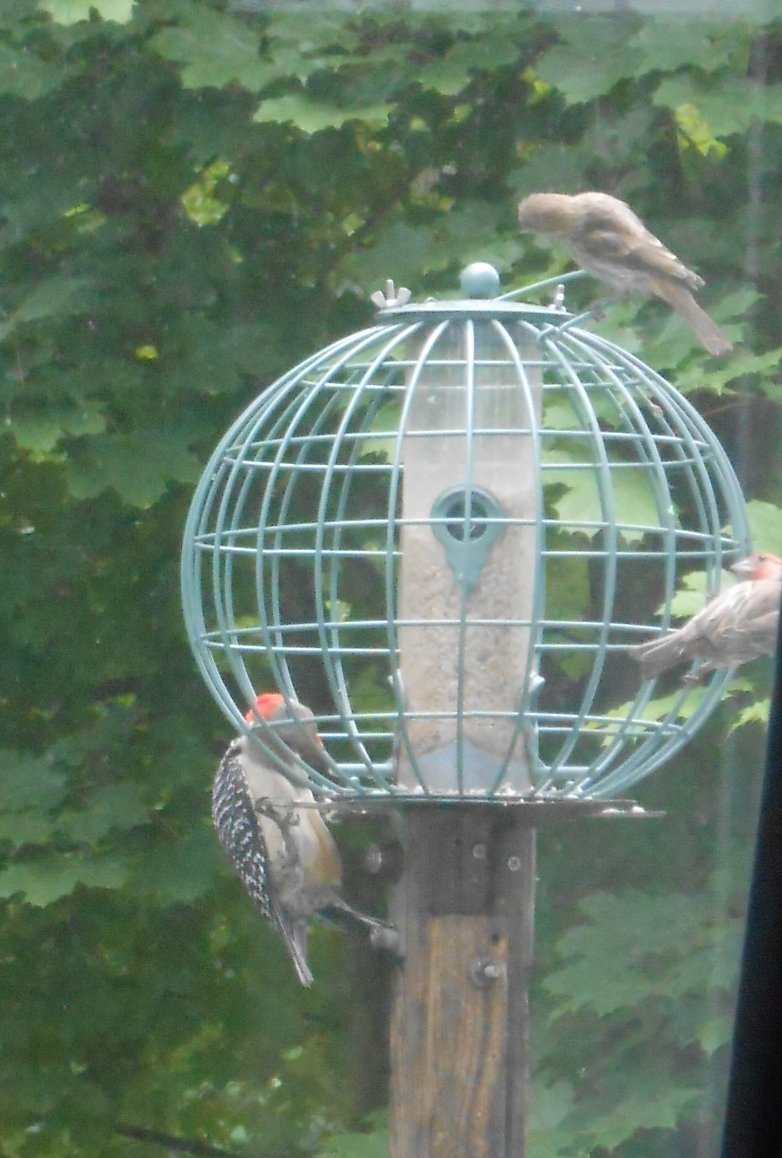
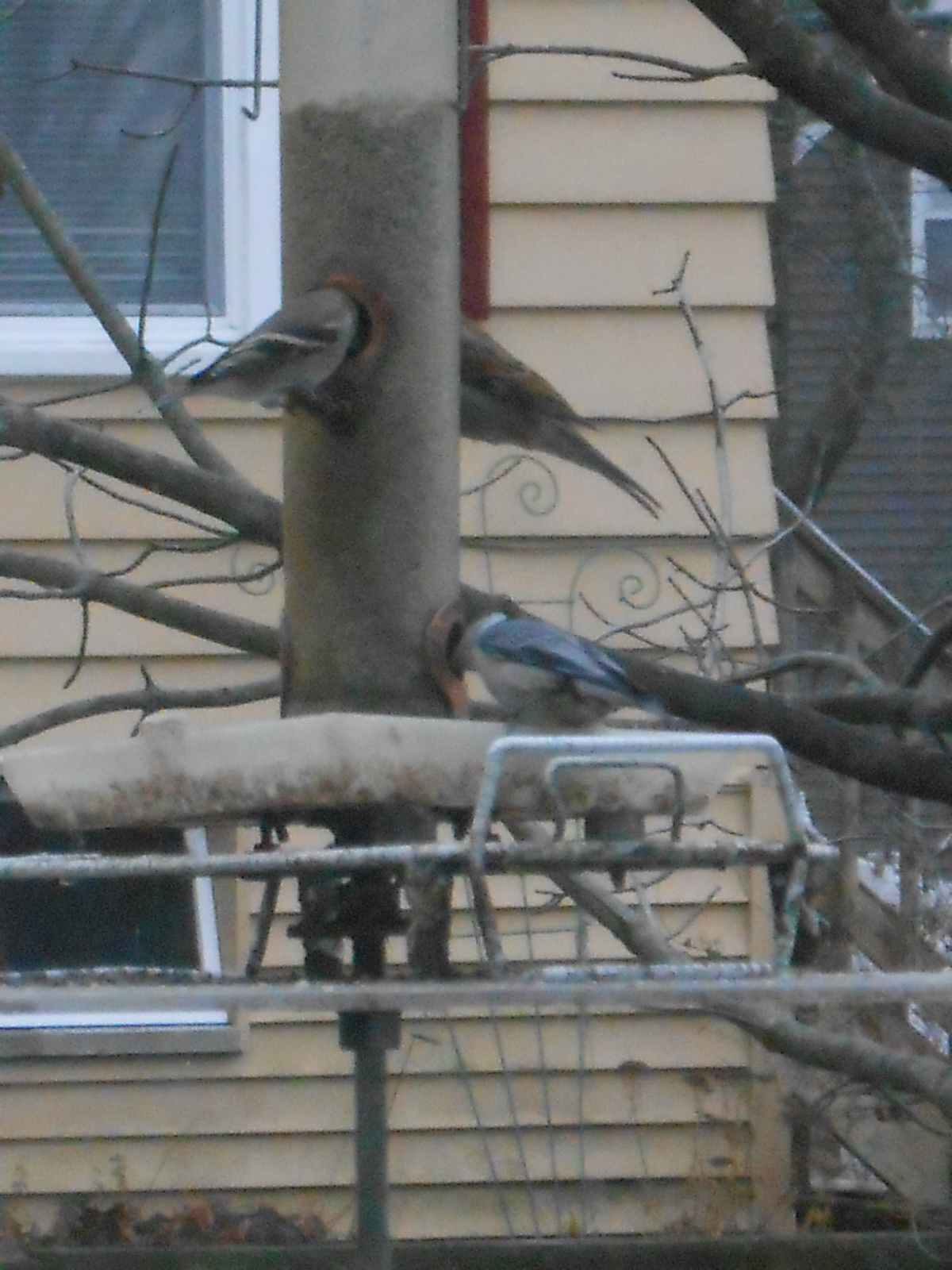
Yang put up a new bird feeder that is sheltered by a globe cage.  The little birds loved it!  Here you can see the Goldfinches mobbing the feeder.  I think that sparrow must have worn a yellow feather to sneak in.  Of course if you’re a larger bird and a Redbellied Woodpecker, you can still grab a snack.  If you click on the photo and look carefully, you can see our friend Red using his looong woodpecker’s tongue to grab some food.


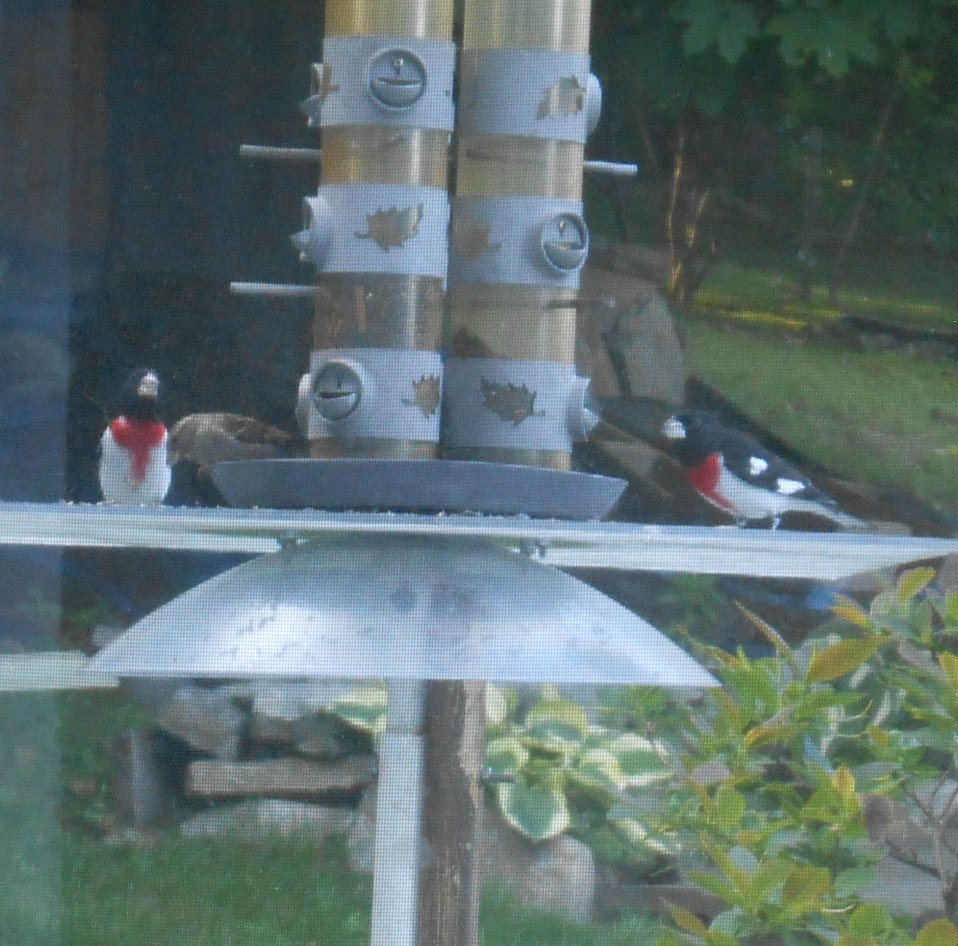
A Rosebreasted Grosbeak was just able to sneak in there, himself – though he and the Orioles faded away unusually early, in later July.


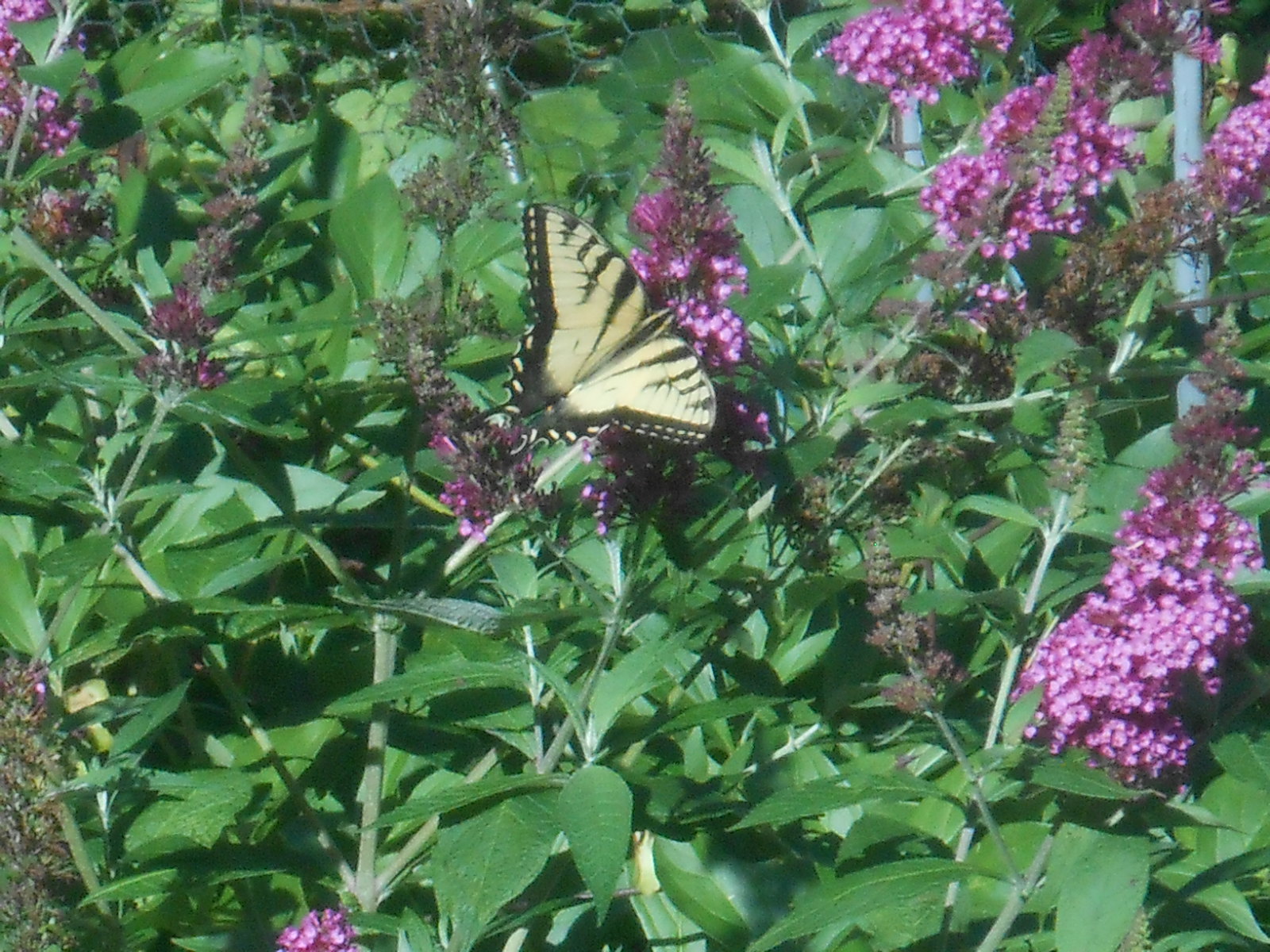
The butterfly bush near the house attracted quite a crew.  Here, you can see one of the several Tiger Swallow Tails who daily dined on the shrub.  We also got some hummingbirds, Wolf Moths, and Bees dropping by for a nectar treat.


Usually, our rose from China only gives us one bloom, but this year it gave us two at the same time.  Neat, huh?


August brought us continued Goldfinch mobbing, and the flowers began to fade a bit.  We had lots of Morning Glories, which I forgot to photograph!  This year, we had orchid, magenta, purple, pink, blue, blue/white, and the white moon flowers.


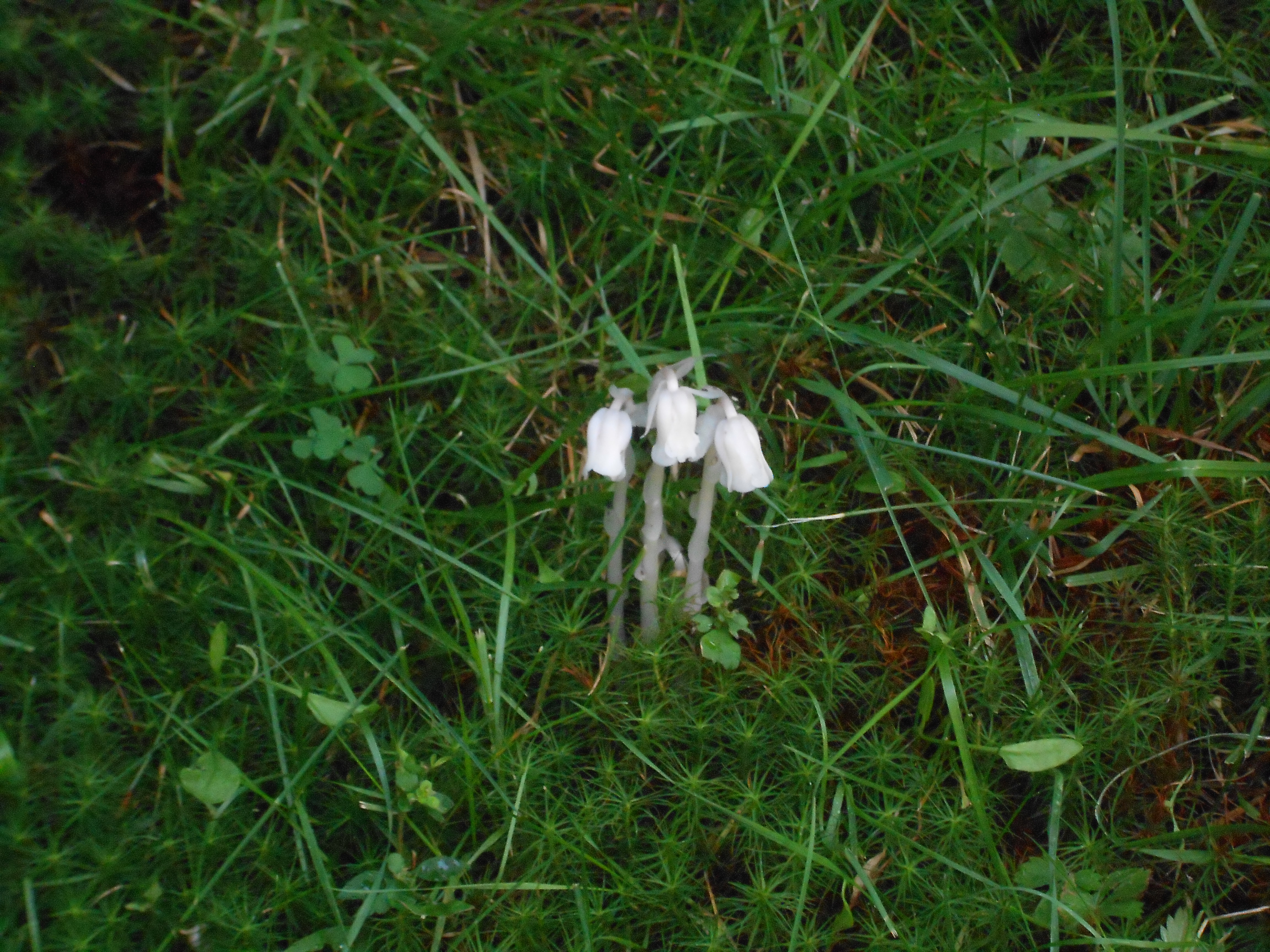
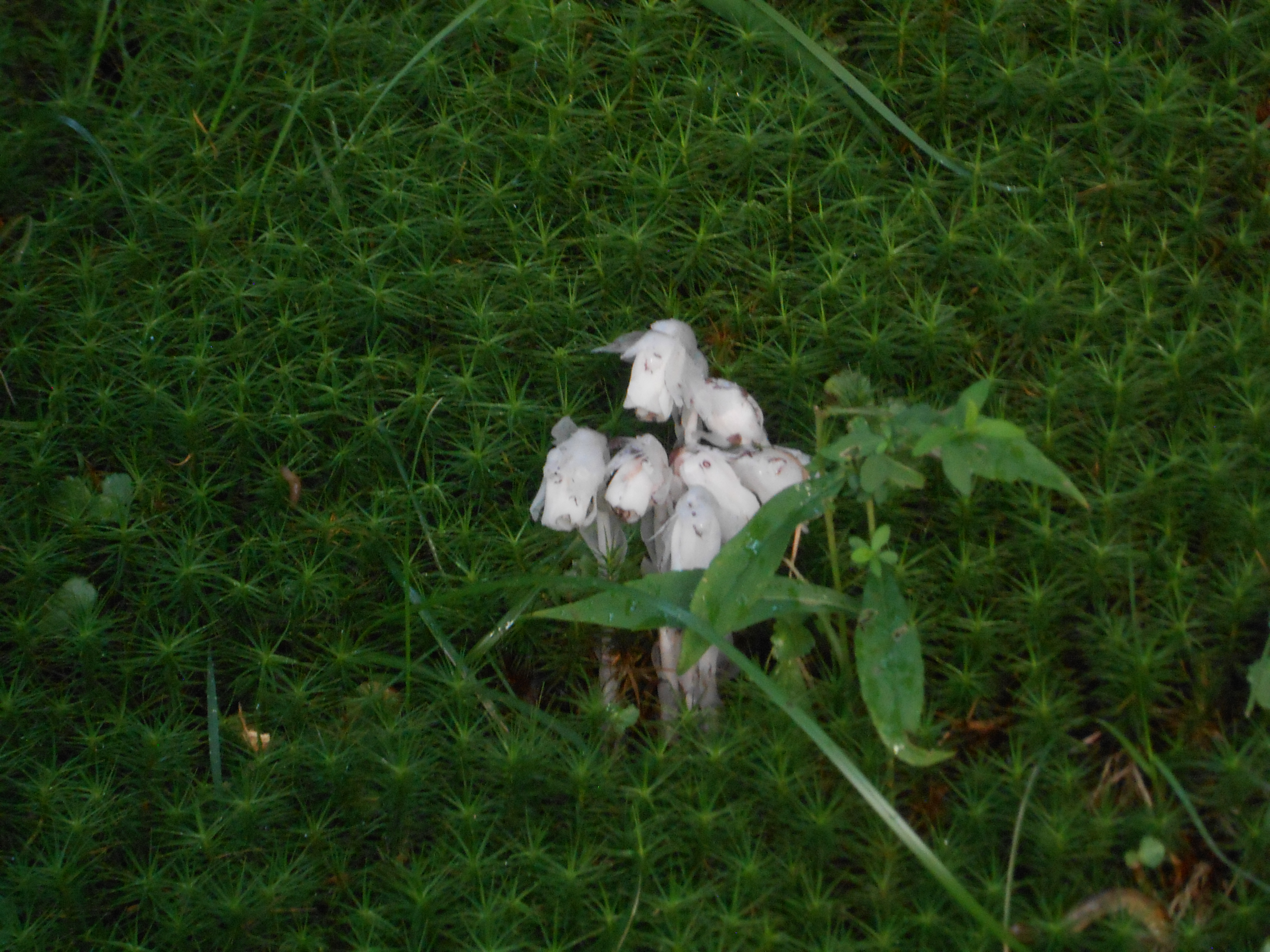
I did remember to photograph the Ghost Pipes that sprang up!  I remembered we had them once before during a rainy summer years back. Consequently, I predicted we might see more this year.  Boy, was I right!  I’ve never had so many!


So, on to Autumn! 

Backyard Birdwatching Is the Best!

As you may have extrapolated from many of my posts, Yang and I are great bird watchers.  We’ve traveled all over the Northeast (and to Canada, China, England, and France in the past) to sight all kinds of befeathered critters.  My count for species this year is now a whopping 93!  However, I can’t help agreeing with him that we often see a greater numbers of birds and species on our bird feeders thnt we do on our trips to woods, fields, rivers, and oceans!  Maybe this blog will lead you to agree.

Many of our regular spring and summer visitors have made their appearances here.  I can report that I’ve seen one Hummingbird, lots of Goldfinches and House Finches, Red-winged Blackbirds (male and female), and Cardinals by the score.  Our Chickadees and Titmice have briefly been on haiatus, brooding their babes, but they are now back at work snagging black-oil sunflower seeds.  It’s also so much fun to see Mommy and Daddy (mostly Daddy) Cardinals bringing their kids to the feeders now that the little tykes can fly.  Unfortunately, I don’t have any pictures of these guys, but I do have quite a few of some of my other feathered favorites.

One of my favorite species are the Rosebreasted Grosbeaks.  Usually, we get the females first, then the males; however, it was the opposite this year.  We had at least one male, finally, on a feeder.  Then, tragedy struck:  we found him dead on the ground under a tree.  Yang and I were heartbroken.  These guys were like our pals.  Still, our hearts mended a bit two week later when we found another male chomping on sunflower seeds.  Then we saw a female.  Then we saw two males at the same time!  There could be up to thirty males on that feeder as long as they didn’t all show up together!  By the way, the males are quite aggressive.  They don’t take guff from each other and not from Grackles, Blue Jays, or Mourning Doves.  The females can be tough cookies as well.  Anyway, I’m glad they are back.  Below is a shot of the males in a more pacific mod. I guess they can stand each other when multiple  tubes of seeds separate them.


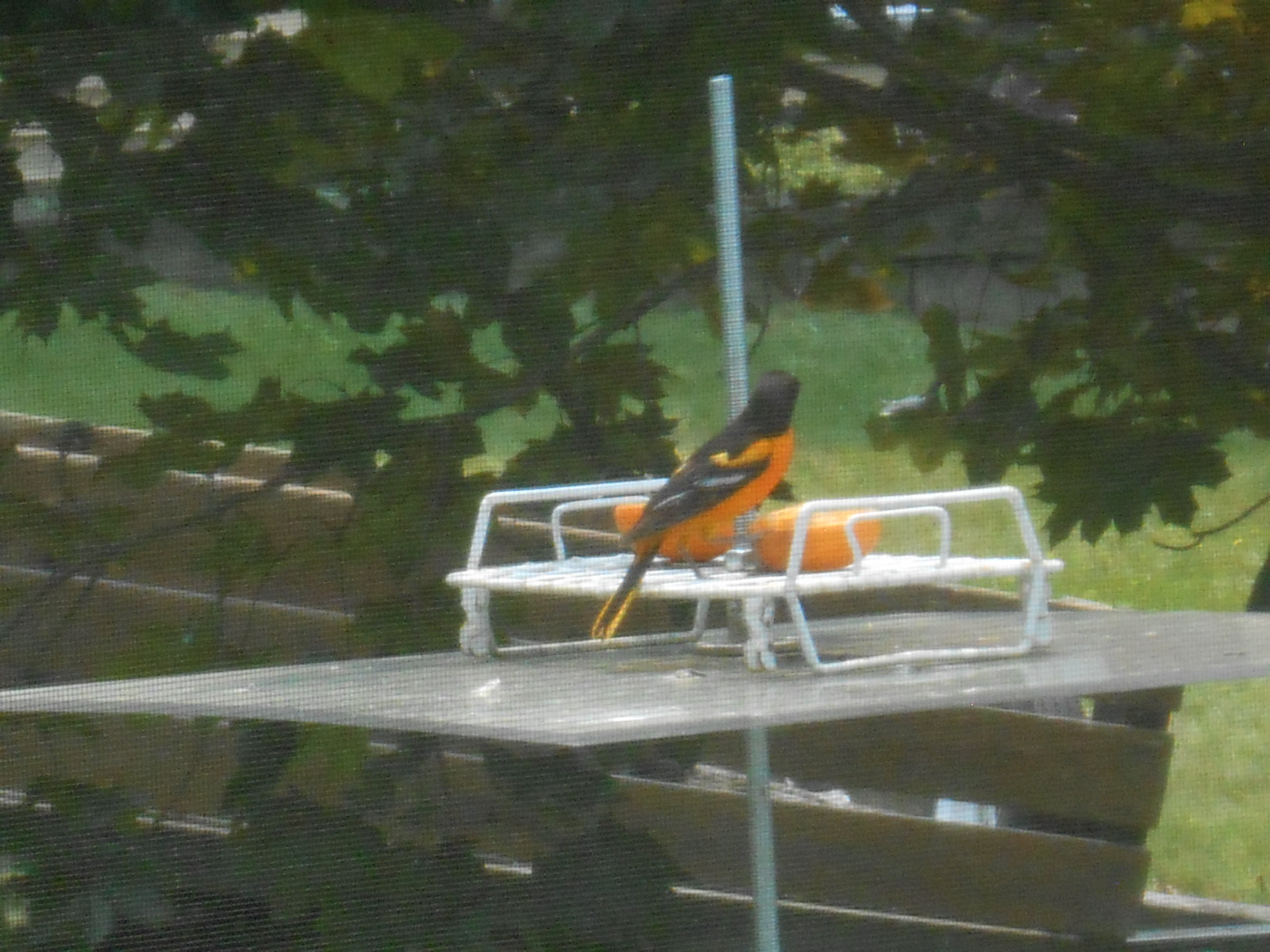
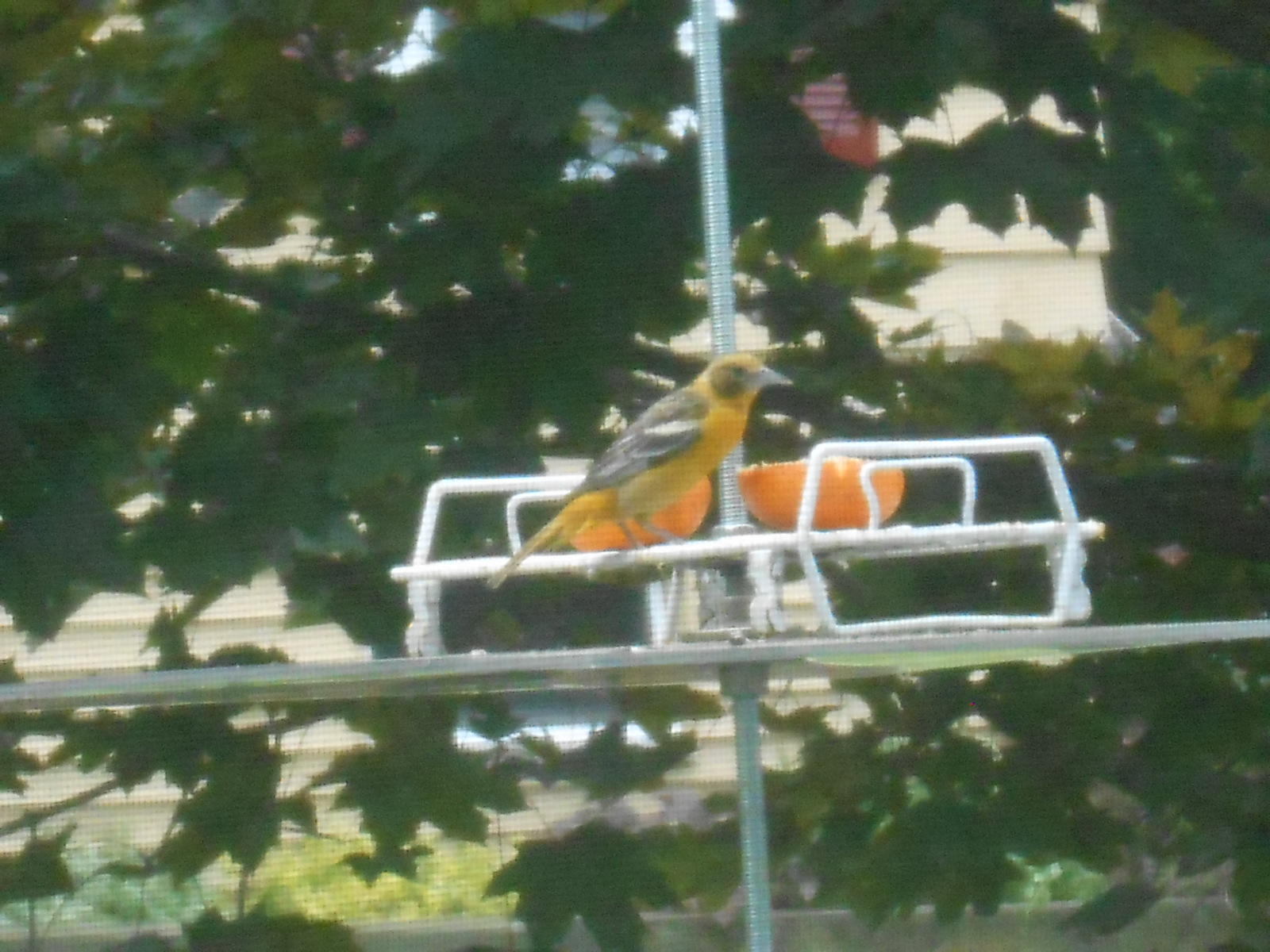
Another of our beloved colorful visitors is the Baltimore Oriole.  After long waiting, we saw one toward the end of May, then nothing!  Many an orange might have withered away if not for other birds. So, we almost gave up hope of seeing another Oriole – until in the middle of June Orioles reappeared!  We saw a male several days in a row, then a female for a couple of days, then a week later:  a juvenile.  It’s been a couple of weeks and – nothing!  Of course, who knows what shows up when Yang and I are away, but we haven’t seen any Orioles since.  I guess this was just a stopover on their way to their real summer grounds.  Well, at least we saw a few of them!  And the oranges did not go to waste.

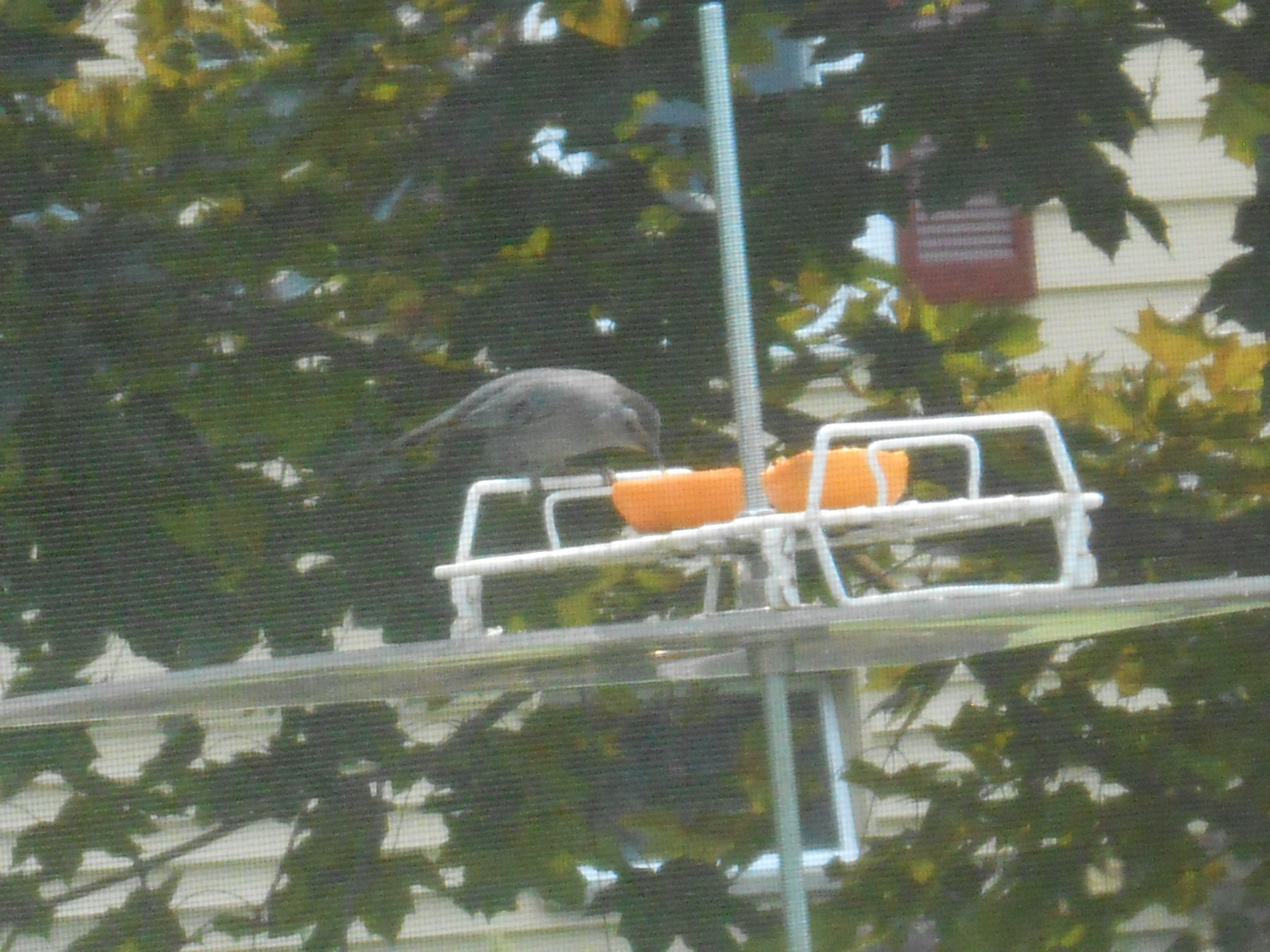
We have discovered that Catbirds adore orange pulp!  When there’s no suet to be had (and even when there is!) our catbird couple come by to snack on the orange halves we have set out.  They must keep up their strength, since they have a nest with babies on our property.

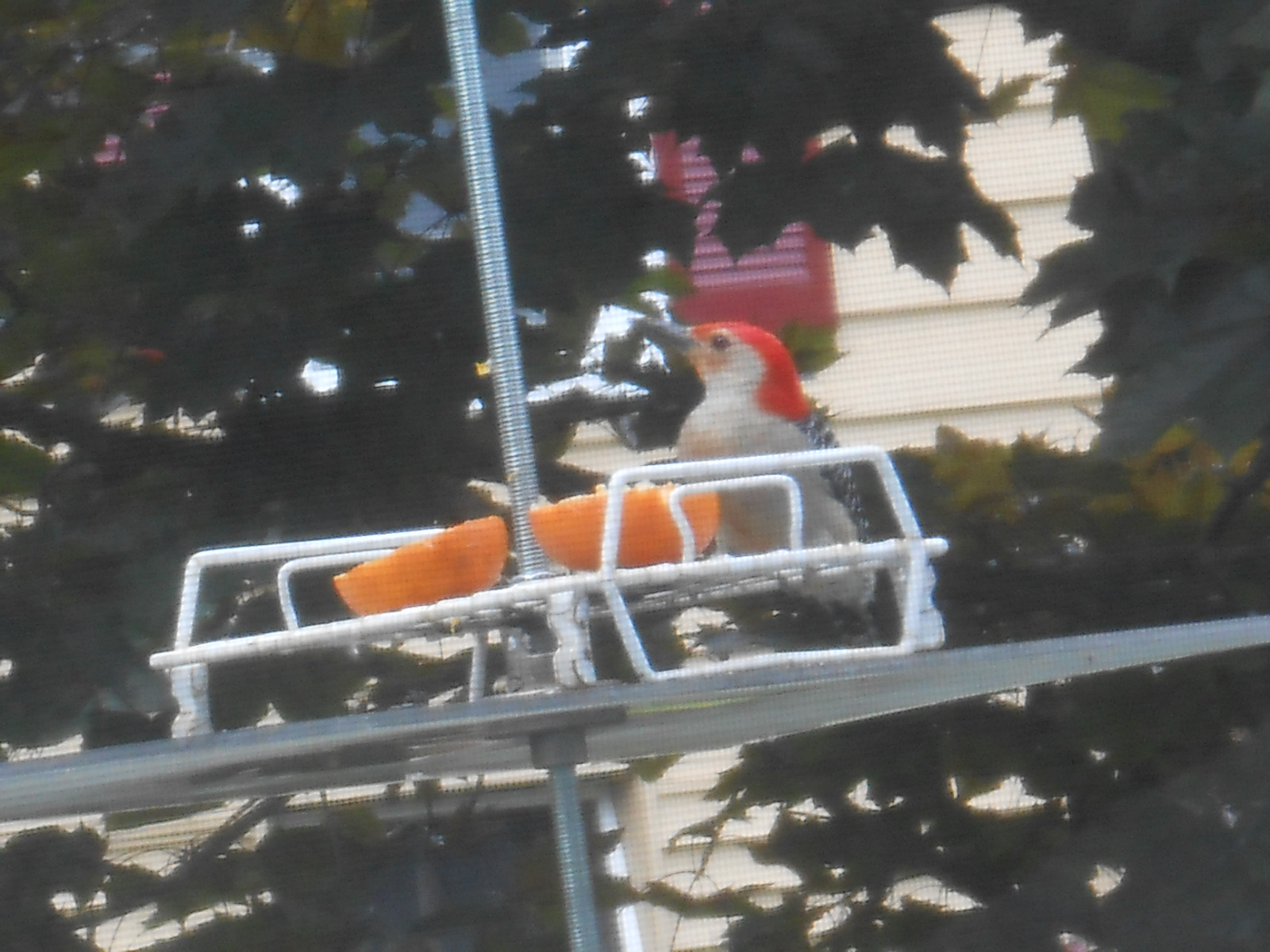
Mr. Redbellied Woodpecker thinks the oranges are pretty cool stuff, too.  You can see him having a grand time chowing down on pulp.  Maybe the Orioles are afraid to go for the oranges with these guys around!

One idea that Yang came up with to thwart the squirrels from stealing food from the birds (and breaking our feeders) was to buy a tube feeder inside a globed cage.  It also had the advantage of preventing the big bully birds like Grackles, Doves, and Jays from keeping the little birds from food.  it works. Of course, medium size birds like the Rosebreasted Grosbeak and the female Redwinged Blackbirds can get in, without being bullies.  Tough luck male Red Wings!  Birds with long beaks also have a shot – like the Redbellied Woodpecker.  The House finches try to out-aggress the Goldfinches, but the latter either hold their own or just wait and dive in when the coast is clear.  Titmice and Chickadees are too fast for anyone to harass them!


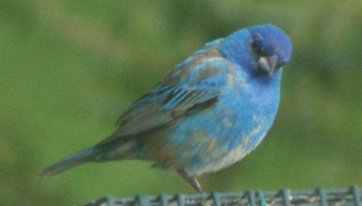
So, you can see, we’ve seen a healthy variety of avian visitors right outside out windows.  Bring on the Scarlet Tanagers, the Pileated Woodpeckers, and the Indigo Buntings!  It wouldn’t be the first time one of them has shown up at chez Yang.


Halibut Point Feathered Friends

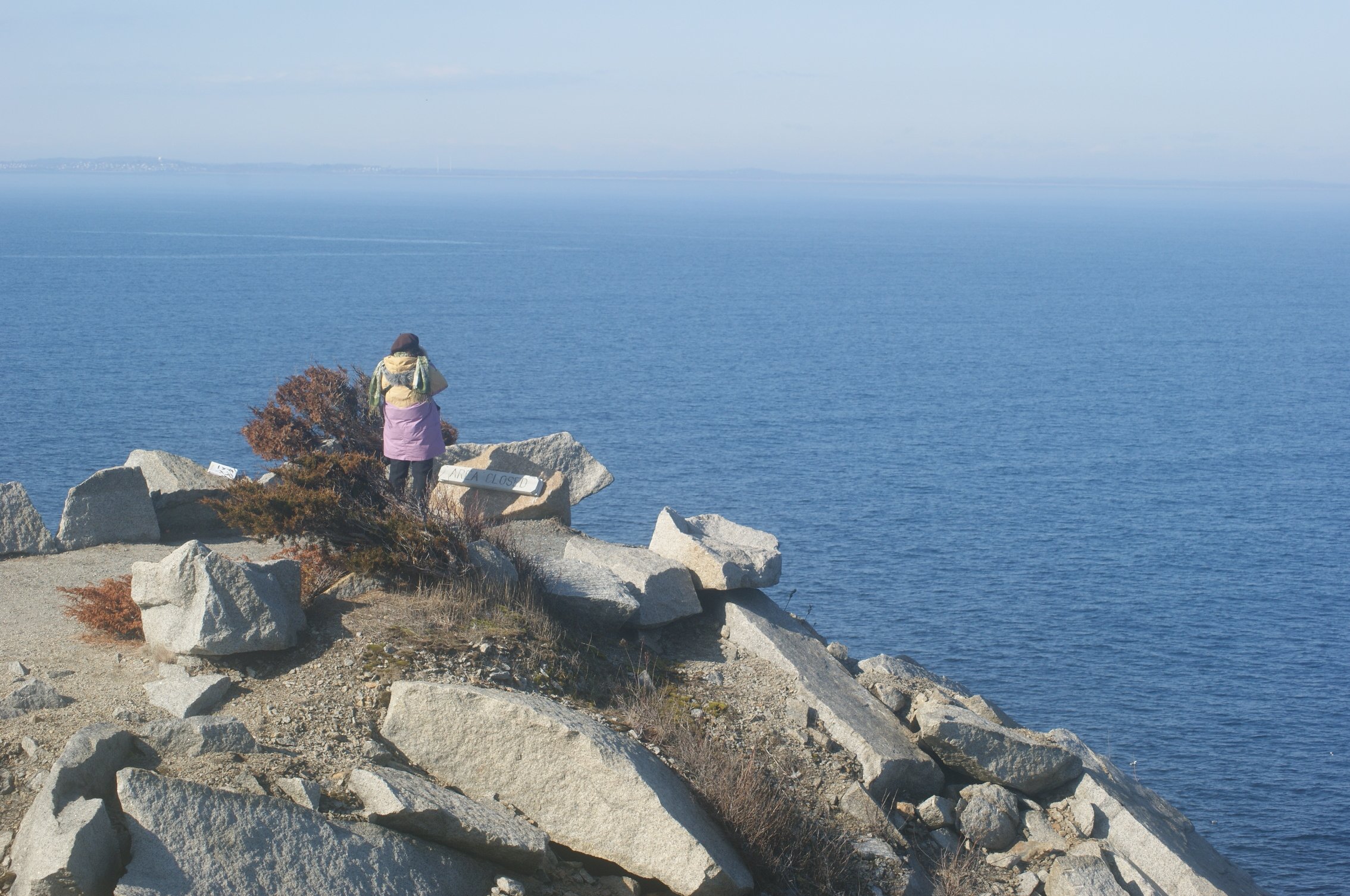
Two Fridays back, Yang and I happened to be on the North Shore, so we stayed overnight in order to make an early visit to Halibut Point State Park.  We’d been meaning to get there since November, after hearing about all the cool water fowl hanging out there.  Unfortunately, the opportunity hadn’t come up before this.  So, after our breakfast of bagels and cream cheese (yum!), we headed out to the state park.  We were not disappointed.  In the quarry, we spotted a Scaup, Black Ducks, and Mallards.  When we headed for the ocean, we got an even bigger treat.  Here you see me peering out at the ocean’s wonderland – or wonderwater- of ducks. Isn’t that point beautiful?

At first, we  saw only a couple of pairs of Harlequin Ducks, looking absolutely adorable.  All the FB bird groups to which I belonged extolled the plenitude of Harlequins out here.  So, we were happy to spot this couple chilling along.


Mrs. Harley seems to be finding a snack while her husband looks on.

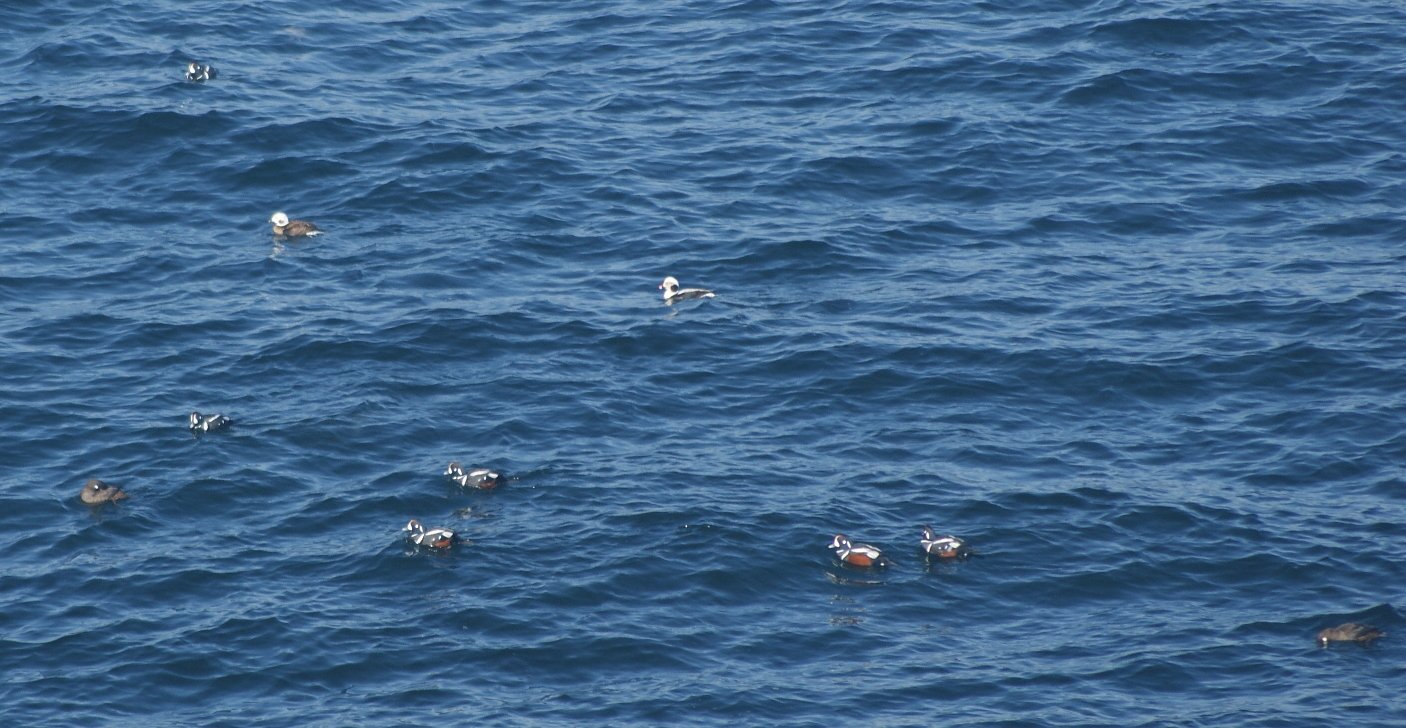
Neat as this sighting was, things got MUCH better.  Looking all around and out to sea, we saw flocks of Harlequins diving, chilling, and looking good.  There were so many that we couldn’t always get them all in one picture.  I would say we saw several flocks ranging from 9-15 Harlequins.  And that’s not counting the friendly-neighbor Long-tail Ducks who joined the party.  Counting the ducks was never easy, because, all of a sudden, the whole kit and kaboodle would take a dive on a hunt for food.  So, Yang had to time his shots carefully to catch them.  I guess it’s true that these ducks love rough waters, because that’s exactly what they got here and in the other place we saw them, Sachuest Point, RI.  This was the biggest contingent of Harleys that I had seen. Though the ducks are hard to pick out in these pictures, if you just click on them you will get a better look.

Then we saw this Loon way off above the group of Harlequins.  It’s the white figure in the upper left corner.

Wouldn’t you know, we also saw plenty of flocks of Scoters. 


Here’s a closeup of a female Scoter.  I believe these are all Black Scoters.


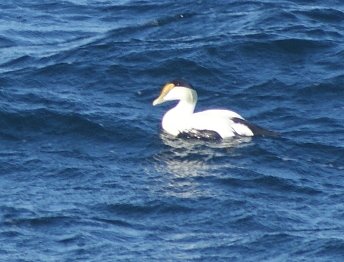
When we moved onto the harbor at Rockport, Yang also got a shot of a male Eider Duck.  Usually we see big flocks of these guys, especially at Cape Cod (check out this older blog).  Today, we saw this guy all by his lonesome.


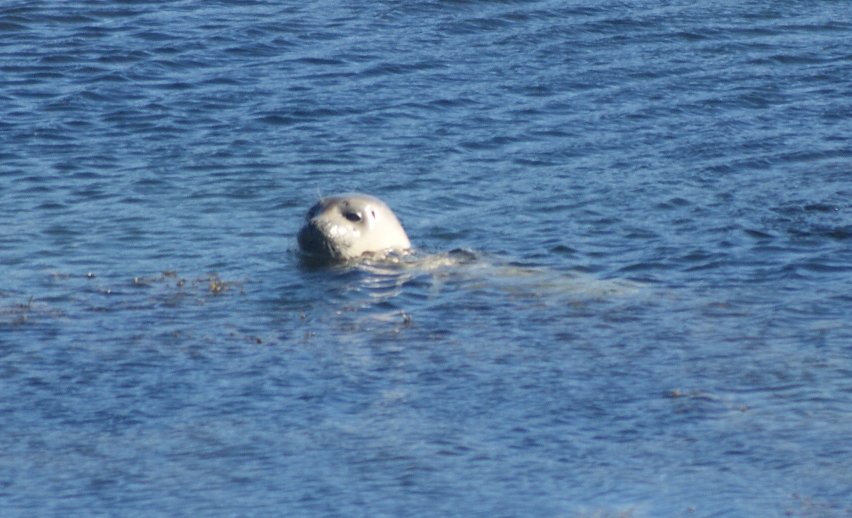
Then, finally, what should we espy on the other side of the point in the harbor in Rockport?  We thought we it was a brown female eider – except, Yang said that once the critter dived  he could see her  walking under water.  Huh?  Then “she” came up.


Yup, a seal!  So I hope this critter can be a “seal” of approval for today’s blog.


Gooseberry Island Redux – or Reducks?

Yang and I returned to Gooseberry island on a sunny day for a change last Saturday – celebrating my birthday over the weekend.  This time, no fog and plenty of sunshine.  Also, plenty of water fowl!

One of the first sightings I want to discuss are the shore birds.  since we could actually get to the shore this time, we walked along the beach and saw a flock of shore birds whip around in tight and angular formation.  When we came around some rocks, we got a good look at these cuties.  I was surprised to find that we had a mix of Dunlins and Sanderlings together.  This time, I didn’t mistake their tummies for seaside rocks, so perfectly had they blended in with sand and sea-smoothed stones, when I saw them in December.  The Dunlins are brownish on top, with  buff tummies and long, slightly curved beaks.  The Sanderlings are grey on top with white tummies and shorter and straight beaks.  They were fun to watch scurrying about in search of dinner, all while seeming quite at home with one another. These images might look tiny here, but if you click on the pictures to enlarge them, you can see the birds much more clearly.
Apparently, the pickings were getting kind of slim, for Yang managed to snap a shot of some of these guys taking it on the wing for better dining.

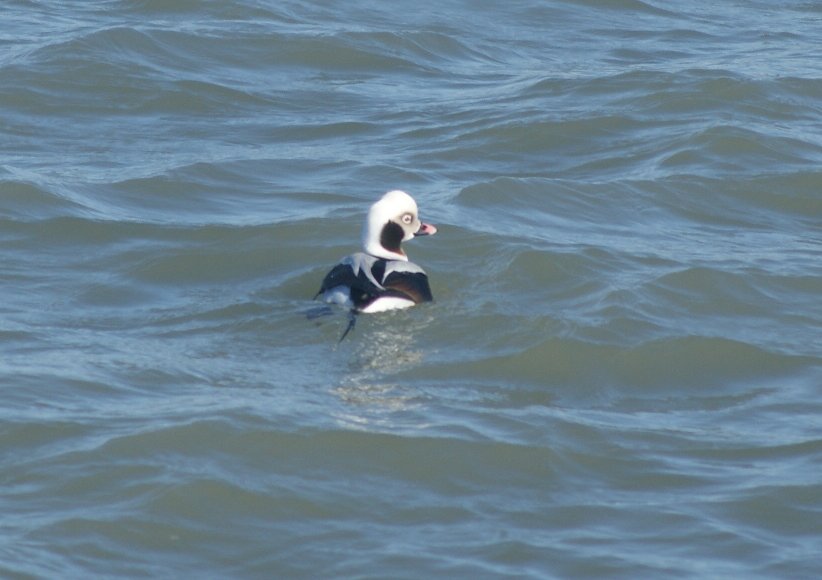
We also saw plenty of birds in the water that day. With perfect visibility and trusty binoculars, we could sight dozens of Long-tailed ducks near the shore and way out in the bay.  Yang got some neat pictures of a few near us.  This male is a handsome specimen.  You can even see a little of his long tail in these photos.  Apparently, these ducks can dive as deep as 95 feet and can stay under water longer than any of the  diving ducks.  Wouldn’t Lloyd Bridges be impressed?  Yang took these pictures as we we heading toward the island along the causeway.


Coming back along the causeway, we found this Long-tail extremely close to shore.  I think it’s a nonbreeding female, but sometimes they are difficult to distinguish from an immature male.  I didn’t see a long tail on this duck, so I’m going to take a flyer and say this is a female.  She was quite unimpressed by the humans walking by.  She also didn’t seem to be much worried about the rocks towards which the surrounding waves  were shoving her.  Still, she did just fine for herself, bold duckess!

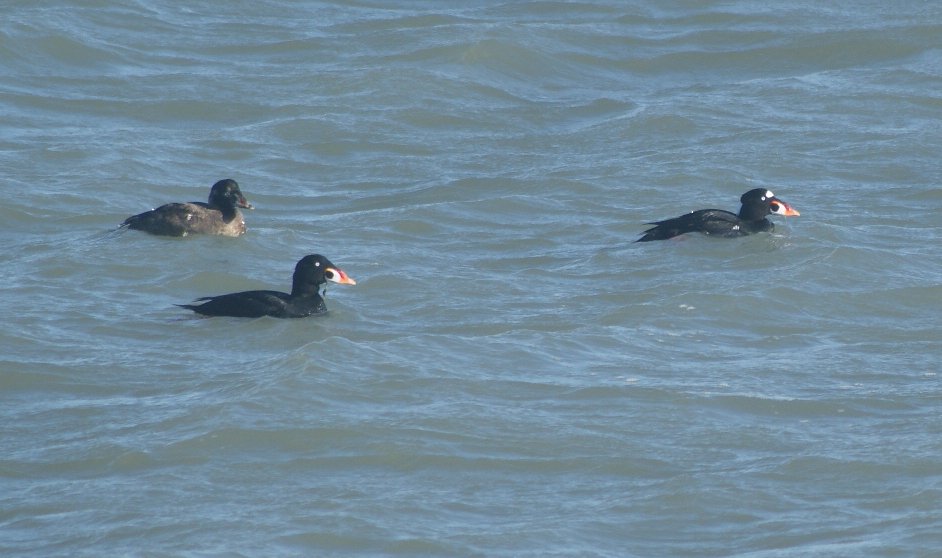
Another aquatic bird of which we saw tons were Scoters.  We saw Black Scoters, White-winged Scoters, and Surf Scoters.  Again dozens and dozens throughout the bay.  Yang was only able to photograph some of the Surf Scoters, but he got some good shots.  As we were coming back along the causeway, there was a trio: a male, a female, and an immature male (I believe). the female is brown with a white spot on either side of her head.  The males all have that unique pink beak with a white spot on the forehead, white on either side of the beak,  and one on the back of the head.  You can see that one of the males doesn’t have the white spots on his face.  We wondered if he were a Black or White-winged Scoter; however, neither type has a white patch on the back of the head like this fellow.  So maybe the younger males take time to get all their patches in?

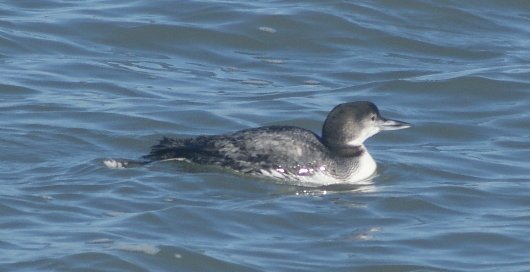
You can see from this shot that the Scoters weren’t alone.  Here’s a  Loon photo bombing the Scoters.  We noticed him hanging out with this group from another species.  We also have a nice picture of the Loon by him= or herself.  I believe this is a Common Loon in winter plumage, but if I’m wrong, feel free to set me straight.

Another, smaller, diving water bird joined the show.  A horned grebe!  We saw one or two popping up (and back down again) amongst the various flocks of Scoters and Long-tails. Again, let me know if I misidentified the type of Grebe.

Last but not least, here comes the Bufflehead!  Usually there are big flocks of these guys around in the winter, but today, this chap seems to be swimming solo.  Well, it’s a big ocean and there’s room for everybody.  So where are the Harlequins?

Happy Harlequin Hunting: Only Shooting with a Camera!

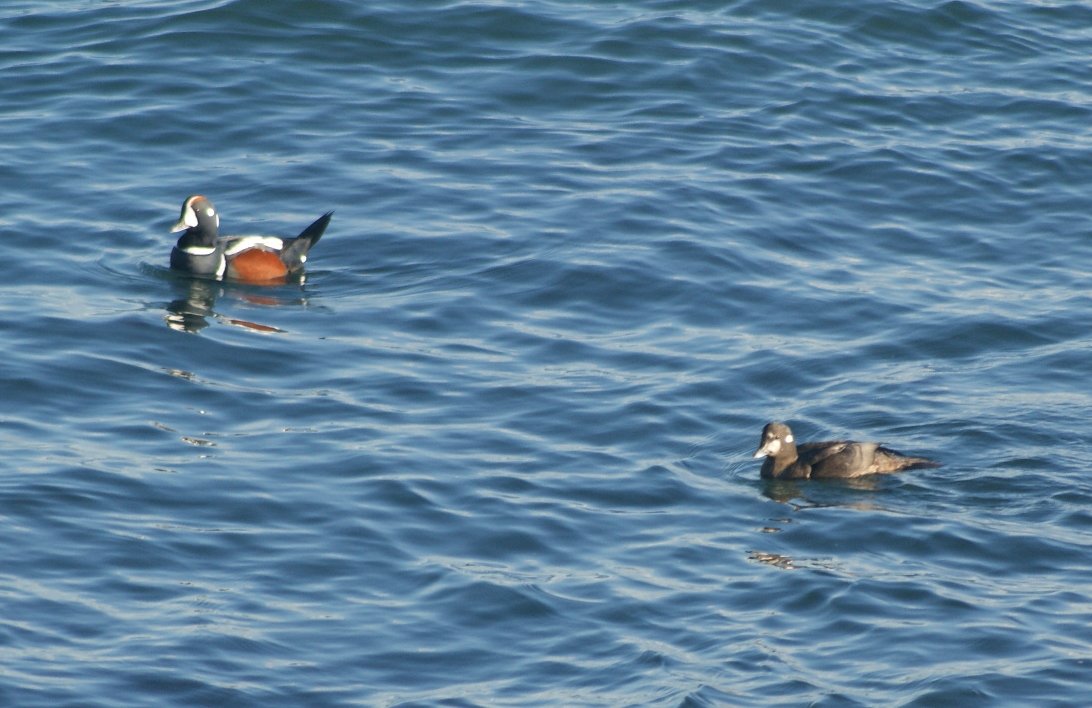
For the past month, I’ve been seeing nothing but posts about all the Harlequin Ducks flocking down the coast of Massachusetts from Plum Island to Westhaven.  Never having seen one, I was eager to make a sighting.  Three trips to the coastal waters, and I was still a Harlequin virgin.  That is until Yang and I visited Sachuest (don’t ask me to pronounce it) in Rhode Island.  Of course, my prayers for a sighting weren’t answered at once.

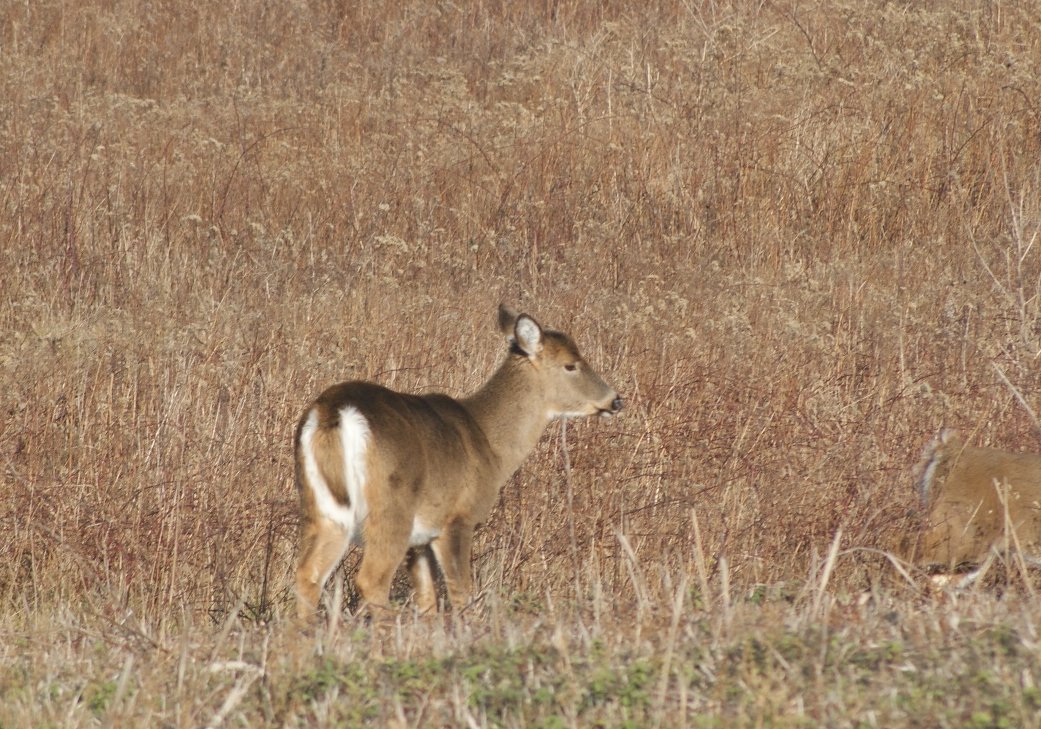
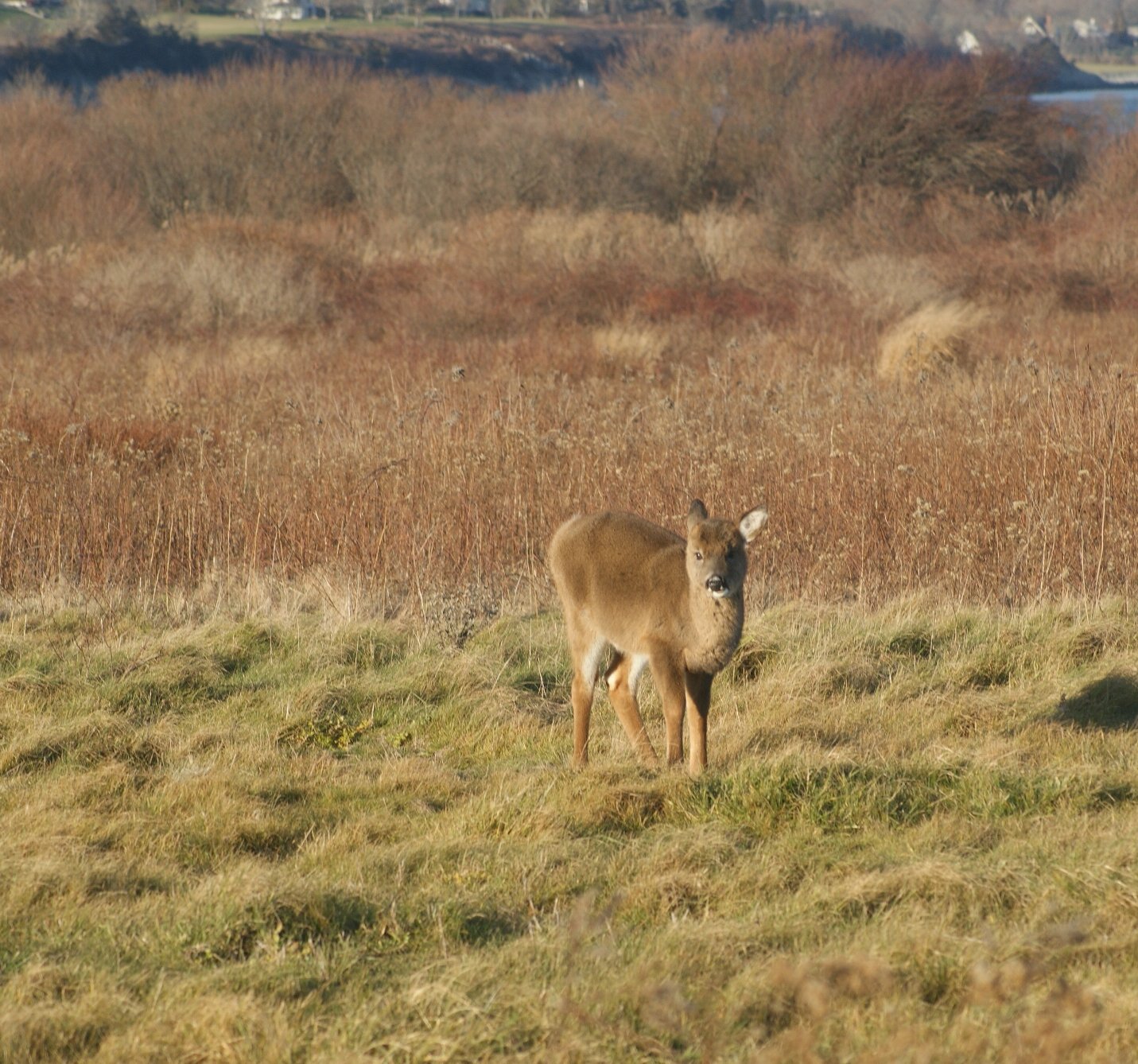
We went down to a cove and saw two huge flocks of Buffleheads bobbing and diving in the waves.  They are adorable with their big white spots on the sides of their heads that look like ear muffs.  But no Harleys!  Then, coming back to the parking lot, to start the trail leading around the other side of the point, we saw four deer grazing nonchalantly in the marsh field.  Beautiful in their heavy winter coats – but not ducks.


We later even found a family of Eider Ducks, one adult male, one juvenile male and two females – joined by a Bufflehead, who popped up out of nowhere – but no Harlequins.

So, we made our way down onto a rocky beach after we spied some Lesser Scaups ( a first sighting, ever!),  some Surf Scoters, and a female Redbreasted Merganser, but no …wait!  What’s that black and white thing bobbing and diving out there? 

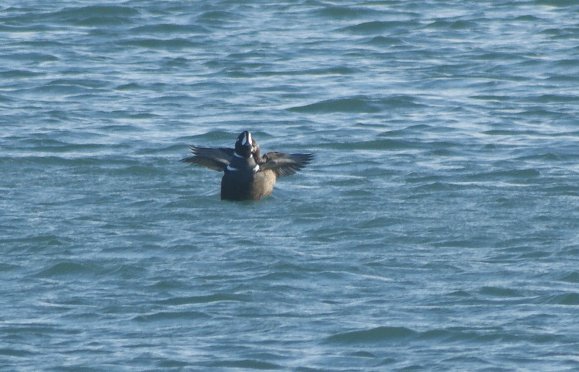
See the tiny white and black thing in the middle of the screen?  It was clearer and bigger with the binoculars.  I said to Yang, “It’s, wait , I think it’s, yes!  It’s a male Harlequin.”  Now before you say, “Hey, I can’t see a darned thing, wait, big deal,” it gets better.  After watching this guy and some Redbreasted Mergansers for a while, we moved on  – and came across another Harlequin chilling with some Scaups.  A little later, we came across a lone pair of Harlequins.  These shots are better, but not our top prizes.  I just love this one of the male flapping at us.  Camera shy or a show off?  You judge.


It’s really interesting to me that when the males look at you head on, with the light colored beak and the white stripe on their face, they appear more white-faced than they actually are.  When we got to another spot, Yang got some gorgeous shots that show off all their glorious markings. So, here you go with a set of photos of another  Harley pair from much closer up.

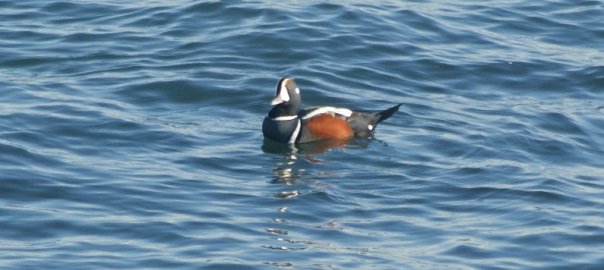
Here’s the male by himself.  Take a gander at that gorgeous splash of chestnut on his side, the way the white stripes demarcate the patches of black, and look carefully for that line of chestnut down the back of his head.


Here is the pair together.    Sometimes they point those short but sharp tails upward. Notice how the female has those lovely three white spots on the side of her head.  


I think they must have had an argument.  Yang and I noticed that the female did most of the diving/hunting.  Maybe she got sick of her hubbie posing for the papparazzi when she was doing all the work. Anyway, they briefly went separate ways.

Well, deers, er, dears, that’s all for now.

Mallard, Mallard, Merganser?!

The nature trail through the marsh/river across from Holy Cross has presented us with many an interesting critter.  We’ve seen deer, black snakes, muskrats and turtles.  Our avian sightings have included Great Blue Herons, Kingfishers, Red-winged Blackbirds, and assorted warblers.  Once, we even met up with a Bob White strolling back and forth in front of us along the promenade.  There hasn’t been a shortage of aquatic birds, mostly Canada Geese and Mallards.  However, for the past week, we noticed a Mallard flock of about 15-20 had an interesting guest!
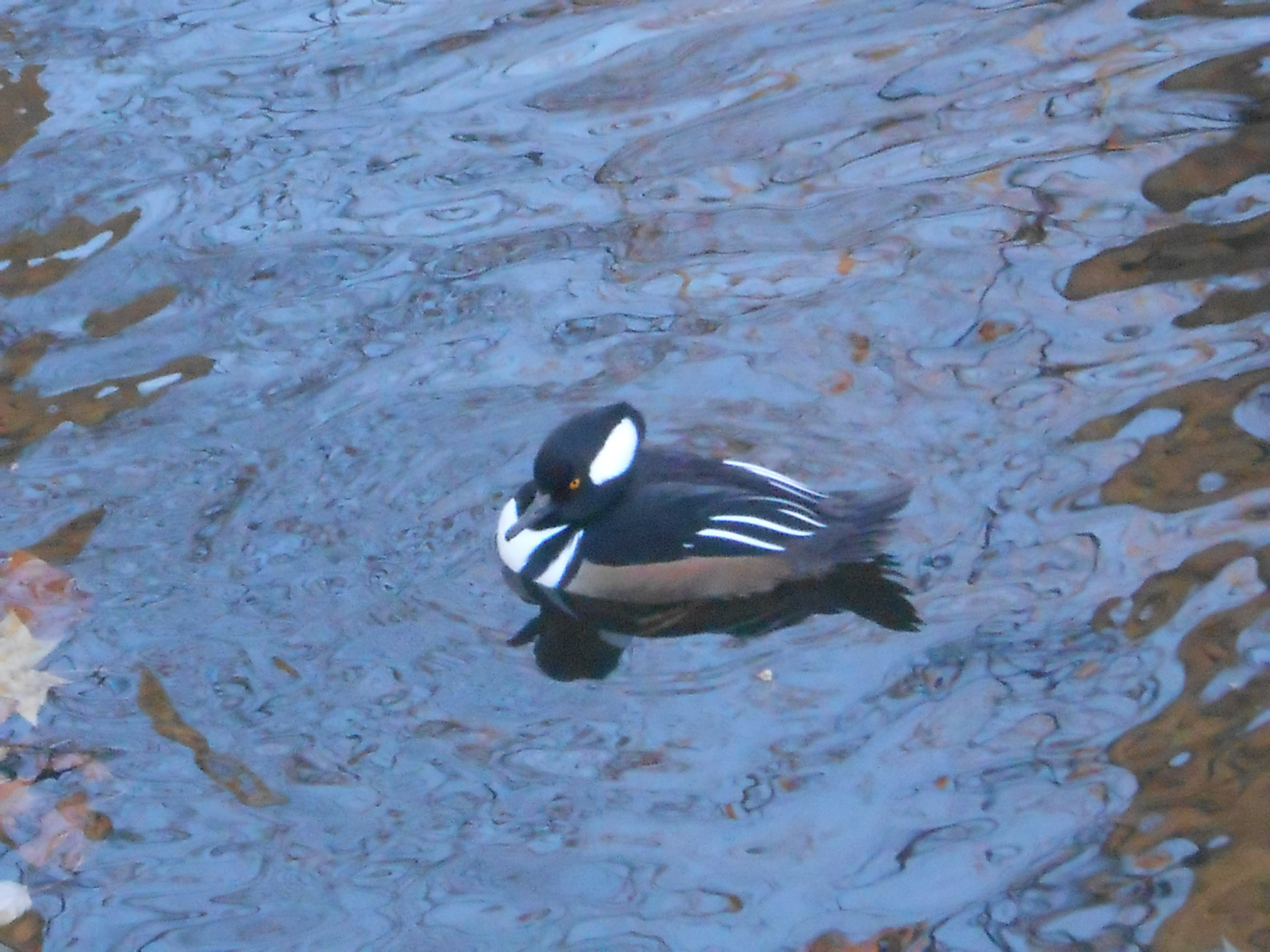
What was an adult male Hooded Merganser doing in that flock?  There he was, swimming up and down the river with the flock – just one of the guys.  Occasionally, he’d disappear in a dive for food.  Then, back up he’d pop to join the crowd.  He seemed especially to bond with a Mallard couple.  Yang thinks that he was adopted as a duckling.  Who knows?  What do you think?  He is quite the beauty.  If only people could be as welcoming to the “different” as these birds.  After all, we’re all ducks.


Return to Colebrook Reservoir

Two years ago, Yang and I made our first trip to Colebrook Reservoir on a brisk Halloween afternoon.  What a treat!.  After at least a year of drought, the old Rte. 8 was completely clear and dry of the water.  We even saw part of the “ghost bridge” and the stone walls marking the boundaries of farms in what had once been a community displaced by the formation of the reservoir.  That day, we saw our first slate-colored juncos of the season, while the fall colors were still in bloom.  (Check out an earlier blog on our adventure here).

We came back last year, after an extremely rainy summer and discovered just how quickly a reservoir can fill up!  Not even a trace of the road we traveled between a slope of boulders and the water.  We were lucky the parking lot wasn’t swimming!

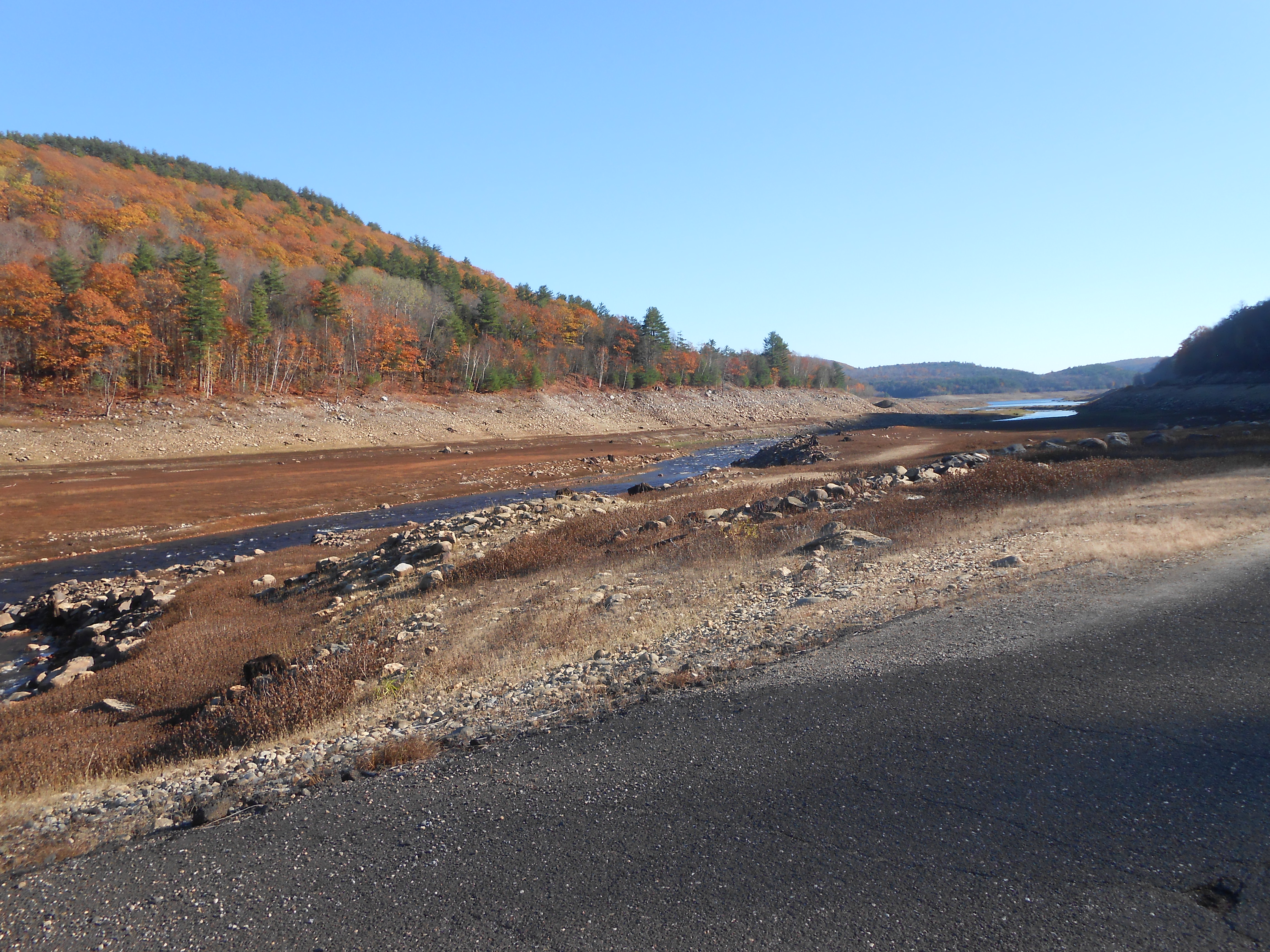
Ah, but 2022 brought another summer drought – and maybe the only good thing about the dearth of precipitation was that the way at Colebrook became so much clearer – though not nearly as clear as two years ago!

So, here’s my report, with photographic evidence!  On a gorgeous September afternoon, we were able to take the road (old Rte. 8) down from the parking lot for a bit of a stroll, until the inundation of the low road cut us off.  Were we daunted?  Not we two Yangs!  We scrambled over 1/8 to 1/4 of a mile of boulders flanking the waters.  You can get a bit of a picture from this photo, though you can’t see quite how steep the slope was – it was too hard to take pictures and scramble at the same time!


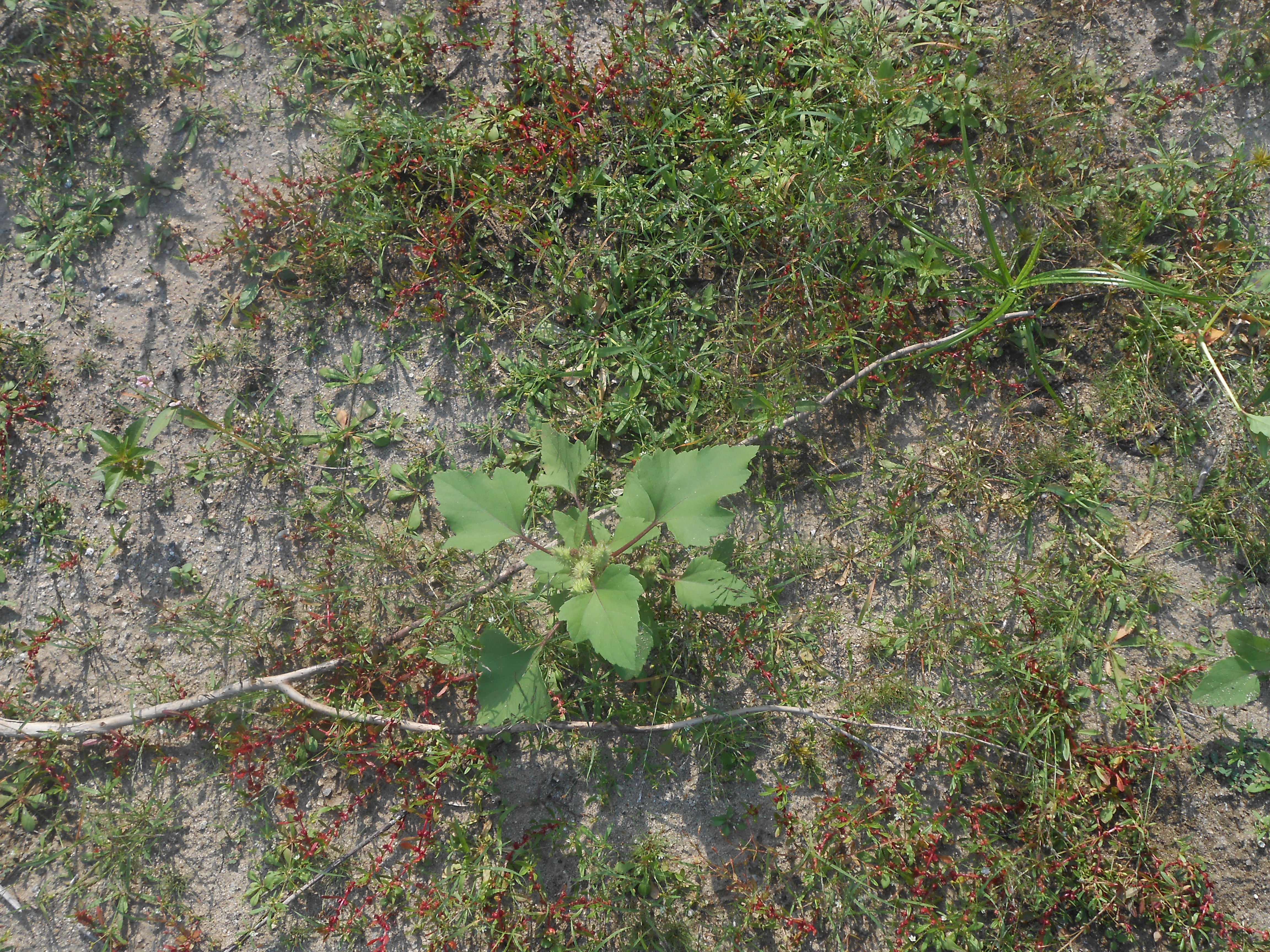
Where the road rose on higher ground, it was clear of water.  Unfortunately, there were gaps of low lying road that were inundated.  So, we managed to circle around the submerged road through rock-strewn mud flats, where we saw all kinds of fauna tracks:  deer, lynx, big herons.  We also saw some neat flora, as well.  I was taken with these nettles, some of which were accompanied by red berries.  Anybody recognize them?  We kept an eagle eye out for ticks!  Also, for fellow MSTKies, we did watch out for snakes.  None sighted – not even in the water.

It was fascinating to see how the wash of waters over the past few years had covered what was left of some of the road with gravel and how the flooded areas created islands of what had once been  roads.  Yang and I were both struck by how torn up the exposed blacktop had been since the last time we’d walked this road.  When we went through a stand of trees, we found some big trees down that we had to climb over.  No riding our bikes here the way we did two years ago when we had returned the day after Thanksgiving.

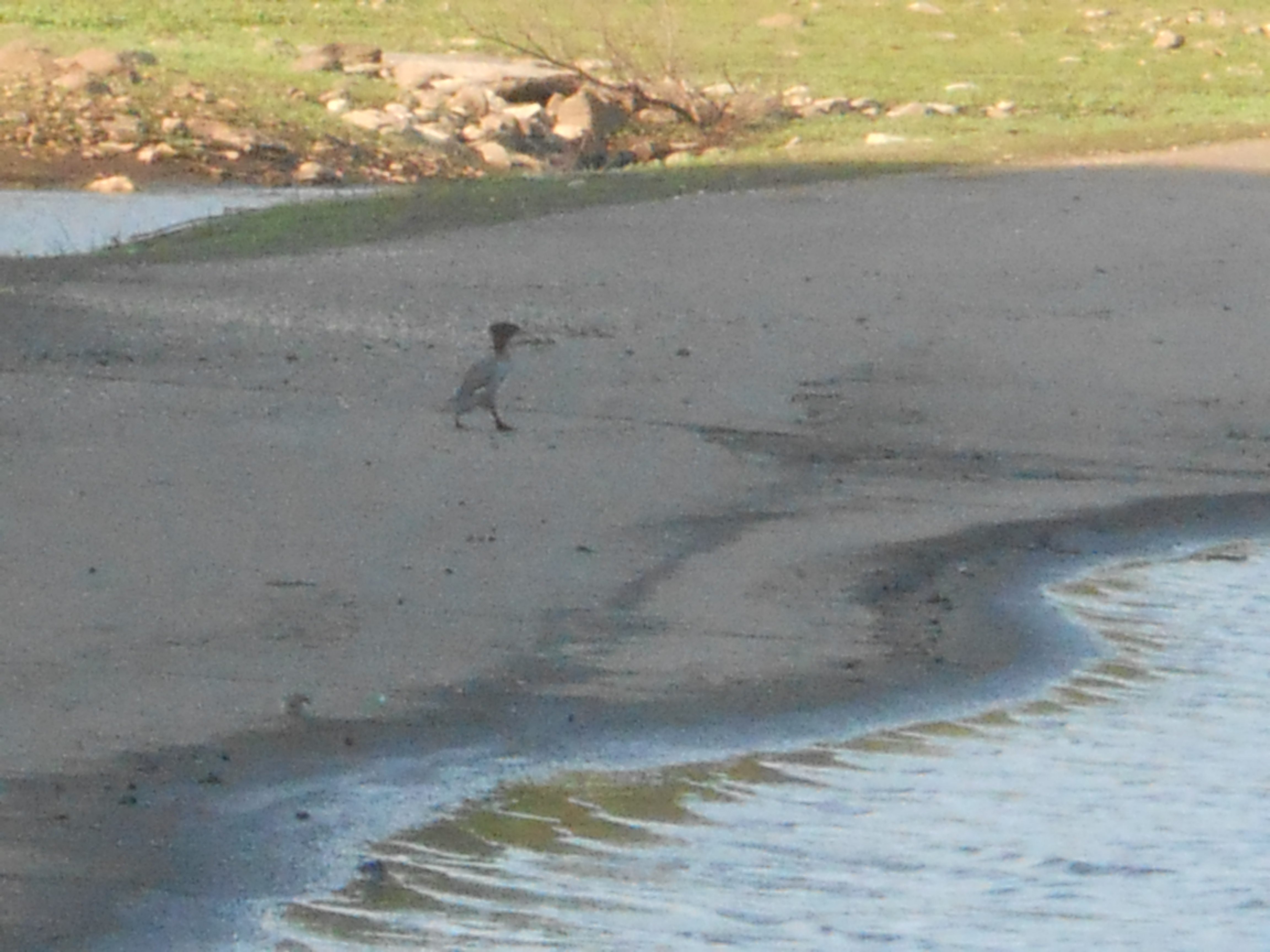
Last time we were here,  we had walked out to a highway bridge from the 1950s that crossed a stream emptying into what was originally a river (now the reservoir).  There was even a jetty to walk out on a little further along.  Well, at least the bridge was still there, but water was almost even with it.  Still we had a nice walk there and a little beyond, until the road dipped and the water filled in everything.  As you can see, we weren’t the only ones who enjoyed the bridge.  The area seemed to have become the playground for female and juvenile male Common Mergansers.  These ducks were having a grand time strolling about, splashing, and playing in the water.

Speaking of birds, Yang was disappointed not to see any Juncos (though it’s a bit early).  Nevertheless, he more than made do with the many water birds we saw.  Across the waters were Great Egrets, and on our side we saw several interesting types.  On the left is one of the Spotted Sandpipers we saw, though we usually saw only one at a time.  Maybe it was the same one a few times over?  We also saw this Greater Yellow Legs.  It might have been a Lesser Yellow Legs, but we didn’t have anything with which to compare him.  Less than whom?  There were plenty of Cormorants, too.

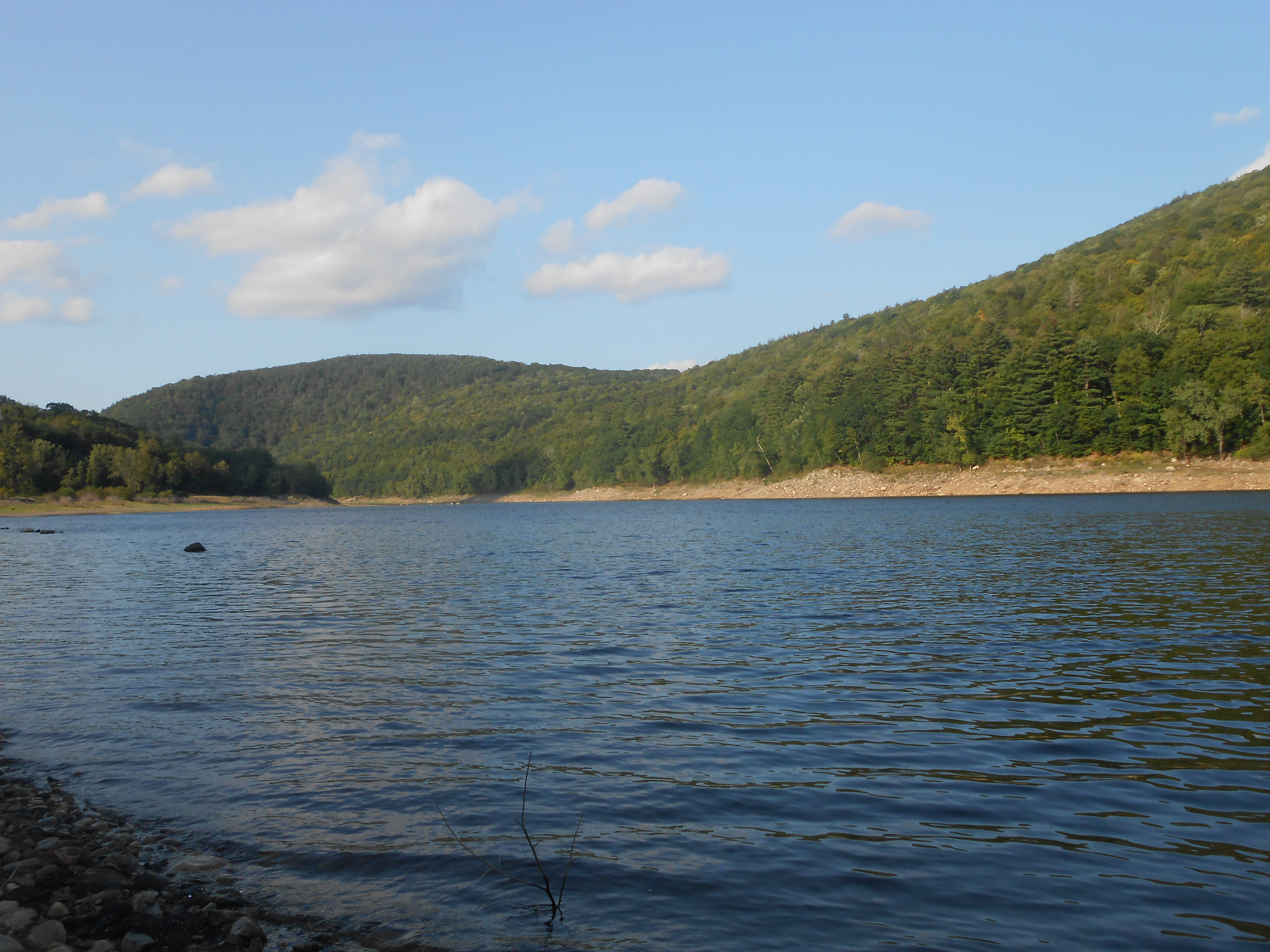
This was a pretty scene of the shore across the reservoir.  I really enjoyed the view.  Too bad we won’t be able to go back this year when the colors really go full-on autumn.

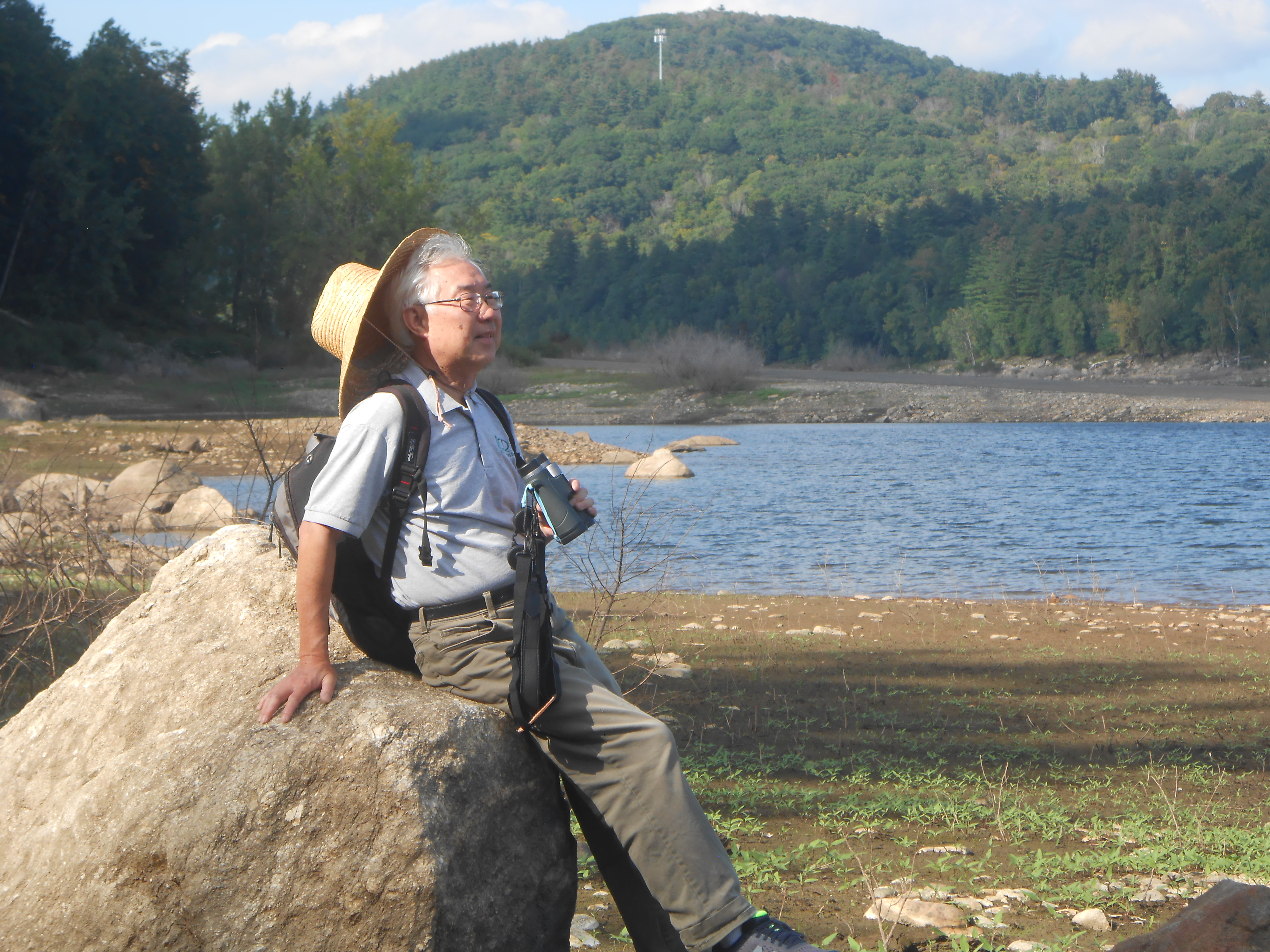
Of course, this is my favorite view.


I hope you’ll pardon me while I duck out now.