Don’t Blink!

Don’t Blink! – Rochester18Cemetery Artistry

Last year, in August, my husband and I drove to Stratford, Ontario for the Shakespeare Festival, to see  Antony and Cleopatra. On the way, we stayed over in Rochester to break up our trip. Once before we’d been to the city and had been driven past two wonderful cemeteries.  We decided that if we ever came back to town, we had to visit.  We love the nineteenth-century “Romantic-style” cemeteries, most of them based on Mt. Auburn in Cambridge: sloping grounds, ponds, shady trees, a beautiful Rochester9parklike setting. As a matter of fact, when these cemeteries were originally designed, the idea was for the whole family to take a Sunday afternoon and picnic, relaxing in the beautiful scenery, communing with nature, and visiting with lost beloveds. The exquisite, evocative, wistful statuary creates a mood of delicious melancholy –– thoughRochester19 Whovians may feel far different emotions when surrounded by (seeming) stone weeping angels.


These two cemeteries face each other across a busy road. Yang and I started on the side without the redstone, castle-like gates. I don’t remember the names, but I bet my friend Tim Shaw could tell me!


The first cemetery that we visited was Catholic, Rochester23which is brought home by the beautiful statuary of saints and angels.

This large monument celebrated St. Joseph, holding his “step son” Jesus.  I love the angels flanking on both sides.  It was extremely hard to get a picture without too much shadowing.  I always liked St. Rochester25Joseph.  He was a good Dad, and my father’s middle name was Joseph – and he was a wonderful dad as well.


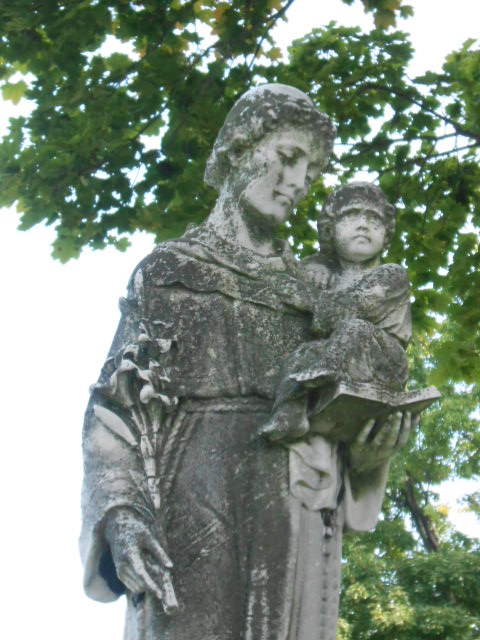
Rochester24Here are two of the St. Anthonys immortalized, also holding baby Jesus.  Clearly St. Anthony is a popular patron saint in Rochester.  Maybe this is St. Anthony’s Cemetery, or a lot of people were praying to find something they’d lost- he’s the patron saint of finding what’s been lost.  Whatever the case, they are so wonderfully sculpted.  The faces show such deep and beautiful feeling.  the graceful folds of the robes Rochester22seem ready to shift with the breeze or a movement.  And the mossy covering adds a lovely Gothic shading.

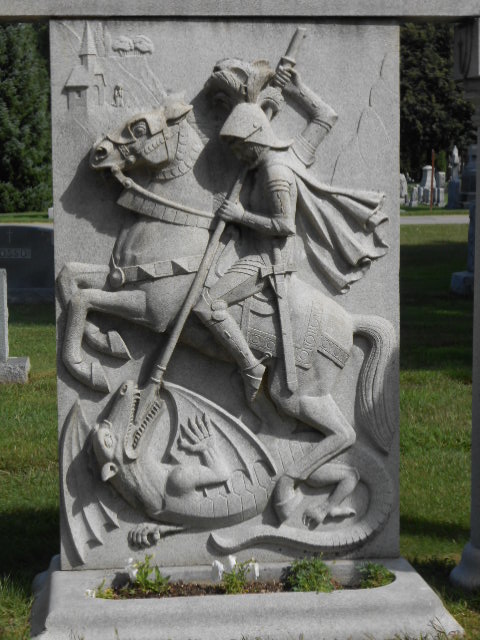
St. George and the Dragon, no less!  Rochester30 This guy’s family clearly thought he was a champion of . . . what?  Pretty impressive, huh?  The monument is actually much wider, with statuary on the sides.  Many of these graves had such elaborate stones that had arches and side statuary.  Two other places you see a lot of these kind of elaborate tombs are at Sleepy Hollow in Tarrytown and Woodlawn in the Bronx. Note thatRochester29 this is one one really long monument.


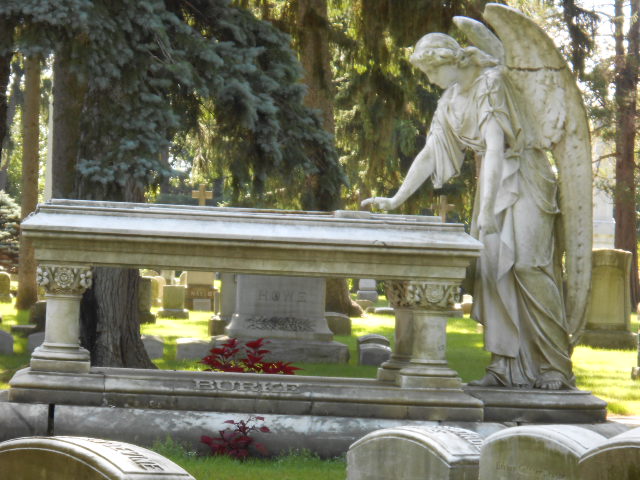
There were also many of the traditional weeping ladies and powerful angels that you find in many Victorian cemeteries. Rochester26 Again, some are still smooth, while others are mossy, but all have a lovely melancholy to them.

Look at  this child, someone’s little girl.  The closeup shot of her face lets us see her as a real person.Rochester6  Look at the sadness in her expression as she holds  a basket of flowers as delicate, lovely, and evanescent as her own life.


I’m particularly fascinated by this brooding woman, standing tall, but not quite able to look us in the eye.  Still, she’s peeking through one uncovered eye.  Or maybe she just has a really bad migraine?  Anyway, Dr. Who fans would probably think she’s trying to cheat.Rochester28


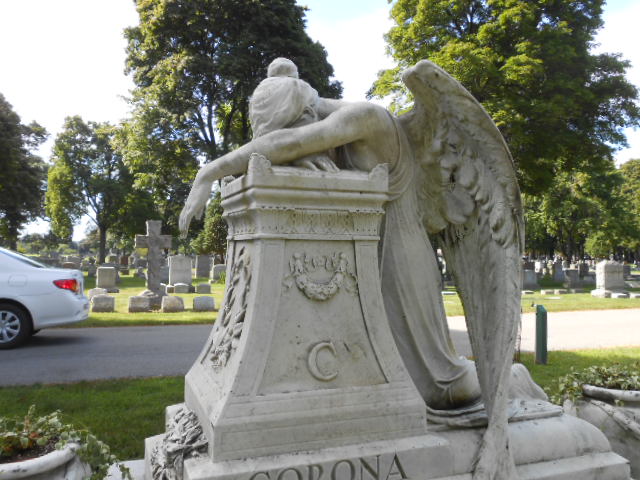
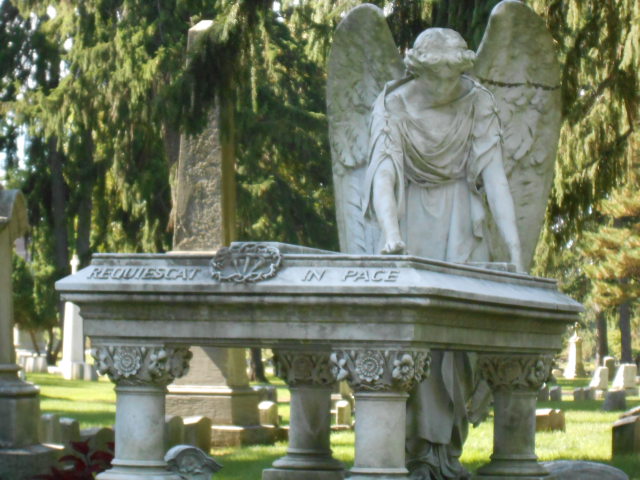
Across the street and past the redstone gates it was much shadier; there were far more trees.  And this was a brutally hot August afternoon.  You can tell by how washed out the sky looks in some of the shots how brilliant the sun was that day.  As my physicist husband pointed out, the UV was baaad. DSCN0972 I have to point out some images of my favorite monument, the greiveing angel.  This figure was actually a tad unnerving, but beautiful.  The grace of the carving made it seem on the verge of movement.  And those enormous wings hinted at an unsettling power.  So here are two shots. DSCN0974


 Again, Dr. Who-followers, keep your eyes open!


Smart-Talking Gals Two: Lucille Ball

Blog 12: Smart Talking Gals Two


Publicdomain LucyLucille Ball

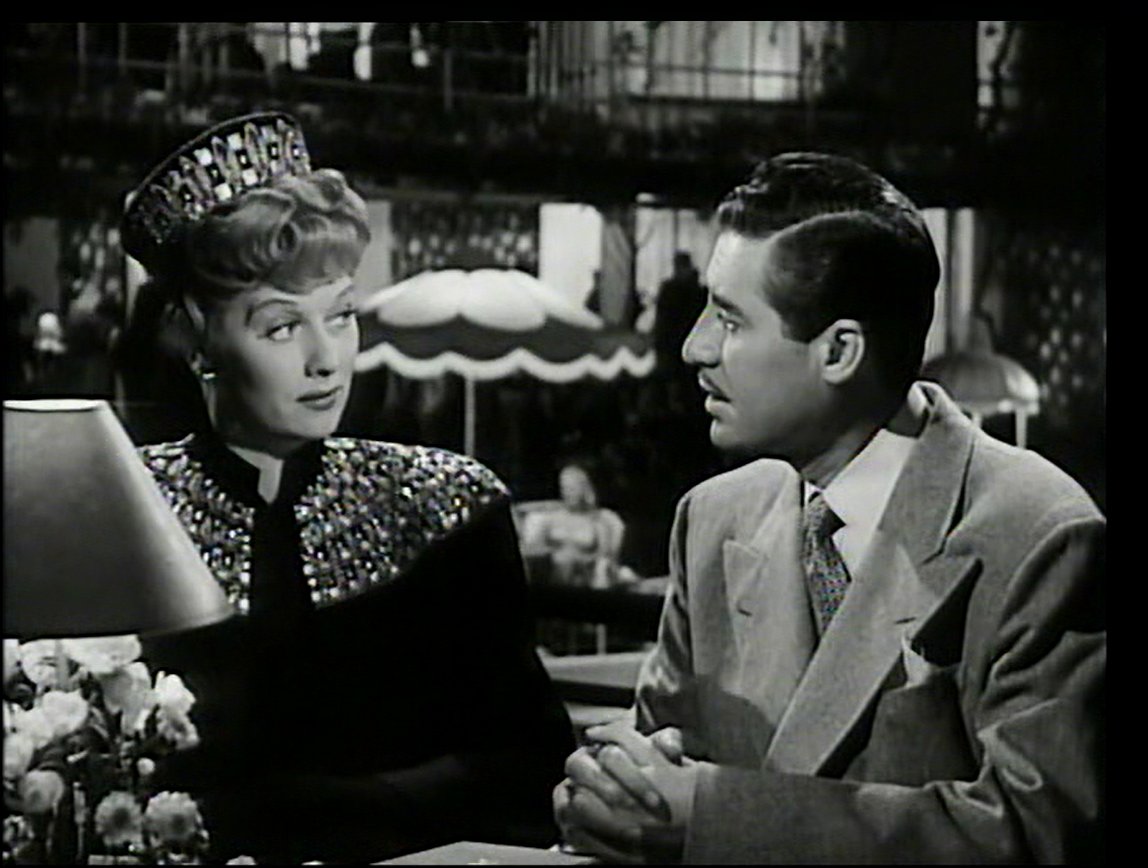
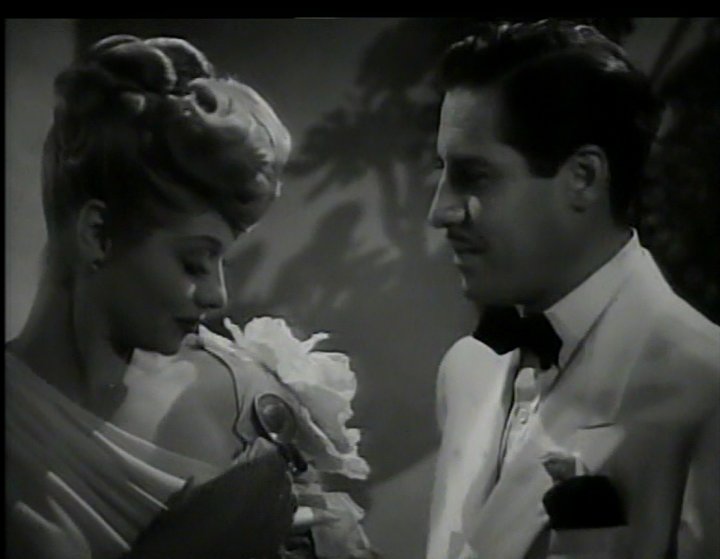
Before Lucy became the daffy redhead of I Love Lucy fame in the ’50s, she was a sharp as a fox smart-talking gal in the late ’30s and ’40s. She had more than a few roles as a no-nonsense, sharp-witted, tart-tongued redhead, but the three that stand out the most for me came in the late 1940s: Easy Living (1949), Two Smart People (1946), and The Dark Corner (1946).

In Easy Living, Lucy’s Anne Lenehan is secretary to a football team owner/manager, played by Lloyd Nolan –– and she has it bad for good-guy-with-problems and star player, Victor Mature. But this gal in no moony pushover. She talks tough and keeps her guard up, deftly deflating Mature’s celebrity by dryly calling him “Miraculous” and warning him when a team mate gets cut, “You ride the gray train, too. Don’t wait until they shove you off.”

Why is she so acerbic? Another player comments sympathetically to Mature, “She was married to a heel” –– whom we later find out ran around on her and was so bad that even his pop, Lloyd Nolan, condemns him as, “No good.”

There’s a neat little scene in Mature’s train compartment that shows Ball at her fast-talking best, just letting her integrity shine through tiny cracks in her cynicism. Mature asks what she’s doing in there, and she quips, “Just for a change of pace, I want to be with someone who doesn’t like me.” When Mature turns that into a crack about her having dated most everyone else on the team, she sets him straight with a little anecdote about her being the subject of a story on “The New York Girl,” that ends with telling her date she had “a lovely evening” and “kissing him good night.” Then she lets him know how she feels, but that she’s no pushover, by kissing him before saying, she’s had a lovely evening and then leaving.

So, what’s really keeping then apart? His wife, whom he loves –– the dope! This time out, it’s the wife who’s greedy, superficial, and a two-timer, EasyLivingselling herself to a wealthy older man to get a boost for her decorating business. Now it’s the other woman who’s the loyal, sharp, wise one –– and Vic’s too much of melon-head to catch on. He almost does, but then decides to literally “slap some sense” into his wife –– leaving us relieved that Lucy’s Anne dodged that bullet, even if not everyone in 1949 figured that one out. You never know, though.

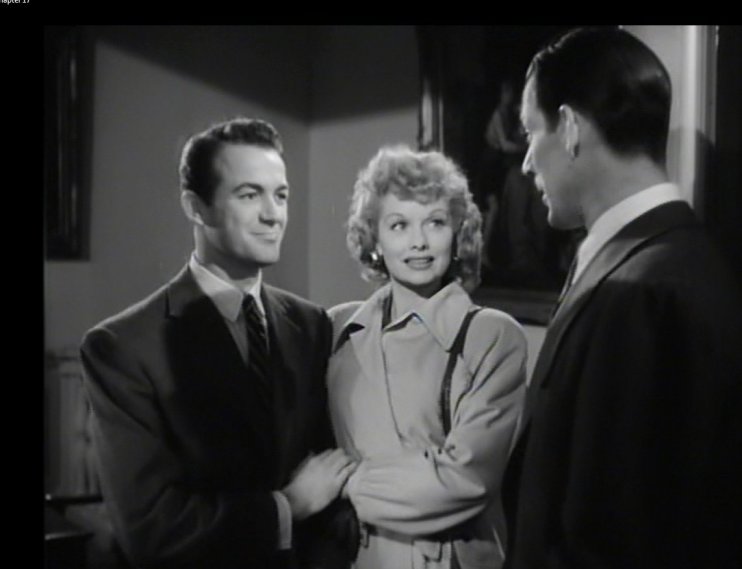
In Two Smart People, Ball plays Ricki Woodner, master con artist, who matches wits right off the bat with another primo scammer, Ace Connor (John Hodiak). Right at the picture’s start, they have a clever little exchange about ortolans (look it up or watch the movie!) and plums, before they each Lucy15proceed to masterfully undo the other’s plot to take the same pigeon. Ricki follows Ace onto a train he’s taking for a roundabout gourmet lover’s trip back to New York where he’s cut a deal to take the rap for some bonds he stole, without actually having to return the $500,000 they’re worth. Ball’s character starts off with a plan to get even with Connor for scotching her swindle, but the two end up falling in love, without either getting too soft. When Ace cracks that she’s going soft, Ricki knowingly comments, “Pretty sure you can walk away from this? You might change, too.”Lucy17a In the end, Ricki outfoxes Elisha Cooke’s crooked hood, who’s been on their trail and tried to get her to help him cheat Connor. Lloyd Nolan (again!) is along for the ride, literally, as the detective bringing in Connor, but joining him in making the trip back one last fling before the con artist has to take on five years in the pokey, all while trying to dope out where Ace has hidden the bonds. Both guys have way too much class to even think of taking a poke at Ricki –– and if you see her in action, you’ll figure they made a smart choice.

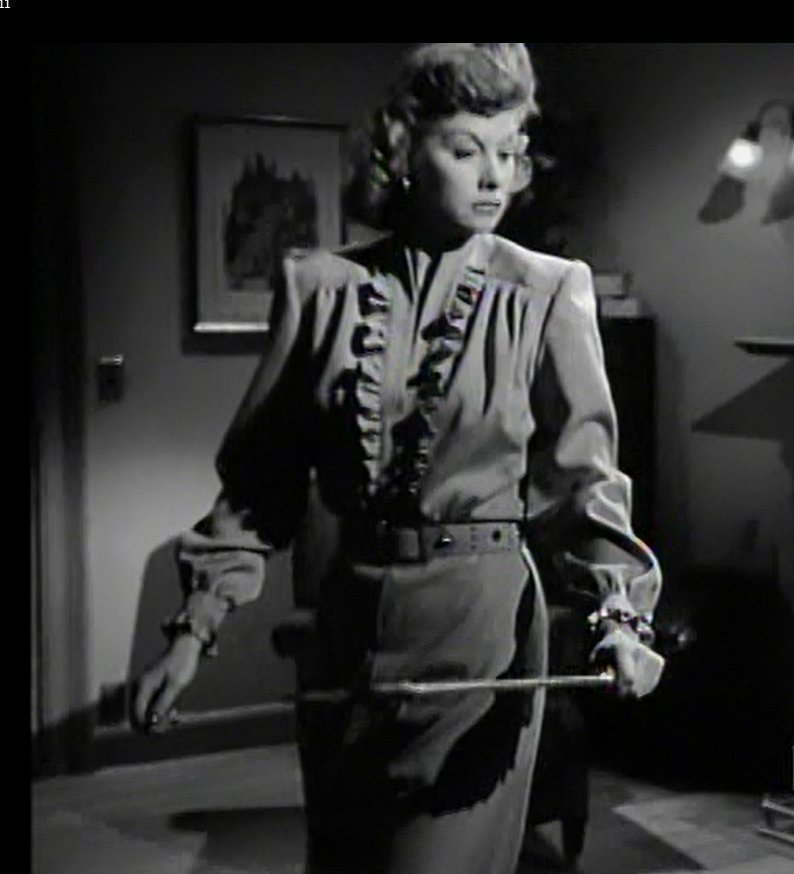
The last movie, The Dark Corner, is probably one of the best parts for Lucille Ball –– and she gets top billing! Once again, Ball is an all-knowing secretary, deftly demonstrating her wit, loyalty, and authority by parrying the intrusive questioning about her P.I. boss from a police detective with, “I don’t know anything you couldn’t find out by asking Mr. Galt.” Lucy2When the detective pushes his luck, she shuts him down with, “I sharpen pencils, do the typing, answer the phones, and mind my own business.”


Her earlier comment to the policeman about her boss, “I like him,” tips her hand that she might be sweet on him. Lucy However, when she tells Galt to put his detecting skills to work and find her a pair of nylons, her flirting is sharp and sexy; she’s nobody’s pushover and he’s got to impress her. Galt takes her out to dinner and then the arcade, and after a successful run in the batting cage, she quips, “What else can I beat you at?” when he tries to put the moves on her, she cracks, “I know when you’re pitching a curve at me.” Galt humorously defends himself with saying that you can’t blame a guy for trying “to score,” and she cracks back, honesty and authority wrapped in wit, “‘I don’t play for a score; I play for keeps,’ said she with a smile.” Lucy4aKathleen gives him an equally clever check at the end of another date, when she stops him at the door and he “innocently” asks if he can’t even come up “for a drink of water.” Without skipping a beat, she smiles dryly, “Pitching low and outside.” She’s not turning him down out of virginal innocence or prudery; she knows she’s worth more than just a toss in the hay. No one’s going to take advantage of her. Galt’s grin and goodbye show he enjoys and respects her street smarts, humor, and independence.

And Kathleen shows herself a valuable ally in practical ways. She doesn’t lose her nerve following Lucy7a thug type (William Bendix!), cleaning up a crime scene for a murder’s frame job of Galt, tracking down clues, stalling the cops, and figuring out the real genius behind the murders. Lucy8aSo, when Kathleen tells Galt, “C’mon, open up the steel safe. I want to know. I want to help,” he knows she’s going to see him through his troubles with the cops, a former crooked partner who’d sent him inside on a bum rap, and a murder frame. He knows that she has the insight, the smarts, and the guts to be as good as her word. He’s got a primo smart-talking gal in his corner.

Lucy13a

Images from The Dark Corner and Easy Living @1949 and 1946, respectively, RKO Picture; images from Two Smart People @ 1946  MGM.  Color image of Lucille Ball from Google Public Domain Images of Lucille Ball.

Beijing Arboretum

One of my favorite places on our trip to China in November ’14 was the Beijing DSCN1267Arboretum next to Xiang Shan (Fragrant Hill, 香山).  We arrived there after a long, traffic-packed drive from the city and got a second dose of autumn colors.

There were plenty of paths to hike amongst the trees and plenty of critters and birds about, including the ever-present magpies and azure winged magpies.  There were also many Great Tits (like our Chickadees) and sparrows – is there ANY place that isn’t over-run with sparrows?  Unfortunately, they were all too quick to allow any Dscn1270picture taking.  However, here’s a picture of Yang, who as just as charming to behold as any of our feathered friends.

The trails wended through wonderful pine and willow forests and up slopes of jagged rocks, at times past pavilions and monuments to students who had camped out and trained here to prepare to fight the Japanese during WWII. Dscn1277 Yang and I weren’t quite so tough.  Here, I’m giving my knee a rest (gardening injury), well-pleased with the scenery and the hiking. Aren’t the seats made from old red wood trees interesting?

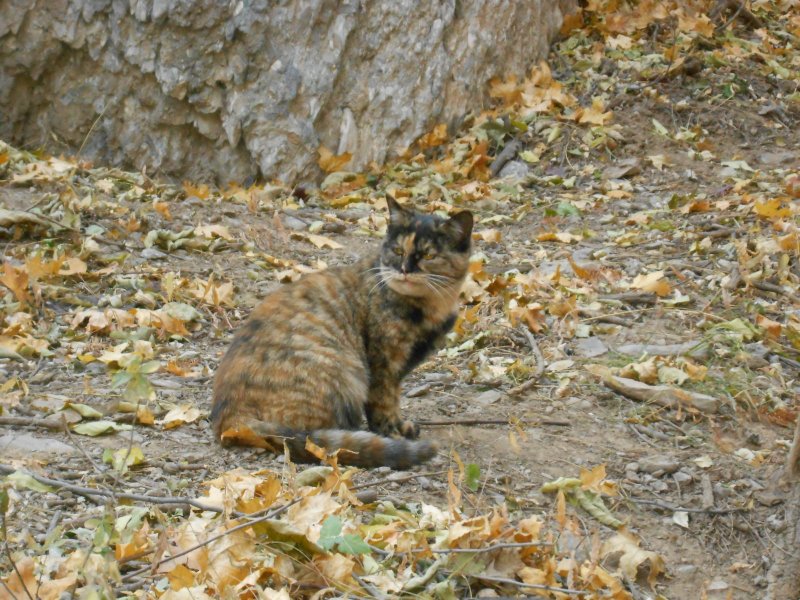
There was also some unexpected forms of “wild life” in the park.  We came acrossDscn1273 well-fed dogs and cats, just chilling in the forest, part of the families of people who worked and lived at the park.  Here is a cat with a surprising resemblance to Winston Churchill.  He even miaowed gruffly!  Dig that expression.  Could it be a reincarnation?

A young Chinese girl and I had a laugh over how unique he appeared, and how nonchalant, in a gruff way, he was with humans.  When she said in English to me, “It’s a cat!” I meant to say “Dui” In Chinese, but my default mode slipped and I concurred, “Oui!”  We both had a chuckle.  Dscn1275I actually managed to converse a little with her in Chinese, saying that I liked cats and we had two at home.  That was as far as I could go in Chinese at that point, so we switched to English.  She and her boyfriend were a cute couple, so we took a picture of them with their camera and they took a picture of us with ours!


Dscn1278 When we came down the hill, we enjoyed the beautiful fall colors around us.


Dscn1279


Surprisingly, though there was lots of traffic coming out here, most people were visiting the nearby Xiang Shan parks.

Dscn1280


Dscn1286

This little guy is called a Little Grebe (if you click on the picture, you can see him much better).


Here’s one more neat shot of the wonderful fall colors.  I understand that when there hasn’t been a drought, the colors are really gorgeous.

Dscn1284


Finally, I have to insert a picture of a creature we saw which really knocked Yang and I for a loop.  Like dopes, we didn’t take the camera out until he had scampered away.  So, this creature climbed out of the tangle of a twisted pine.  At first, I thought I was seeing a big black crow.  Then he settled on the ground and sat up.  I was flabbergasted!  It took a moment to figure out we were seeing a squirrel.  He poked around, looking for food, then sat eating for a bit, and finally scampered away by the time I realized we had a camera.  When we got back to the hotel, we checked him out on line.  I knew I’d seen pictures of this critttree squirel1er before, and discovered he was a Eurasian Red Squirrel – except he’s black.  Go figure.  Interestingly enough, I read that the black variety of squirrel thrives in pine forests better than its red brethren.   There’s plenty of pine in this place! tree squirrel4 Also, in China, the name for this type of guy is “Satan’s Squirrel.”  He is rather demonic looking, isn’t he?  Apparently, they are also bred commercially and sold as pets.

Getting home was almost as much of an adventure as the hike, what with overpacked buses – when they finally came.  What the heck!  When you have great company and beautiful weather and everyone’s in the same boat, er, bus, who cares!Dscn1272


No copyright infringement intended, noncommercial use of photosTree Squirrel Photo 1: http://cutterlight.com/tag/hiking-near-ulaanbaatar/
Tree Squirrel Photo 2  Squirrel, Photo © Tim Edelsten on http://www.birdskorea.org/Birds/Birdnews/BK-BN-birdnews-2009-02.shtml


Pacification via a Dosage of Feline Adorableness

Hi folks! Many people have been champing at the bit for more information on Bait and Switch. Since I don’t have anything for you yet, I thought I’d extend a calming hand with this post about a beautiful black kitten who became my buddy on my trip to China last November.

My husband’s sister-in-law and her husband took us out to a cafe for coffee and dessert. While they had me sitting alone, waiting for them to graciously bring over all our comestibles and beverages, I felt something soft settle in my lap. I looked down and this is what I found!Cat3a

Of all the people in the restaurant, this little black kitten had selected me for her buddy. Do yoCat2au think she knew I was missing my two feline pals at home and needed some catly comforting? Maybe my lap was more padded than the other customers’? Whatever, she settled in for me to do some petting that pleased us both, while she dozed and kneaded away. When the others joined us, she protested leaving my lap when my sister-in-law picked her up – sneaking back as soon as Cindy wasn’t paying any attention.

Needless to say, the kitten was quite happy to get a few bites from my cheesecake; but her visit wasn’t purely gustatory. She decided to snuggle with me long before any food showed up.Cat5

Happily, this little guy was no stray. She lived at the cafe with her mom and two siblings. You can see from her coat and girth that she was well-cared for.

TheCat6a owners told me that her name was Shao Bai, which means “Little Whitey.”  Sometimes irony is adorable.

Dusty from Bait and Switch would surely approve!  Dusty reduced1

Mont Saint Michel

When I was a little girl, perusing my geography book in a grade I can’t quite remember, I came across a photograph of and sidebar on the island castle/monastery Mont Saint Michel. Its inaccessibility, magnificence, and antiquity fascinated me.  I remember reflecting that never in a million years would I get the chance to visit such a cool place. It was a place to dream on, though.  1Stmicehl1Well, a million years rolls around sooner than you would ever expect. Last month, I found myself journeying to the mysterious isle, and not being disappointed.

The tide was out when we arrived––otherwise, we never could have crossed to the towering rock island, which would have been surrounded by tide-ripped ocean. Still, no one ought to feel all that much at ease, even with the tide out, for the sands hide quicksand, 2St.Michel2waiting to suck you down. So, stay on that boardwalk!  Then, when the tide comes back in, it’s with a rush that’s earned the nick-name “galloping horses.”


The monastery/cathedral that tops the island seems like an organic outgrowth, built into the 3Village1rock, as is the village, circled by city walls, that spirals up narrow, cobbled streets and ancient stone stairs to the  magnificent edifice melded into the summit.


3village2


5steps1

5steps2


Fortunately, the collapsible stool Yang got me, enabled me to climb almost ad infinitum, with moments of rest to forestall the onslaught of my plantar fasciitis pain.7steps4


10view below1

It’s a long drop below.


9gargoyles2What would a castle/cathedral be without presiding gargoyles?


13cathedral1

The church where mass was said had beautiful Gothic architecture


14cathedral2


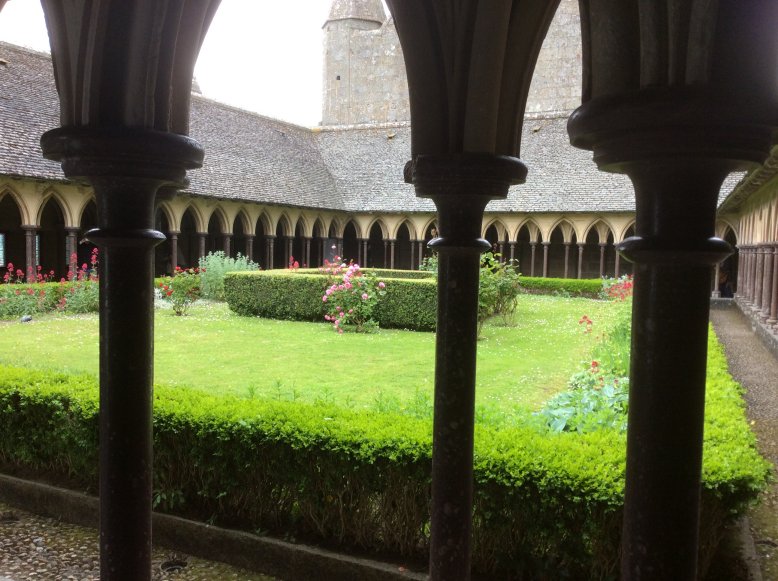
Outside at the top were gardens, which reminded me of the Cloisters in New York, near Fort Tryon State Park.  The Cloisters is clearly inspired by this wonderful aspect of some monasteries.  But how do 15cloiser1these flowers grow so beautifully on an island smack dab in the ocean?  How do the salt air and the harsh winter cold affect them?


Inside, within the monastery that contains that cathedral space is the refectory that fed a 21refectorypassel of monks and their royal guests in ages long ago.  They must have seen me coming and hidden all the food.


Crypt:  here, the crypt refers to the original meaning, a hidden place as opposed to a burial 19inside1place.  This was one of the vast chambers in the monastery.  The lack of light in these rooms made taking photographs extremely difficult, so I can’t share the dark, dreamy quality of the chambers that twisted around each other. That’s why the image of the Black Madonna here (a much later installation) isn’t the best.   I could definitely understand why in “The Horla” Guy deMaupassant characterized Mont Saint Michel as a setting that left one susceptible to possibilities of the fantastic and eerie.18Blackmadonna


24comingdown3

Going down showed us the beauty and magnificence of the curving stone walls, seeming to be an organic extension of the mountain rock.  22comingdown1


And gorgeous flowers and other plants revealed Nature’s tenacity, growing from the slightest cracks in man-made and Nature-made walls.


25comingdown4


26cominingdown3


Back in the village, we wound down the narrow streets, toward St. Michael’s Church, with the 27downvillage5warrior angel, himself, on guard in statue form by the door.  We visited inside and felt the joy of painting, stained glass, and statuary celebrating wonder at the Divinity (Take that Protestant Reformation!).  We also visited a tiny cemetery of tall gravestones with plots of flowers or colored broken stones enclosed by stone borders.  Finally, we made it to a little cafe for lunch, where I managed to order in French without embarrassing us!  Mmm, savory galettes of jambon, champignons, and fromage, complemented by cafe au lait.  What a wonderful day.28downvillage

Jewels of the Triple Crown Part 3

Blog #8

War Admiral: The Mighty Atom

Man O’ War was considered the yardstick for greatness in racing for most of the twentieth century––and still is by some. The original “Big Red” was a tall, rangy powerful chestnut with a star and stripe on his face and the look of eagles in his eyes. A fast horse out of the gate, he was almost impossible to pass, except for that one really bad start that cost him his only loss, to a horse aptly named Upset. War Admiral was his best son, amongst some fine stakes horses. Two horses couldn’t have looked more different: Big Red tall, some claim 16.3 hands, and lean; War Admiral muscular and compact, only standing 15.3. Man O’ War a gleaming red chestnut, the Admiral a solid dark brown, almost black. Nevertheless, the two shared a blinding speed and feisty spirit that brought them home first over some very good competition.

War Admiral, nicked named the “mighty Atom” for compressing such a concentration of speed and power in such a small package, was foaled at Riddle Faraway Farm, the home of his magnificent Dad and owned by Samuel D. Riddle (who raced both horses). As a two year old, the colt’s record was respectable, though not spectacular: three wins in six starts, including one stakes race (Drager 62, Robertson 318). Still, he showed both promise and spirit, which he fulfilled by going unbeaten at three. In the Chesapeake Stakes, he trounced the winners of the Flamingo and the Santa Anita Derby, leading Samuel Riddle to break his rule of not running in the Derby for the first and only time (Riddle felt that early in May was too soon to ask a three year old to go 1 1/4 miles). After War Admiral caused an eight-minute delay at the starting gate (the spirited colt loathed the confinement), he shot to the lead and stayed there to romp home by 1 3/4 lengths over the good Pompoon (Drager 62, Robertson 318). The Preakness proved an even more thrilling race, with Pompoon’s jockey sending the colt to challenge War Admiral early and the two staging a furious battle on the lead. War Admiral prevailed by just a head (Drager 63-65, Robertson 318). Interestingly, Robertson claims that the victory was more authoritative than it looked, with the Admiral decisively turning back every attempt Pompoon made to move ahead (318). The Belmont Stakes was a particularly impressive victory, and not just because War Admiral led from start WarAdmiral2to finish as if he were on a sprint rather than a 1 1/2 distance run––or because he tied the American record for the distance of 2:28 3/5 (Robertson 318). War Admiral left a trail of blood behind him as he trotted to the winner’s circle because at the start of the race, during his hijinks, he had “shear[ed] off a piece of the wall of his right forefoot” (Keller qtd Robertson 318) and “run the race without noticing” (Robertson 318, Drager 68).  You can see his accident in the photo above.

War Admiral was out of action for four and a half months, but when he was back in action, he racked up wins in the Washington Cap and the Pimlico Special (under 128 lbs!), to take Horse of the Year Honors for 1937 (Robertson 318). That year, another horse was making headlines, the rag-to-riches handicap star you may have seen a movie about: Seabiscuit. The Biscuit and War Admiral missed meeting in 1937 when the former was pulled out of the Washington Cap, and 1938 proved to be a year of exciting rivalry for handicap and horse-of-the-year honors between the two. Both horses won big and racked up high earnings; both horses carried high weights to victory over the top stakes stars of the year. After several near misses, the two finally met in a winner-take-all match race for $15,000 (not chump change in 1938). Anyone who’s been to the movies in the past few years knows how that turned out. Tom Smith used shrewd training techniques to get the Biscuit to break fast and put on an early burst of speed. For the first time in a long time, War Admiral was headed, almost literally, out of the gate. The Admiral made several runs at the Biscuit, but it was the older horse who finally prevailed (Drager 73-82, Robertson 325-26). Still, War Admiral hardly suffered a broken heart, turning around shortly afterward to trounce his rivals soundly in Rhode Island Cap under 127 lbs. at the old ’Gansett in Rhode Island. War Admiral came back to racing at five; owners weren’t afraid to ask their horses to prove themselves (without necessarily over racing them) in those days. He took a prep for the Widener, then was seWarAdmiral1t back, first, with laryngitis, then with a bowed tendon, and retired (Robertson 326, Drager 83). Marvin Drager (83) suggests that War Admiral got his “revenge” on Seabiscuit by having a far more successful breeding career, siring Busher, War Jeep, and Busanda (the inestimable Buckpasser’s Mom). However you look at it, War Admiral did his Daddy proud.

Sources: The Kentucky Derby: The First Hundred Years (Peter Chew); The Most Glorious Crown (Marvin Drager); The History of Thoroughbred Racing in America (Willaim H. P. Roberston).

Smart Talking Gals, Part One

Blog #7 Smart-Talking Gals27-claire_trevor

One of my friends was asking me about my inspiration for Jessica Minton and Elizabeth Hennessey in my novel Bait and Switch, and I explained that I love creating characters in the vein of those smart-talking gals from films of the 1940s (sometimes ‘50s and 30s, too)––especially film noir. Lots of ink has been devoted to the femme fatale/innocent girl split-personae of women in noir, but not enough has been devoted to the women whom writers and actresses created who could not be easily relegated to either the “whore” or the “Madonna” category. Sheri Chinen Biesen moves us in that direction, though, with her article “Manufacturing Heroines: Gothic Victims and Working Women in Classic Noir Fiction,” where she discusses “multi-faceted, working career women” as part of the film noir cast of characters. I can see definite overlapping between her working girls and my smart-talking gals. What I’d like to do is focus on several actresses who made careers out of playing the smart talking gal––and you can feel free to suggest and write about such actresses, yourself, in this page’s comments.

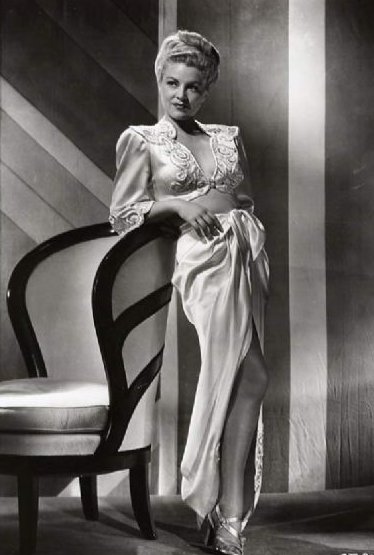
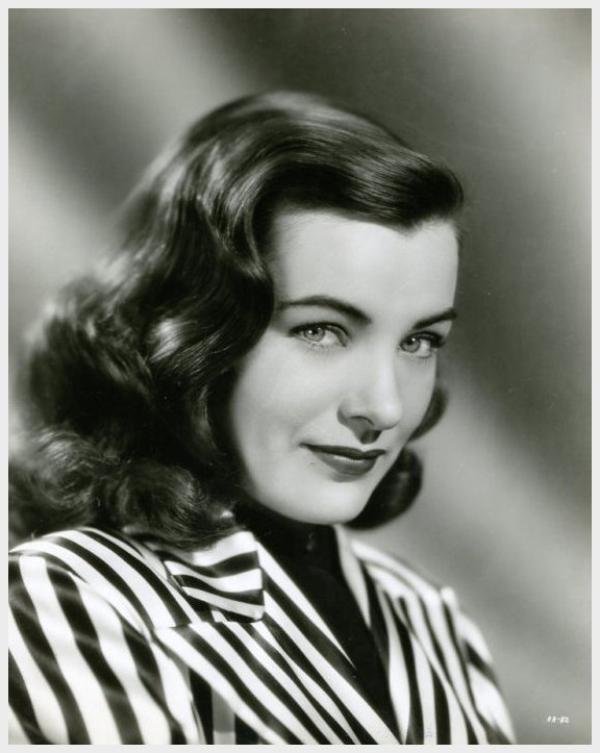
JoanCFirst, though, what is a smart-talking gal? She’s too sharp witted, independent, and experienced to be the virginal, innocent. Still, she has too much wit and class to be anyone’s moll. Further, she’s definitely not a femme fatale. She doesn’t so much use wiles as wit; and her strength, smarts, and experience serve to get at the truth, solve conflicts, and protect herself and those she just might let herself care about––if they prove they’re worth it. She has a heart, but hard knocks have taught her to armor it. She may be sexually RainesBexperienced, she may not be; she’s definitely not an innocent. This type redefines what it means to be a “good girl.” Some actresses who best personify the smart-talking gal include Joan Bennett, Claire Trevor, Ella Raines, Ida Lupino, Veronica Lake, Lucille Ball, Lauren Bacall, Rosalind Russell, and Lizabeth Scott. How about we look at a few of them at a time?

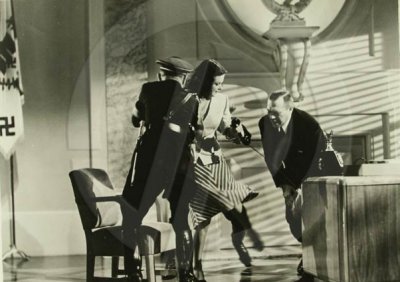
Joan Bennett: Joan has to be my favorite, and in many ways, she inspired the wit and JoanAindependence of Jessica Minton in Bait and Switch. Now, Joan could play the evil femme fatale with the best of them. Think of Kitty March in Scarlet Street. Still, even some of her “hydrochloric dames” (as a NY Times critic put it) revealed genuine humanity behind caustic smart talk and ostensible manipulativeness. In The Woman in the Window, The Macomber Affair, and The Woman on the Beach, her characters act in defense against the bullying of men, and their seeming femme fatale status is a projection of a man’s fears and darker nature. However, in other films she’s a lot more fun––or at least clearly not the villainess. This is definitely more like Bait and Switch’s Jessica. In House Across the Bay, Joan’s a show girl not about to let anyone reduce her to a kept woman “dressed up in furs” who “takes a Pekinese for a walk around the block.” She’s also no pushover for a tough broad, either. When a jealous dame calls her, “Cheap, cheap, cheap,” she laughs back, “Where’s the bird seed?” And when that same dame pushes her luck further, Joan’s Brenda Bentley nails her with the rejoinder that she has a voice like “four panes of cracked glass.” The Man I Married finds Joan getting away JoanDwith kicking Nazis in the shins and telling a German-born husband who has let German imperialism go to his head, “Heil, Heel!” In Confirm or Deny, she forestalls Don Ameche’s passes with dry humor and upholds national security with determination as the London blitz rages on. While in The Secret Beyond the Door, when faced with almost the same problems as the second Mrs. deWinter, rather than turning to whimpering mush, she uses common sense, humor, honesty, self-confidence, and a healthy dose of Jungian analysis to set everyone, including herself, straight. The Scar shows Bennett at her most incisive and tart, deflating Paul Henreid’sJoanF attempt to charmingly snow her with, “First comes you, second comes you, third comes you . . . . and then comes you.” When he later calls her “a bitter little lady,” she shoots back a cool, “It’s a bitter little world.” And yet Joan’s Evelyn Hahn has the heart to trust him when he finally does try to be on the square with her, only to have that heart smashed when fate, not his duplicity, makes it seem he has deserted her. In my film noir class, all the students, upon seeing her shadowed expression of resignation at the end of the movie, call for a rewrite.

Claire Trevor: Here’s another actress who can also hand you a dangerous femme fatale, but with NO redeeming traits. Her sexy villainesses in Johnny Angel; Murder, My Sweet; and Born to Kill all epitomize the characterization made by Anne Shirley’s character in Murder, My Sweet as “‘big league blondes.’ Beautiful, expensive babes who know what they’ve got . . . all ClaireTrevorBbubble bath, and dewy morning, and moonlight. And inside: blue steel, cold––cold like that . . . only not that clean.” Nevertheless, Claire could deftly play the smart-talking gal with wit and warmth, as evidenced by her art critic in Crack-Up, Brian Donlevy’s seen-it-all secretary in The Lucky Stiff, the girlfriend who helps Dennis O’Keefe escape prison in Raw Deal (and gets one, herself when he dumps her for Marsha Hunt), and her government agent in Borderline. She’s particularly fun to watch in Crack-Up and Borderline. In the first, she helps a former “Monuments Man,” played by Pat O’Brien, evade the police when he’s framed for art theft and murder, while juggling Herbert Marshall’s British Intelligence agent and the police. Driving up and rescuing O’Brian’s fugitive art expert from being picked up by the police, she responds to his suspicion and lack of gratitude by pulling the car over and TrevorAremarking with a neat blend of sharpness and warmth: “You can wait here. They’re going to put in a streetcar soon. Unless . . . unless you have some dim idea of what you’re doing and want me to help you.” Borderline finds Trevor as an undercover police woman trying to crack a narcotics ring by pretending to be part of a couple whom a drug trafficker will use to smuggle drugs. What she doesn’t realize is that her “husband” is also an undercover agent with a different agency, who is just as ignorant about her. The two have some wonderful exchanges, and their attempting to get each other to “cooperate” and go straight with each other’s agencies at the border is worth a chuckle or two.

Ella Raines: Ella Raines of the pert page-boy bob; the mischievous, knowing half-smile; and the clear green eyes that hint of something devilish up her sleeve is always a joy to watch. In RainesAThe Phantom Lady, she’s Kansas, the faithful secretary who’ll move heaven and earth to clear the boss she unrequitedly loves of a murder frame-up. She’s tough enough to stalk a bartender to break his lying testimony (only to overplay her hand when she frightens him into running in front of bus rather than into telling the truth). She’s intrepid enough to doll herself up like a tart to try and pump a hyped up (or is it hopped up?) drummer for exculpatory info. Yet she’s compassionate enough to tread gently when she finally finds the fragile woman who holds her boss’s (and beloved’s) alibi in her broken mind. The Runaround finds Raines outsmarting two P.I.s hunting her down to bring her back to a father who doesn’t want his daughter marrying the man he believes a bounder, all with a knowing twinkle in her eyes. In The Web, she playsRainesC Noel Faraday, efficient and almost all-knowing secretary to shady Vincent Price––she doesn’t realize quite how shady Vincent is. All this while, initially parrying the come-ons of a brash lawyer played by Edmond O’Brien, replying to his claim that when he has “forty million” he’ll have a secretary that looks like her with: “Oh, my tastes are fairly simple. Twenty million would be quite enough.” Also check her out The Strange Affair of Uncle Harry, Impact, and White Tie and Tails.  A neat web site on Raines can be found at: http://ellarainesfilms.blogspot.com/2013/01/ella-raines-in-web.html

Quotations from Claire Trevor’s movies can be found at “Claire Trevor,” on the IMDB, under quotations for the film.  Quotation from Ella Raines’s film can be found at “Ella Raines,” on the IMDB, under quotations for the film. Quotations from the Joan Bennett films can be found in the films noted. I remember them. What can I say; I’m a movie geek––but I don’t live in my parents’ basement.  So there!  Photos of Joan Bennett from the author’s collection (mostly bought from Jay Perino’s The Mint); photos of Claire Trevor from unknown sources; and photos of Ella Raines from the ellarainesfilms.blogspot (second image) and unknown sources.

Jewels of the Triple Crown, Part 2

Blog #6 Father/Son Act: Gallant Fox and Omaha

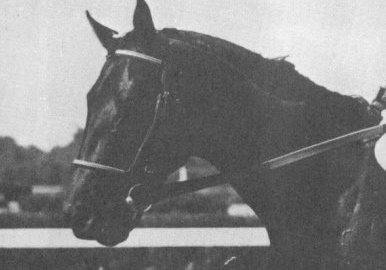
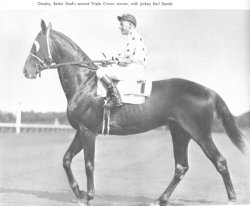
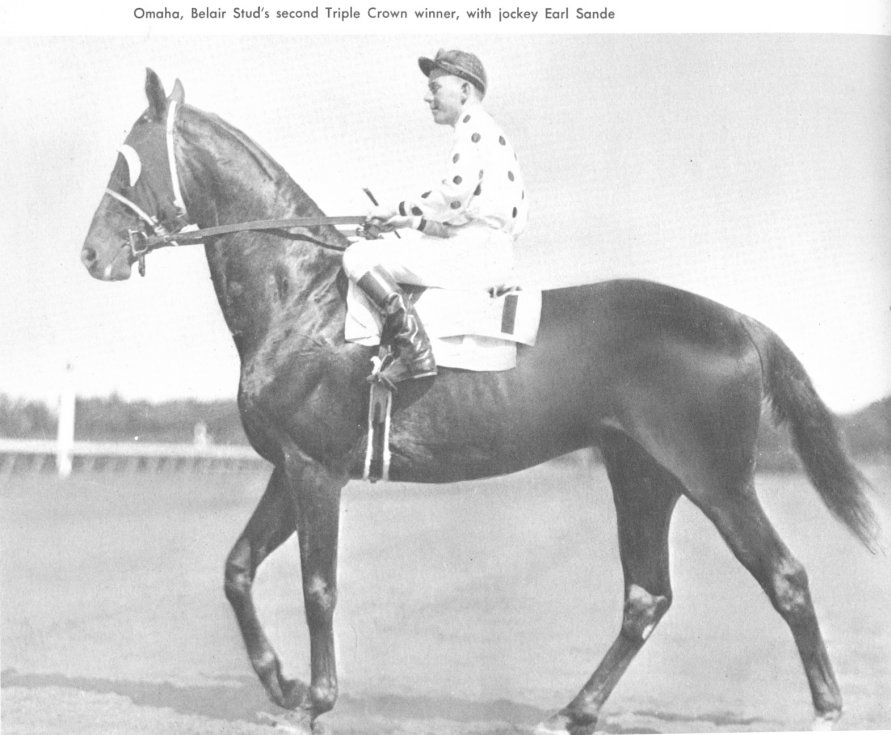
Although there have been many parent/offspring winners of individual triple crown races, there only one such duo has taken the entire triple crown: Gallant Fox and his son Omaha. Both horses were owned and bred by William Woodward’s Belair Stud and both carried his white with red dots silks. Gallant Fox was foaled in 1927, a trim bay with a crooked blaze, son of import Sir Gallahad III. As a juvenile (two-year-old) he was not stellar, but not bad, winning two of six starts, including stakes. His problem was not lack of speed or stamina but a plethora of curiosity (Drager 36). William Robertson described him as “lively as a puppy and just as inquisitive” (276). At the start of the Tremont Stakes, he was left at the barrier because he was too fascinated with watching the other horses. Things got much better at three.

GallantFoxThe year of Gallant Fox’s triple crown, the Preakness was run before the Dery, on May 9th. The colt went into the Preakness with a romp in the Wood Memorial. Even with bad racing luck, being boxed in and shoved back, Earl Sande found racing room for the colt, and after a tough duel with Crack Brigade, Gallant Fox pulled away for a three-quarter length victory. All this was a major coup for the colt who had “appeared to be so hopelessly lost on the first pass of the grandstand,” earning him his soubriquet “The Fox of Belair” (Drager 38-40). In the Derby, on May 17th, he came from behind in the pouring rain to win by two lengths (40). The Belmont, run on June 7th, matched him against juvenile star Whichone. Everyone expected a spectacular duel between the two; but when Whichone challenged in the stretch, Gallant Fox turned him back easily for a three-length win (43-44). From then on, there was little turning the Fox back, as he went on to win the Dwyer, Arlington Classic, Saratoga Cup, Lawrence Realization, and Jockey Club Gold Cup. There was one shocking comeuppance for the Fox at Saratoga. In the Travers Stakes, Gallant Fox and Whichone engaged in a suicidal speed duel on a muddy track, leaving the way open for a fresh long-shot named Jim Dandy to slip through on the rail and leave the two exhausted champs behind. Whichone broke down but did not have to be destroyed. One more race earning Saratoga the title “the graveyard of champions.” (Drager 45-47).

Gallant Fox developed a cough and fever at the end of the season, so Woodward, feeling his colt had more than proved himself, retired him. Initially, the colt did well at stud, siring Omaha, Granville, and Flares––then, not so much. He died on 11/13/54, an hour before the runnings of the Gallant Fox Handicap and the Marguerite Stakes (named for his dam) (Drager 49).

Omaha was a stunning beauty: “Bright gold chestnut, [with] a slash of a blaze” (Drager 51). His two-year-old season wasn’t exactly stellar, either, although he won or finished second in several stakes. He was just too big and awkward. However, at three he was no longer gangling but imposing, standing 16.2 hands tall (a hand equals four inches) (51-52). He took two races before the Derby, including the Wood Memorial (like his Dad), then took the Derby in muddy going by 1 1/2 lengths with a strong finish; the third time a father/son duo had done so. In the Preakness, Omaha earned the name “the Belair Bullet” when he “smotheredOmaha his field” to win by six lengths!   He failed to come home first in the Withers, but then shone in the Belmont on June 8th, coming from behind on a muddy track to out-duel Firethorn for a 1 1/2 length score (Drager 52-54, Robertson 310). Omaha’s post-triple crown career won him honor, as he took the Arlington Classic and the Dwyer (again following in Dad’s hoof prints), but came up lame prepping for the Travers and retired for the year. As a four-year-old, Omaha campaigned in England, winning the Victor Wild Stakes under 129 lbs. and the Queen’s Plate by a neck under 130. The filly Quashed nipped him at the wire in the Ascot Gold Cup, with him giving her weight; and the British took the colt to heart for his gameness (55-58). Woodward tried again for the Gold Cup the next year, but Omaha came up lame and was retired. Unfortunately, he did much worse at stud than his sire and was sent from Claiborne Farm to the Jockey Club’s Lookover Station in upstate New York, before he finished his days at ease on a farm in Omaha (how appropriate), Nebraska. He died in 1959 and was buried at the state’s premier racetrack, Ak-Sar-Ben (read it backwards) (58-59). Next installment: Man O’ War’s best son: War Admiral.

Sources: The Most Glorious Crown (Marvin Drager);  The History of Thoroughbred Racing in America (William H. P. Roberston).

Gallant Fox photo from The Most Glorious Crown (Marvin Drager).
Omaha photo from he History of Thoroughbred Racing in America (William H. P. Roberston).


Sharon and Yang Go to Normandy – along with 39 or so other people on our tour

Here is our intrepid cohort from the tour group getting ready to board the ferry from Portsmouth to the French coast.  Normandy1 Our fearless leader Judy is making sure that we’re all here.  No one has wandered off in search of Great Bustards.  Sharon and Yang blush here.We leave Portsmouth behind.Normandy2 


A jaunty sailor, Yang on deck.  Normandy3


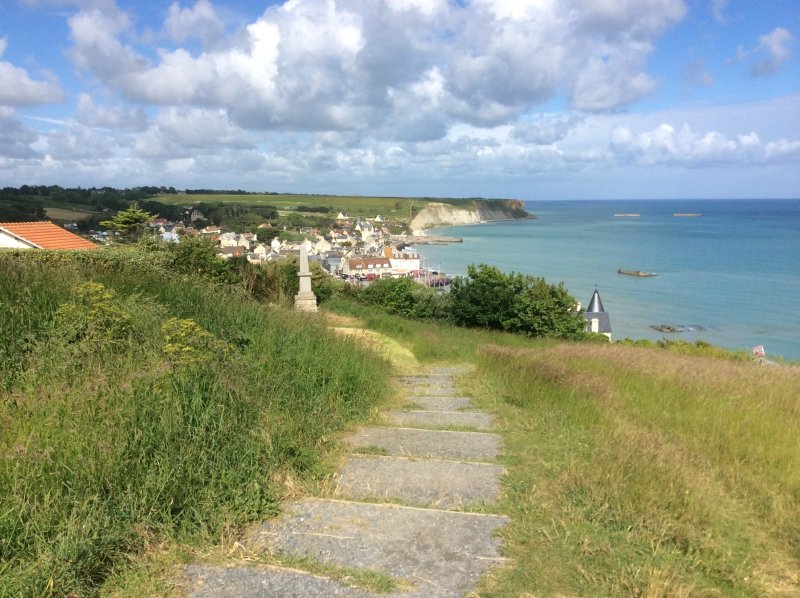
Our first glimpse of the D-Day beach after a bus trip from Caen.

Normandy4


Remains of German shore defenses.

Normandy5Normandy8


Normandy6A fierce cliff to face.


A look toward the village.  Imagine living there during one of the most savage Normandy9amphibious assaults in WW II – or ever.


Normandy10


Pilgrims to history.


Re-enactors in the village.  We were at the site only a few days before June 6th, so there were many people there who did historical re-enactment.  We were even Normandy26fortunate enough to see some men who had actually been at the landing.  Yang and I have some pictures, but we didn’t want to post for fear of violating their privacy.


The American Cemetery

Normandy16Monument to Victory

Monuments

to

Valor

Normandy17 Normandy18

Normandy25


Omaha Beach  Normandy23


Normandy 23


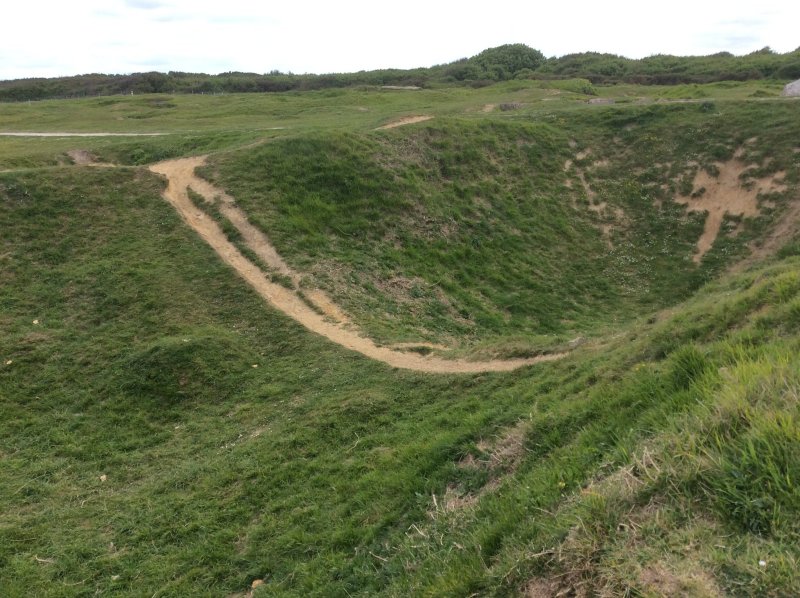
These are craters from the shelling.


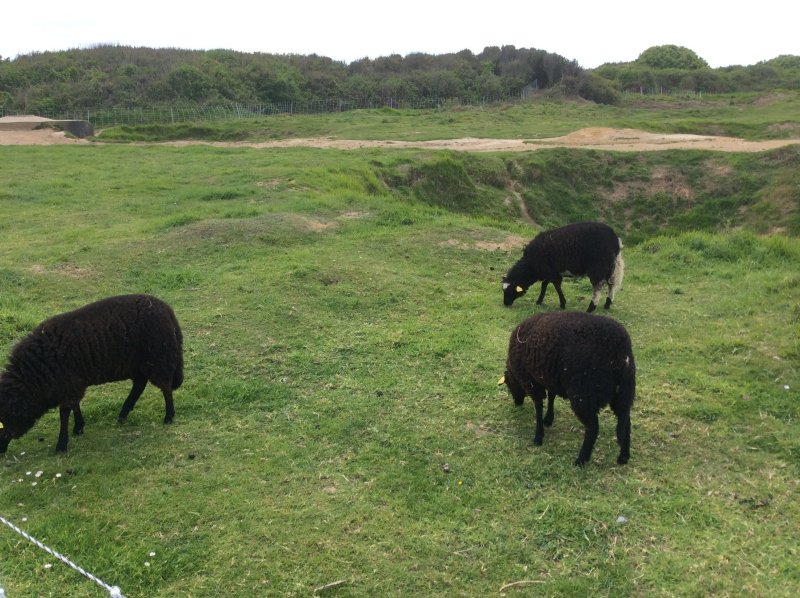
The black sheep are there to keep the grass trimmed.

Normandy22

A thought-provoking juxtaposition of peacetime serenity with the gruesome brutality of war.


Normandy19Memorial Sculpture on the beach.  I was told they symbolize a striving upward, but I kept seeing the wooden crosses pointing upward on their sides, designed to rip the bottoms out of landing craft.


Normandy7  A poppy for remembrance.

Great Bustards, Batman! Holy Rooks! Birds in England

 The last few days of May and the first week of June, my spousal unit and I joined a tour in England and France.  Of course, we had to take advantage of the opportunity to sight and photograph lots of birds that we couldn’t see back home.  In England, we got most of our shots in and around London and at Stonehenge.  The special guest star who appeared at Stonehenge, I’m saving for last on this page.

One of the most common birds comes first, the Wood Pigeon.  This guy looks a bit like thewood pigeon Rock Doves back home, but he is quite plumper and longer.  People in Europe probably see them the way we see pigeons back here, but for my husband and I they are a treat for being a bit different from what we’re used to seeing.

We got to add some new ducks and geese to our list of bird sightings for the year.  Here is the Grey Lag  goose.Grey Lag1 There was also another duck we weren’t quite sure of.

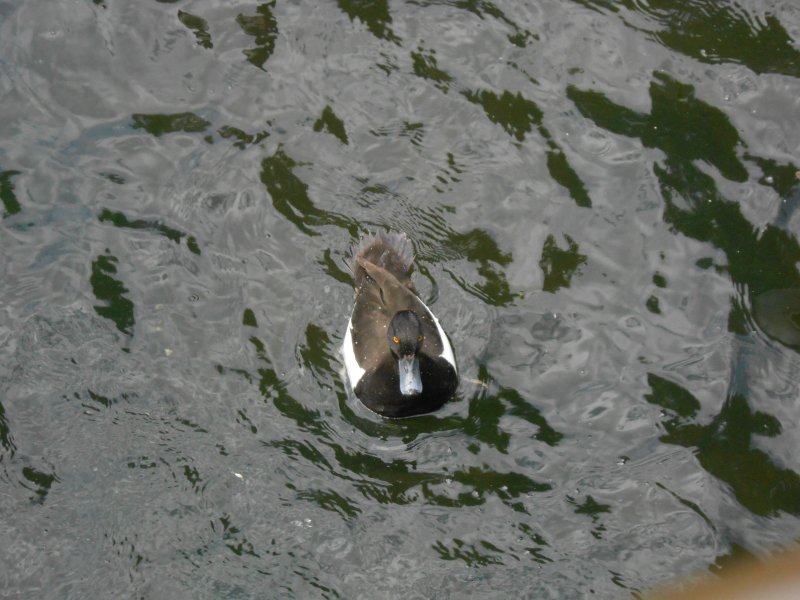
It looks like a Tufted Duck with his tuft slicked down.  If anyone else can better identify these guys, please let me know.  We photographed both the male and the female.  Dig those crazy, Satanic orange eyes!  Tufted3


This one is probably the male.

This one looks like the female.  What a lovely couple!

Tufted2

We also saw some coots, including these  babies.

coots2

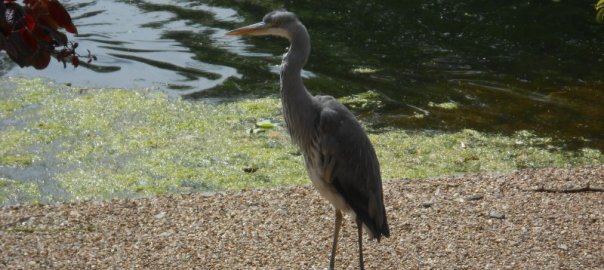
grey heron1One of the prettiest of the water birds was this Grey Heron.  I believe he is an immature one.  Not only have the tuft feathers on his head not developed as they do on a mature bird, but he giggled anytime anyone said “underwear.”  Don’t ask me why anyone did.


Here’s an even better shot of the heron.grey heron2


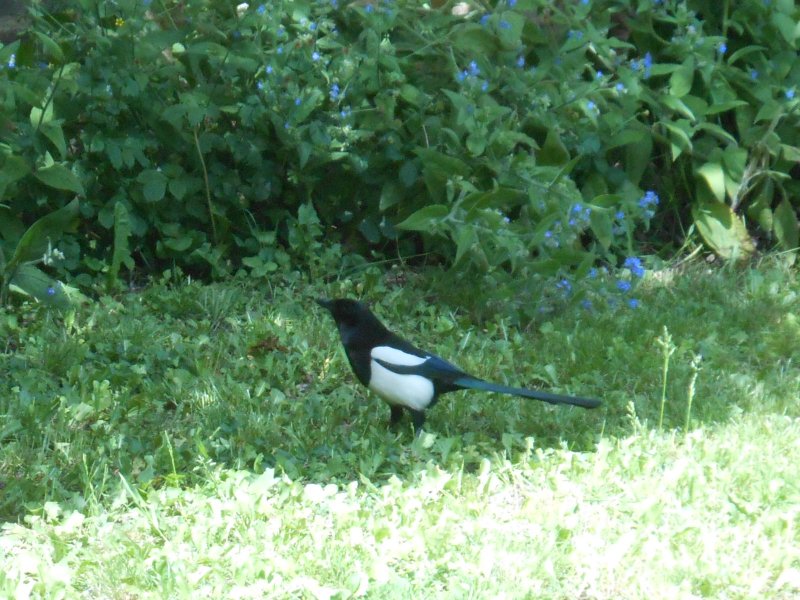
We also noticed there were lots more birds in the crow family here in England than back at home.  We saw this beautiful Magpie in Highgate Cemetary.Magpie4  Notice how the blue toward the back of his wings picks up the blue of the flowers.  Did he plan that?  We don’t have any of these guys in New England, but I’ve seen them on the West Coast, in California and as far east as Colorado. There are tons of them in China as well.  I wonder why they never seemed to spread past the Rockies?

At Stonehenge, we also saw some other crow relatives, Rooks and  Jackdaws.  I’m fascinated by the missing feathers right above the beak on Rooks.  Since Rooks are carrion feeders, does this lack of feathers help them ward off bacterial infections, as does the Condor’s and vulture’s featherless noggin?IMG_0487

Here’s a Rook.

And here’s a Jackdaw. My husband loves the grey at the back of their heads. jackdaw2 He thinks it makes them look cute.

So here is the treat I promised you at the beginning of this blog!  The Great Bustard! Apparently this bird was almost extinct, and the conservation people have been breeding them to bring them back to repopulate the country.  I was told that I was extremely lucky to be able to see one when I was at Stonehenge.  I certainly feel lucky.  Good luck to these guys making a comeback.

bustard8

     bustard6

bustard5