Well, you might not know it from this week’s temperature, but summer should be moving into autumn now that it’s September. So, perhaps my late developing pumpkins and veggies may come to full bloom after all. Earlier in the season, we did dine deliciously a couple of times on our own eggplants. And there are more growing! We also have had a few meals flavored by our home grown peppers. Here’s a shot of one harvest. Don’t you just love the deliciously spicy and fresh smell when you slice open a garden pepper?
We haven’t had such good luck with our tomatoes and pumpkins this year – although we did get a few fresh tomatoes for Yang to add to his omelettes and stir fries. The beans are just now coming into form. We had one serving earlier, and we’re planing on harvesting some of these beauties soon.
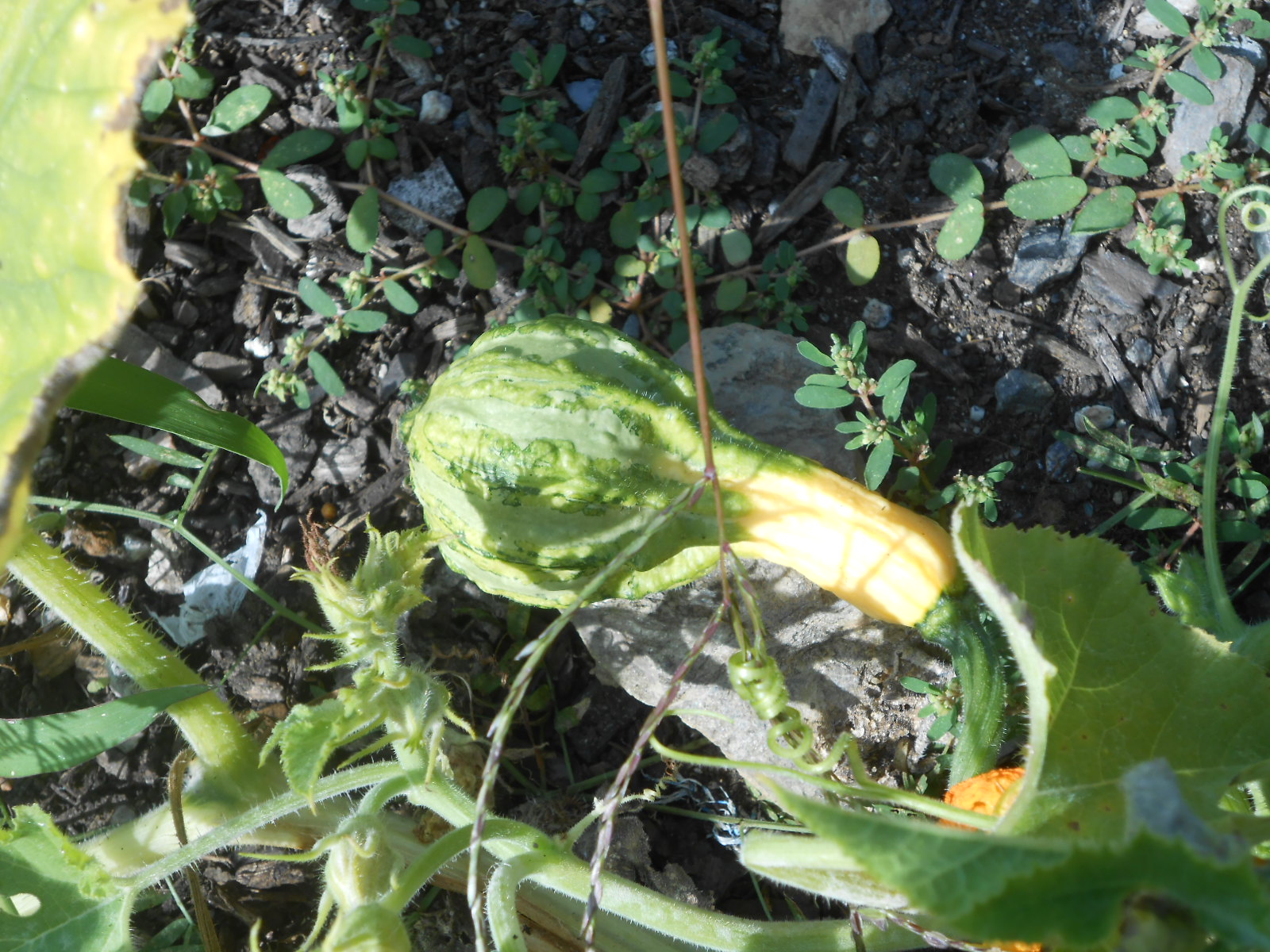
I’m also hoping that though these pumpkin and gourd embryos are late comers, they may still grow and ripen with the hot autumn we’ve been having.
We didn’t have the best of luck with our sunflowers, as some form of insect (we think beetles) brutalized the plants grown from seeds planted directly into the garden. However, after a daily spraying of tabasco sauce in water to drive off the insects, most of the sunflowers recovered. Some even grew up to full height and even better than the ones we’d protected by growing them as seedlings in cups before planting.
The Morning Glories had been growing full throttle, vines creeping up the trellis, until chipmunks tunneled out of the wood retaining wall on which the flower’s boxes were located and munched them silly. It’s a jungle out there! Again, tabasco spritzing did its job and some managed to recover and grow. I especially like the orchid colored ones.
Did you notice the two-toned orchid and purple one? Those hybrids pop up every year. If you look at the seeds, they are even half black (purple flower) and half cream-colored (orchid flower). I save the seeds every year and replant, so I sometimes even get pink instead of orchid. I guess that’s the orchid and magenta hybrid.
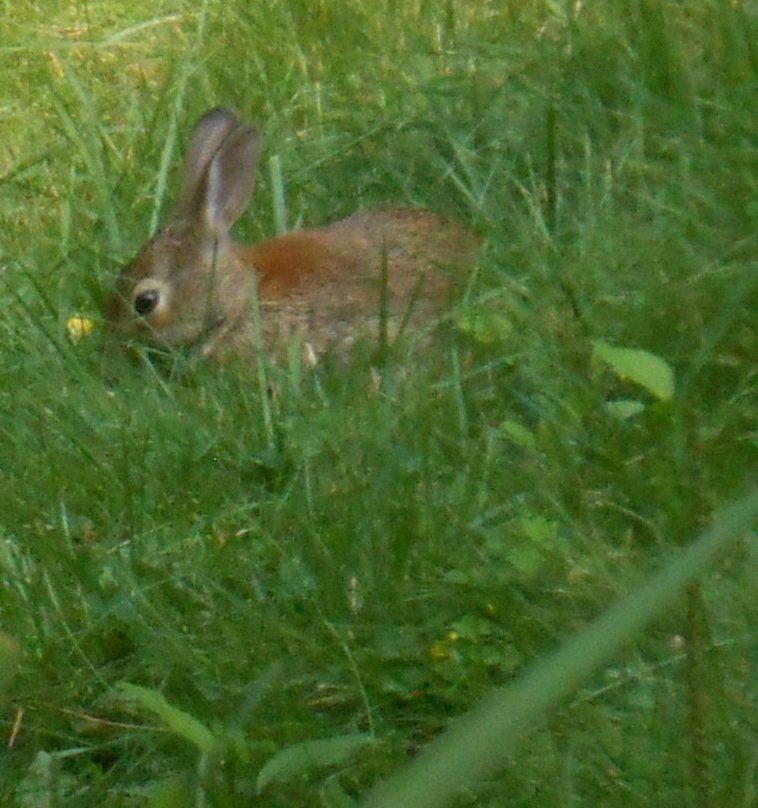
We’ve had interesting fauna as well as flora this year. First, let me introduce you to Bunzie. A very young and small rabbit showed up at the beginning of the summer. He has since grown! Best of all, he seems to eat only clover and grass – well he did devour much of a dying petunia. However, that petunia regrouped and has a lovely deep pink flower now. So, I guess he was just dead heading for me. He’s actually not too afraid of Yang and me, but we don’t bother him, either. One night, he triggered the motion-detector light outside the sun porch and we got to watch him dash hither and yon while two skunks patiently waddled about that stretch of yard looking for grubs.
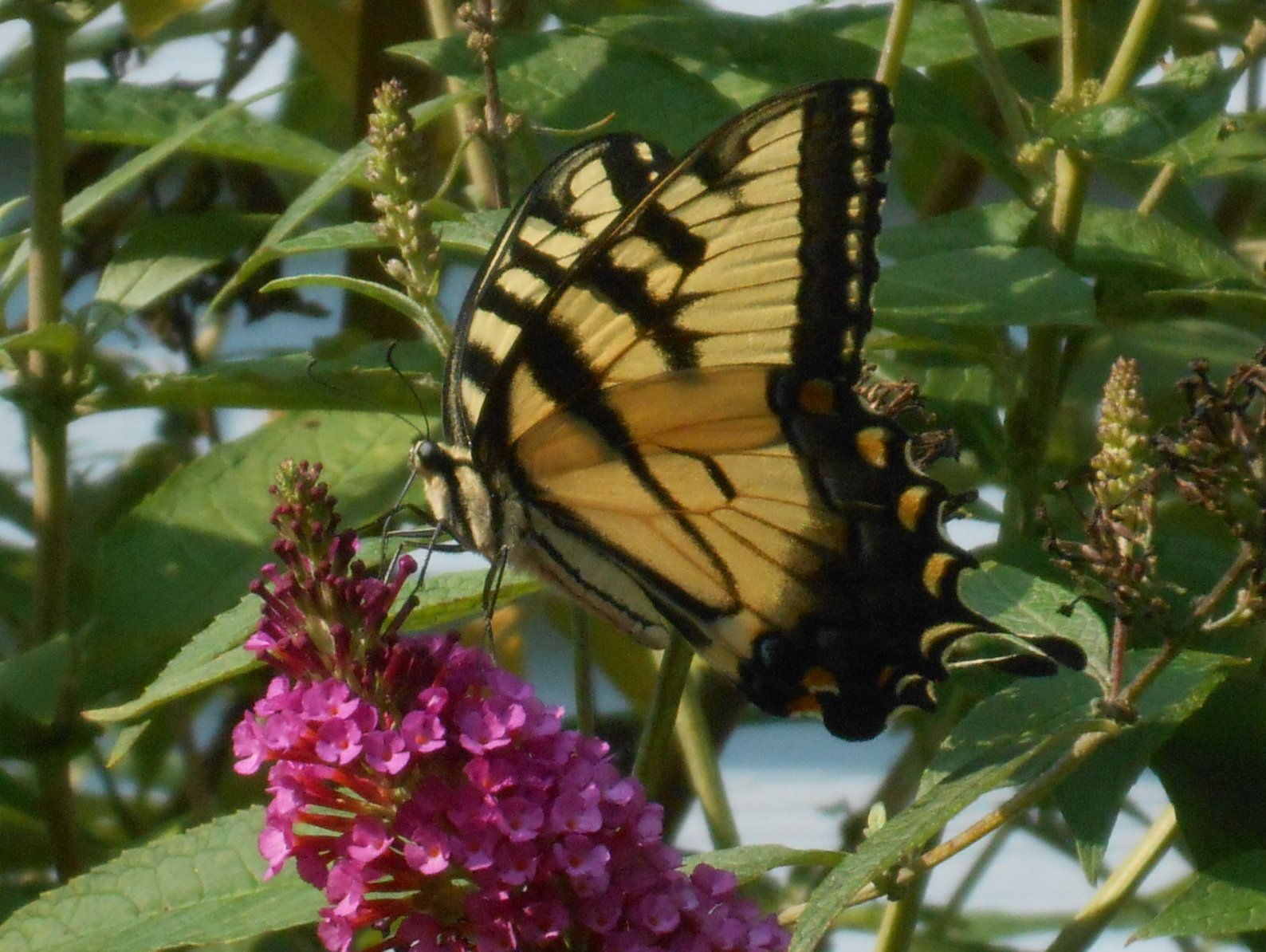
I only saw one Monarch Butterfly this year, yesterday. Unfortunately, I didn’t have a camera with me – and I scared Bunzie when I rushed over to the butterfly bush to see it. We have had at least two regular visitors to the butterfly bushes, these Tiger Swallowtails. I love how you can see the same yellow and black patterns on the insect’s body that you can see on his wings. I was so surprised that these guys let me get close enough to watch and take these pictures. They also love to dine on the nectar of flox and Rose of Sharon flowers.
Another critter who loves butterfly bushes, flox, and Rose of Sharon would be the Hummingbird – or birds. We had at least two, though usually only one showed up at a time. When there were two, feathers flew, so to speak. Yang got some great shots. It’s fun to watch him , the bird not Yang, come in for a landing, wings a-whirl! I’m sure that you can understand why the pictures are a little blurry! Once he/she landed, the little guy enjoyed our nectar – as well as taking sips from all the flowers.
Sometimes, he just liked to sit majestically atop the feeder and survey his domain. Other times he enjoyed parking his tuffett on the structure on which the Morning Glories grew – he thought they were tasty, too. If you’re wondering what that contraption is atop the feeder, it’s a moat that Yang created to keep ants from climbing down into the feeder. Yang saw some designs for sale on line, figured he could make one for much cheaper – and did it!
Sometimes the Hummer just stared at our window with a “Who you lookin’ at?” attitude.
Of course, we also had some of the other usual suspects this summer. The Goldfinches pretty much dominated the two globe feeders, though the Redbellied Woodpecker wasn’t above shooting his long tongue through the bars to steal some sunflower hearts.
The Rosebreasted Grosbeaks were back as well. I saw as many as three males at once one time! I also saw the females and some juvenile males as well. Unfortunately, though we kept putting out oranges, we only saw an Oriole here twice. My neighbor said he saw the Oriole quite a bit, though on the feeder.
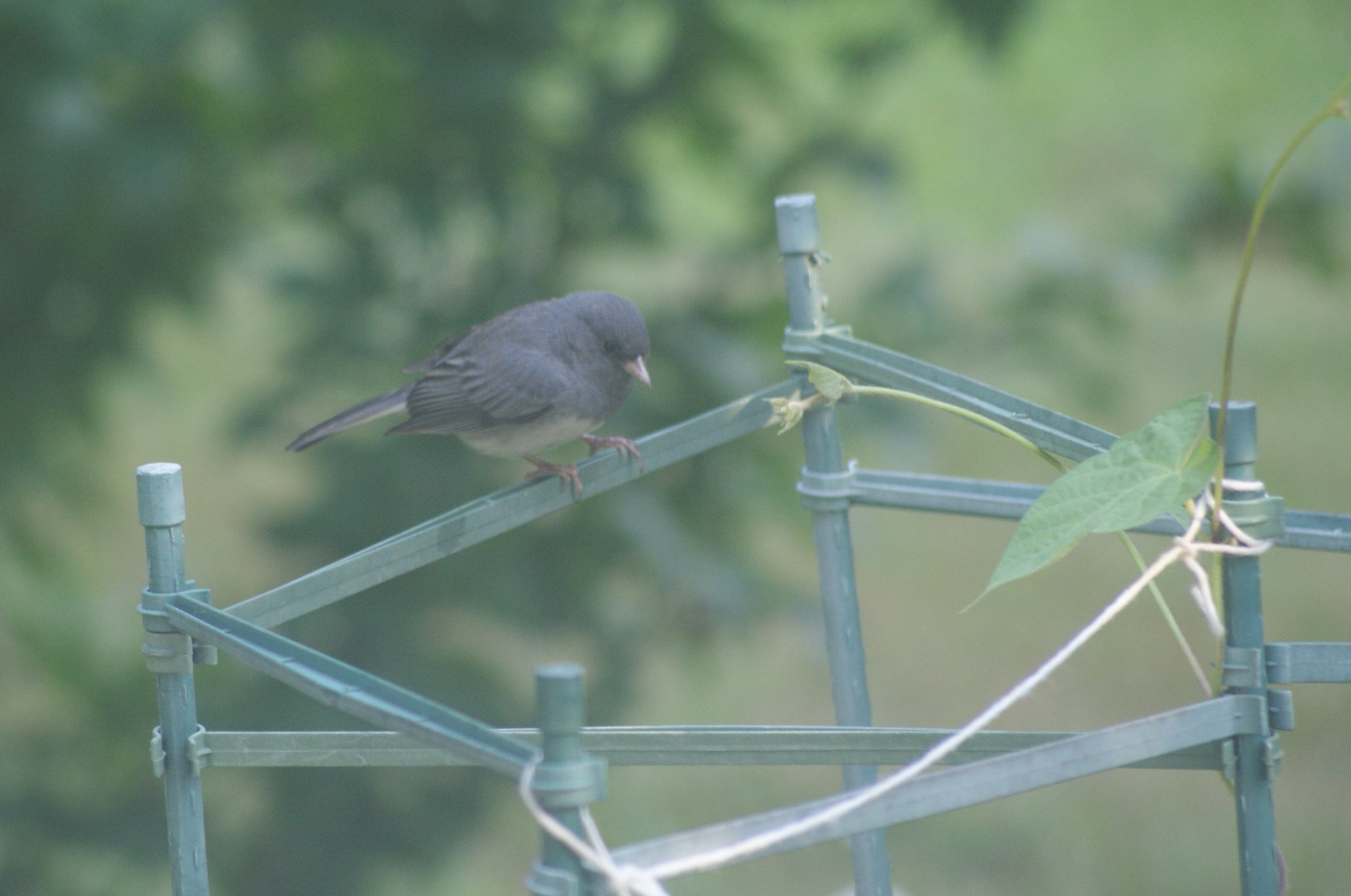
One visitor to the feeders who was rather unique for the summer was this chap.
Now how often do you see a Slate Colored Junco in new England in the middle of July? He stayed around well into August, then I haven’t seen him since. Someone got his GPS all fowled (ahem) up! Now, will he be back this autumn? Stay tuned!
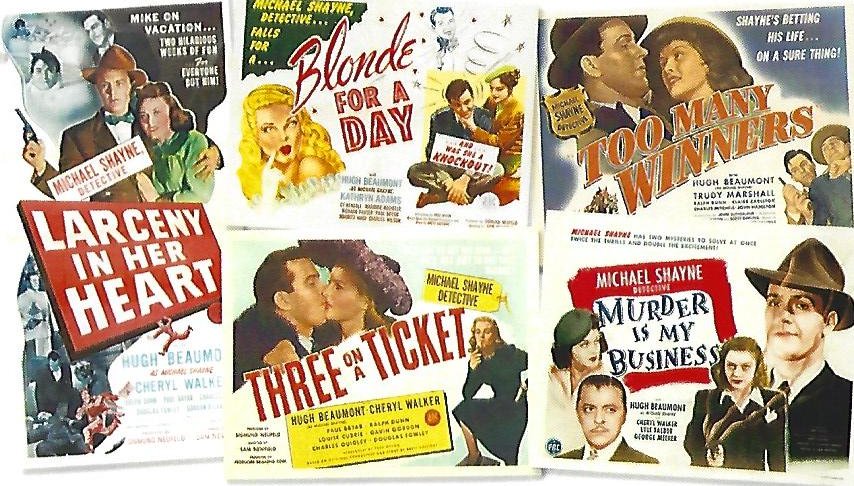
Beaumont didn’t always play a homicidal, narcissistic maniac in his noir career. In two low-budget series he actually played a detective. Still, even in this role, he wasn’t exactly on the side of the angels. When PRC took over the Michael Shane series from Twentieth-Century Fox, Beaumont replaced Lloyd Nolan in the title role. Nolan’s Shayne, though nobody’s fool, was something of a lovable lug. Beaumont’s Shayne was much too acerbic to be lovable, much less a lug of any kind, tossing off such gems as, “C’mon, look at the girl. Don’t be afraid of waking her up. She’s dead.” He tackles two spoiled children of a recently murdered father by telling the girl to “shut up” her lip, shoving around the son, then turning back to the daughter and calling her a “spoiled, brainless brat.” Not exactly the reasoned chats with Wally or the Beaver in the study (Murder Is My Business, 1946).
This Mike Shayne certainly isn’t as lawless as the Steves, Kennys, and Scots in Beaumont’s psychotic repertoire, but he’s not exactly playing according to Hoyle when it comes to dealing with the law. His Shayne enlists his newspaperman pal to help him move the body of a murdered girl left in his apartment on a frame job so the police will find the body elsewhere and include him out of any pesky investigations (Murder Is My Business). This guy just doesn’t want to be bothered and certainly has no respect for the cops. For example he warns the lead detective to “back your monkeys off me,” then warns those monkeys, “Don’t stick you nose outside the door unless you want to get it shot off” (Larceny in Her Heart, 1946).
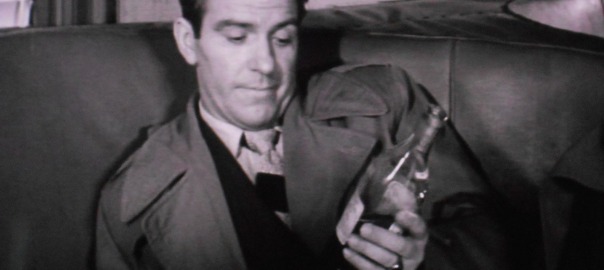
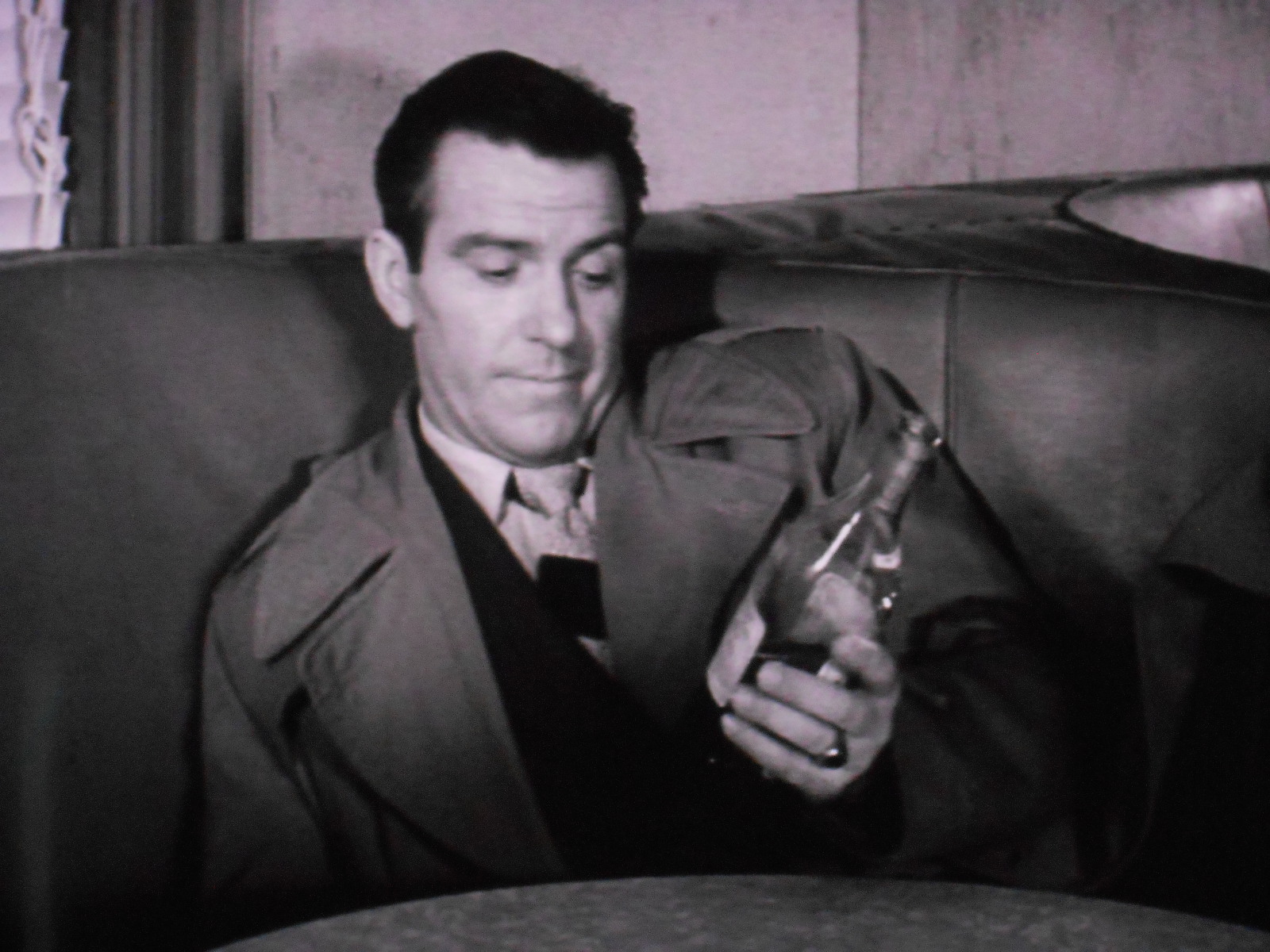
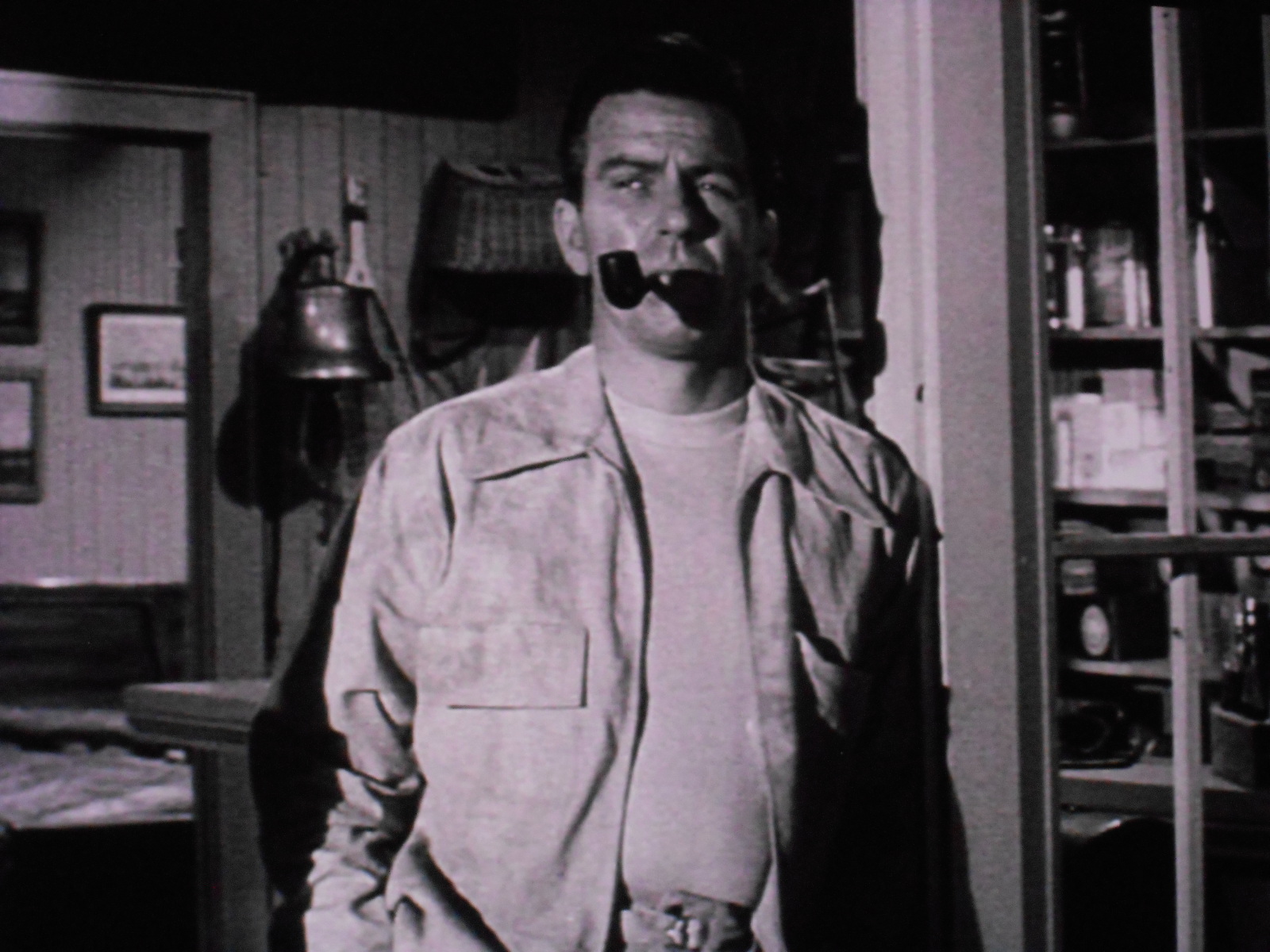
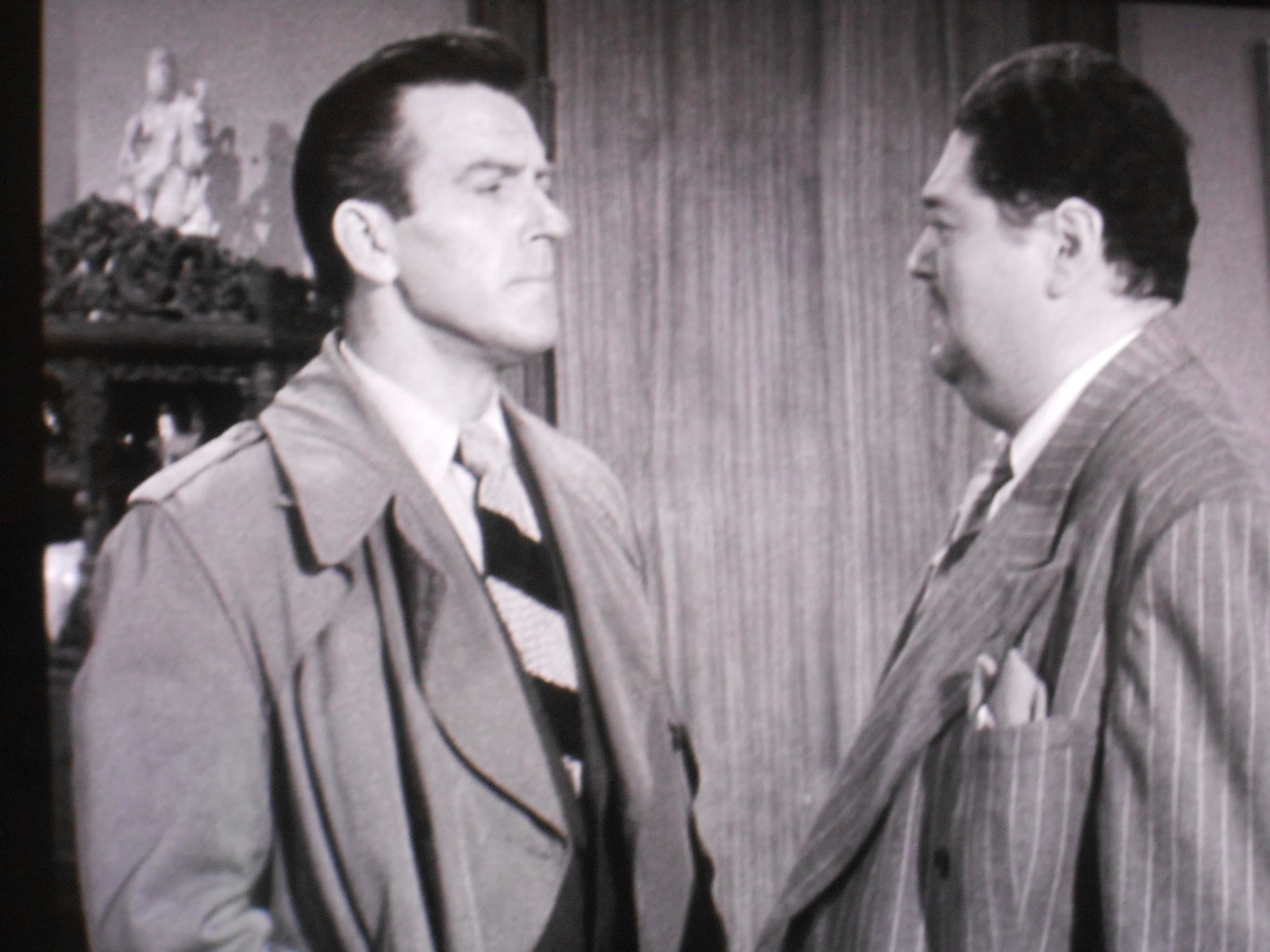
In Hugh Beaumont’s other PRC detective series, about the only thing Dennis O’Brien has in commonwith Ward Cleaver is that they both smoke a pipe. That said, Denny would rather snuggle up to a bottle of bourbon in a seedy bar with his souse helper, The Professor (more on him later). If Beaumont’s Mike Shayne was somewhat left of the law, this character barely peeks in as he passes its room. Even a seedy guy says to O’Brien, “Anybody’s a bum at the right price. I hear yours is $200” (Roaring City, 1951). O’Brien confirms this assessment at the beginning of each of the three films in the series when he says while lounging in front of the run-down, two-room shack he shares with The Professor on Pier 23 (aka a “crummy layout,” Danger Zone, 1951), “[A]s long as I get paid, I can’t be responsible for the guys who hire me” (Roaring City).
O’Brien’s cases bear out his less than sterling self-appraisal as he repeatedly gets himself into hot water by agreeing to front a crooked manager’s bets against his own fighter; playing escort for a young woman under the pay of an unsavory lawyer he knows is up to no good; and taking money from a priest to help an escape convict elude capture after blowing Alcatraz, amongst other unsavory cases (Roaring City, Danger Zone, and Pier 23 (1951), respectively.
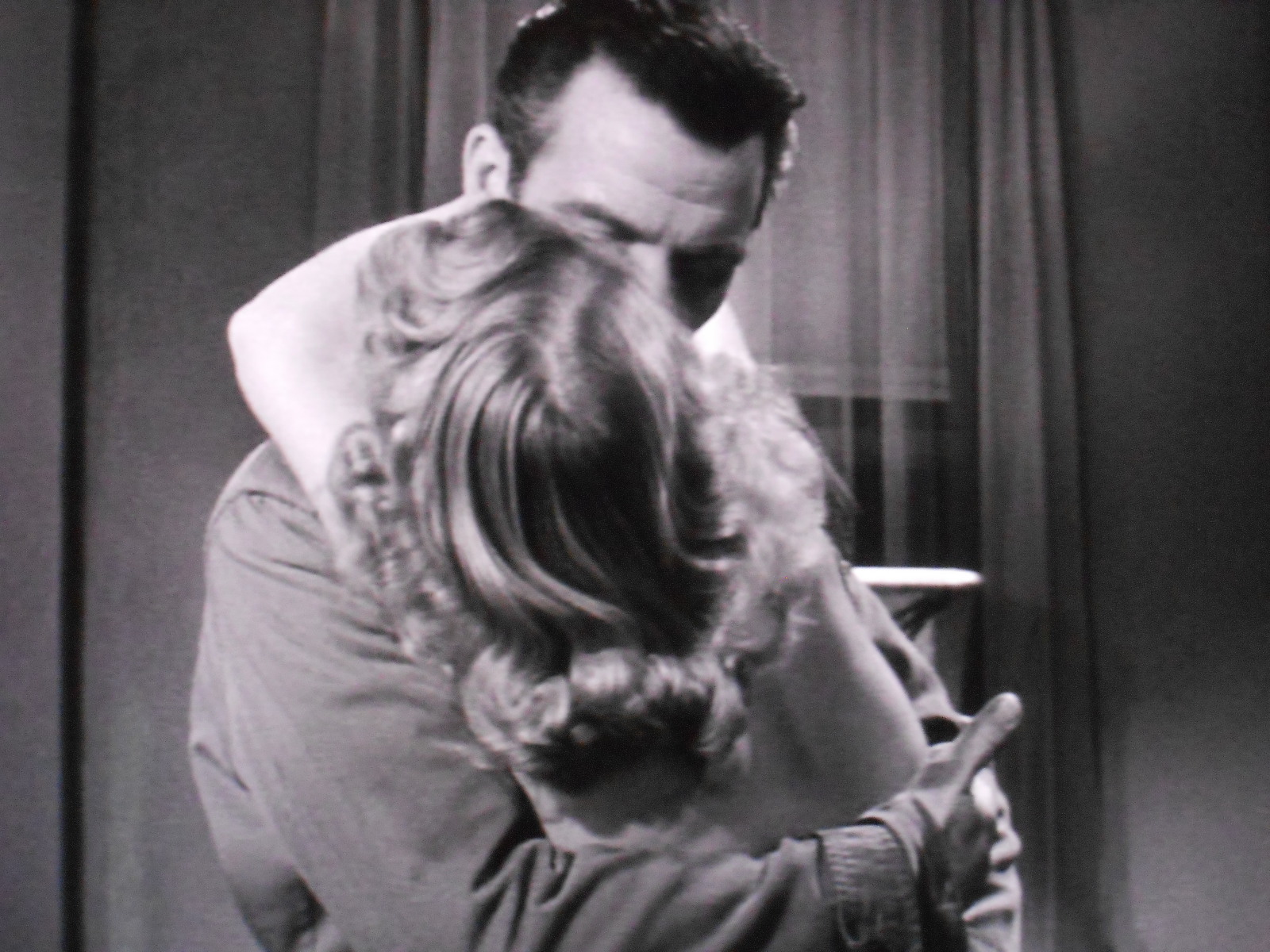
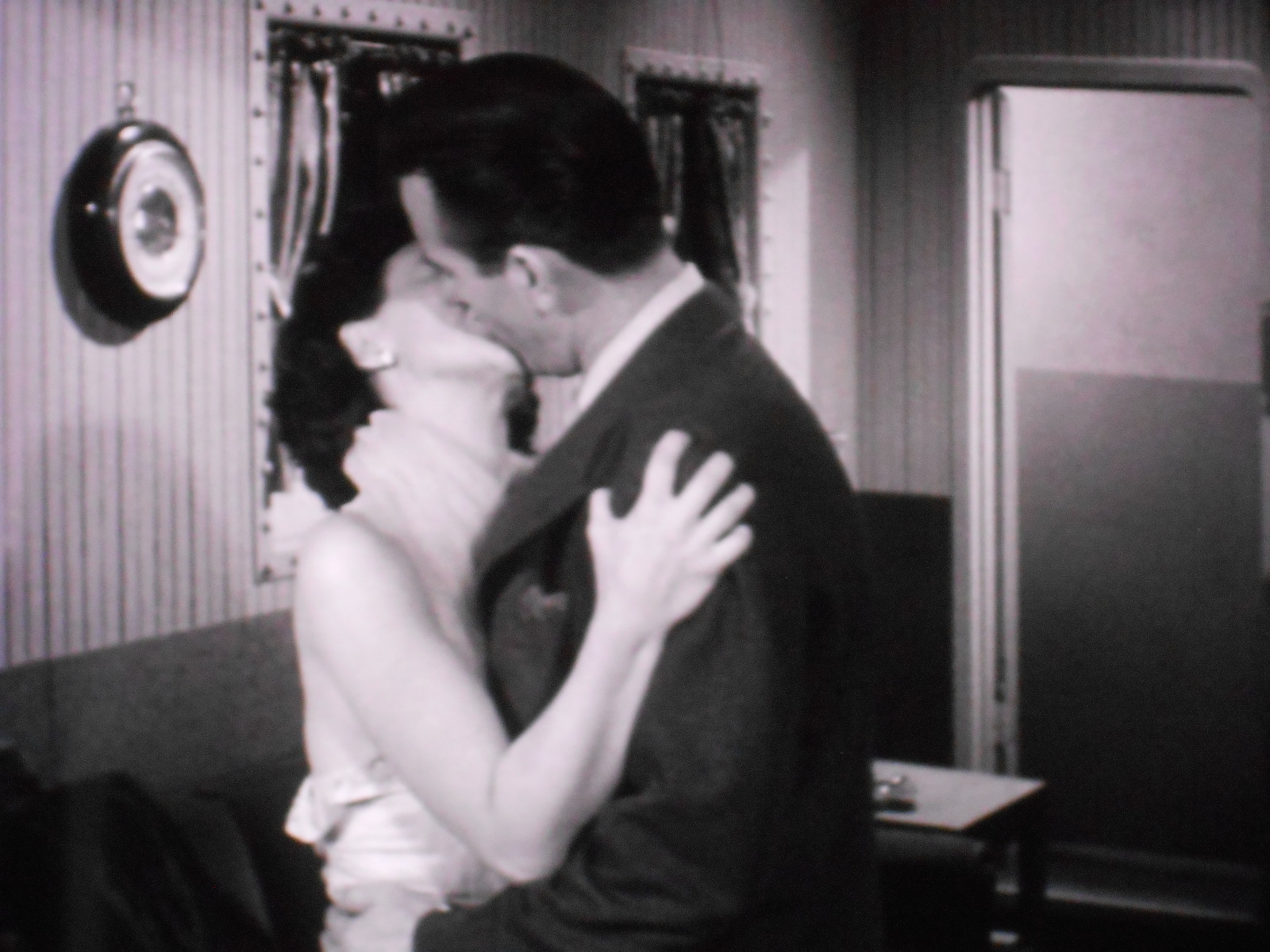
Additionally, where Beaumont’s Shayne might have done some looking but was basically loyal to secretary/girlfriend Phyllis, O’Brien pretty much tom-catted his way through three films, containing two stories each. Eyeing some chicks in bullet-bras, he comments, “Yes, sir, the town [San Francisco] has some good points” (Danger Zone). In every film, he’s sucking face with at least one gal per story – that’s at least six gals per series. His lips must be mighty tired of puckering! June would not approve. Watch out Gwen Rutherford!
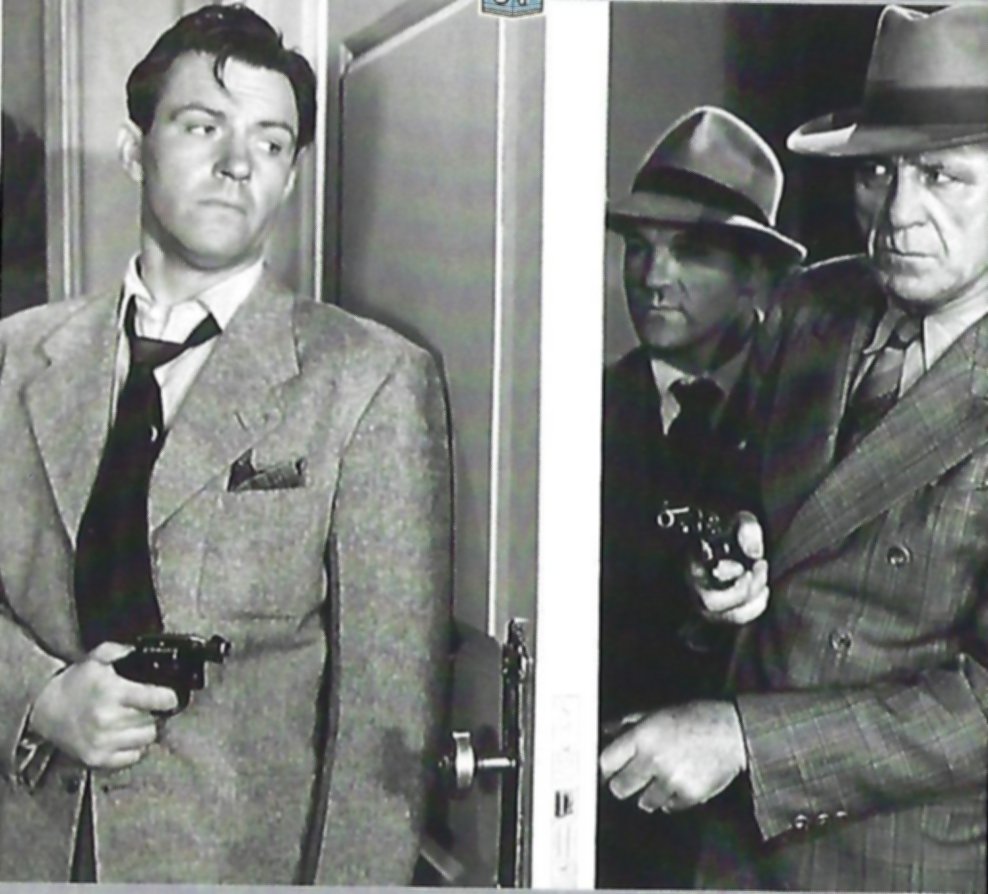
Denny has two regulars in the film. There’s side man, The Professor, who as O’Brien puts it, “prefers glasses to classes,” and the former filled with bourbon, scotch, or whiskey. Then there’s Inspector Breugger, his nemesis on the police force, who’s always suspecting O’Brien of murder – mostly because he’s always finding Denny unconscious in the near vicinity of a corpse –whom he never turns out to have killed. You’d think the inspector would have learned before he got through six stories in three films.
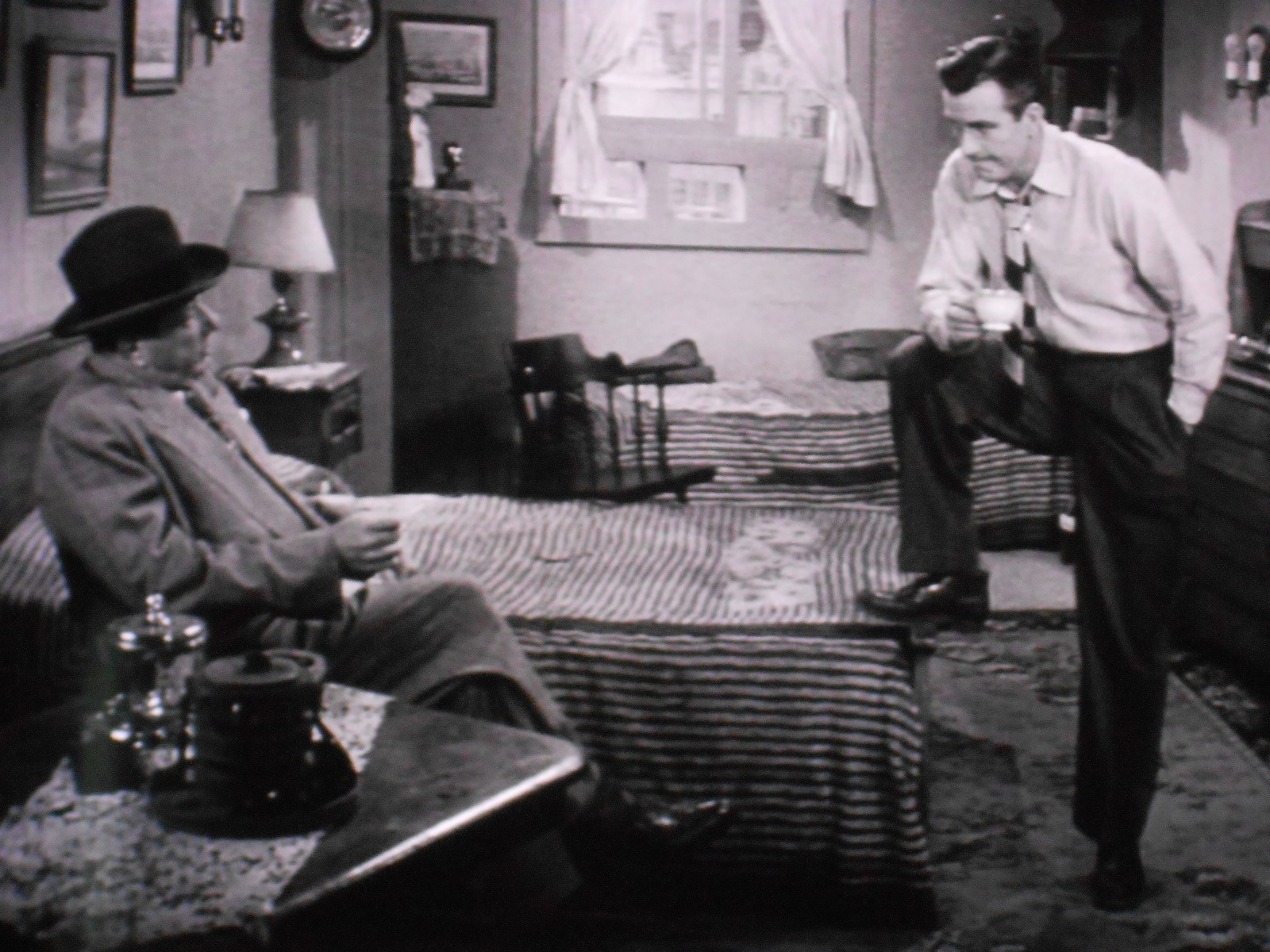
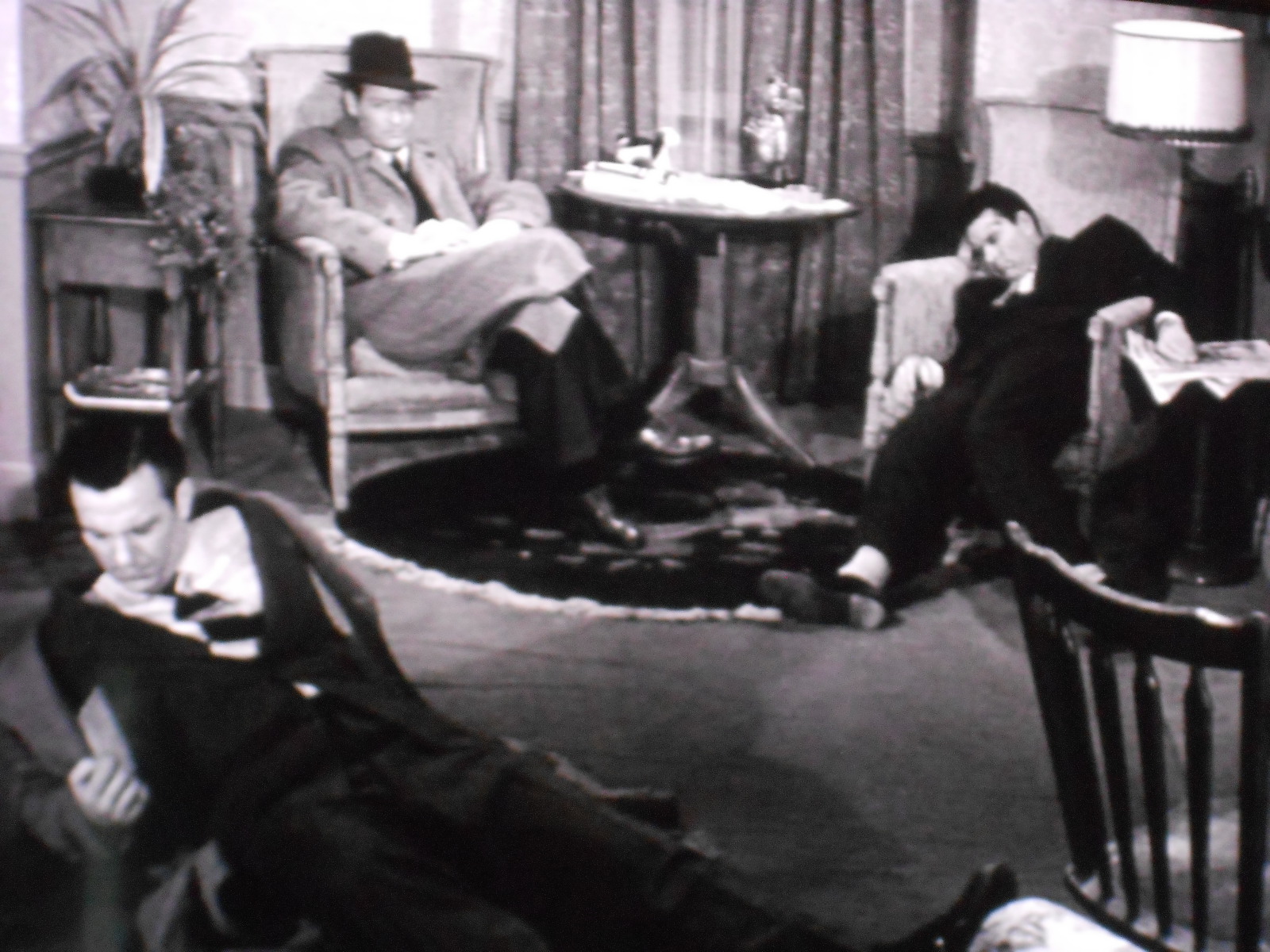
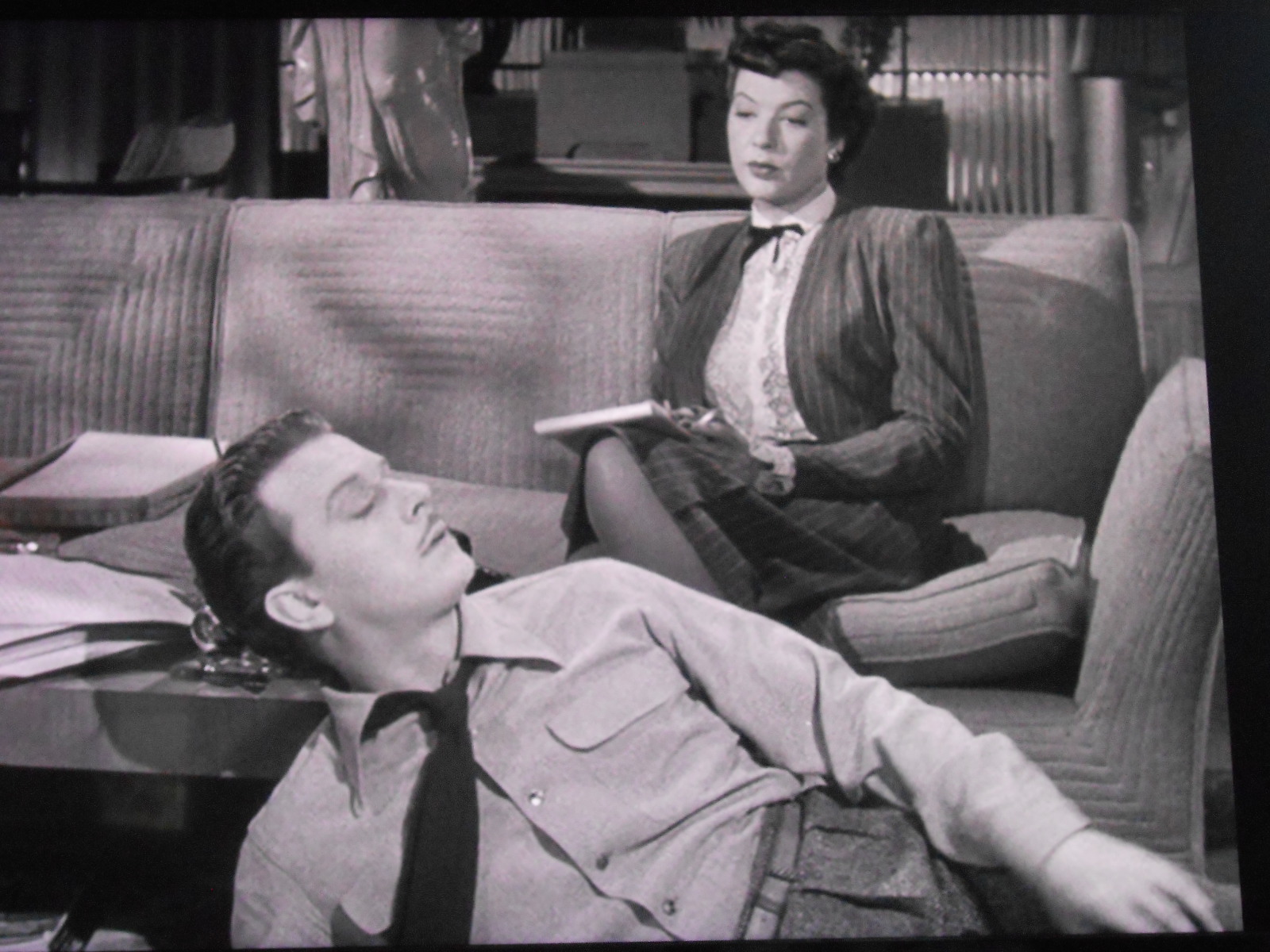
You’d also think Dennis would learn, too. Every time he turns his back – often while he’s smooching some deceptive dame – he gets cracked on the noggin and sent to la-la land, only to wake up next to a corpse and a freshly arriving Inspector Breugger. This photo is just a day in the life of O’Brien, Breugger, and the corpse du jour.
Now, our detective still isn’t a complete dope. He always gets his man – or dame, as the case may be. He even is quick with a quip. When Breugger asserts, “I got an idea,” Denny cracks, “Did it hurt?” Or there’s his cynical assessment of his part of San Francisco where “[a] set of morals won’t cause any more stir than Mother’s Day in an orphanage.” Beaumont gives us a private dick who may be on the seedy side, but his trenchant cynicism establishes that he knows he lives in a world that’s amoral to the core.
So, low-brow, psychotic, or somewhere in between, Hugh Beaumont is a champ at playing the noir anti-hero deeply engrained in the world he inhabits.
What noir performances by Beaumont would you add to this list?
– Images 1 & 2 of the Mike Shayne films from the Classic Flix dvd covers, copyright 2019, ClassicFlix.com
– Screen Shots from Danger Zone, Pier 23, and Roaring City from the Kit Parker Collection of Film Noir, vols. 7-9., Copyright VCI Entertainment, 2008. author’s Collection
People argue over who’s the toughest, grittiest, most acerbic, maybe even most psychologically damaged, of film noir anti-heroes. Is it Alan Ladd of the tight jaw and cold eyes? The coolly sarcastic and sharply violent Humphrey Bogart? Robert Mitchum, sleepy-eyed, drawling voiced, and deadly? Maybe Robert Ryan with his violent psychosis seething beneath a tautly charming exterior? How about Dick Powell and John Payne, who exchanged careers as fading singing romantic leads for playing opportunistic, quick-fisted, and switchblade-tongued types? Naaugh – The most sardonic, amoral, dark, or even psychotic of them all was, yeah, you guessed it – Hugh Beaumont!
Hugh Beaumont?!
“What?!!!” you say. Wally and the Beave’s staid, gentle-humored, reasonable dad? You bet your blackjack, Baby. In the late 1940s and early ’50s, Beaumont turned in a rogues gallery of noir baddies that would have sent June Cleaver running for the hills – if Hugh let her live that long!
A busy supporting player through the 1940s and ’50s, Beaumont did play his share of good guys. However, even some of them were a bit left of center. Consider the justifiably nerved up pal of John Garfield, afeard of fifth columnists in The Fallen Sparrow; The Seventh Victim’s staid and steady (ironically last-named Ward) husband of the tortured Jacqueline whose “normal” qualities made him useless to face her demons; or Army Air Force buddy of William Bendix and Alan Ladd in The Blue Dahlia, whose cool skepticism betrays a healthy dose of contempt for the Law.
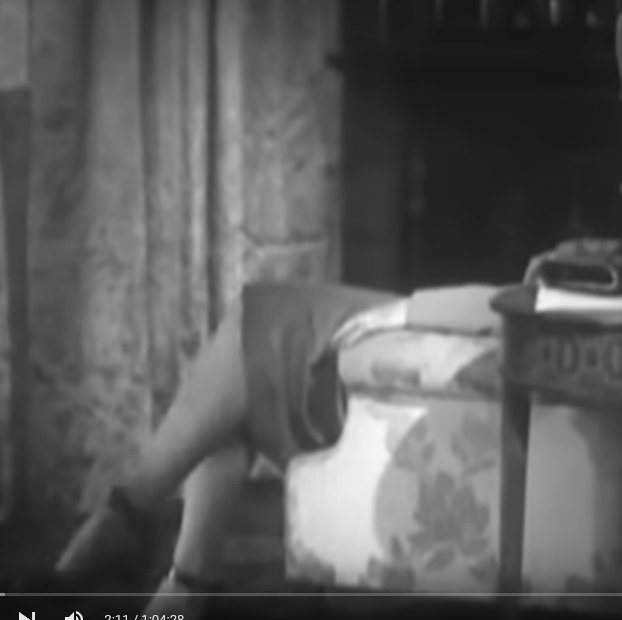
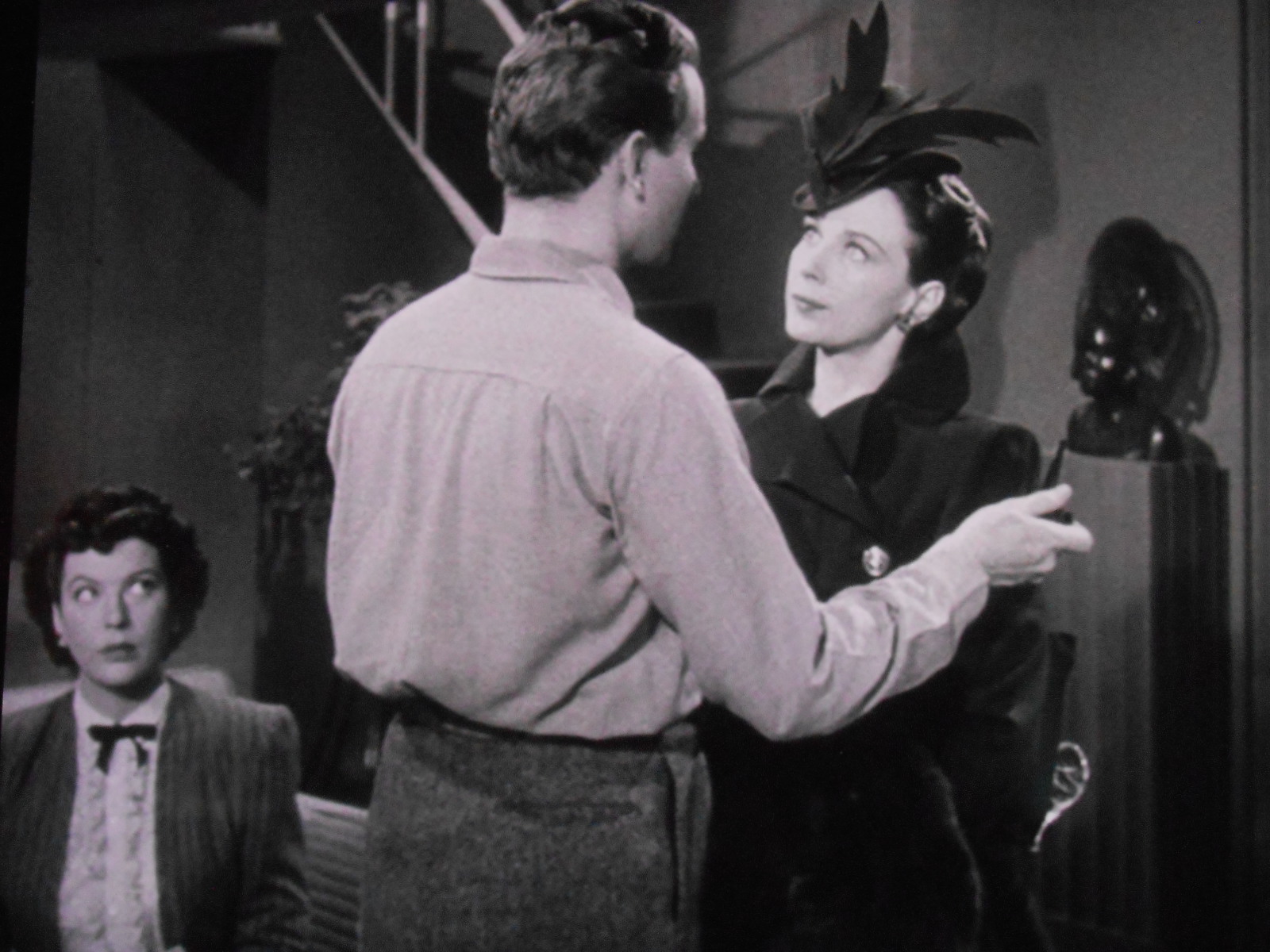
Still, it was the films that Beaumont made at Sig Neufeld’s Poverty Row studio PRC that were one of the best showcases of his ability to shine, or more accurately glower, as characters on the dark, even monstrous, side. Apology for Murder (1948), directed by Sam Neufield (né Neufeld, Sig’s brother), is particularly interesting. Beaumont’s amoral Kenny Blake is a smart-talking reporter whose editor chides that he would make a great writer except all he “could write about was a good lookin’ pair of gams.” Case in point, the slick chick whose strategic flipping down the hem of her skirt draws his attention to her shapely pins and away from the wealthy business man in the room he’s supposed to be interviewing. In no time flat, Kenny and this babe are running around in her fast car, locked in passionate clinches, and sucking face – until her revelation that she’s not the businessman’s daughter but his wife puts the skids on things, but only momentarily. Before you can say “double indemnity,” the femme fatale (Anne Savage of Detour fame) has played on Kenny’s libido and greed to plot and carry out the husband’s murder and let an innocent guy take the rap – while later making a sucker out of Kenny when she no longer needs him by playing footsie with a lawyer she’s using to break her husband’s will. Needless to say, it does not end well for the three in the hail of bullets in the penultimate scene.
Do the misadventures of the amoral, weak Kenny and his seductive paramour sound familiar? They should. Apology is a blatant rip-off of Billy Wilder’s Double Indemnity: from the tempting via sexy gams early on to the adulterers’ secret meetings and murder plans, to murder by wrench to the noggin while the camera focuses on the wife’s face to the avuncular/adversarial relationship between mentor (editor/insurance investigator) and mentee (writer/insurance salesman) to the near finale shootout and finally to mentor/mentee discovery of the crimes’ recorded history at the very
OLYMPUS DIGITAL CAMERA
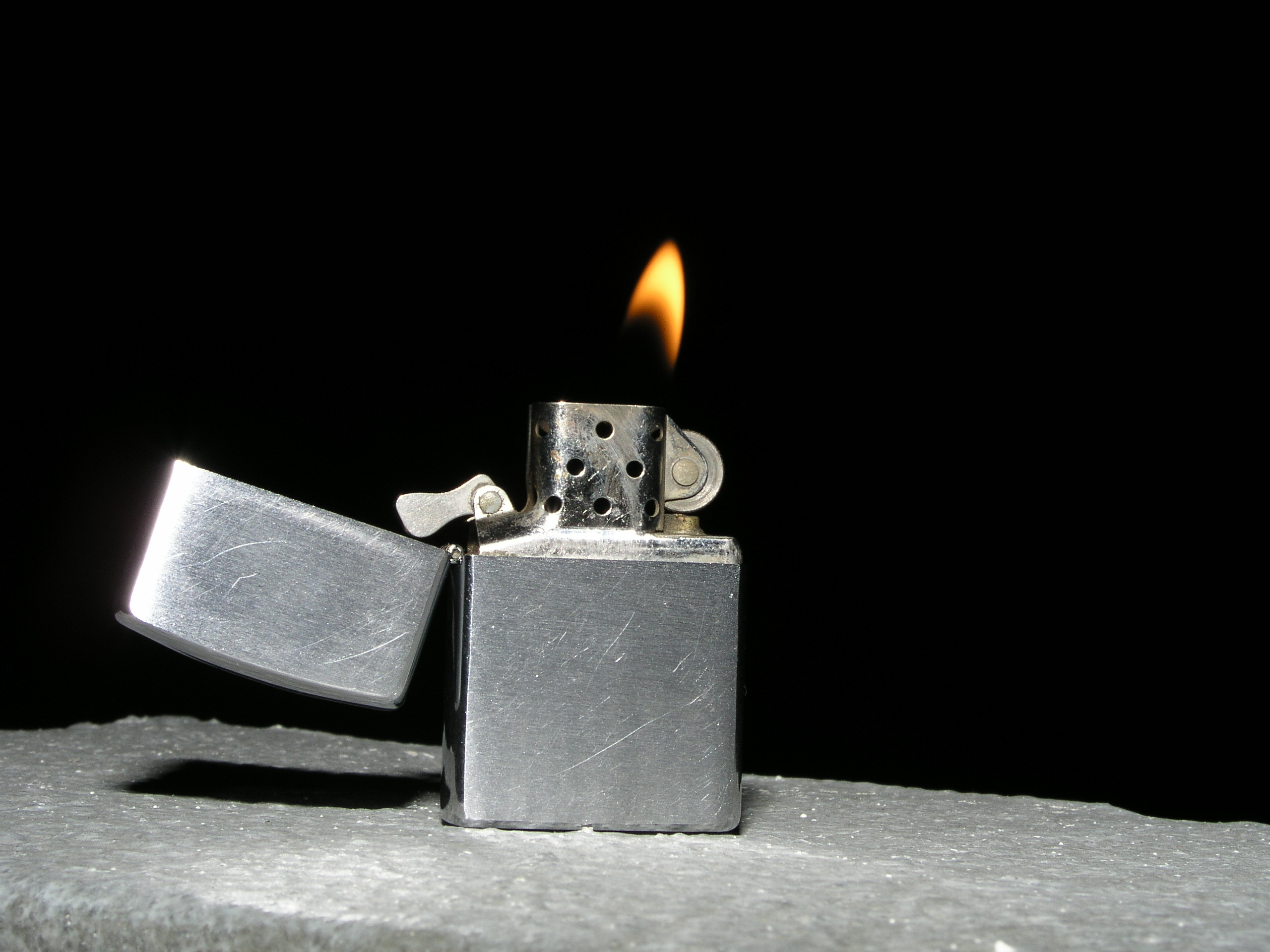
end. But the choices that Neufield and his writer Fred Myton make don’t innovate on, often only weaken, the original. Kenny make crack wise, but there is no dialogue between him and his leading lady or his mentor that comes close to the crackle of Walter Neff with Phyllis or with Barton Keyes. The tension when Phyllis gently pulls on the door that hides her to signal to Walter that he mustn’t give away her presence to Keyes standing before him dissipates into Steve hopping into the bushes by the femme’s front door when she lets out an important character. Notable switch up in this film from the original? Neufield and Myton reverse who can light a cigarette and who can’t from mentee to mentot– oh, and we move from matched to lighters.
Apology for Murder isn’t a bad movie. It would just look better if there weren’t an original with which to make a comparison. Then again, without the original, there’d be no Apology, or a need for one. Still, we can clearly see why Neufield was working at PRC and Wilder was at Paramount.
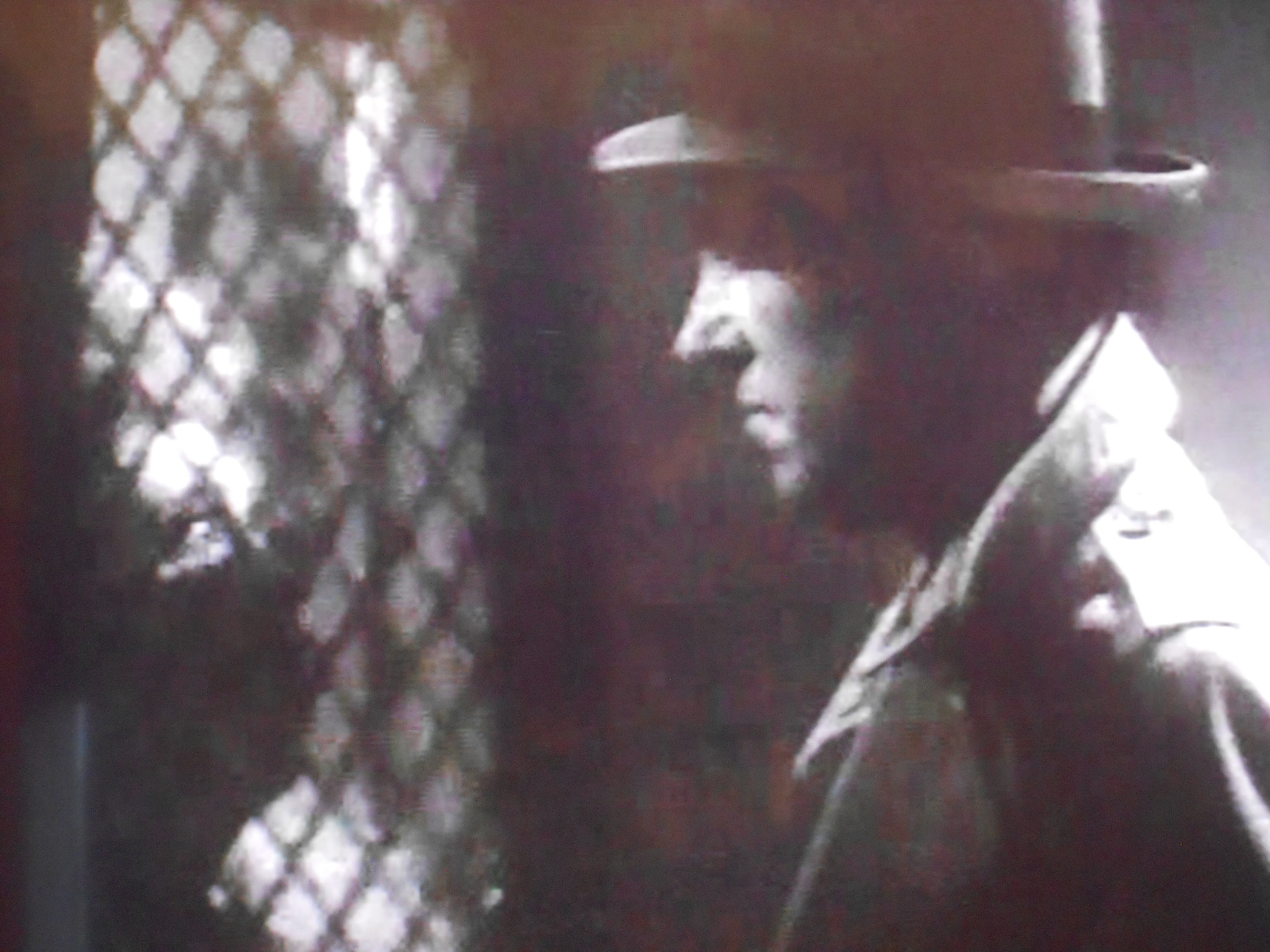
Two other PRC gems in Beaumont’s noir resumé reveal him as a player of not only the louche but the downright monstrous. In The Lady Confesses (1945), he’s Scot, a personable fellow happily engaged to Vicki, until his first wife shows up after having disappeared almost seven years ago. Next thing you know, the ex is found strangled with wire, Steve’s alibi of sleeping one off in a nightclub singer friend’s dressing room doesn’t convince the investigating detective, and Vicki has signed on undercover at the night club to find evidence to clear him. Genial and protective of his fianceé, Steve comes off as the typical beleaguered and framed noir hero (The Dark Corner, I Wake Up Screaming, TheBlue Dahlia) – until about three-quarters into the movie: he emerges from the shadows of the nightclub singer’s apartment to finish her off when she tries to blow town and leave a confession busting his alibi. The cinematographer’s use of shadows and Beaumont’s coolly menacing voice in concert with his determinedly pitiless expression are a shocking transformation from the regular guy we’d come to believe in.
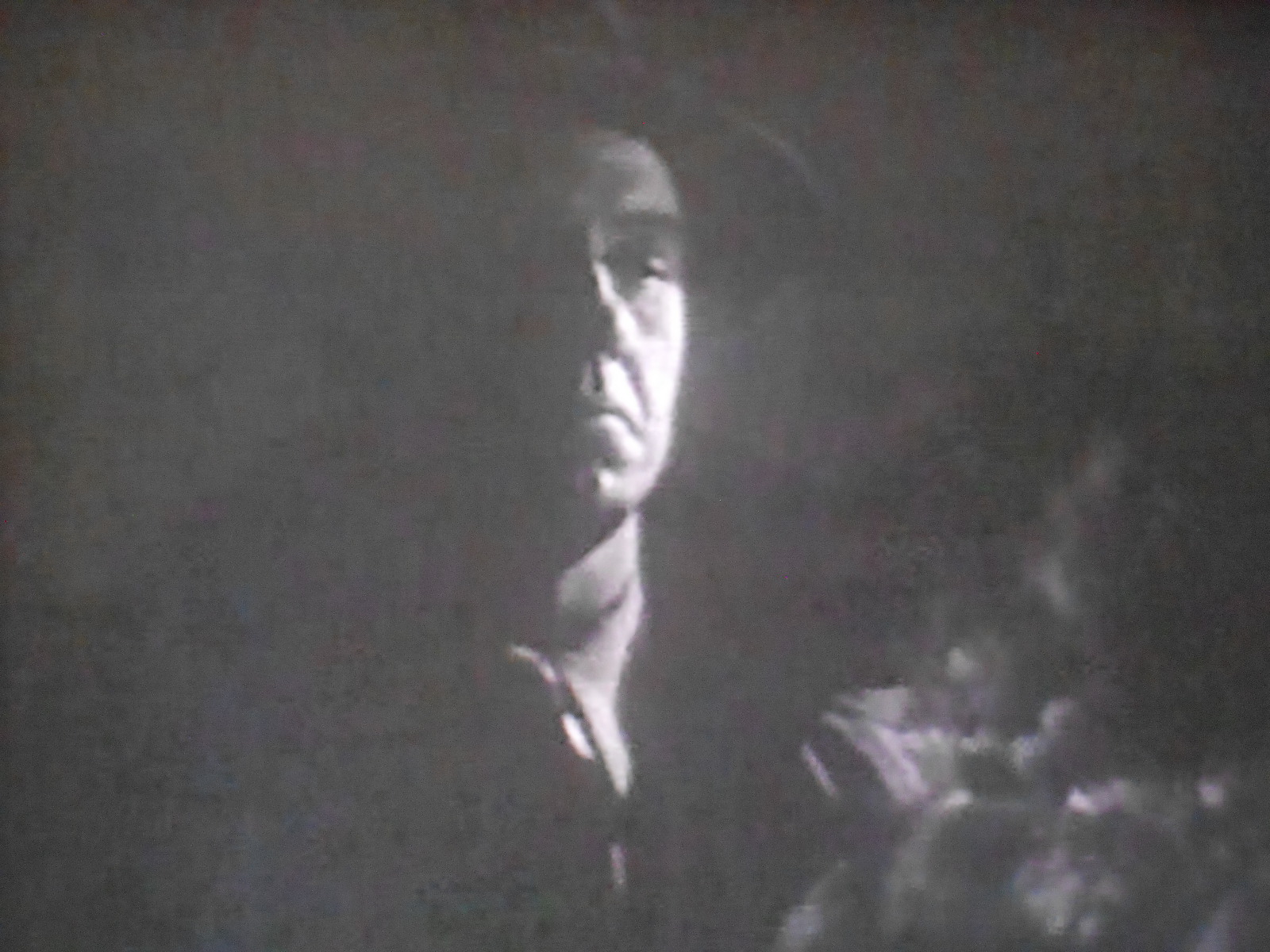
Vicki is no safer when Steve starts to think that she may know about the letter revealing his culpability. The tender, protective fiancé drops his mask – again beautifully, horribly revealed by lighting paired with Beaumont’s eyes and facial expression The horror of such villainy in a trusted ally crushes both Vicki’s and our own faith in any capability of recognizes what lurks beneath the disguise of feigned virtue.
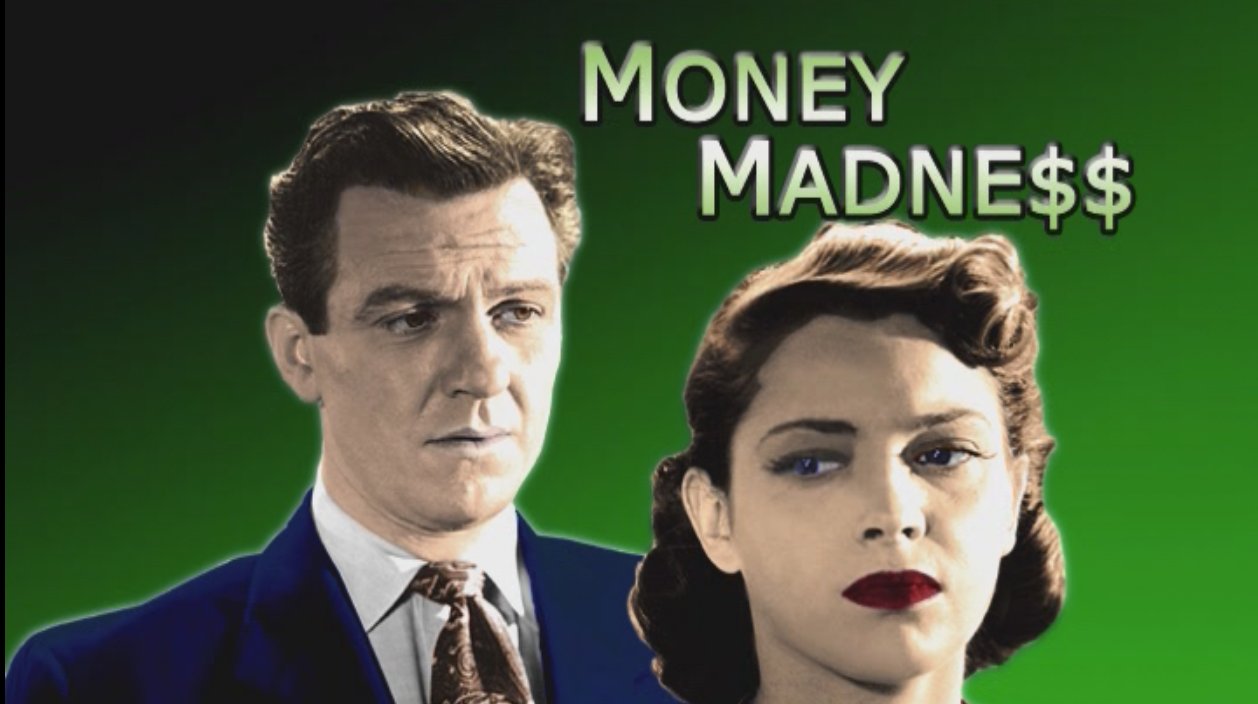
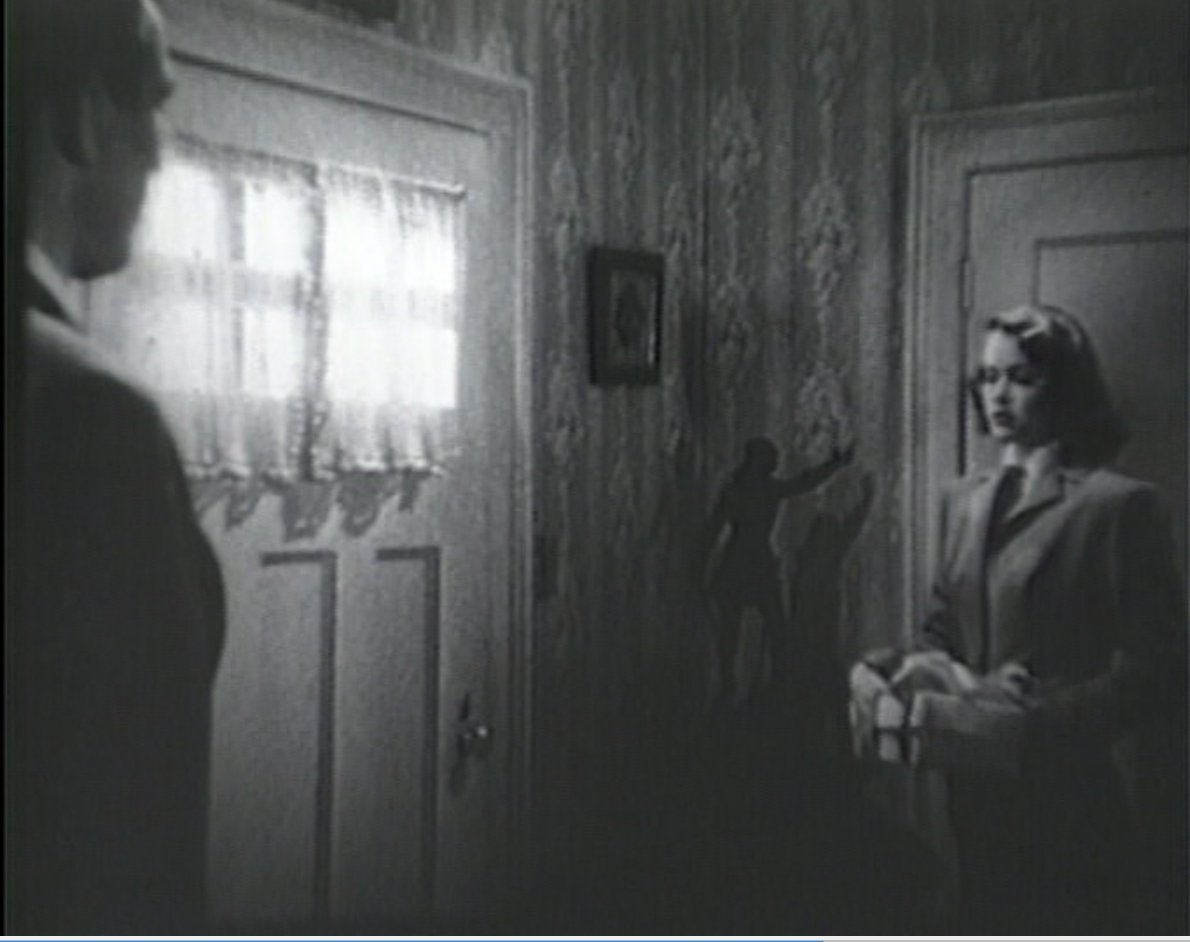
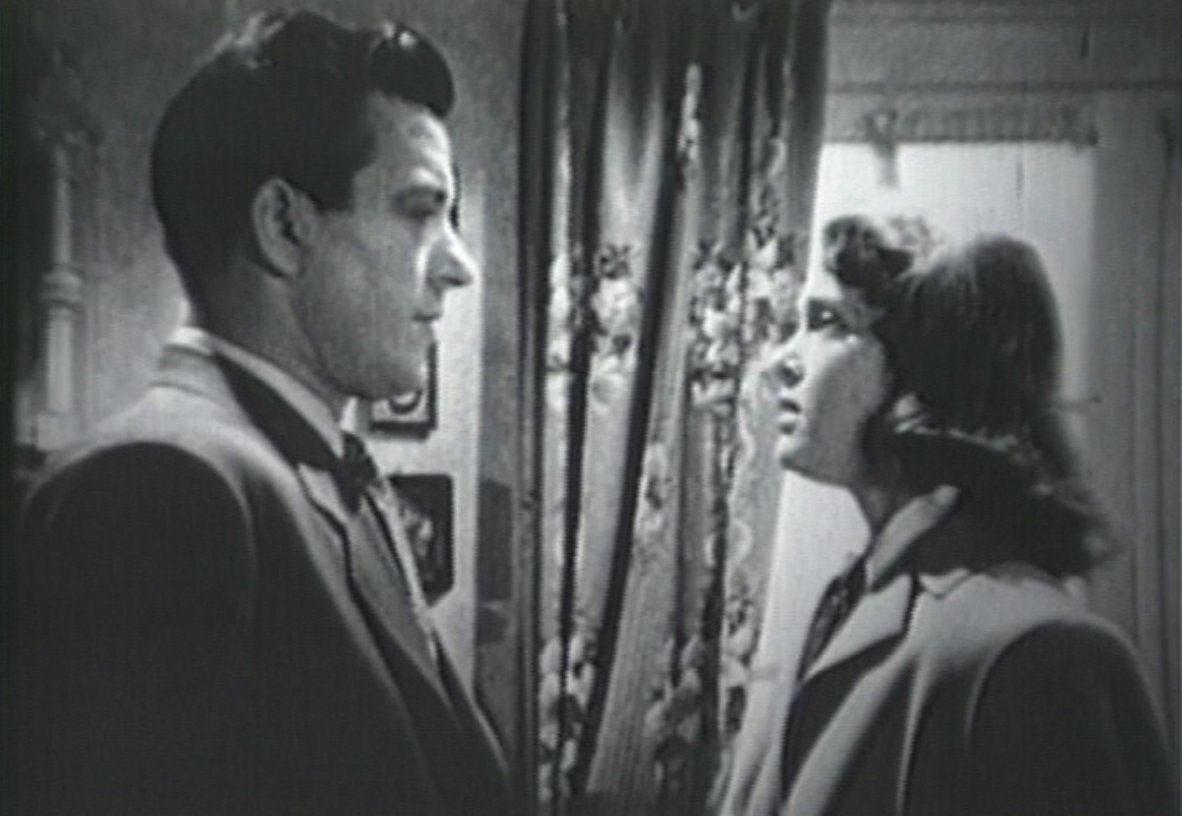
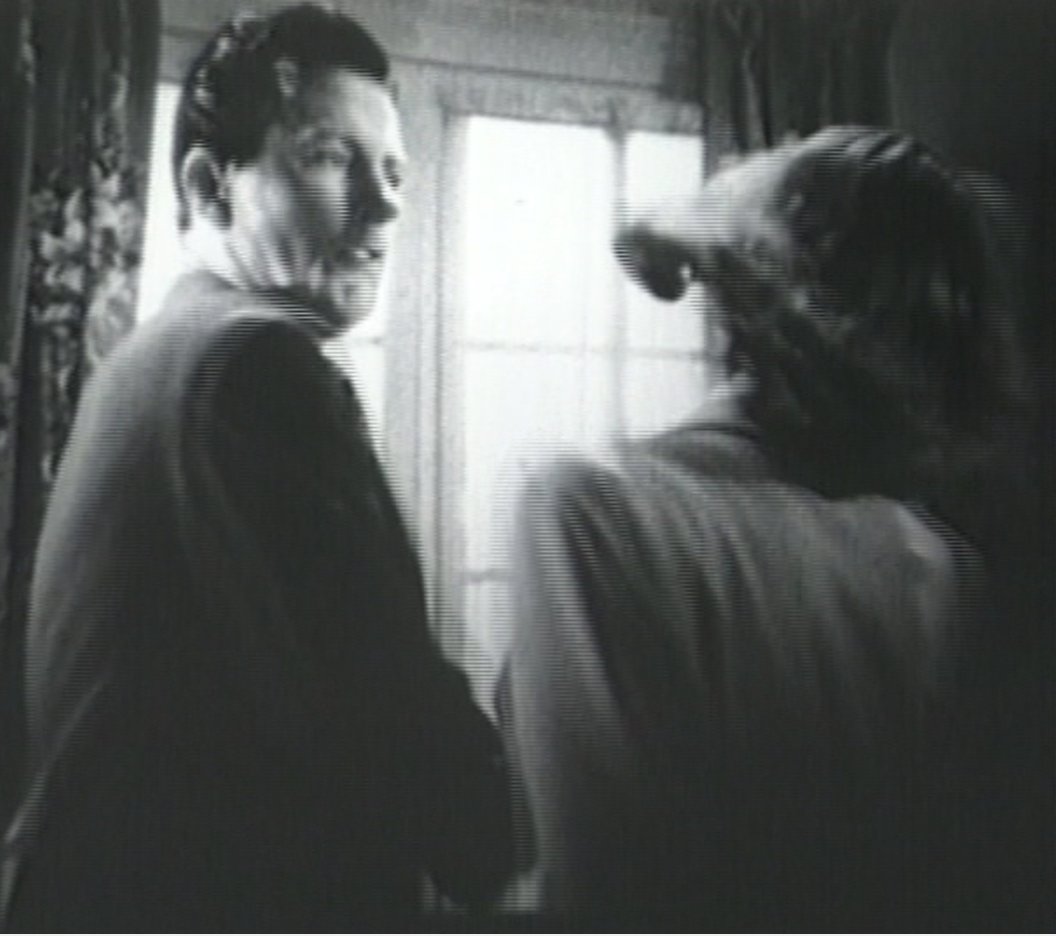
Money Madness must be Beaumont’s most unnerving performance. The writing and the player enacting it keep us as off-kilter as the female lead, Julie, in understanding who the real Fred Howard (aka Steve Clarke) really is. We first see Beaumont’s Howard/Clarke get off a bus a stop before he was originally ticketed, deposit some dough in a bank strong box, and grab an advertised job as a cab driver – all with the arrogant attitude of someone with a mission, but with something to hide. However, next thing we know, he’s saving Julie from a masher, wooing her with kindness and humor, and charming the possessive harridan of an aunt with whom she lives. Ah, so he’s not a bad guy after all. Maybe he’s just been misunderstood or framed for something. He marries Julie in a whirlwind courtship. How romantic – except we see Steve carefully set up Julie’s deception that he’s the victim of an invalid divorce so they can’t tell the old girl that they’re married just yet. Oh, and he starts to poison the aunt secretly, after he’s withdrawn his money from the safety deposit box to hide it in the old gal’s attic so everyone will think the money is hers, which Julie will then “inherit” to share with her hubby. Julie only finds out about the murder when she can’t do anything about it; next thing you know, he’s bound her up as his unwilling conspirator after the fact – revealing they are married after all and warning her, “What I have, I keep.” That Steve repeats this threat while promising to kill Julie when the police have him cornered in her house marks him as a text-book psychotic abuser for sure! The body of the movie repeatedly asserts his inescapable abusive control. Steve alternately slaps and threatens Julie, then offers tenderness and pleas for her love to save him.
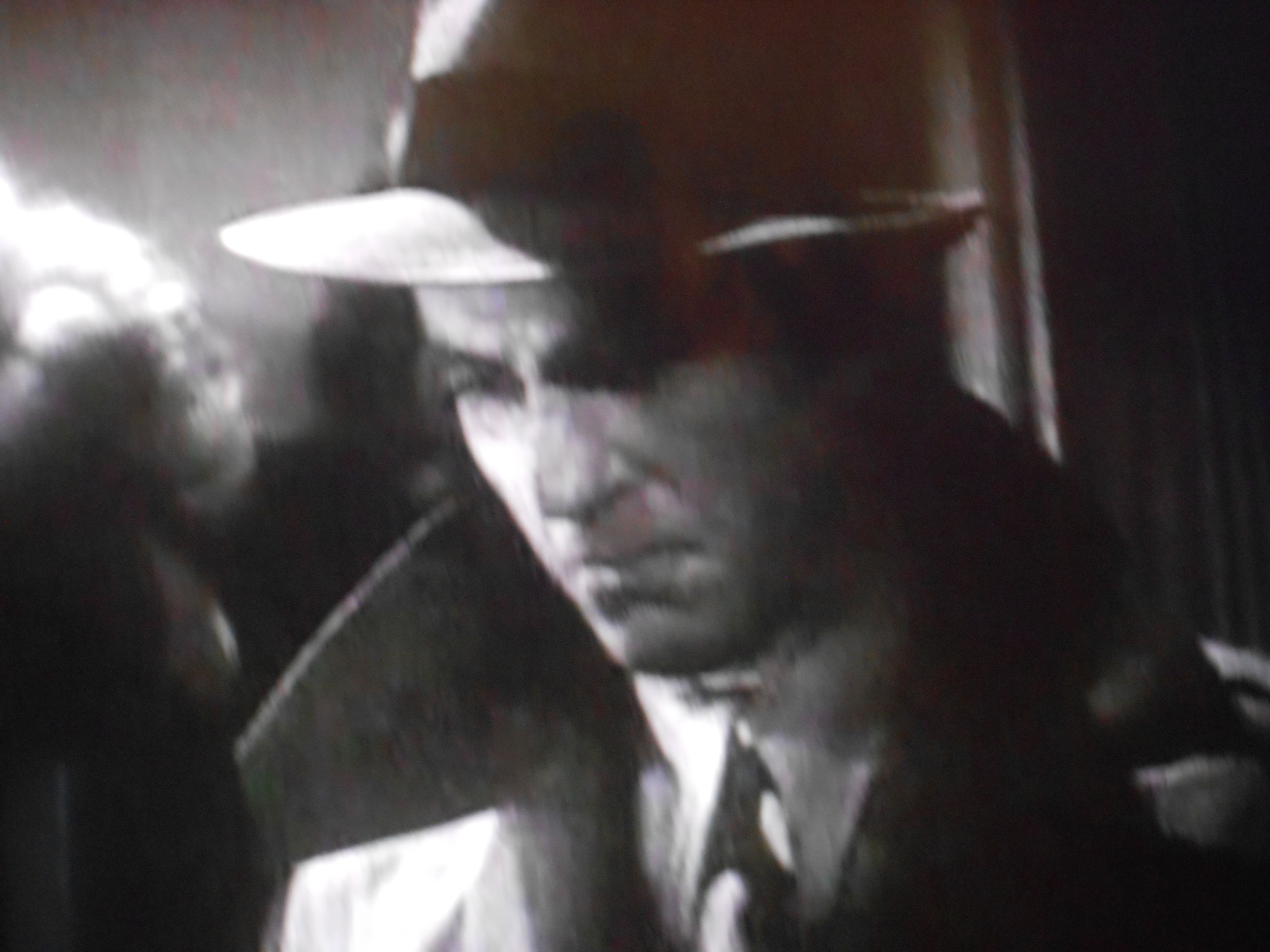
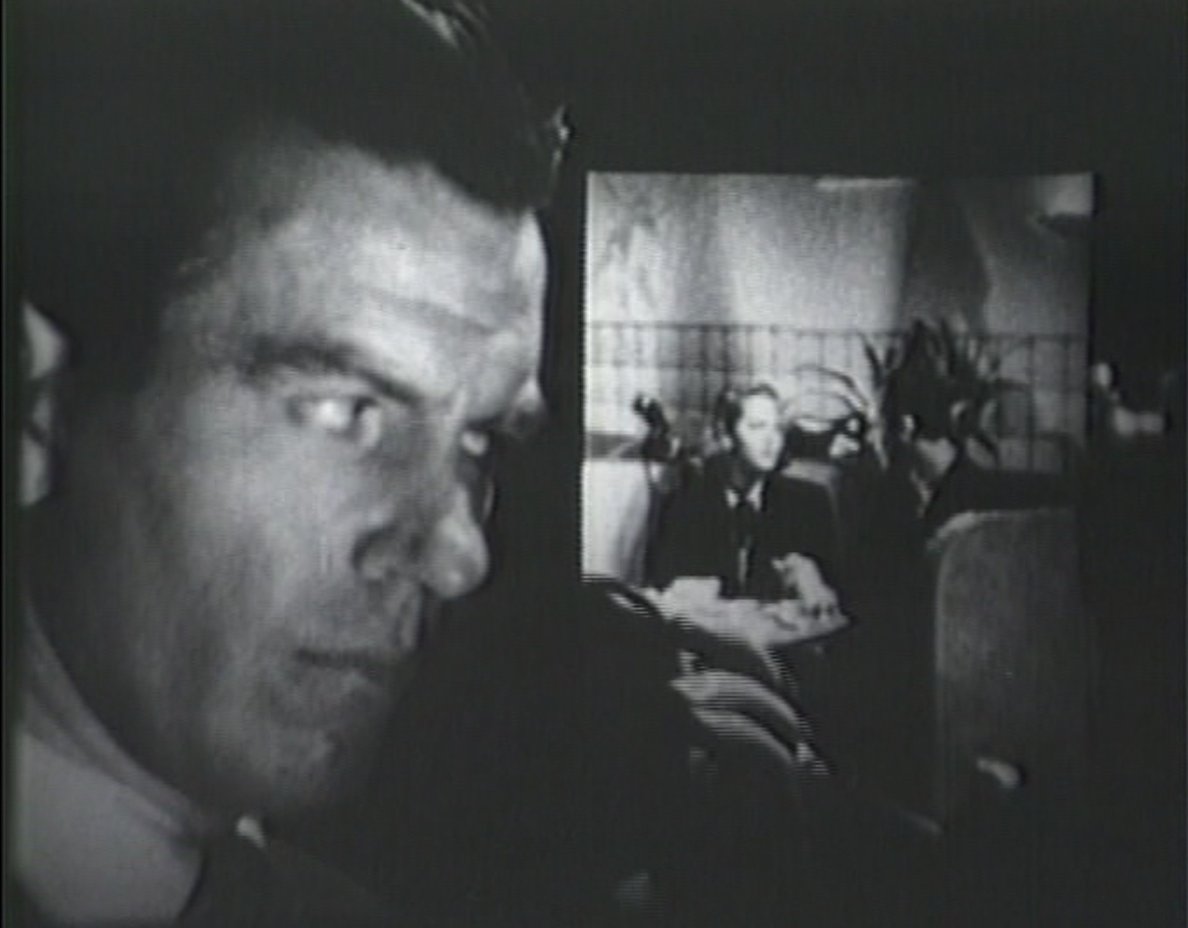
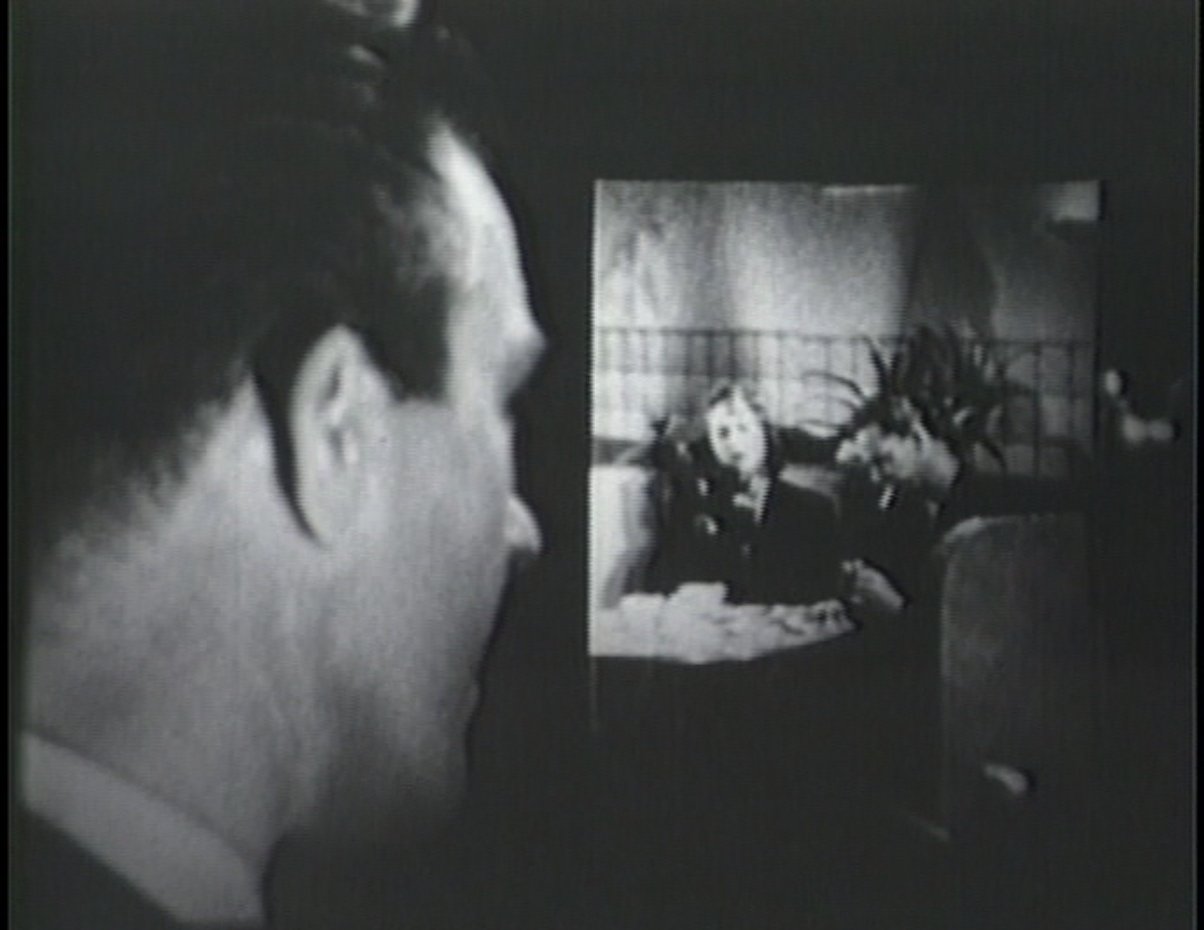
One shot where Julie talks to a supportive lawyer in a restaurant sums up Steve’s sadistic, overwhelming power over her. Steve has made a phone call to Julie at this table, while he is hidden in a nearby phone booth. An unnerved Julie has not properly replaced the receiver in the cradle, so he can hear every worry she grudgingly shares with the lawyer. The set up of the shot powerfully over-inscribes his inescapable predominance. In these two photograph, you can see that the scene is shot over his shoulder, rendering Steve’s head enormous and overpowering he while listens in on Julie and the lawyer. In contrast, those two are seen at a distance, small, insignificant figures in comparison beneath his gaze. This image and Julie’s accidentally leaving the phone off the hook establish that no matter how careful she tries to be, she is under Steve’s vicious power, as well as how ineffective the Law(yer) and friendship are to save her. This film is Beaumont at his most horrific.
To read “King of the Noir Anti-Heroes, Part 2,” click here for Beaumont’s left-side of the law detective series.
-Hugh Beaumont Image from The Lady Confesses screen shot, Alpha Video public domain video (author’s collection)
-Image from Apology for Murder screen shot, YouTube, https://www.youtube.com/watch?v=IY7q2fbEbuo&t=29s
– Lighter image: Photo by alexsandro on Freeimages.com
-Images from The Lady Confesses same as above
-Images from Money Madness, screen shots from Alpha Video’s public domain video (author’s collection)
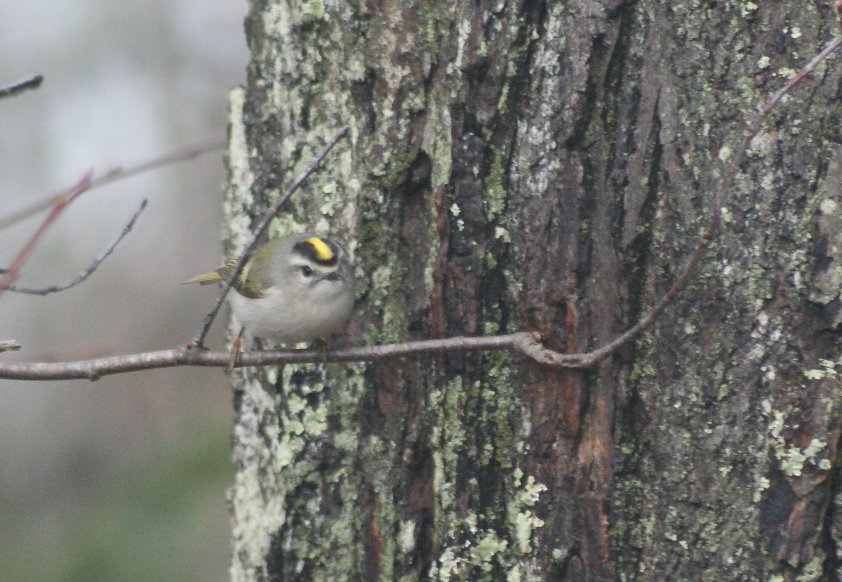
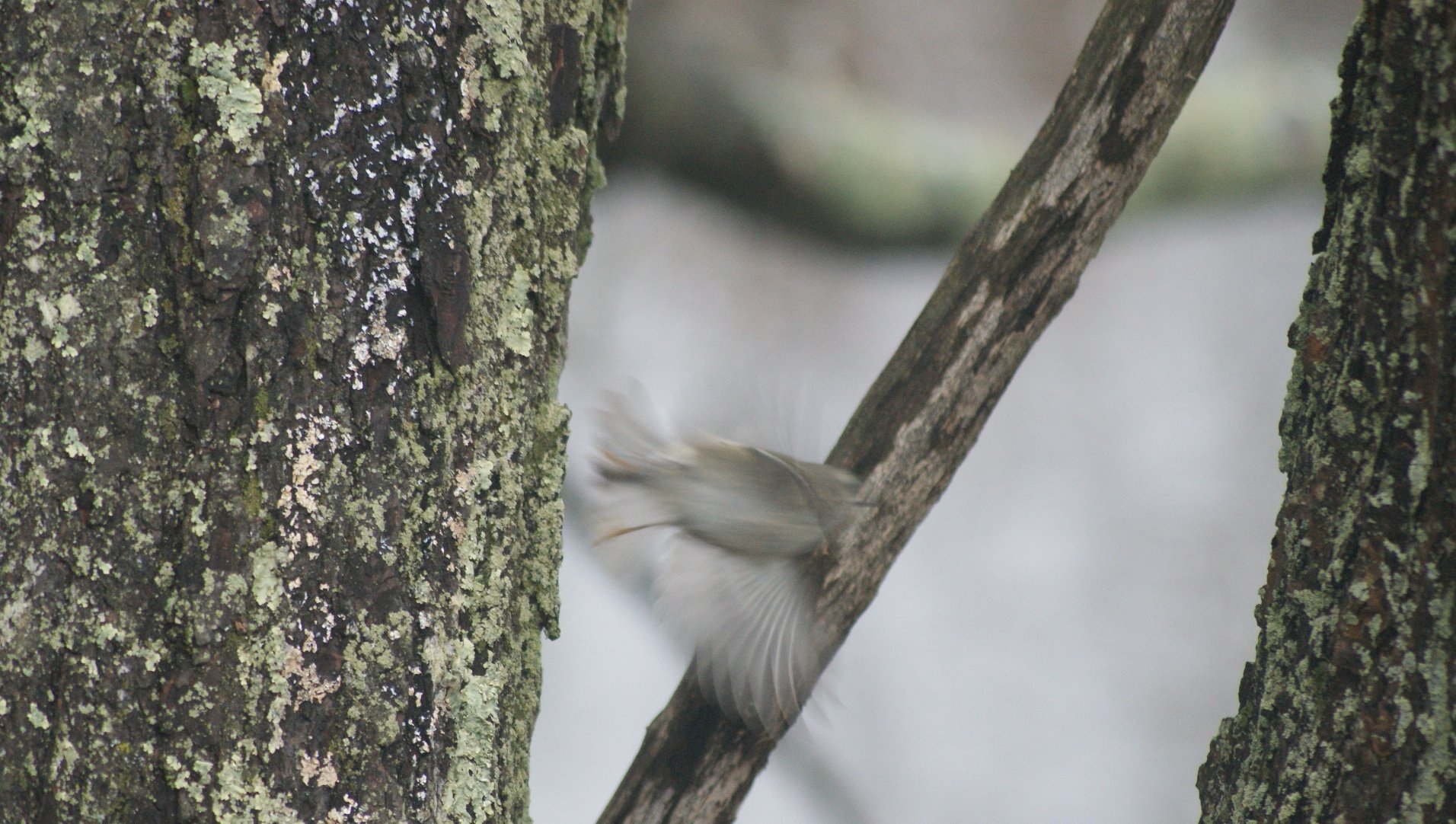
Well, this title isn’t entirely accurate. Many of the winter birds are still hanging out, as is the cold weather. Still, I thought I’d better post on some of our winter visitors before the air conditioners snap on and the Baltimore Orioles start sipping mimosas and fanning themselves. The first visit I want to mention was a local one: the Swedish Cemetery in Worcester. Here, we had the great pleasure of snapping some shots of Gold Crowned Kinglets. These cuties are awfully fast, so Yang actually managed to end up with a few shots of a tree where the bird had been a millisecond before. Nevertheless, he did get some nice photos, as you see. Some were even “action” shots like the one below!
In January, we also made it to Gooseberry Island, one of our favorite spots. Though, for the first time, we missed out on the Long-tailed ducks there, we did sight lots of other feathered pals. We caught some Eiders on film. There was a male, a female, and an immature male. Note the immature male at the the top, right, acting like a typical teenager – not wanting to be seen with his parents.
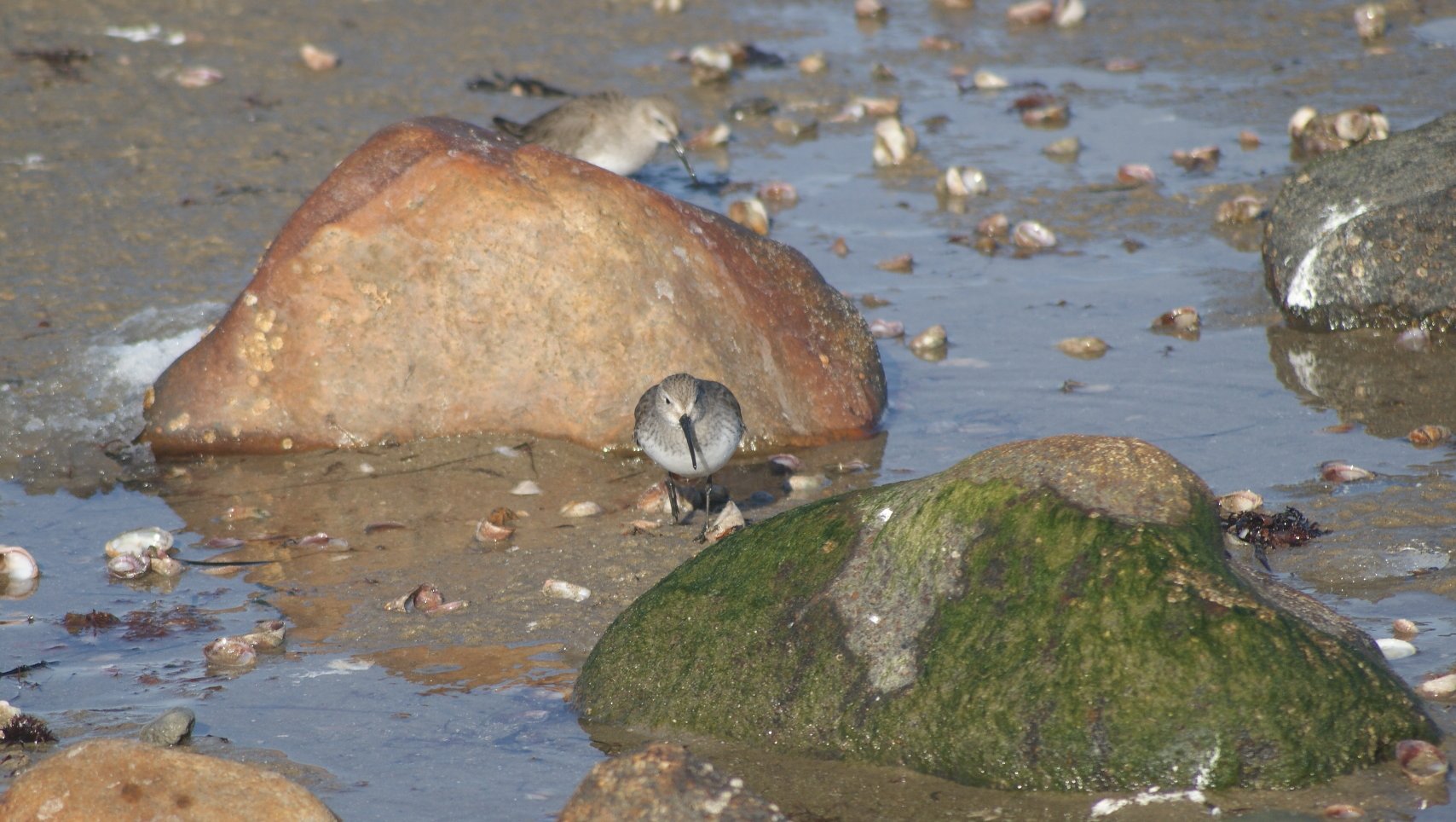
We also some adorable shore birds. The Dunlins were real cuties.
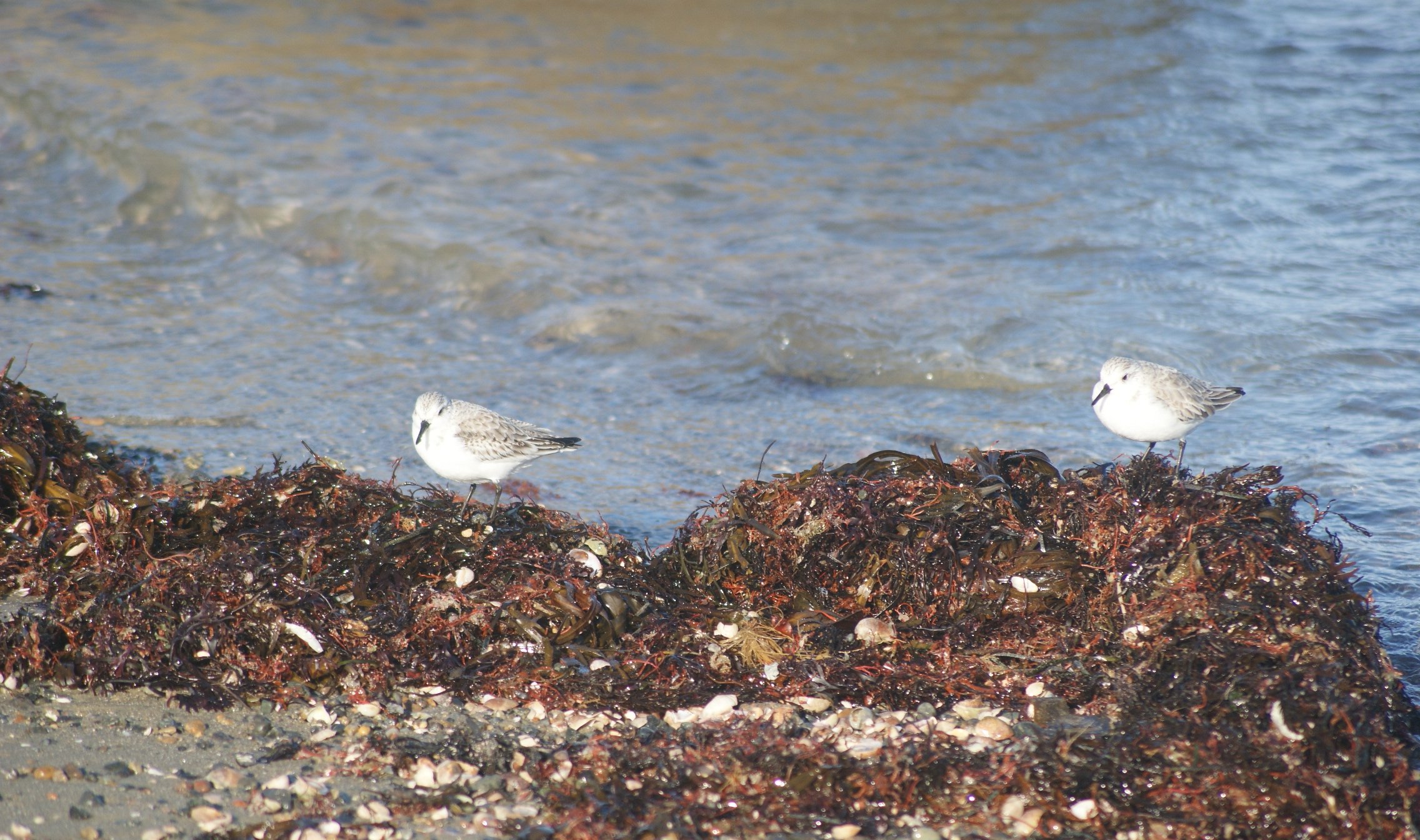
And the Sanderlings were no slouches, either!
We had to go to Halibut Point to see the Long-Tails and Harlequin Ducks.
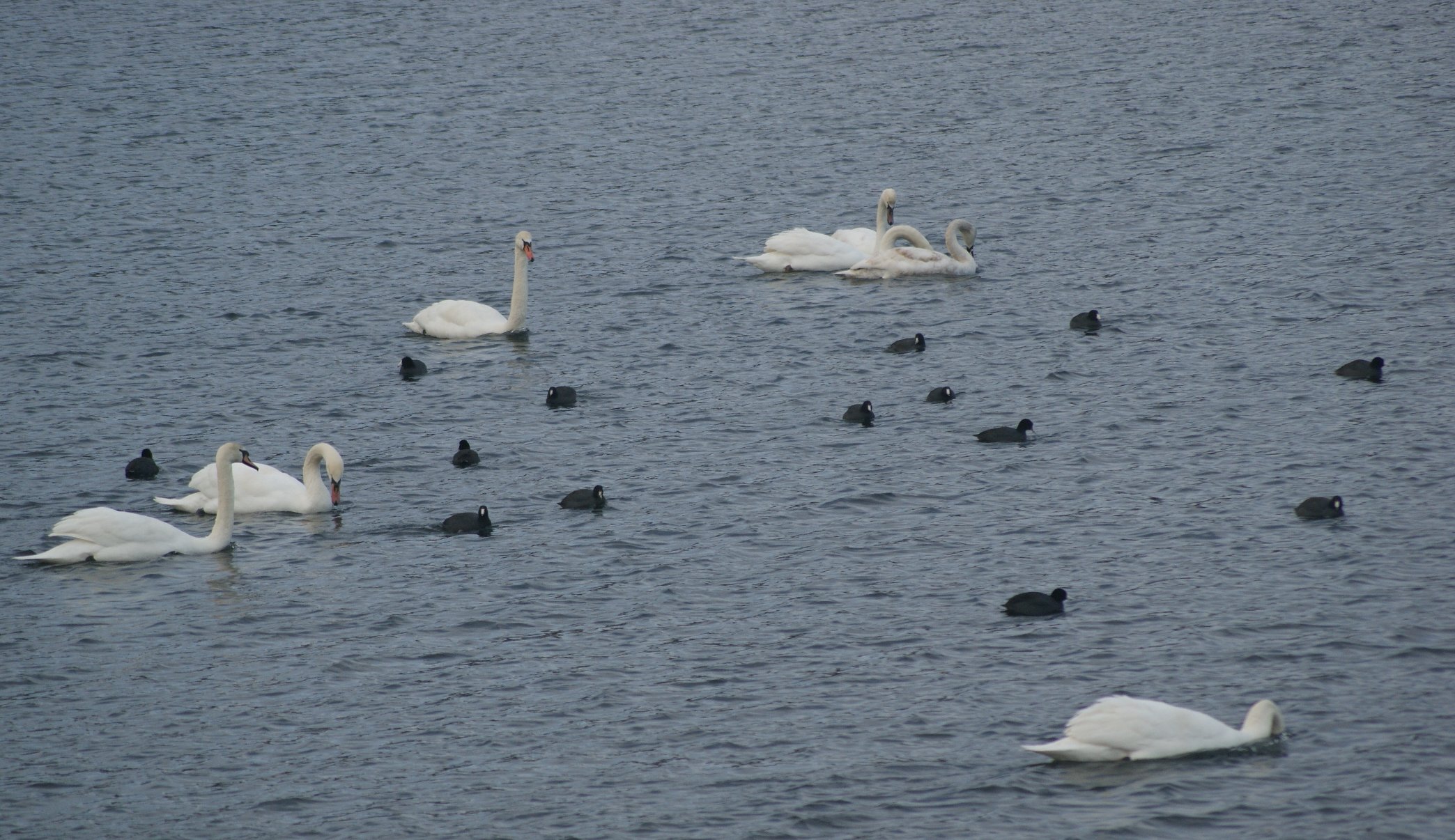
We also made to the Chestnut Hill Reservoir, where we saw many a different waterfowl. The Coots were in abundance – and they loved to hang out with the Swans.
We also got some closeups of these plump guys. Their heads are black, their bodies are grey, they have a white streak over their beaks, and they have huge, lobed, yellow feet. We couldn’t get a good shot of their feet because they were in the water. Still, we did get some nice close ups of these guys. They are still at the the Reservoir now, along with tons of Ringed-Neck Ducks. The Ruddy Ducks have also re-appeared – but that’s a set of pictures for another blog. For now, enjoy these rotund cuties. By the way, they also love Horn Pond in Woburn – the forthcoming subject of another blog.
Their bodies may be plump and take-off may be skittery, but the coot can fly!
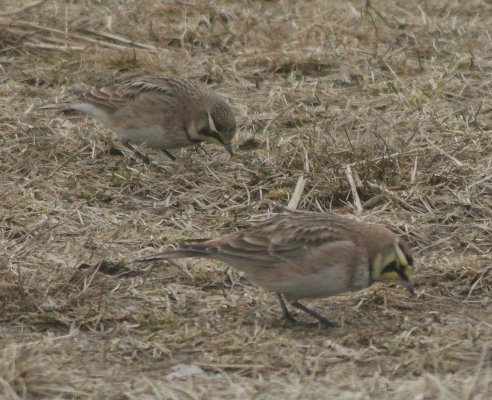
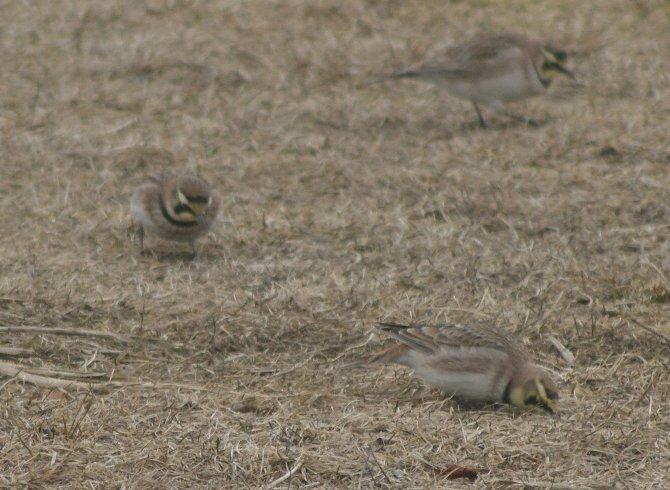
Last report is on our visit to Meig’s Point in Connecticut in February. A week or so before, we’d gone there on an unseasonably warm Saturday – and, unfortunately, everyone else had the same idea. There were tons of people but hardly a bird to be seen. That was sad for Yang, because this was the place we always saw one of his favorites, the Horned Larks. So, we went back on a colder weekday a week or two later and guess what we saw?
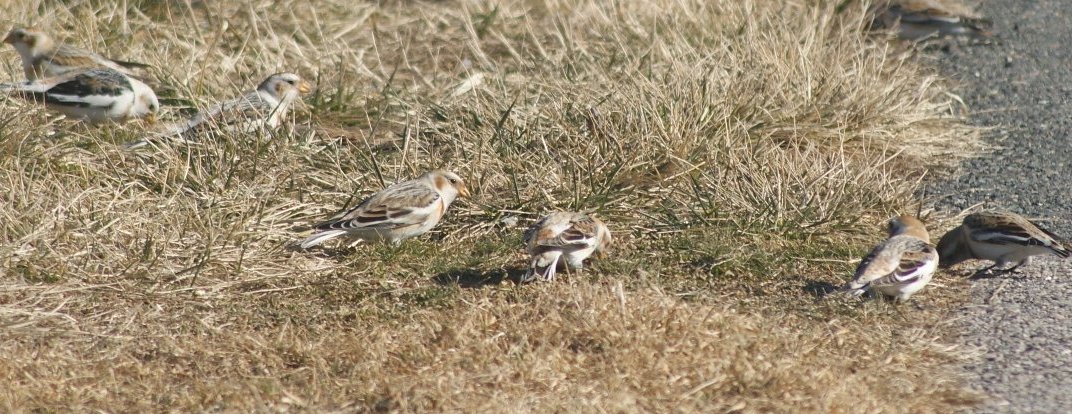
We got to see a whole flock! We were so careful to approach them quietly, because these guys are very shy. The the flock will fly off in a winged shape, much like the Snow Buntings that we saw on Deer Island. It’s so neat to see that sweep of black feathers giving them a “horned” appearance, with that splash of chartreuse on their faces. As you can see, it’s hard to pick them out with the way their brown feathers blend them in with the winter seared grass. If you click on the photo, you’ll get a better look.
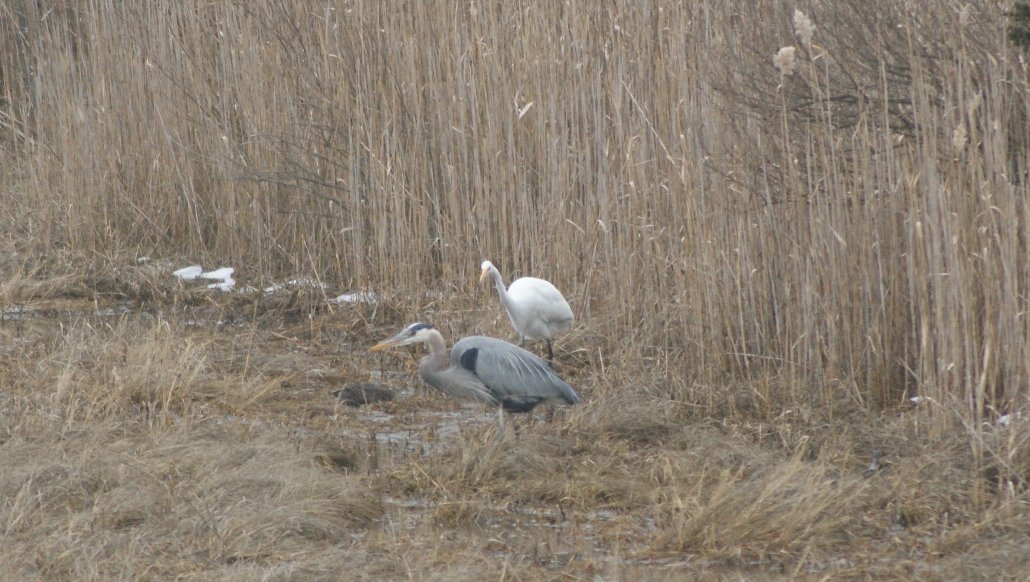
We didn’t just see the larks, though. I wasn’t able to get a picture, but I did see a female Ruby-Crowned Kinglet close up. We were sighted lots of Loons (the avian not the human kind) swimming along the shore, like this chap. At one point, we even saw three seals sunning themselves out in the bay. Sorry, they were too far to photograph. Here’s one of the many Golden Eyes we saw, along with tons of Surf and Black Scoters. We also had the pleasure of watching a conference between a Great Blue Heron and a Great Egret that, fortunately, ended without bloodshed.
So, winter may be past, or passing, but we did get some nifty bird sightings in!
One of the FB birding groups to which I belong mentioned the presence of snow Buntings on Deer Island. These cute guys were birds that I had never seen close up, but I’d always wanted to. So, Yang and I took a jaunt out one weekday early afternoon and had quite a treat on our long walk around the island. It’s about a 2 1/2 mile circular trail around the island on a paved path, so the going is easy. It was a gorgeous day – and the views matched the weather.
There are some wonderful views of Boston Harbor. You can also see that I have this really neat white hat on, given me for Christmas by my good friend Kathy Pender Phaneuf. This hat has kept my noggin warm on many a seaside trek to scope out the water fowl. Thank you, Kathy – and dig these views!
On the far side of the island:
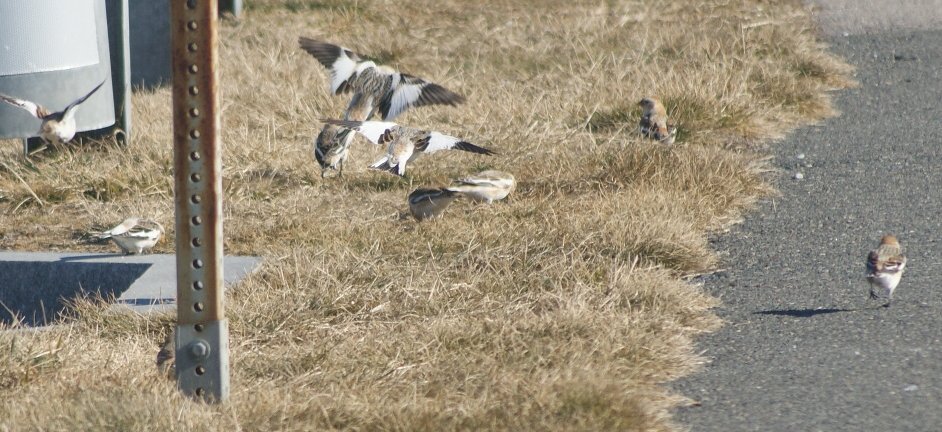
There was, indeed, quite a bit to view in the fine-feathered-friend department. I got to see my Snow Buntings! You should click on the images to get a really good look at these guys.
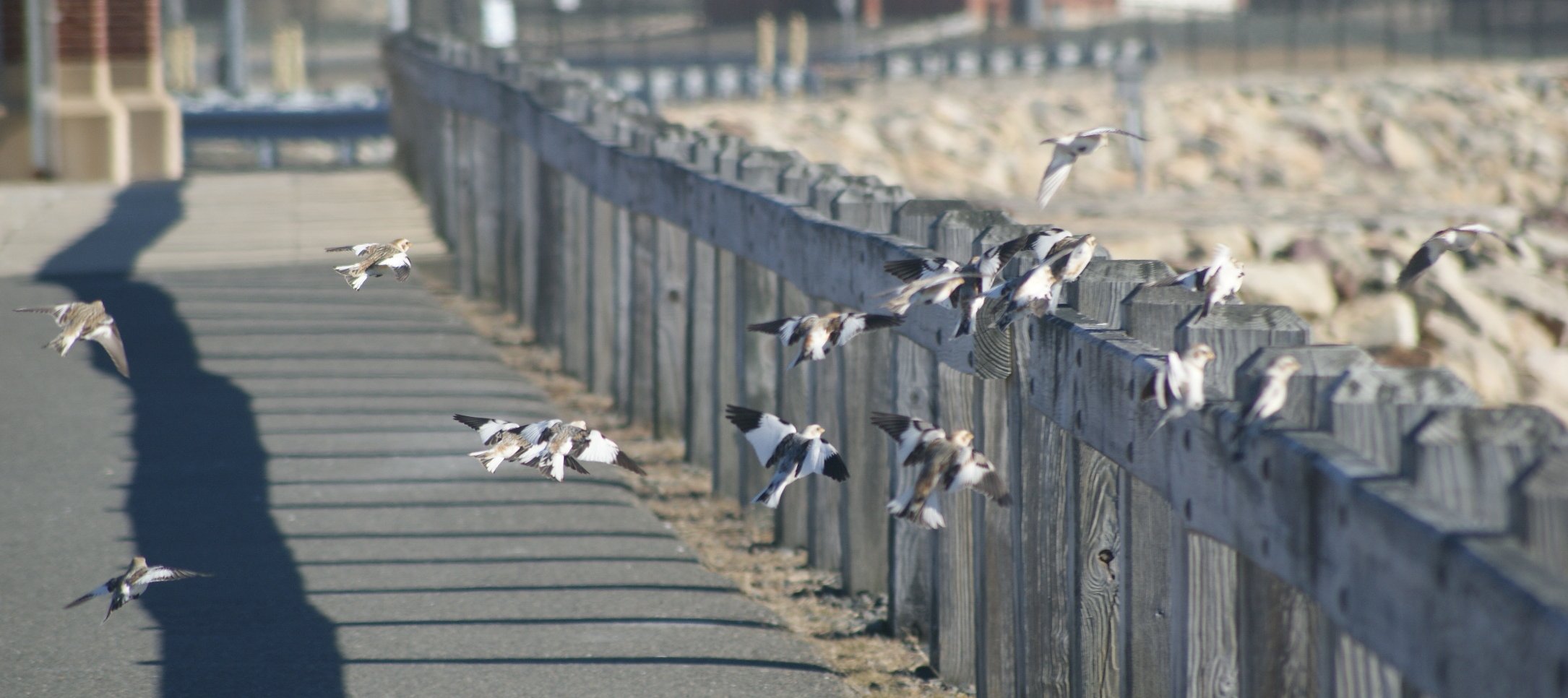
I first heard them somewhere on the beach, but couldn’t see them. I walked along the wall next to the trail, looking at the ground to watch my step, when all of a sudden, Yang called, “Stop! Look in front of you!” There they were – and what fun they were to watch. If you creep up very slowly and quietly, you can get a good look at them, but you have to be careful. These birds are extremely timid and spook easily. Then the flock is in the air, flying in precision formation, but often circling back nearly to where they started. When they fly, you can see white and black chevrons on their wings that are beautiful!
Here are a few closeups. I love that gorgeous white on their tummies.
There were even more birds IN the water than out of it! We had been to the Cape looking for Eider Ducks recently, but hadn’t seen many. Now we know where to find them – along with Scoters of all kinds, Scaups, Buffleheads – you name it!
Here are some close ups of the Scaups, and it looks like a female Bufflehead.
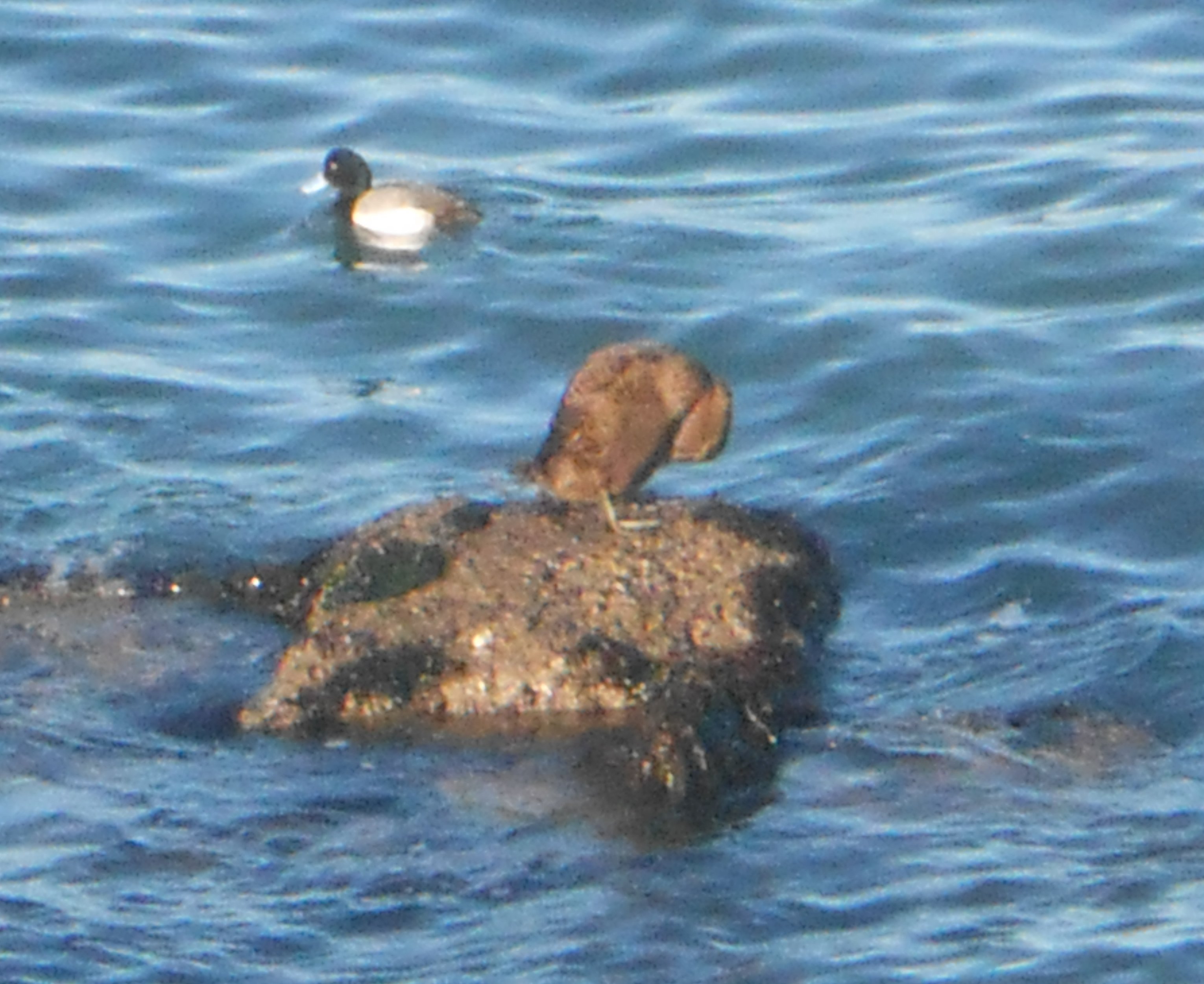
There were lots of Eider Ducks. We got a special kick out of this lady who was have a fine time for herself out of the water on her own personal rock – with a special guest shot by a Scaup.
Then, she has to get down with her bad self in this next picture.
We did see and hear some Song Sparrows. I wonder if in the spring some interesting song birds will return to sing in the brush or atop this Celtic Cross?
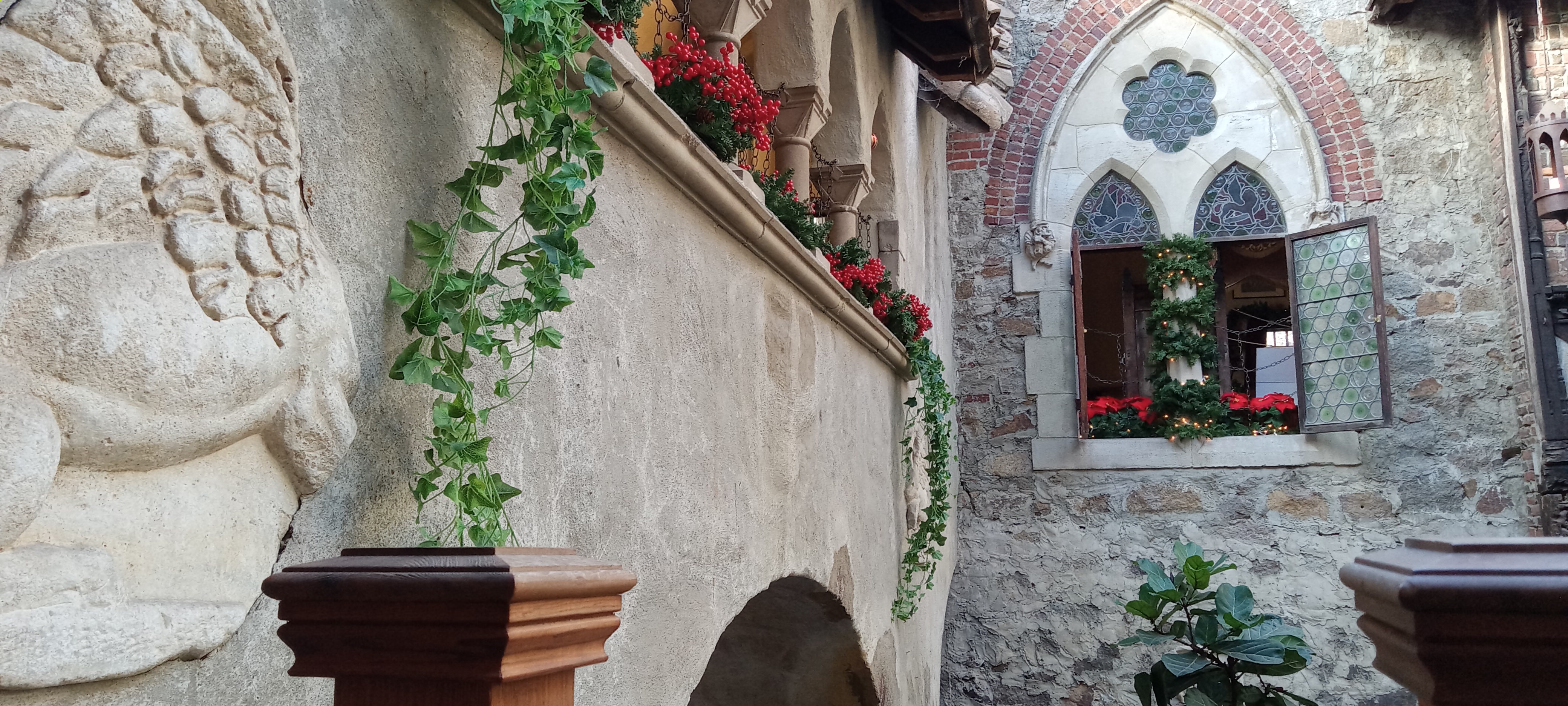
Since we’re still in the middle of the twelve days of Christmas, how about a blog where you can see the cheery holiday decorations at one of my favorite spots, Hammond Castle? I hadn’t been there for years, but I remembered how they did up the castle right for Christmas one of the times I was there many moons back. So, Yang and I decided to celebrate the season by visiting once again. We were not disappointed.
John Hammond built this castle early in the 1900s, funding it by the sale of his patents for all kinds of applications to navigation, radar, radio, etc. In fact, I believe he holds the record for the largest number of patents awarded in this country. He did come from a prominent and wealthy family, but they disowned him for marrying an older divorced woman – with whom he shared a long and happy marriage – so there Mom and Pop Hammond!
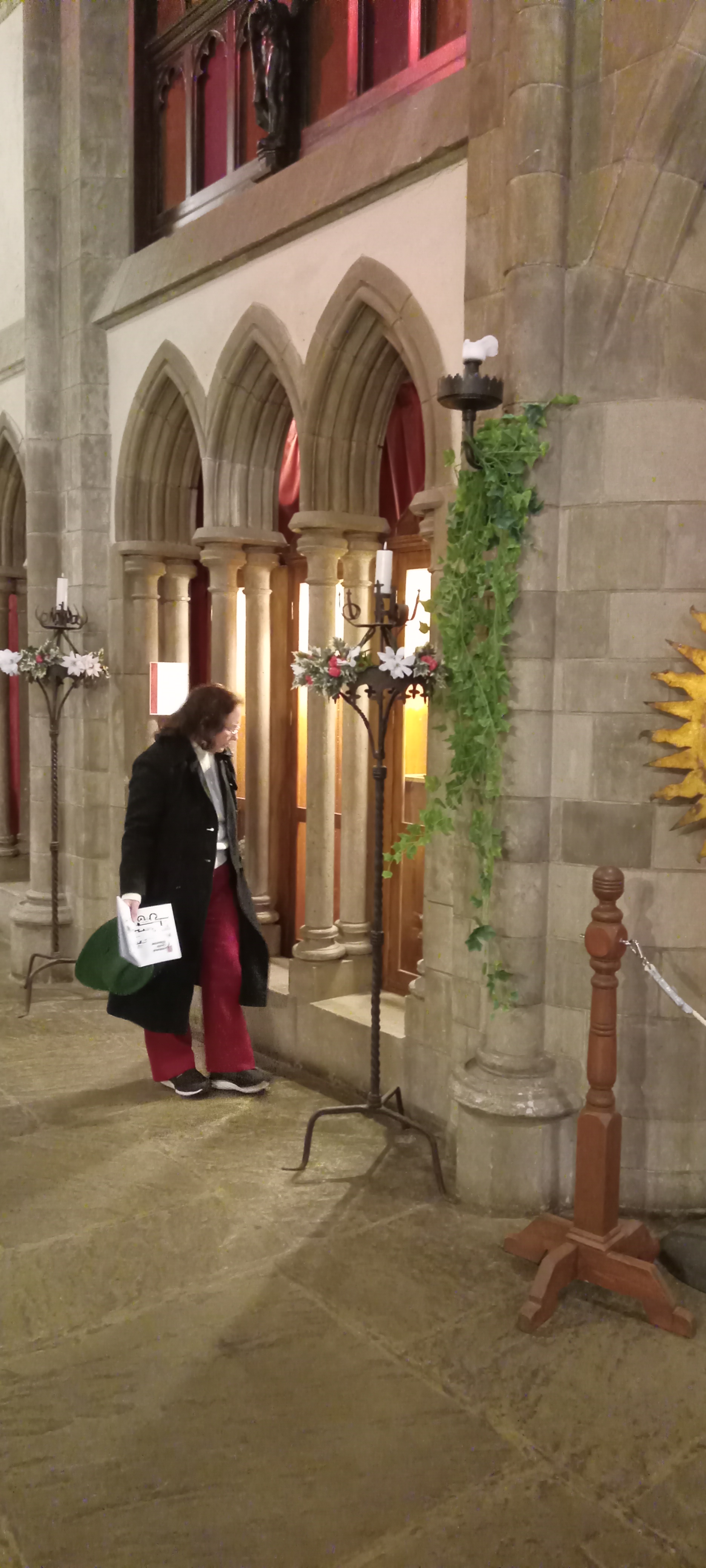
The main shots we have here are of the Great Hall and the Courtyard. Yang took some really neat shots of the Great Hall. Hammond would have large family and friend gatherings here in his day, including lots of famous film political, and business figures. I remember back in the 1980s and later when I came here, I attended concerts on the pipe organ and by smaller consorts. I also got to watch silent films in the Great Hall. It was the perfect setting to enjoy Lon Chaney’s The Phantom of the Opera. In this photo, you can get an idea of the length of the hall. You can also see the beautiful rose window.
You can also observe some of the alcoves off the main hall in these photos. I wish we’d had achance to take pictures in the dining room and the library off the Great Hall, facing the ocean, but the light was not great for photographing — too much sun coming in. Natasha would have liked it, though! Some of the decor were skillful reproductions of classical, medieval, and renaissance art; however, much was also pieces that had been rescued from ruins or antique dealers.
How about this huge hearth? Would it keep the entire hall warm? Well, maybe you ought to remove the Christmas decorations first!
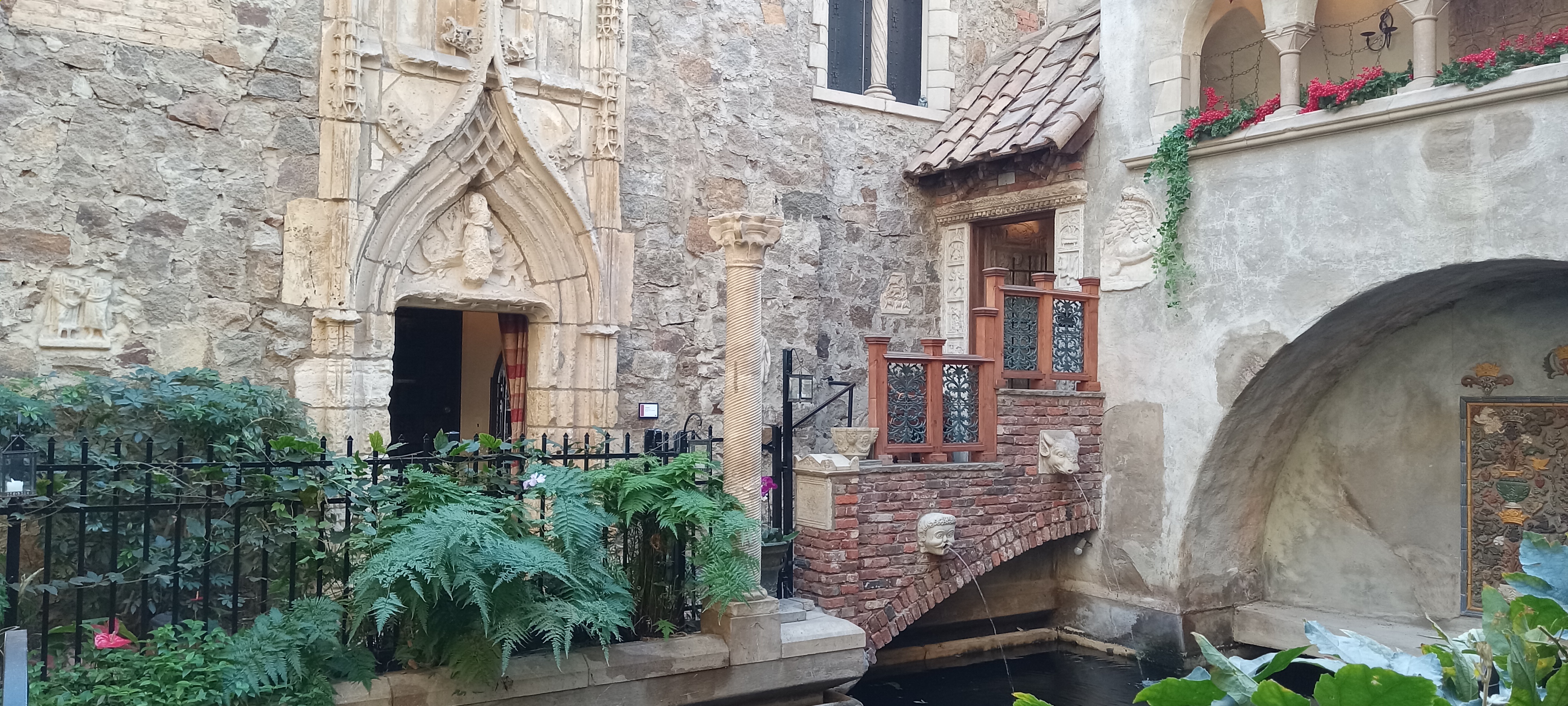
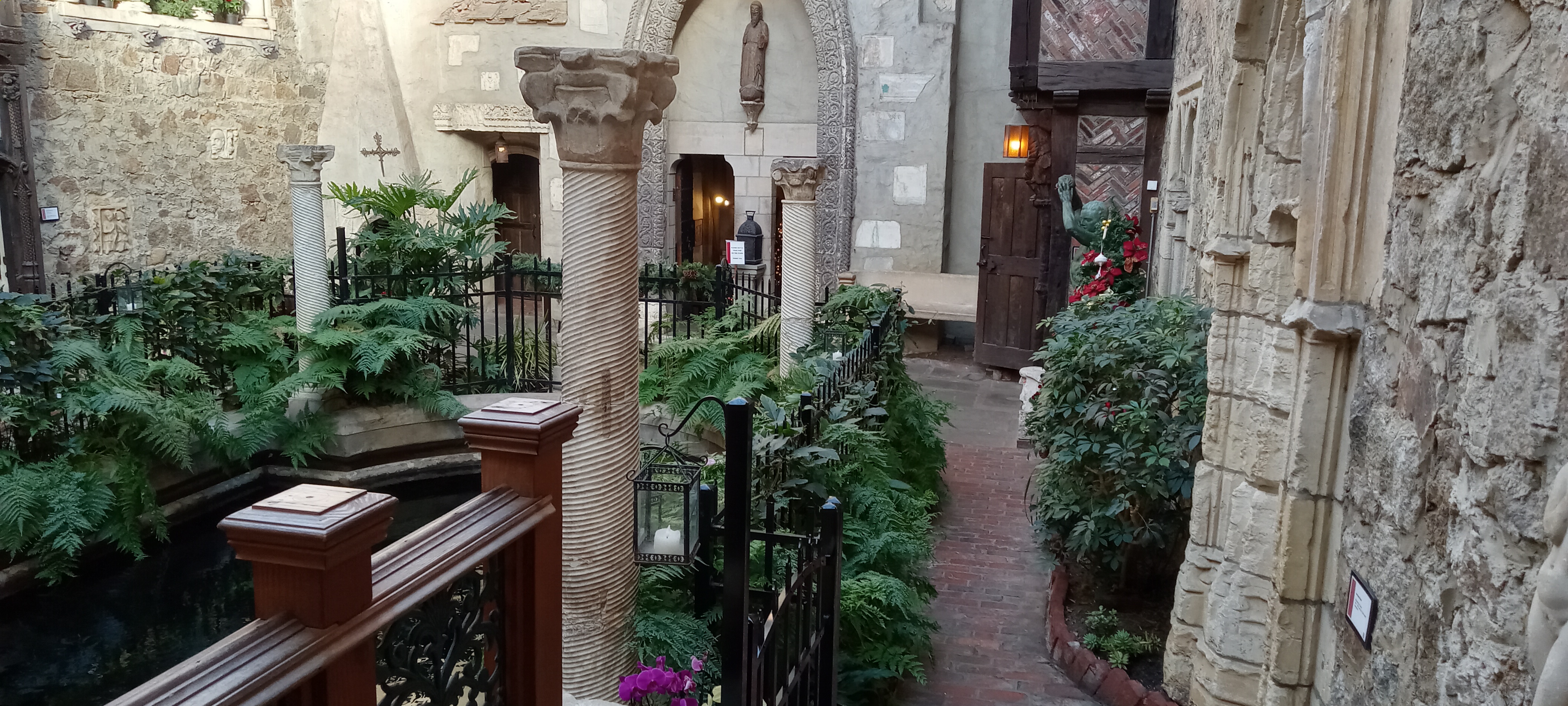
The courtyard was a real treat! Recreations or imports of medieval and renaissance shop fronts were integrated into the walls, leading into various rooms. The courtyard was roofed with glass skylighting, allowing for the growing of all kinds of plants that surrounded a long, eight-foot deep pool. Here is a view from the balcony to one end of the courtyard from which Mr. Hammond enjoyed diving off into the pool for a swim – but I think he changed into his trunks first. How would you like to jump in from here?
We were lucky enough to meet two of the guides there who took our picture. We had a great chat with them about the castle and ruins, castles, mansions, and other haunted spots in new England. If we go back for a guided tour, I know that they would do a great job. they helped make our day!
Anyway, here are some more shots of the courtyard.
Looking at these photos, you can see how Hammond integrated reliefs, tombstones, storefronts, etc, into the construction of the hall. It’s eclectic, but it works!
The Christmastide greenery adds seasonal beauty and cheer to the castle.
We don’t have photos of the bedrooms or the kitchen or Hammond’s workrooms. Maybe that’s for another day – or for you to find on your own trip to the castle.
Finally, the outside is also a pleasure to enjoy. For one thing, there’s a draw bridge. An interesting story connects here. Apparently, Hammond also built a covered bridge for the cats to leave the castle near here as well – but they didn’t deign to use it. I think they were busy chilling in the boxes in which some of the antiquities arrived.
Of course, we can’t forget to include picture of the person to whom we can credit the majority of these photographs.
I love these Gothic arches framing the view of the Atlantic on this sunny winter’s day.
For your final delectation, below is a video that reveals the glory of the Great Hall in panorama. If you want to enjoy Hammond castle for yourself, here’s a link to their web site. Their “Deck the Halls” tours are open until December 30th.
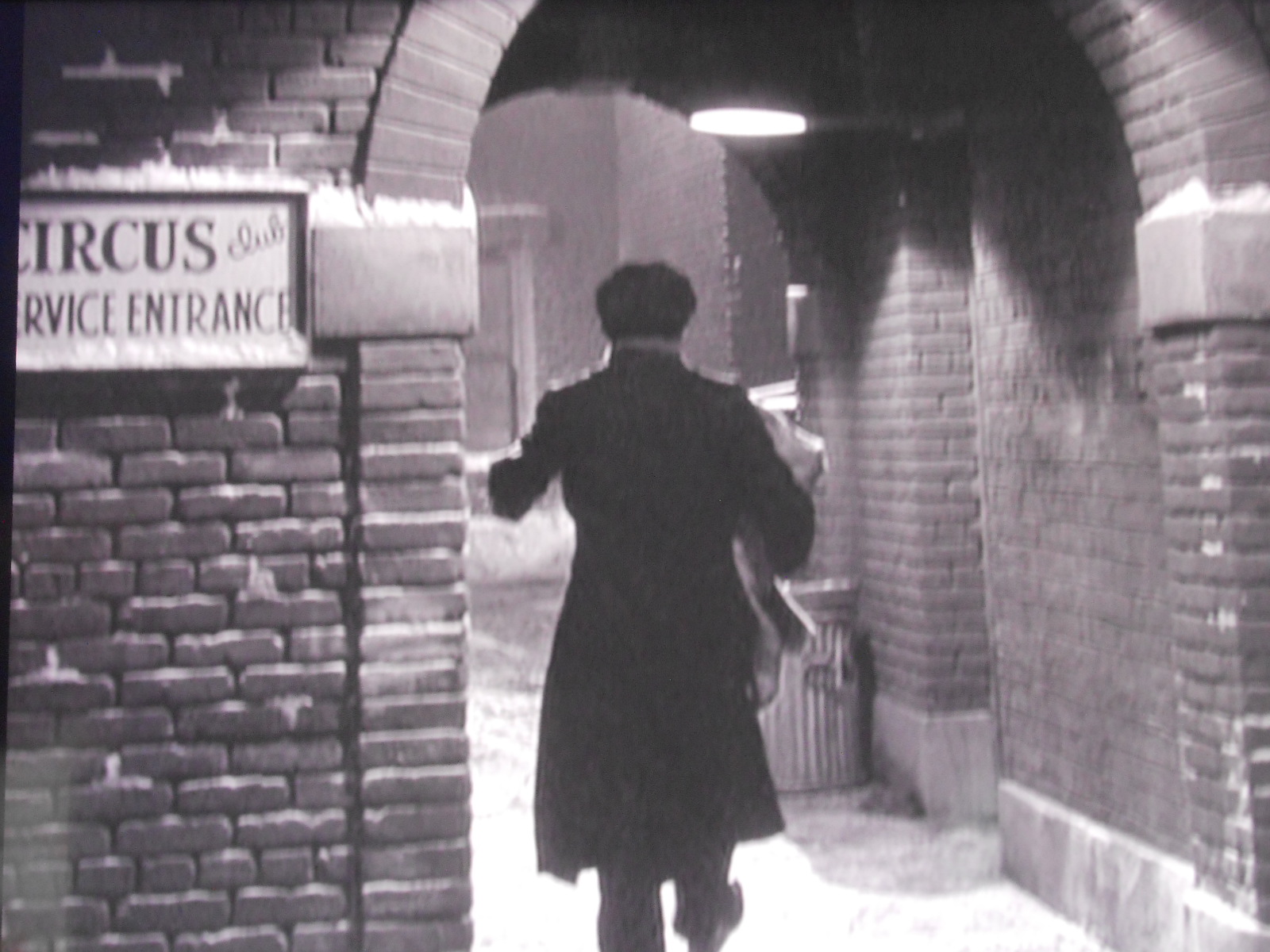
Lady on a Train is more comedy than mystery; however, it possesses some nice dark touches that give its holiday setting a noir flavor. The opening title cars starts us off with the blacks and greys, stark lines, and and dusky darkness of falling night so characteristic of noir. The essential plot gives us Nicki Collins (Deanna Durbin), a sassy San Francisco heiress, witnessing a murder from her compartment window as her train pauses before chugging into New York’s Grand Central Station shortly before Christmas. The image through her window is perfect noir. An old man arguing with a overcoated and fedored form lowering over him. When the old man angrily turns his back, the menacing figure spots a crow bar on the table, pulls down the window shade without facing the outside, and then bludgeons his victim, visible only through silhouette on the drawn shade. All just before the train pulls out and rushes toward the station.
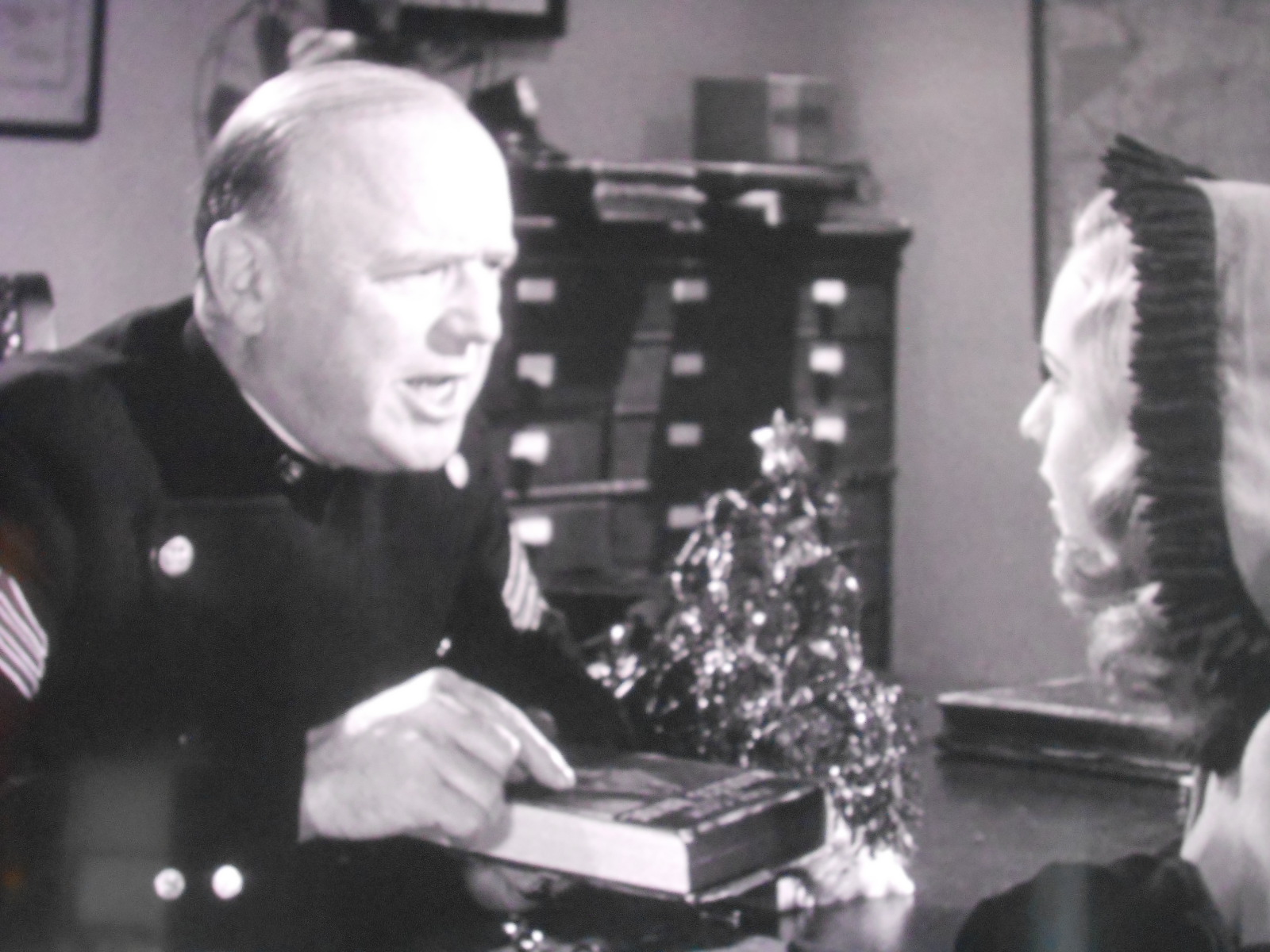
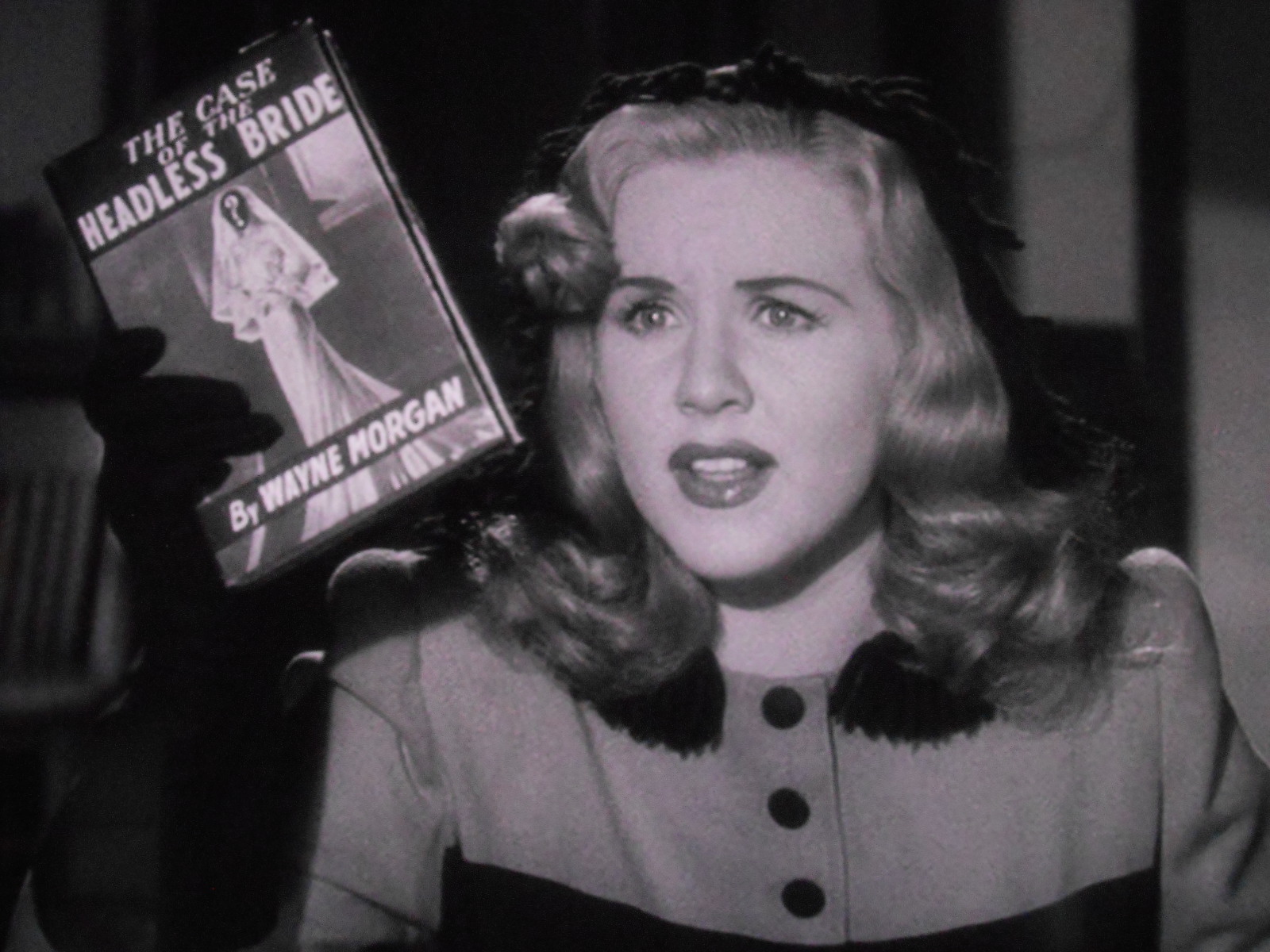
Of course, no one really believes Nicki when she tries to sound the alarm, not fussy factotum Edward Everett Horton sent to meet her at the station and definitely not the crusty desk sergeant (William Frawley at his crustiest best) – especially when the latter sees that Nicki is holding a sensational novel by her favorite mystery writer.
So, what is our undaunted heroine’s next step? Why, track down that mystery author, Wayne Morgan, to help her solve the crime. Played by David Bruce, the author does not appreciate her throwing this strange tale in his lap and expecting him to solve the murder – especially since she hounds him by interrupting his meeting with his fiancee and then tracking the writer and fiancee to a movie theatre – where Nicki sees in the newsreel that the famous wealthy man recently found dead from “falling while decorating his tree” is the same guy she saw murdered! Our poor author ends up really up against it while trying to fend off Nicki’s insistence he help her while he is under the gimlet eyes of a formidable fiancee ( the elegant but indomitable Patricia Morison) and a secretary (Jacqueline DeWitt), whose dry cracks and skepticism over the writer’s capabilities would do Eve Arden proud.
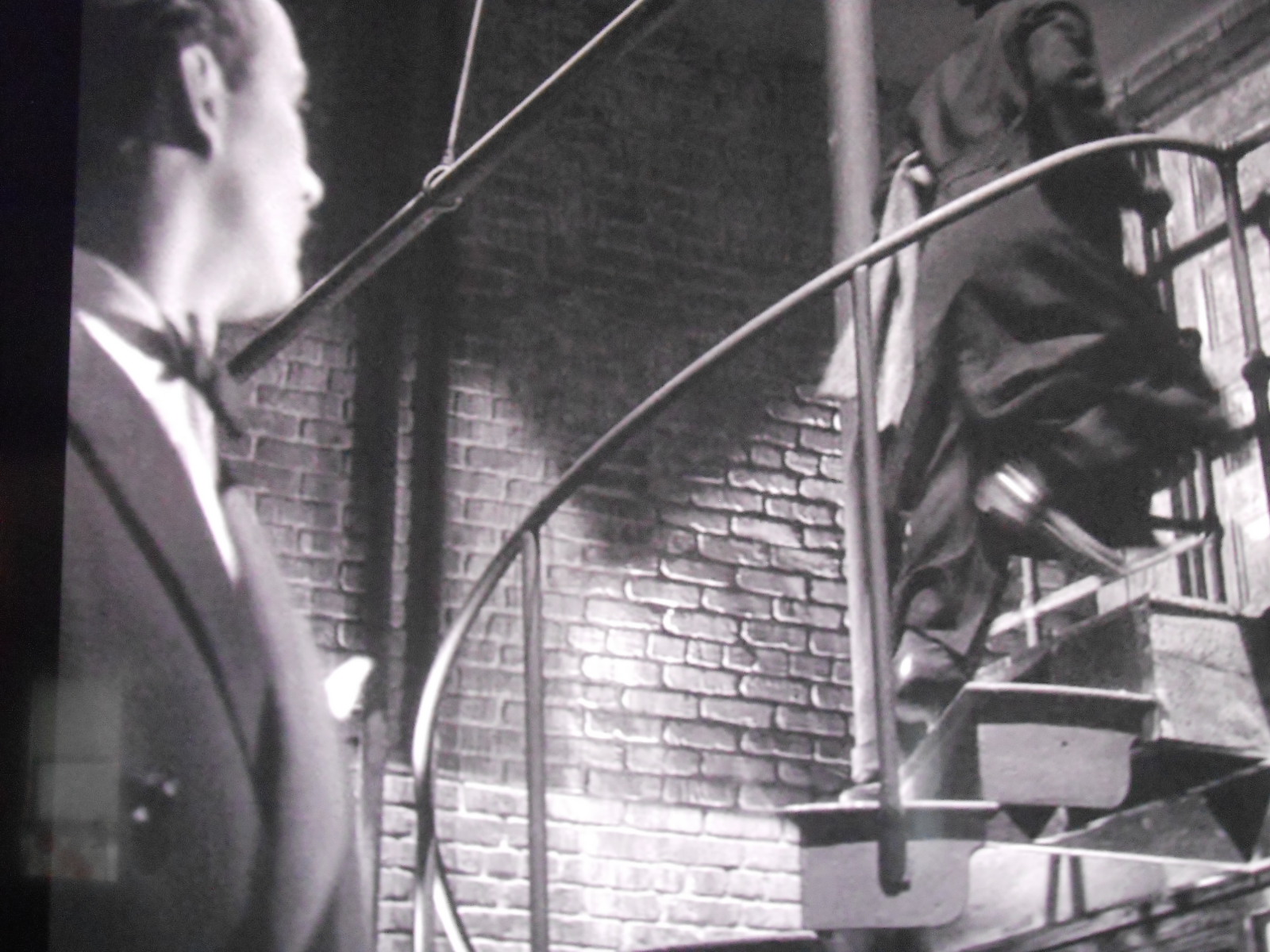
Even with Nicki’s feisty and cheery determination to get to the bottom of things, Lady on a Train has some deliciously noir moments: Nicki’s incursion on the murdered man’s mansion through sharp contrast of black night shadows with stark white snow; the mansion itself’s cobweb of shadows and hazy grey lighting, twists and turns of its interconnecting rooms, and the startling contrast of double doors opening from a foyer’s gloom into a brightly lit room filled with relatives listening to the dead man’s will – themselves an disconcerting mixture of charm and menace. A noir staple of mistaken identity comes into play when Nicki is taken for the old man’s gold-digger girlfriend, the singer in a downtown night club that itself will contain a two-way mirror for spying, dark and twisted corridors leading to shadowy basement rooms of hidden threats. Of course, there’s no forgetting the estate’s caretaker, who also seems to run the nightclub and have master-minded a plot to con and murder the old man – a smoothly sinister sort who slides snakelike through back ways and hidden doors, bearing a white cat – I guess I mixed a metaphor there with the cat and snake thing.
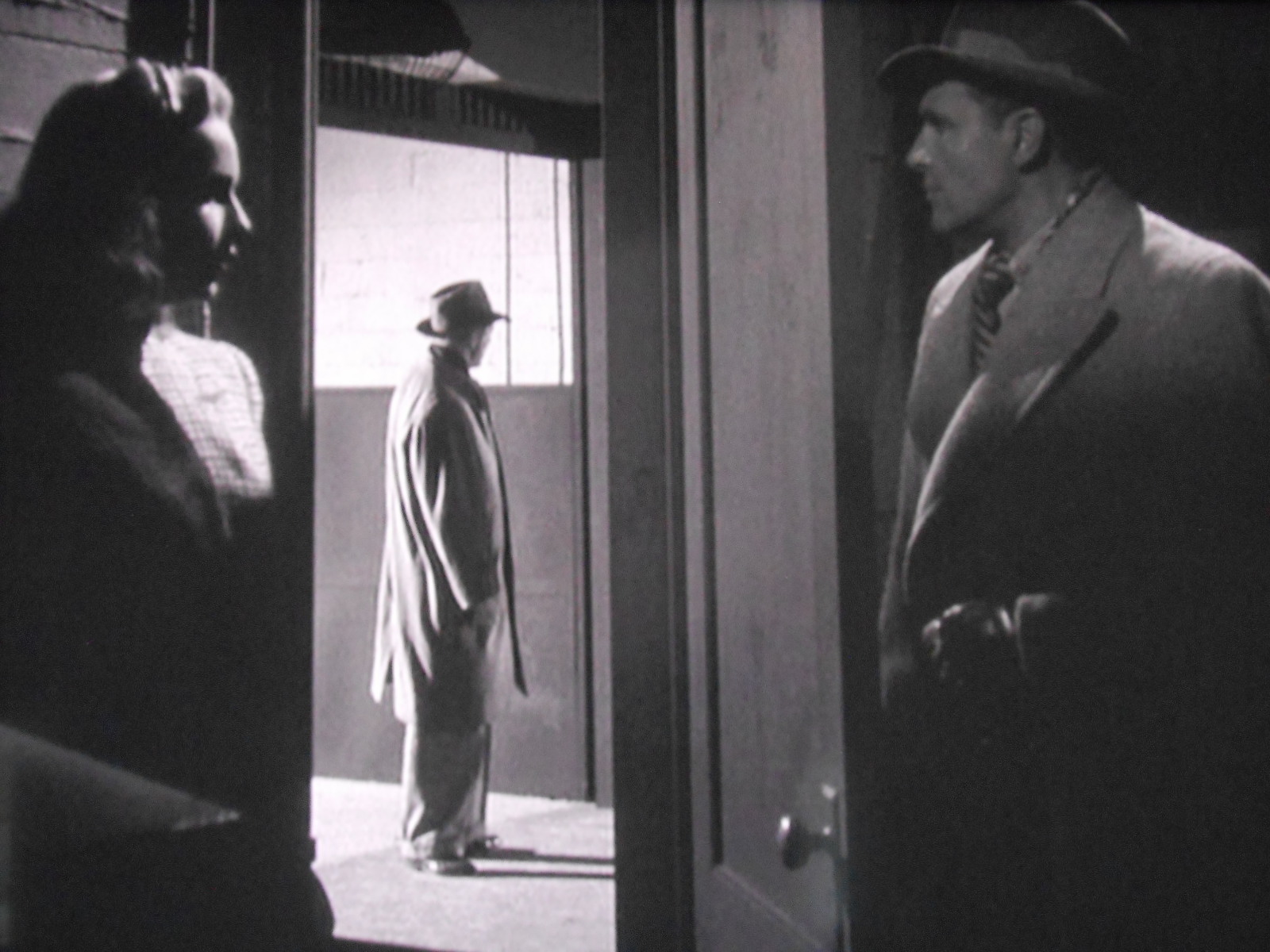
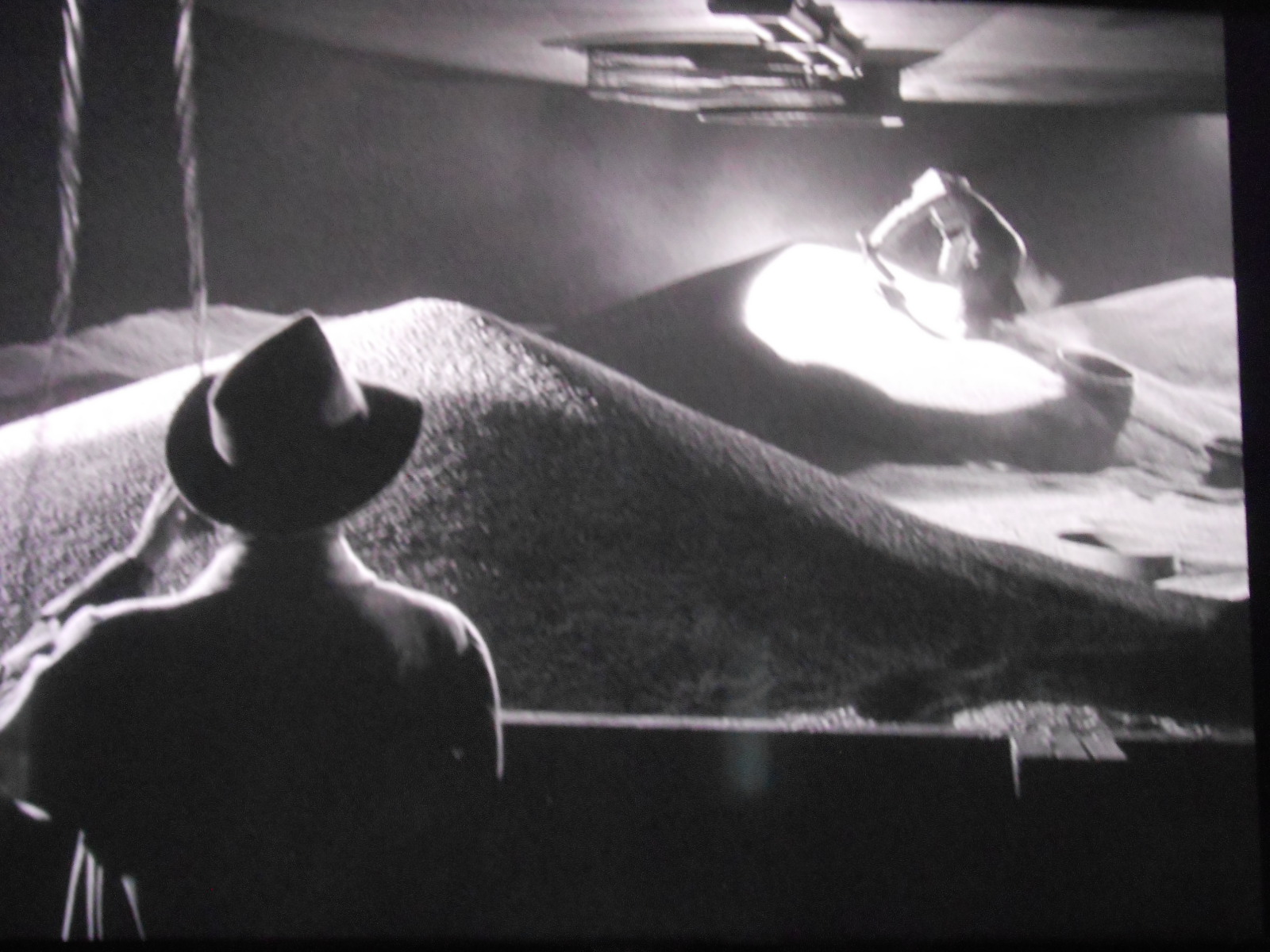
One particular sequence squarely fits the noir motif when Durbin inadvertently lets slip as she rides a car up an elevator in an urban garage a clue she may be wise to the killer – who likely is her companion, the murdered man’s nephew Dan Duryea (a noir stalwart if there ever was one). What follows is a pursuit through chiaroscuro shadows and interconnected rooms, people framed or trapped in doorways, people being pursued or unknowingly spied upon, even through the dunes of sand waiting to be used against the snow outside. Another scene finds the other nephew, played by Ralph Bellamy, addressing her with a creepy smile and revealing that that old stiff Aunt Sarah used to visit him at night and . . . we never find out what?! Brrrrr!!!!!
The mystery author does arrive on the scene to save our heroine; however, his doing so brings chuckles as well as anxiety over the result.
So, how is this playful take on noir a Christmas movie? Well, we did see that Nicki arrives near Christmas Eve, and there are trees all over the place in this one – including the one that allegedly did in our murder, correction, our first murder victim. Lots of snow as well. Maybe the best connection is the lovely version of “Silent Night” that Durbin sings to her Dad over the phone. Check it out here. Anyway, it’s a nifty noir to drive away the holiday blues. If you want to see Durbin do full on Christmas Noir (more noir than Christmas, though), check out her and Gene Kelly playing against type in Christmas Holiday.
Screen shots by author from the film Lady on a Train, Universal films, copyright 1944.
Even as November eased into December, Yang and I have still enjoyed the creatures and plantation around the Yang Manse. Would you believe that we still had morning glories toward the middle of November? Gallantly battling colder, shorter, darker days, these Heavenly Blues waited until the last gasps of autumn to bloom. Their beauty shown through the dying colors of the late season. They even provided a lovely contrast to the last of autumn’s orange and rust foliage.
Though we had an extremely poor crop of pumpkins and gourds (three fertilized, two surviving long enough to be picked), we did still manage to grow some of the plants to maturity. Here, is one gourd that started out lovely, but succumbed to cold, too much dampness, and the onslaught of slugs. You can see how pretty it was before Mother nature went wild on it.
In a happier vein, though, how about a look at the survivors? This gourd that did make it was a surprise fertilization, which we found peeping under some leaves. Here it is shortly after discovery. We try to put a rock or plate under the growing gourds and pumpkins to keep the damp ground from rotting them.
And here is the same gourd all grown up. Sadly, because it was fertilized, late it never grew very much and then spoiled after only about six weeks. It was pretty while it lasted!
We also managed to get one pumpkin! It was fertilized during a short break in the rain for a week or so of sunshine and hot weather. Here’s our pumpkin a beautiful dark green as it grows slowly but surely, out facing damp and ravenous slugs!
It may not be the biggest pumpkin we’ve ever grown, but like Reba Mcentire, it can sing, “I’m a survivor” – if pumpkins can sing. Now the pumpkin resides in state in the picture window on the sun porch, where we can enjoy viewing it as we watch the birds chowing down at our feeders.
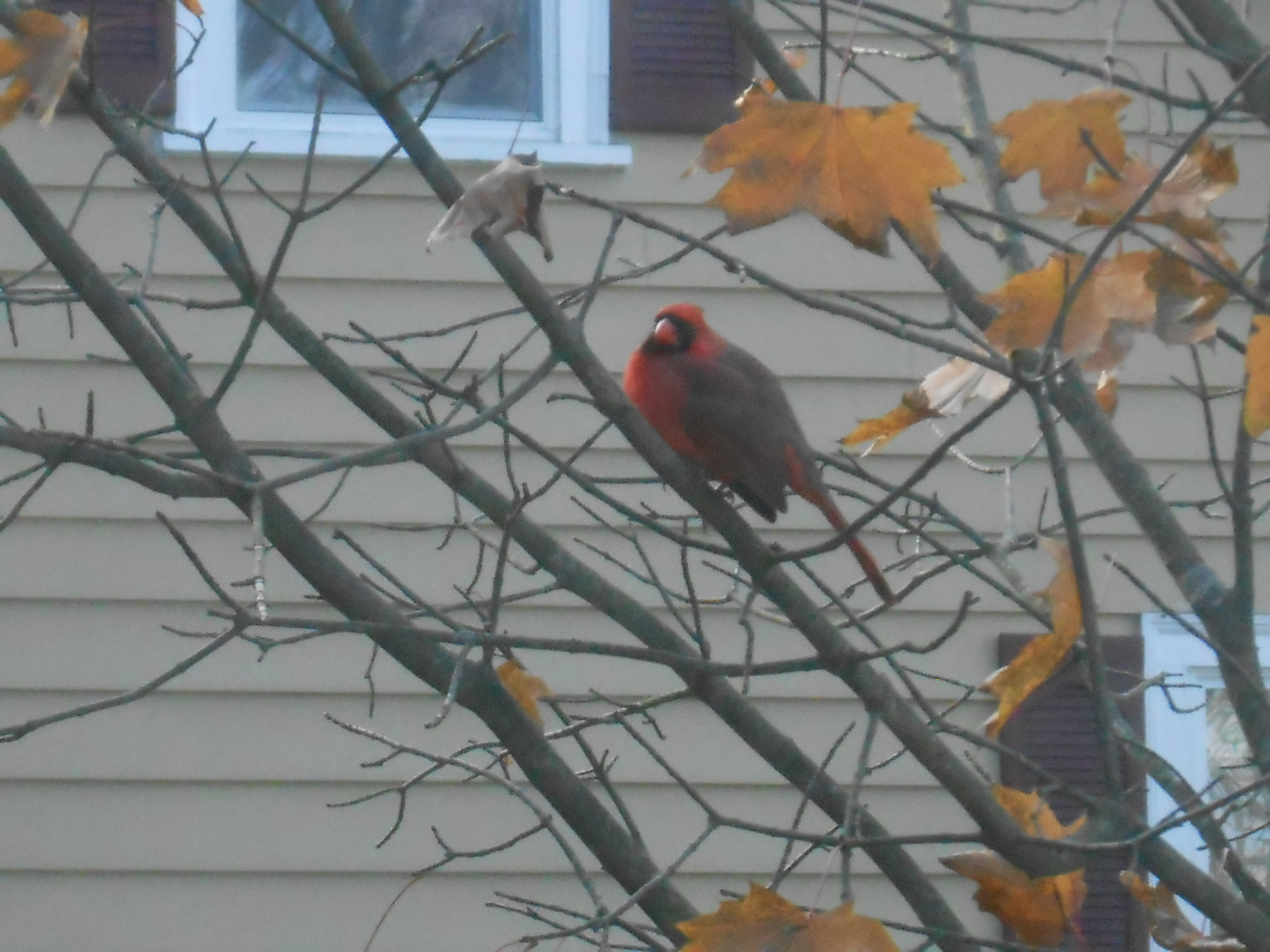
And speaking of birds chowing down on our feeders, we’ve got plenty of the little feathered guys to watch! We have the usual suspects: Mourning Doves, Blue Jays, Cardinals, Chickadees, Red Bellied Woodpeckers, Titmice, Downy Woodpeckers, and Nuthatches, for example.
But there are also returning old friends, as well. The harbingers of winter, the Slate Colored Juncos, are back. At first, they did their typical feeding off the ground, but now they are returning to old habits of taking lunch at the feeding bar. It just takes them a little while to remember that they can do that. I love to see them flying away, making the sound of castanets and flashing the white stripes on the fan of their tails.
Who else should make a return engagement after a short absence, but the Goldfinches! As summer ended, these guys disappeared from my feeders for several weeks. Then, suddenly, they all returned in November, wearing their olive winter coats. They also like to chow down with the other birds, so I have some neat shots of them with their pals, though woe betide the bird who tries to chase one of these aggressive little olive-garbed guys away! I love this picture with two Goldfinches and a Titmouse (on the right)doing acrobatics.
Here’s another one of the Goldfinch with a Nuthatch. Isn’t the Nuthatch in picture #1 adorable, just peeking around the corner of the feeder? Don’t you love the gorgeous blue/grey of the Nuthatch’s cloak, more visible in picture #2?
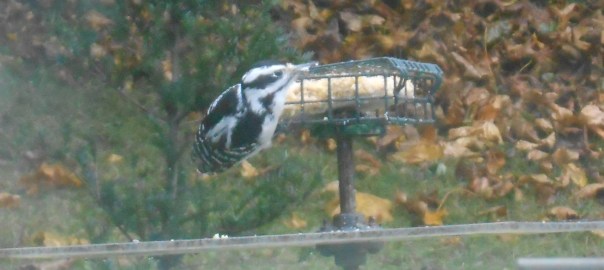
As you can see here, the Goldfinches don’t seem to have trouble getting along with either the Hairy (photo #1) or the Downy Woodpeckers (Photo #2).
In fact, this summer and fall, I don’t think I’ve seen so many Hairy Woodpeckers on my feeders. They certainly do seem to look like Downies on steroids. Here are some nice shots I got of the female Hairy. You can tell the difference because the only the male has a red spot on the back of his head – like in the case of the Downies.
So, I’ll just end with a shot of a Titmouse and a Goldfinch snacking away.
Until the Titmouse turns to me with a definite, “Who you lookin’ at, human!” expression.
All the leaves brown and the sky is grey. The Mamas and Papas song seems to sum up perfectly the end of November and beginning of December. So, I thought you might enjoy a look back at some of autumn’s leafy glory to tide you over until the soft blues and pristine whites of winter take over.
One new place Yang and I visited was the Albany Rail Trail in New York. The trail starts on an uphill slope, but once you get to the top, it levels off and is smooth sailing till the end. We ended up doing 18 miles of beautiful fall scenery along a river and through the woods.
Then, returning, after a flat ride, we sailed downhill at a feisty clip – but not before I stopped a few times to get some gorgeous shots of the brilliant fall colors, especially gorgeous along the sides of the valleys that sloped into the river, with that goldening light of the setting sun.
Here’s your liquid moment of Zen, in video format:
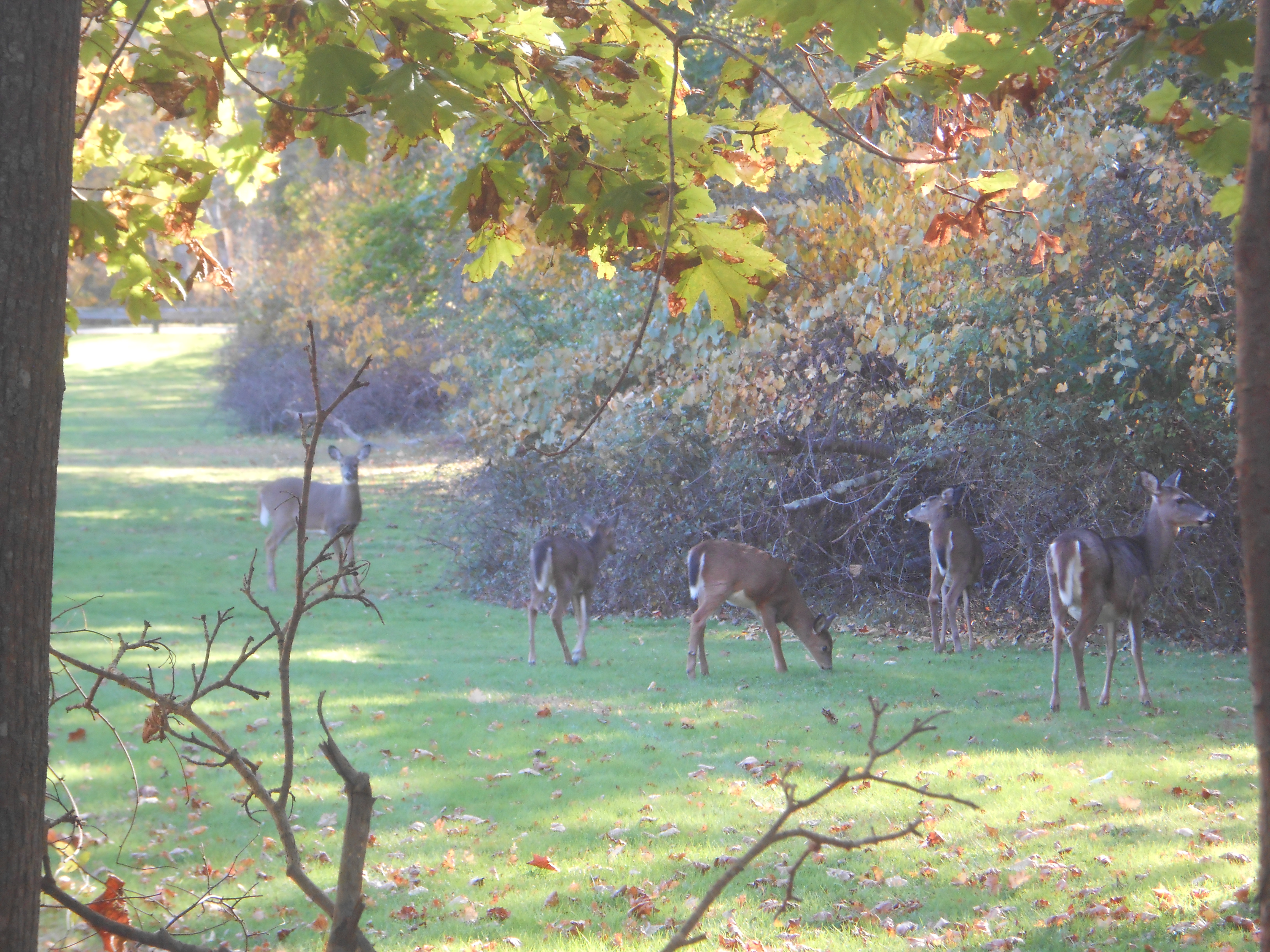
Yang and I also made our autumn pilgrimage to Colt State Park – after lunch at the Beehive in Bristol, RI – Yum, their pumpkin spice latte! The day was brisk and sunny. We had the pleasure of all kinds of fauna. Walking up a road that cut through the woods and emerged into the open with two large, stone-fenced fields on either side, we caught sight of these guys on our right. Since we were on foot and not in a car, we had no fear of another fatal collision. The deer were chill, too.
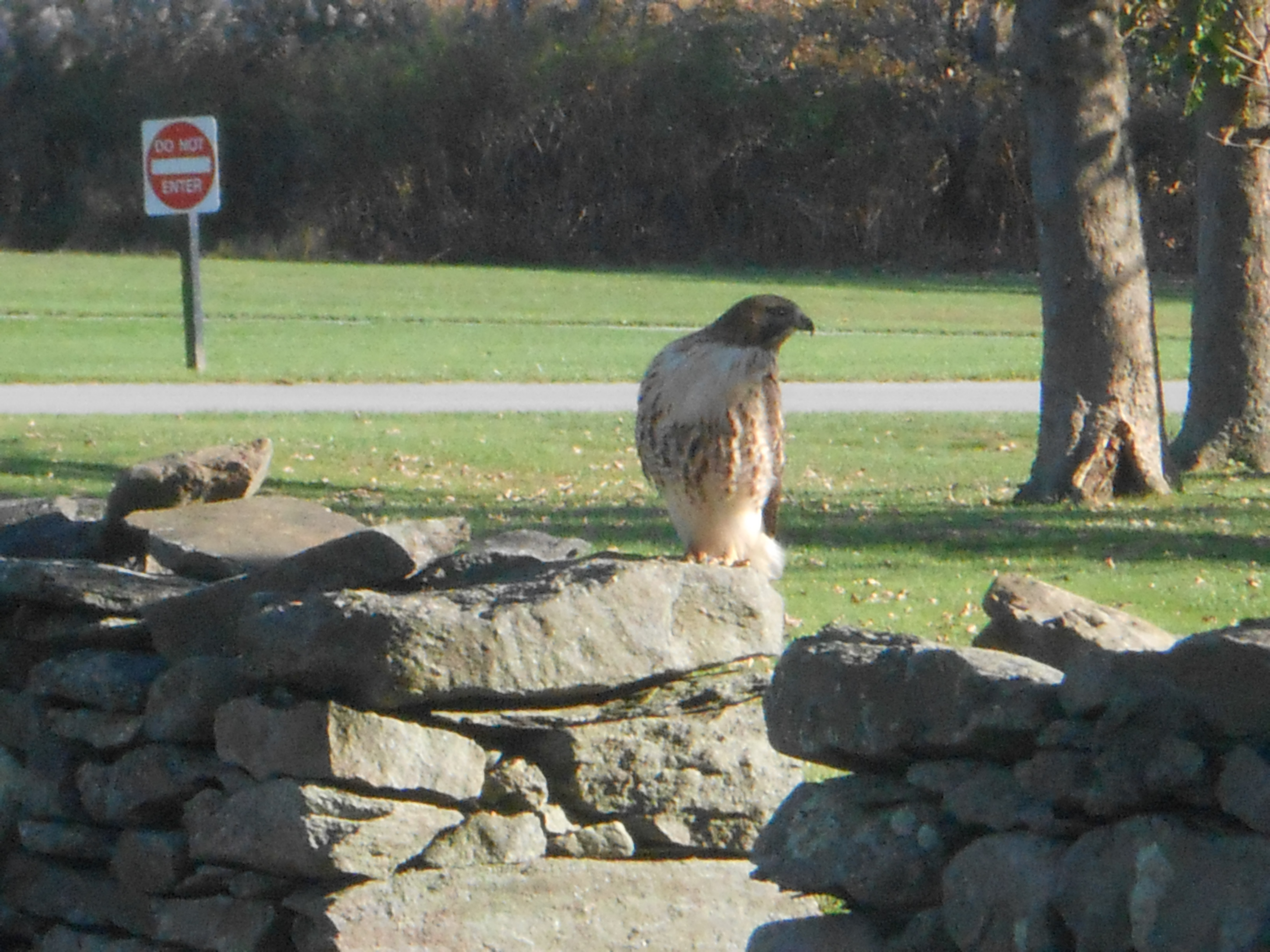
A little further down the road, what should swoop past us to disappear on the other side of the stone wall but a Red Tail Hawk! Clearly, her eagle, err hawk, eyes had spotted something edible scurrying through the leaves on the far side of that wall. Unfortunately for her, but fortunate for the mouse, vole, rabbit, or whatever, our hawk hunter emerged and tromped down on the wall with nothing to eat in her claws. Apparently she was a tad embarrassed because her look here clearly says: “What are YOU lookin’ at?”
Finally, we also made it out of the woods and onto the shore to make our first sighting of Brant Geese. They kind of look like stocky Canada Geese, but they are quite different. They also may have a black head, but that’s marked by a white band around their necks, plus, they lack the brown feathers of the Canada Geese. These guys always swim in tight formation and have the most adorable vocalization – not the rowdy honks of their North of the border brethren.
Below is a video where you can hear them almost quacking, rather than honking, but you have to listen carefully!
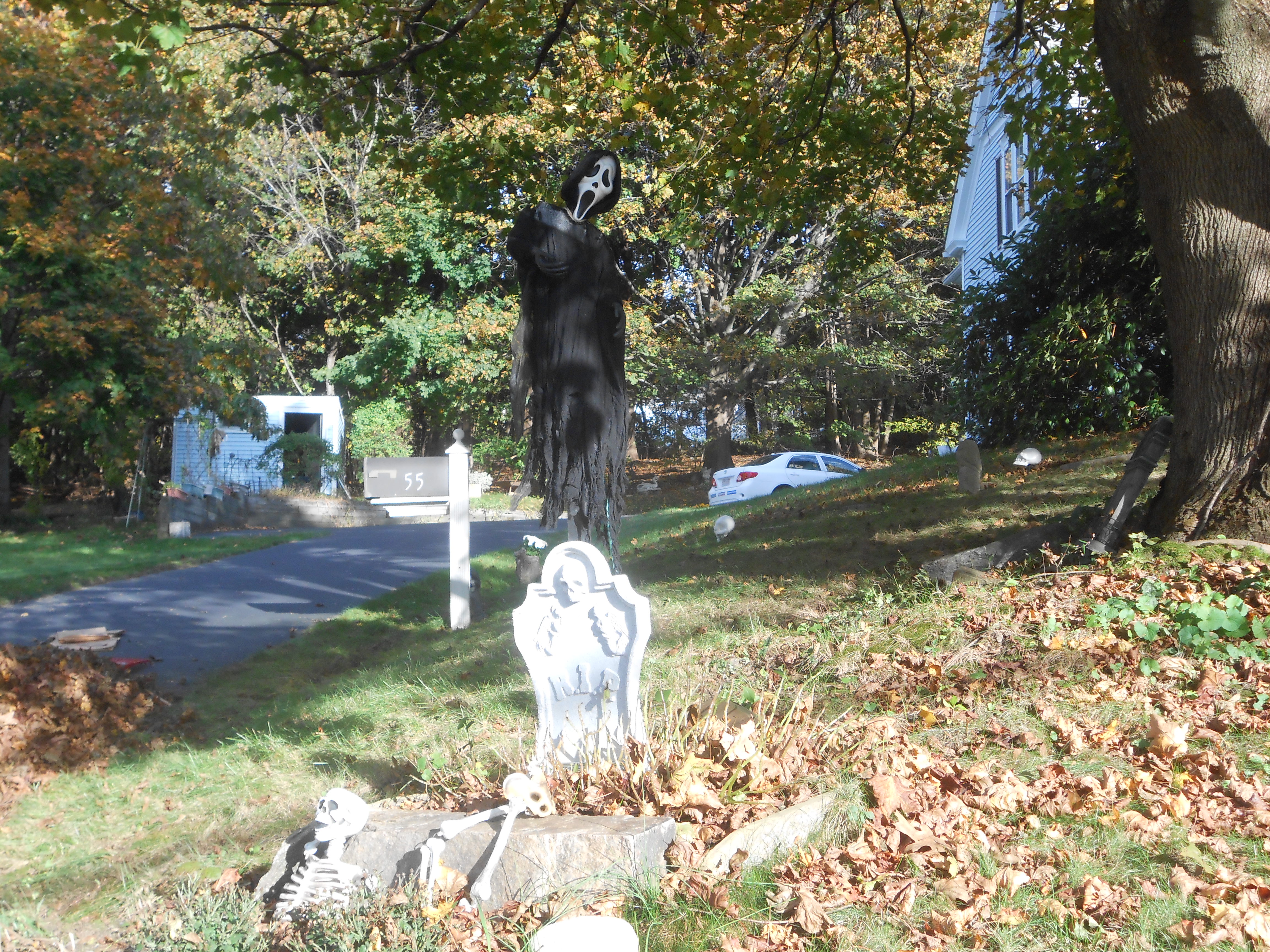
It wouldn’t be Halloween on my street without our yearly decorations for the holiday. Some of you friends are far away and can’t enjoy the view. So, If you’d like to pay a call on – the Yang fam-i-ly, make a virtual stop right here. Turn right up our driveway! See the number and your official greeter?
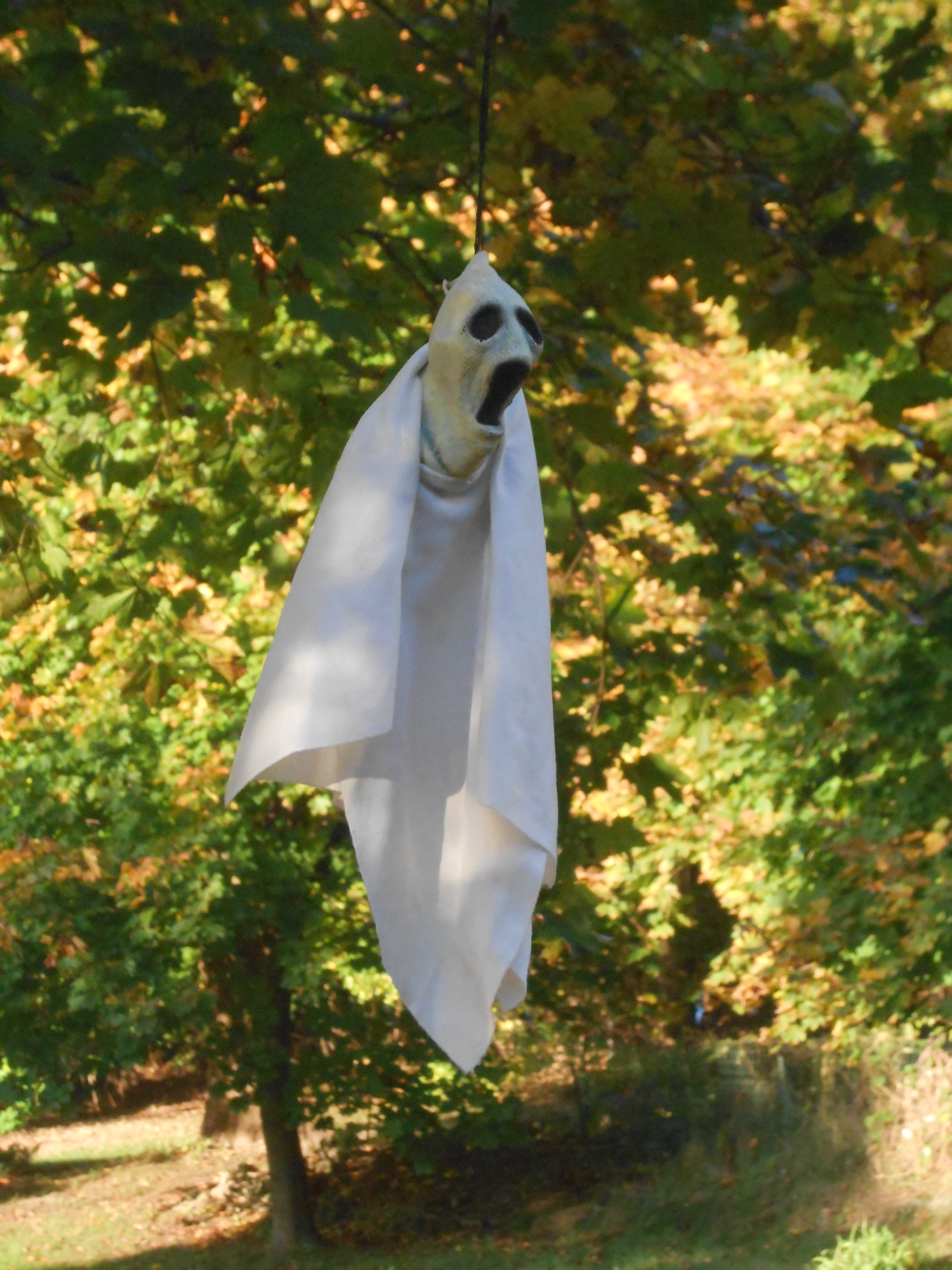
Just keep driving right past the lamp post, where another welcoming spook will let you know that you’re in the right place. Aren’t those white mums lovely? They go perfectly with the ghost’s robes, don’t they?
Pull into your parking space and enjoy a greeting from these lovely ladies. They just love the camera! I guess the redhead is a little shy.
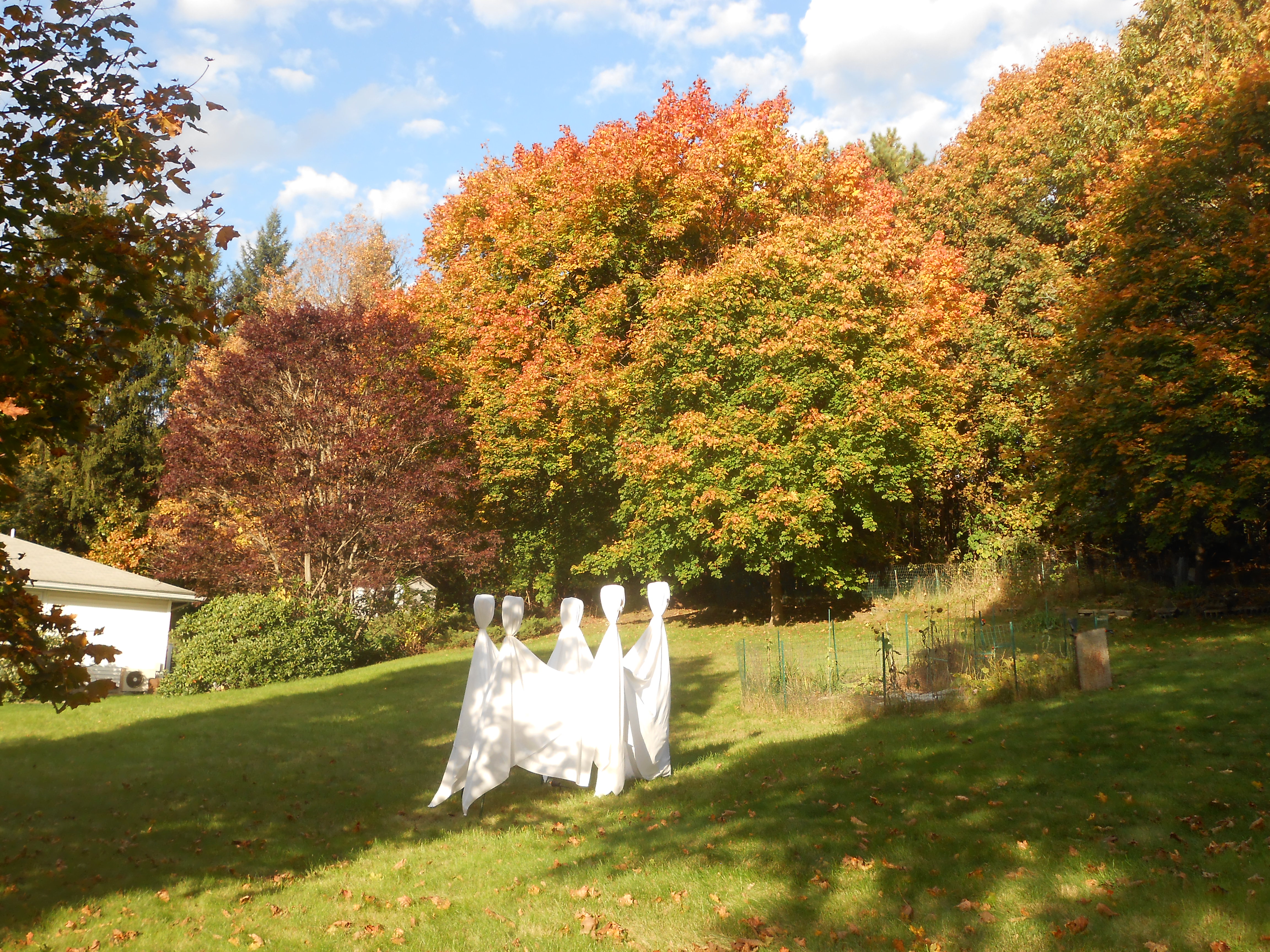
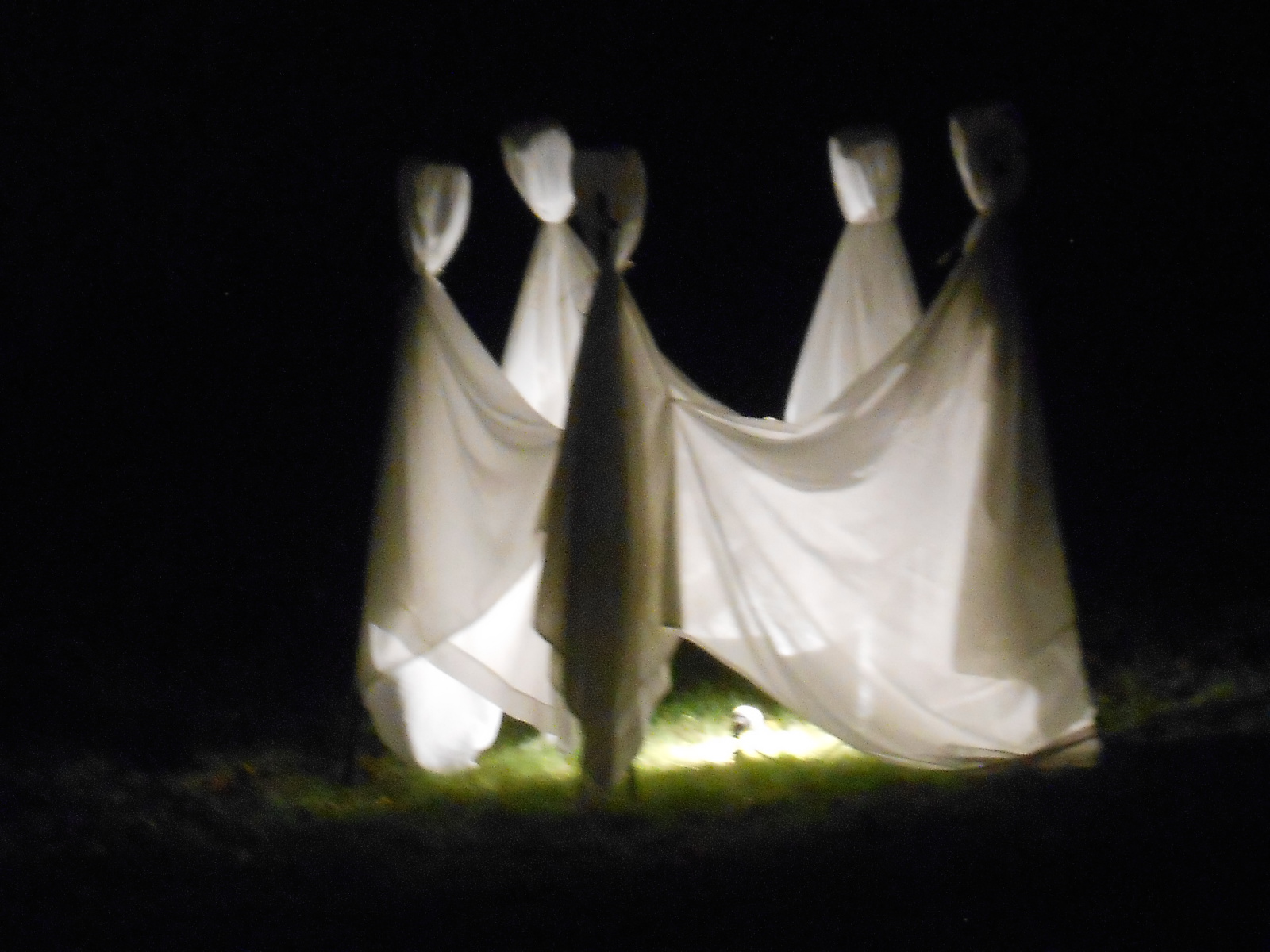
Don’t forget to wave to the dancing ghosts. They adore the fall foliage colors. Maybe they’ll let you join in their little circle – for ETERNITY!
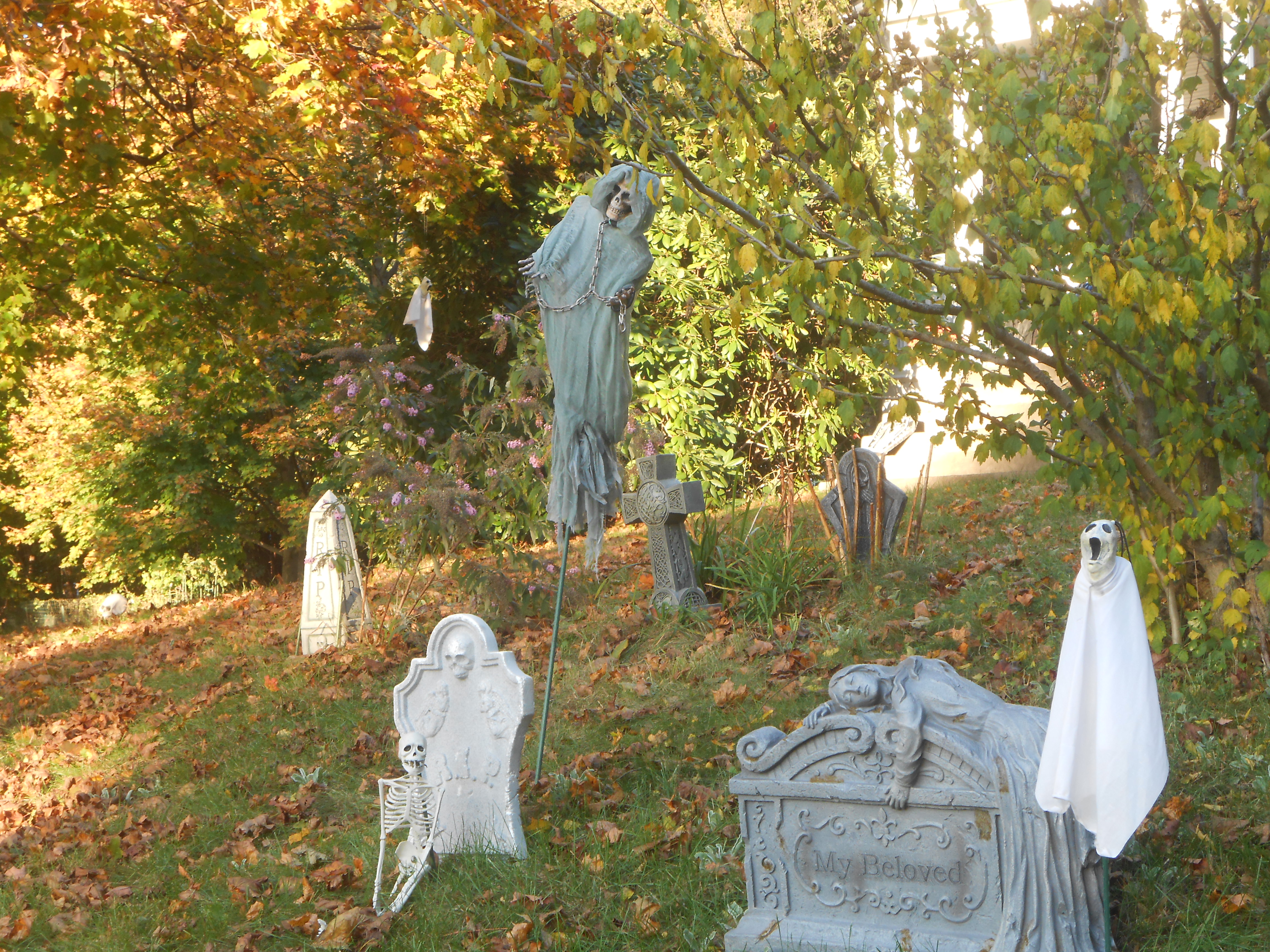
Of course, there are lots of other friends to see at the Yang House of Haunts.
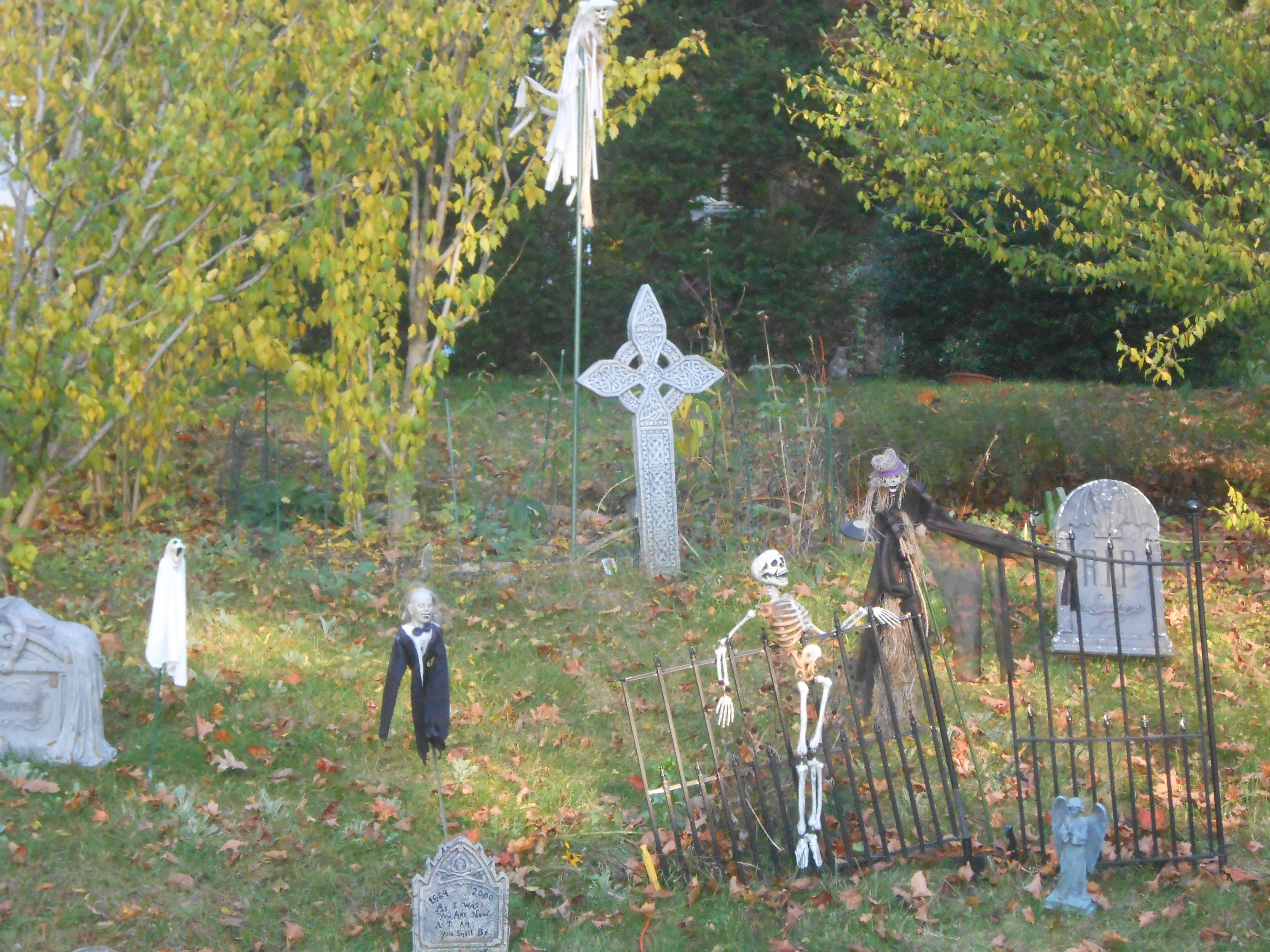
And we mustn’t forget that sweet little front-yard cemetery, full of delightful souls to meet, eh?
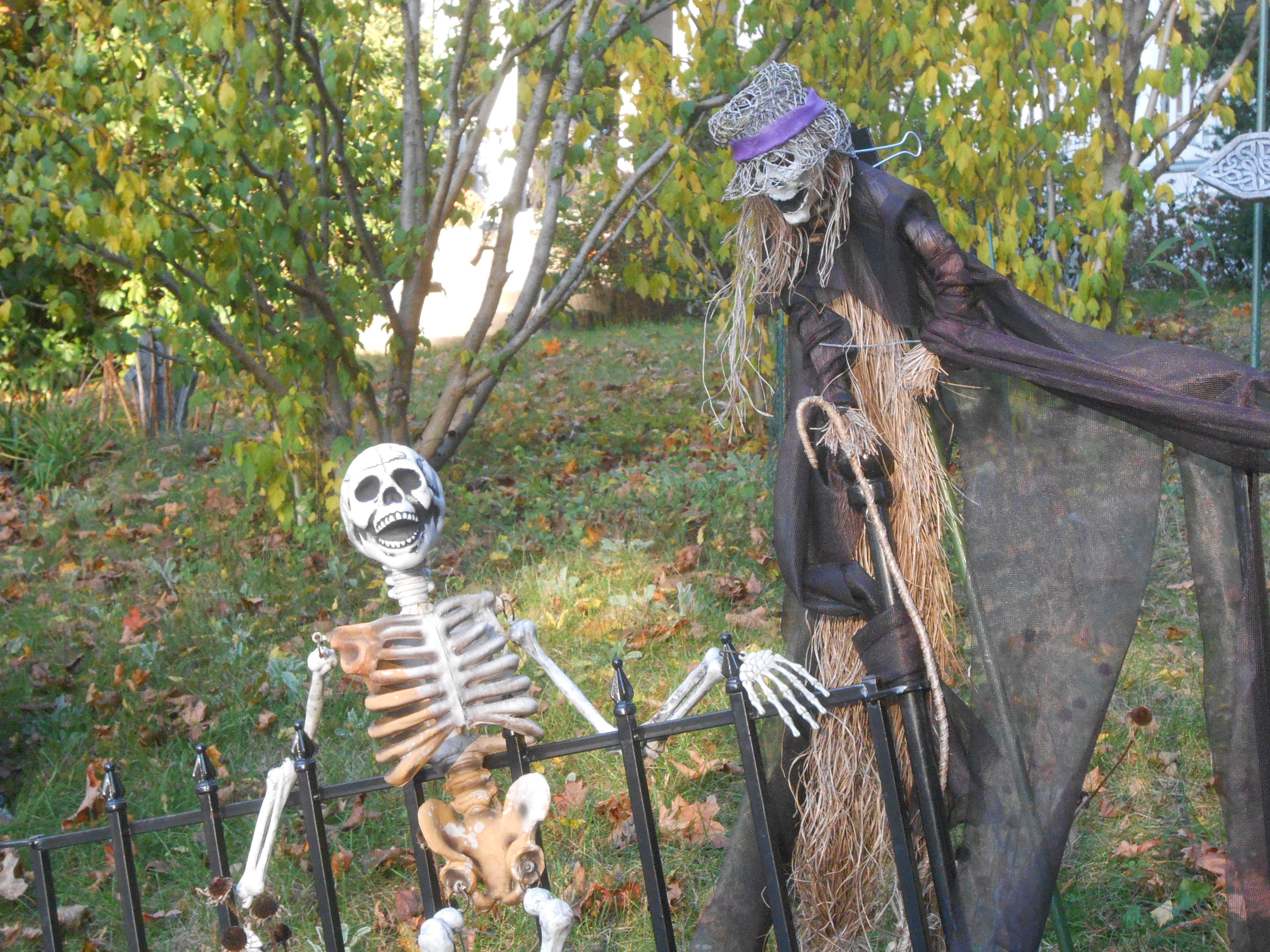
I wonder what witty little jest these two are sharing?
Then, as you leave after night falls, things get a bit shadier, as it were.
BOO!
Phasing in from another dimension, no doubt. The Old Ones send their regards.
Here’s another ghostie making some interdimensional night moves. That old devil moon glows ominously in the background.
Ready to join in the dance, yet?
Some other darkling friends.
Y’all come back now.
Remember, Natasha says that monsters need love, too.
 full bloom after all. Earlier in the season, we did dine deliciously a couple of times on our own eggplants. And there are more growing! We also have had a few meals flavored by our home grown peppers. Here’s a shot of one harvest. Don’t you just love the deliciously spicy and fresh smell when you slice open a garden pepper?






























































 Sharon Healy-Yang