Precious Blood Cemetery, an Autumn Visitation

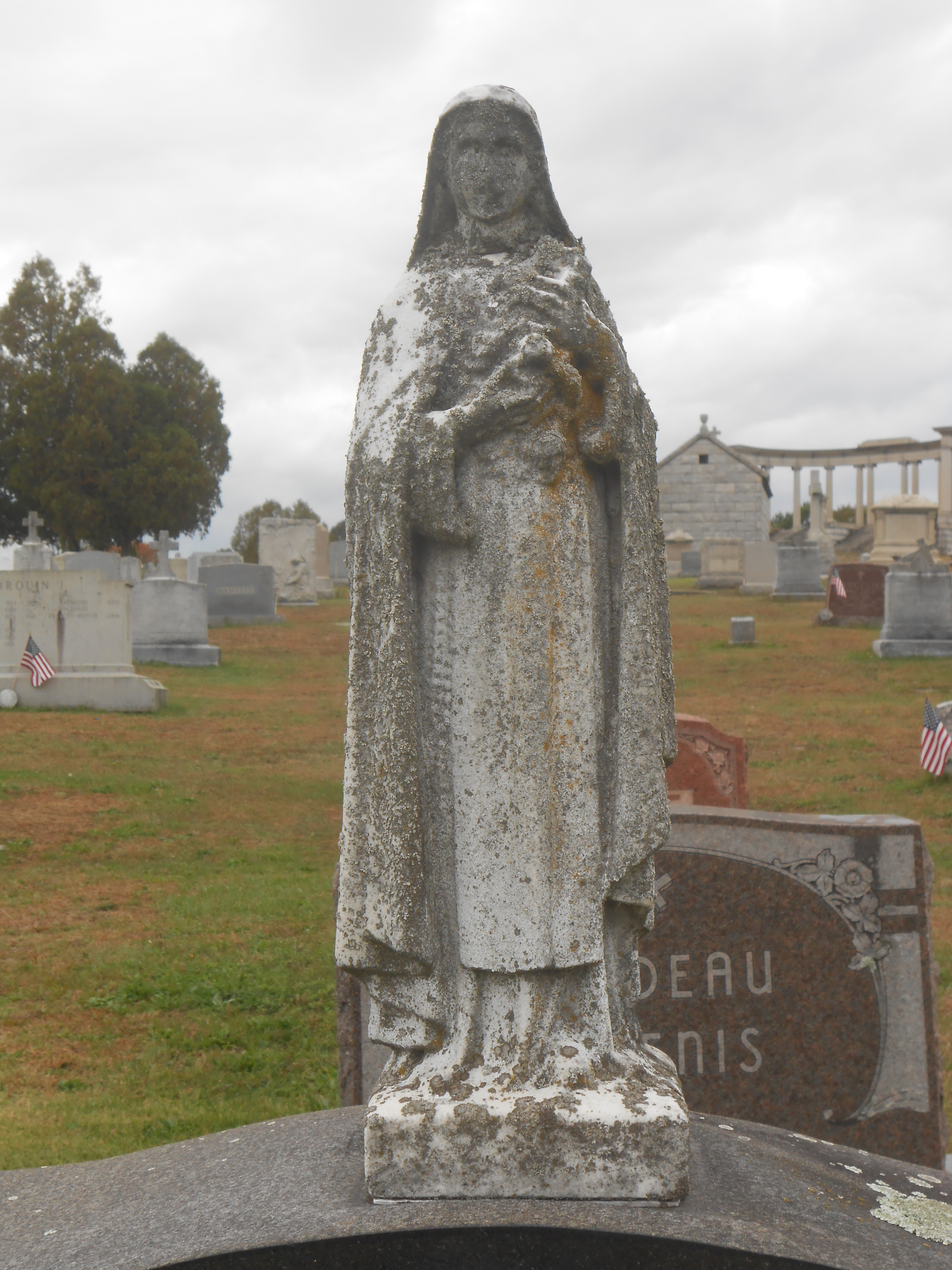
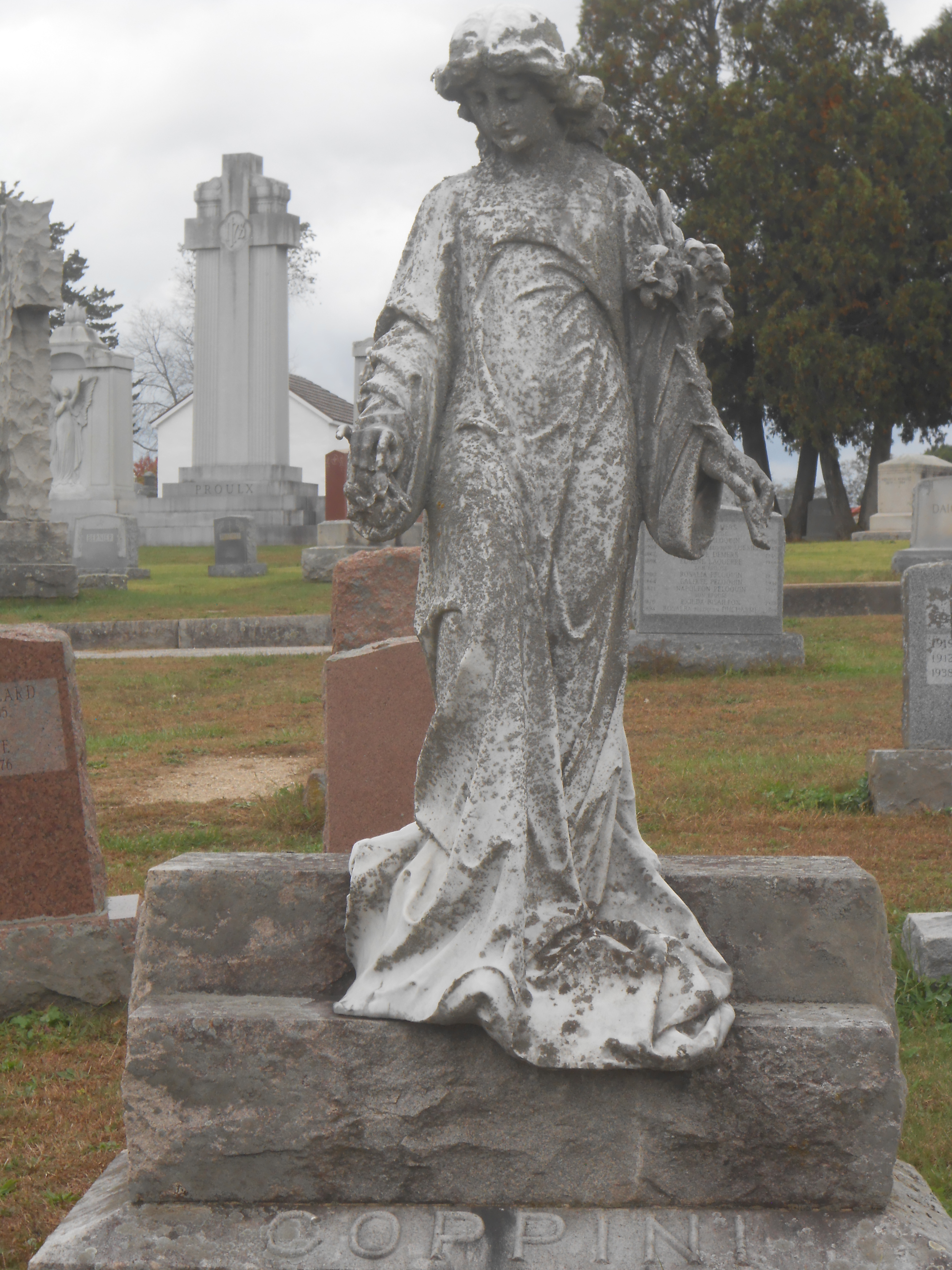
Earlier this fall, Yang and I took a trip to the Precious Blood Cemetery in Woonsocket, where my patron saint is buried.  Here’s a picture of her grave – though technically she was never canonized.  Does that mean I was never really a Catholic?  Oh well, I’m an Episcopalian now anyway.
It’s a wonderful graveyard on the edge of the city with some lovely statuary – and on a grey Saturday afternoon, the trip seemed perfect for the season.   As a Catholic cemetery, there are statues of saints that you just don’t find in the Protestant cemeteries.
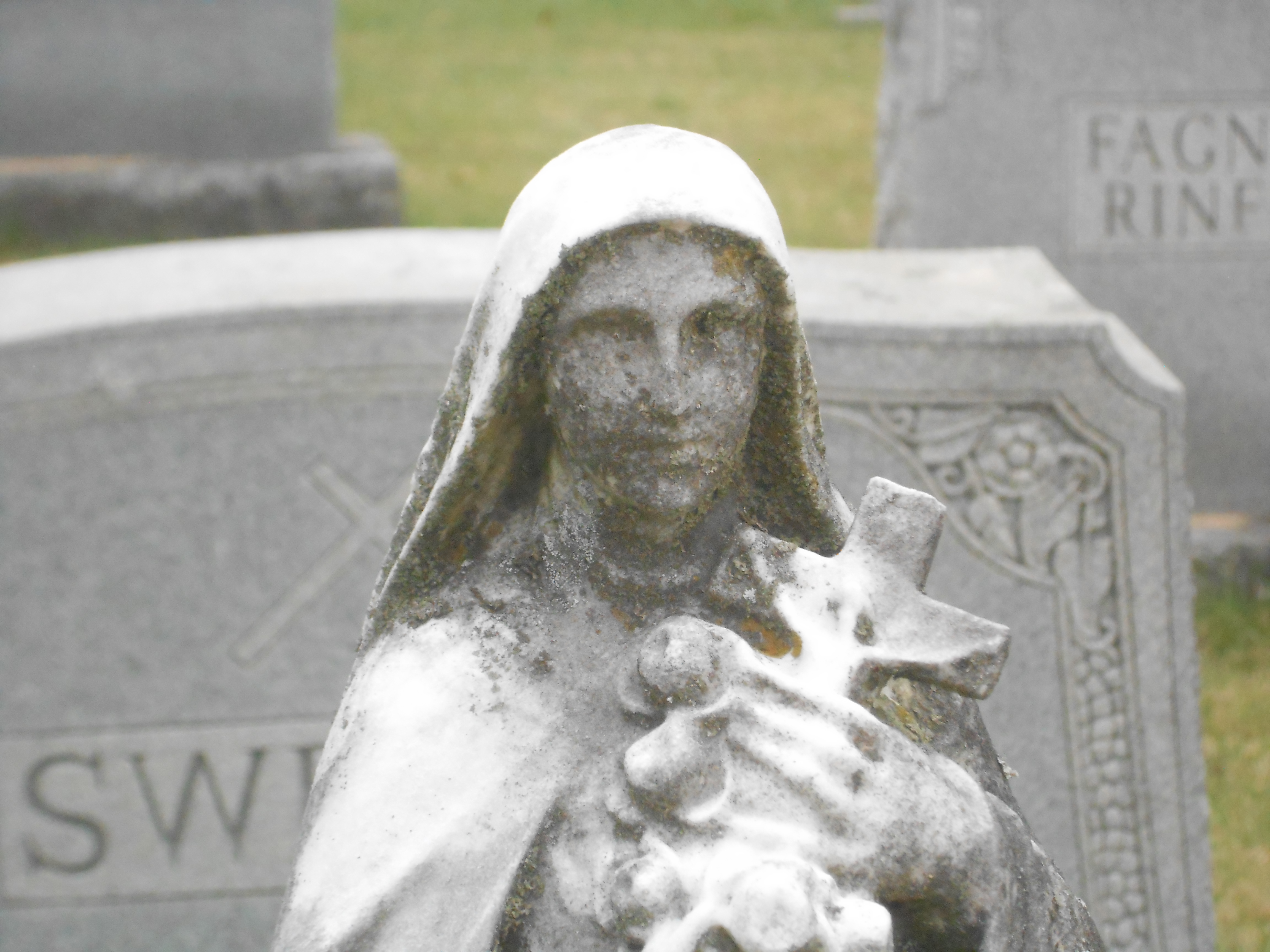
Many people seem to have valued the Little Flower, Saint Therese de Lisieux.  Not surprising since she is a French saint and the large number of Catholics here are immigrants or descendants of immigrants from Canada.  I actually took Therese’s name as my confirmation name because she had to struggle with a bad temper with  incompetent people – guilty as charged.  Those who know me can let me know if you think it helped.

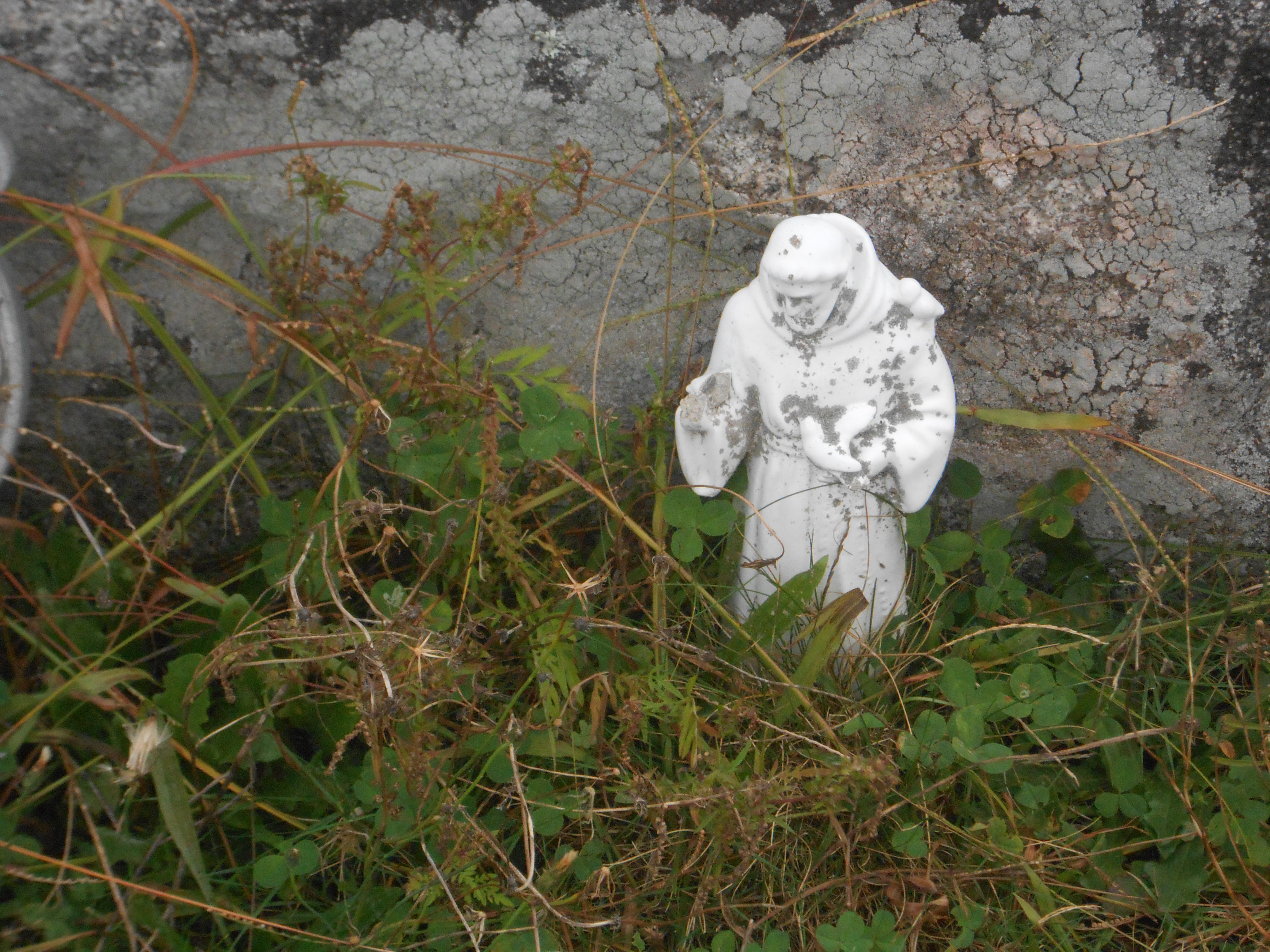
I also saw  a mini St. Anthony, 
and a St. Anthony with the baby Jesus – in statuary form, that is.  Remember, if you’ve lost something, Anthony is the go-to guy.

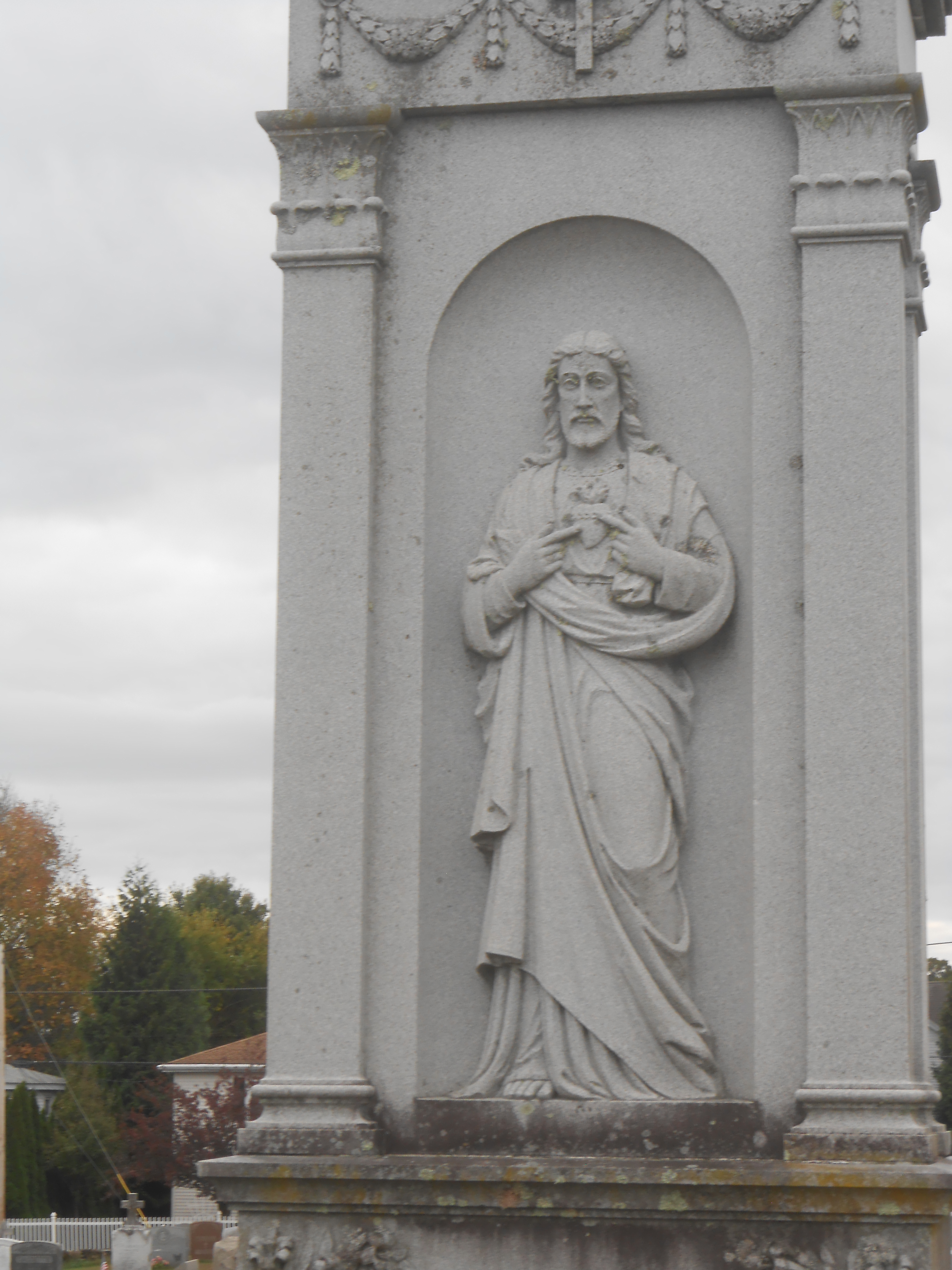
Jesus also made other appearances – again only in statuary form.
Here’s the sacred heart.


Here is a bronze relief of Christ’s passion on the cross affixed to a grey granite monument, his suffering conveyed through the twist of the metal form.


One grave was surmounted by a life-size bronze of of the three Marys suffering along with Jesus as they witness his crucifixion.


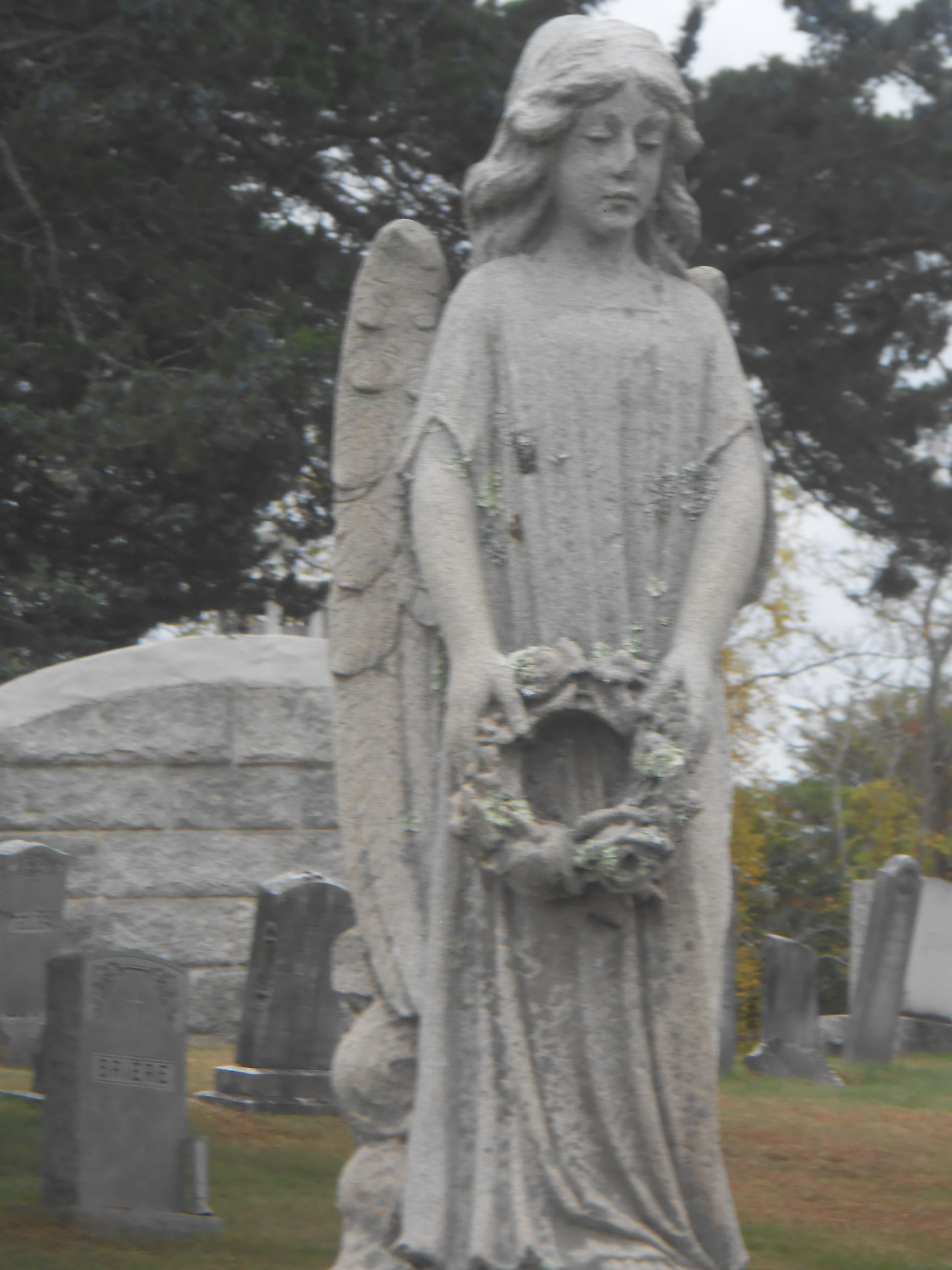
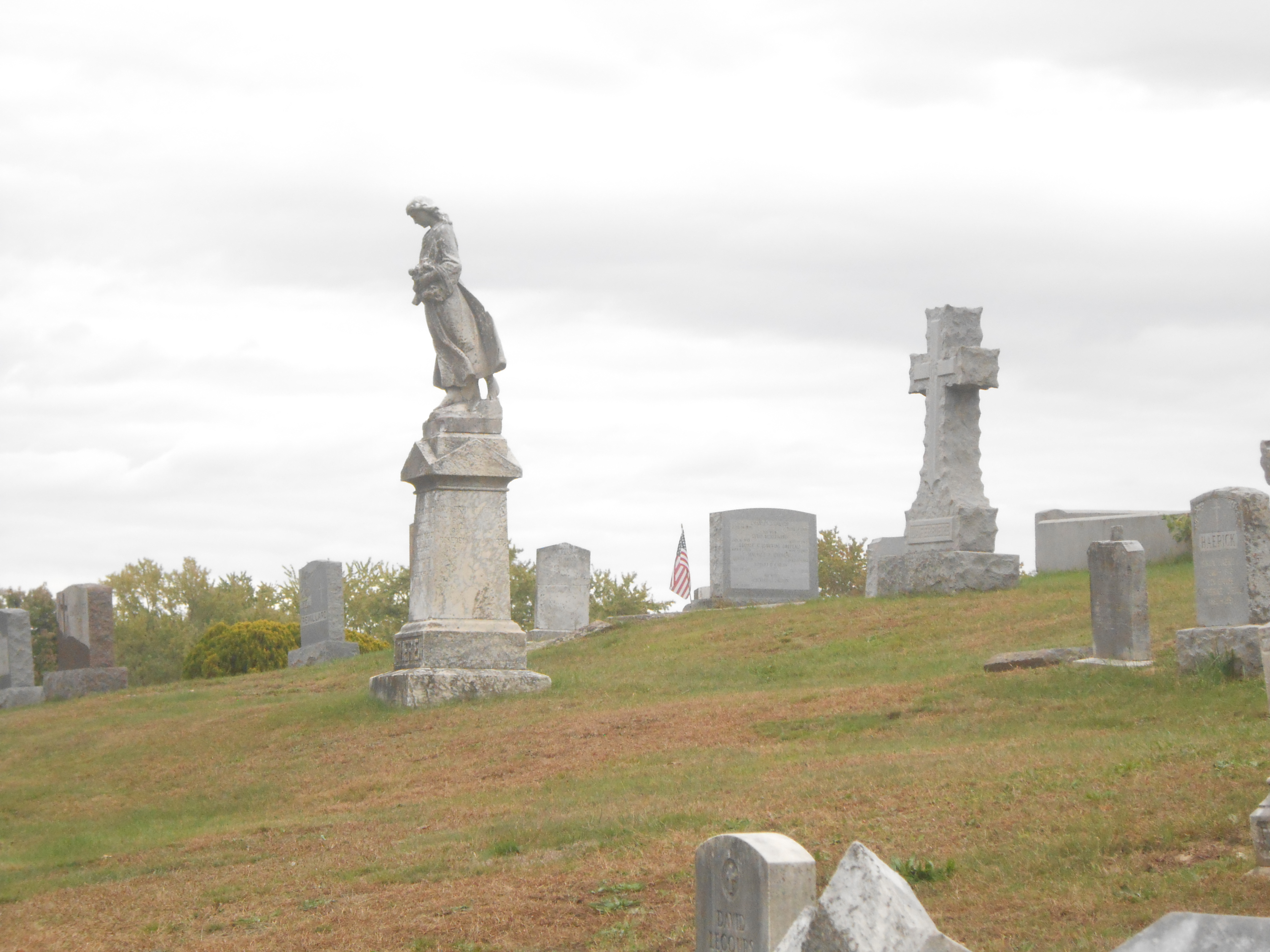
There were also  funerary sculptures that you might find in more secular or not Catholic cemeteries.  Everyone has angels!  Here are some of my favorites from the visit.  There is this child angel.


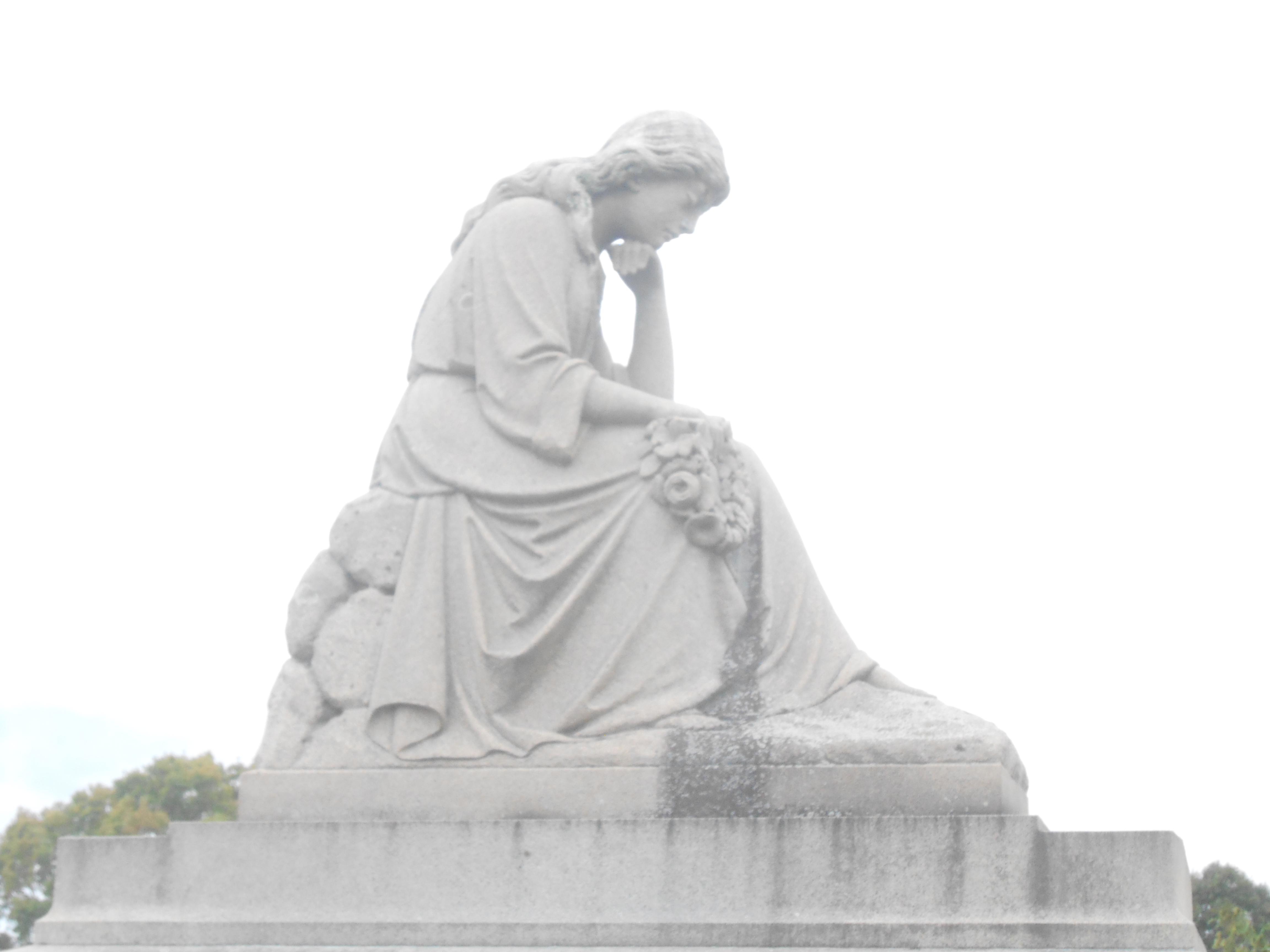
And this grown-up grieving angel


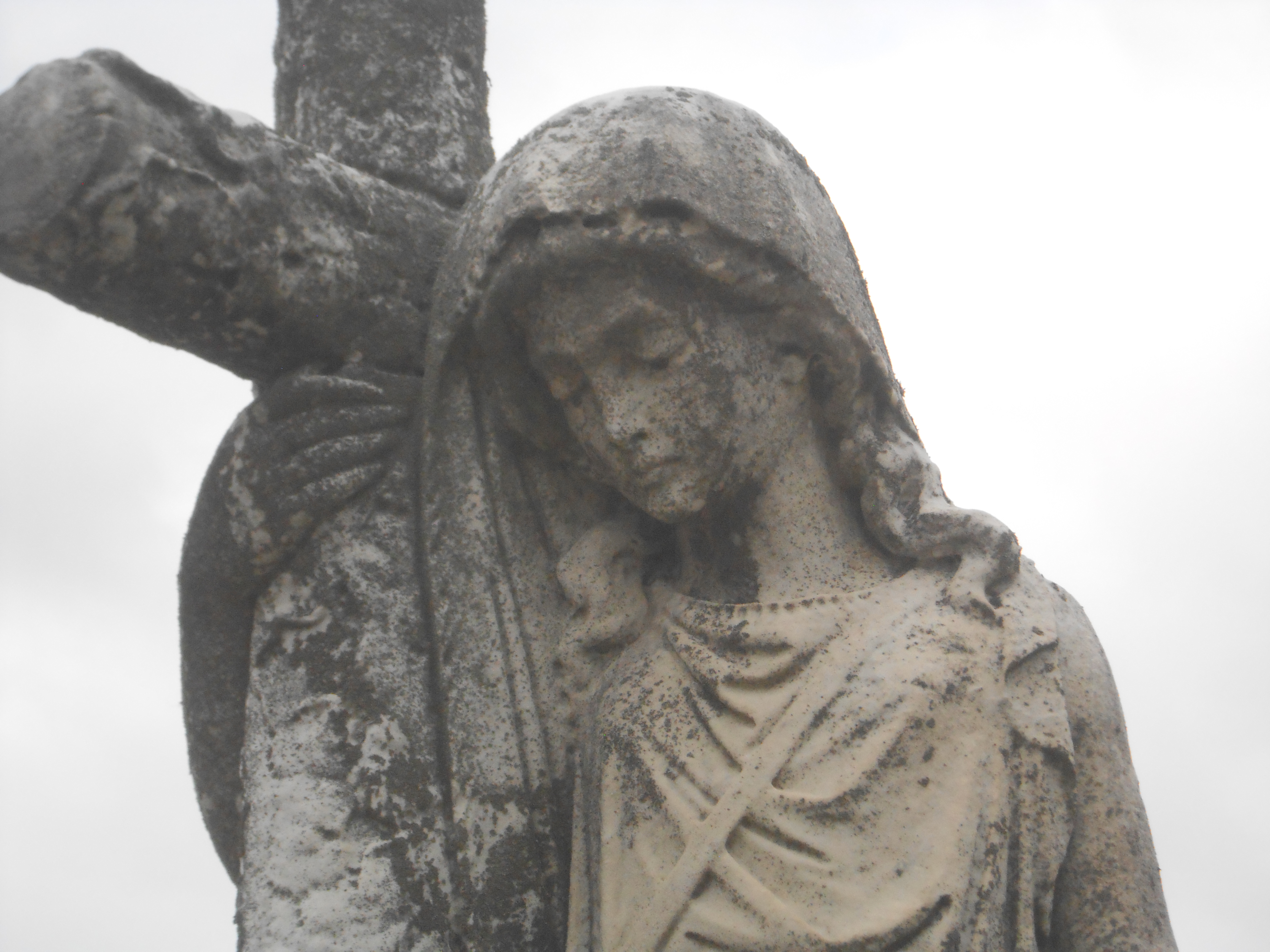
I saw many women, grieving, bearing their crosses of repentance, or descending with grace for the departed


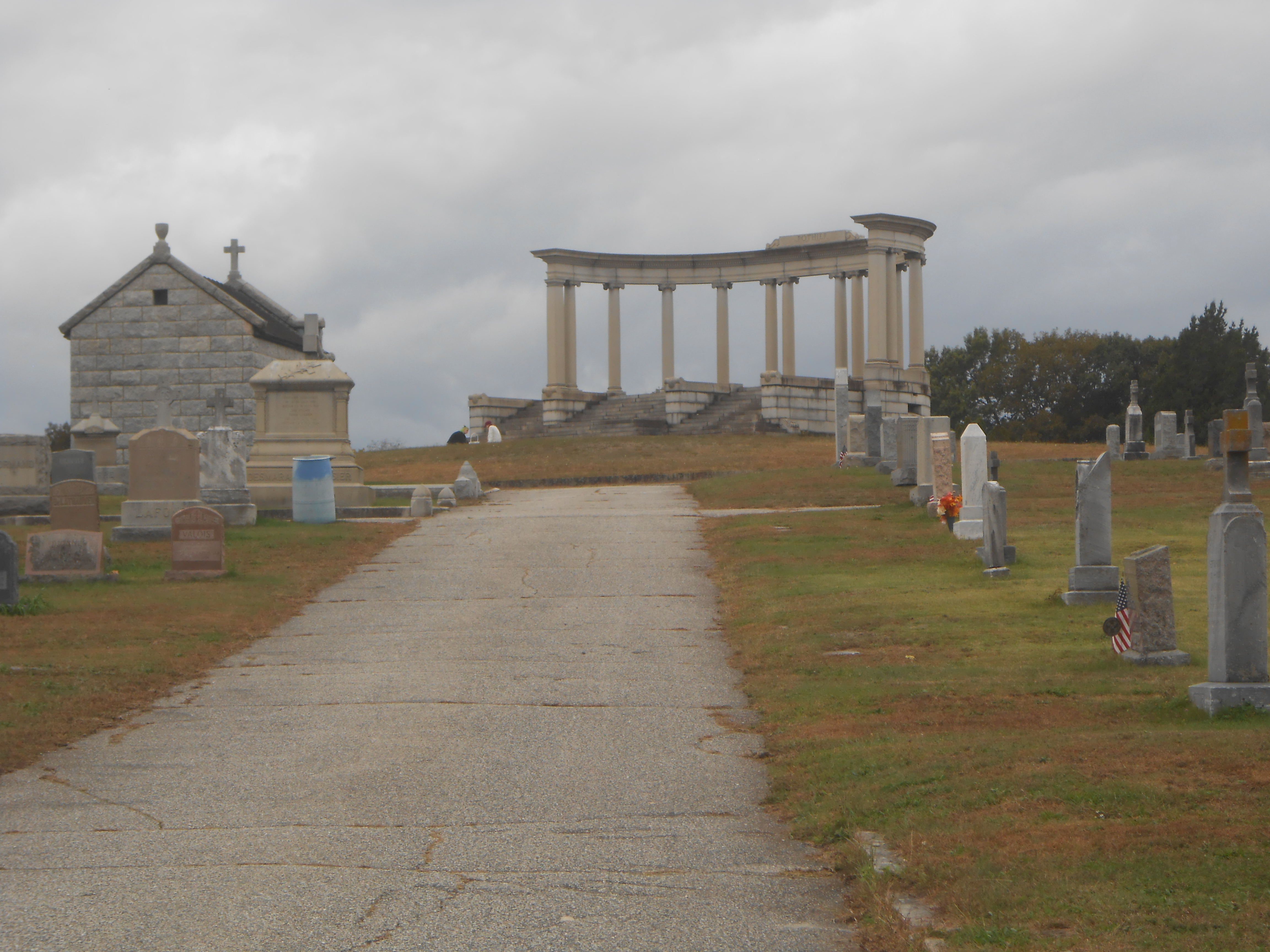
I was particularly taken by some of the mausoleums.  One looked like a French or Canadian farm house.


Another was a circle of columns raised above the cemetery on a hill.  It was like a classical ruin.


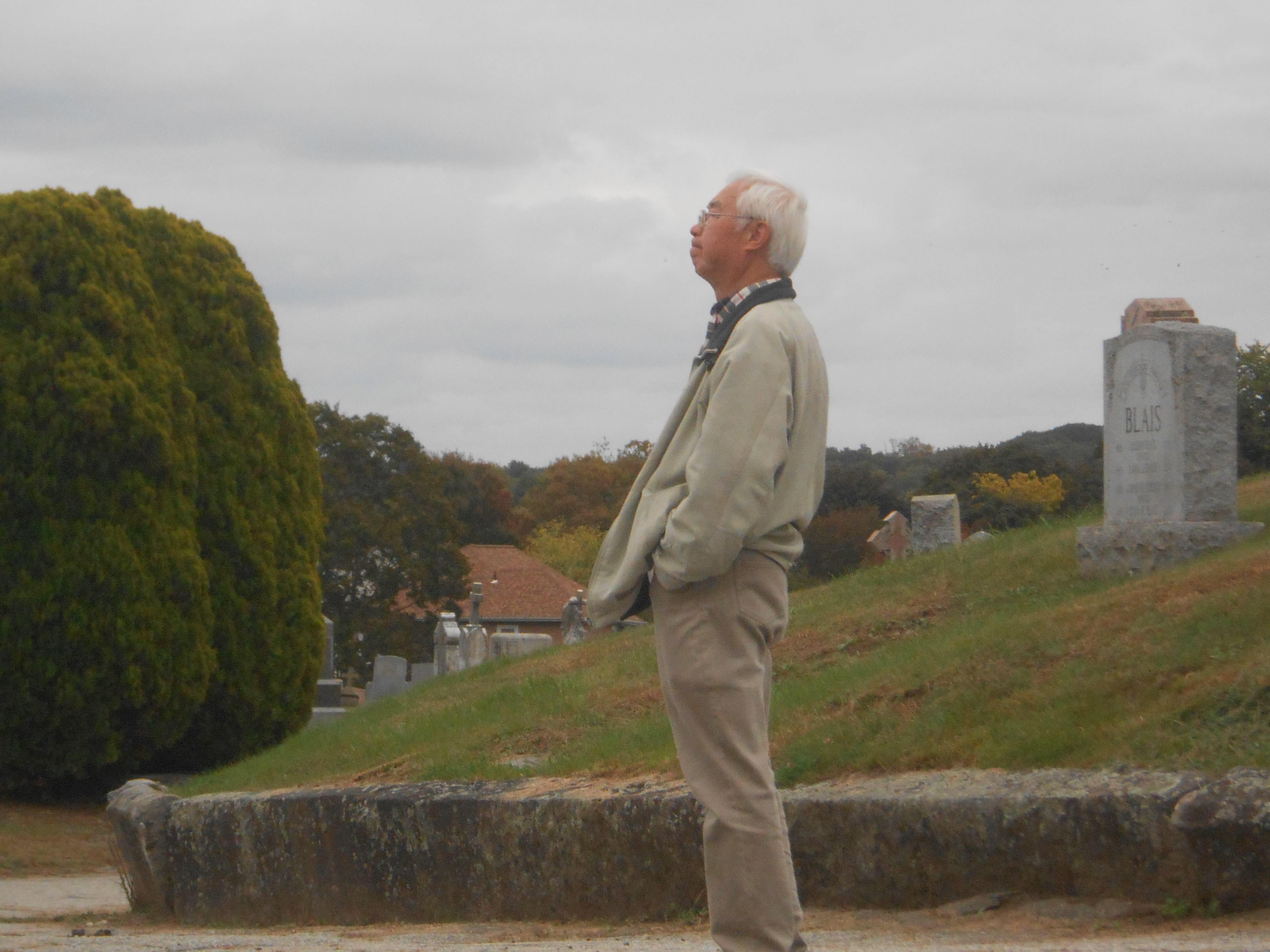
Yang took a moment for contemplation.
I was looking out on vistas of graves


to view this:


And aren’t these graves always the saddest ones of all?


Research Follies

I recently saw this meme in my feed on FaceBook and said to myself, “Oh, how painfully true!”
You may plot out the most deliciously intricate and logical outline for your masterpiece.  Every piece may seem to interconnect beautifully in your initial set up; but, darn it, not only the devil is in the details but Belial, Beelzebub, Moloch, Asmodeous, Lucifer, and the whole gang are too!
Case in point, my current project, a sequel to Surprise! with the ironic working title Memories of You.  I knew where I wanted to move my main characters, scene to scene, but creating those scenes, developing them, dealing with new and tempting possibilities once I got started, that was another kettle of guppies – sometimes sharks, hammerheads!
For example, I knew Vicki Westlake would clue in to some important information about a dangerous man from her veteran husband’s past while she was doing research in the Boston Public Library for a new mystery novel that she was planning.  Simple, then, kind of.  If I plunk her down in the library, I have to describe the library to create a genuine sense of place – except I hadn’t been doing research at the BPL for many years.  Field trip!
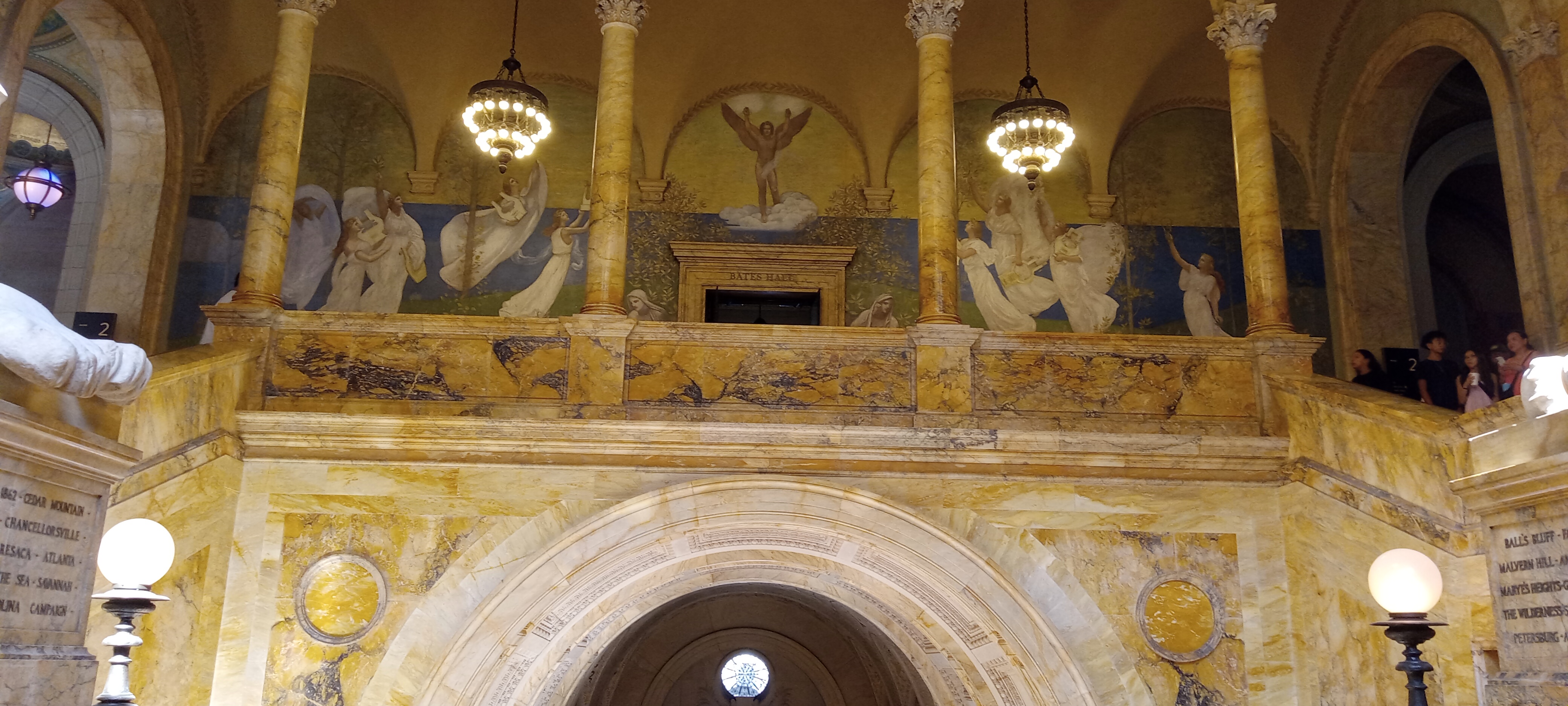
Off Yang and I went to that gorgeous receptacle of knowledge to take pictures and just drink in the impressive architecture as we explored the layout – part of which led me to a side room that would help me develop a new part of the story.  Problem solved.

Um, not exactly.  I was visiting the library in 2025; my story takes place in 1947.  Things change over the years.  So, off to the internet to find architectural plans and photos of the library that would work for the time period of Memories.  I even found a floor plan of the first and second floors! Side note:  I’m now really enjoying the FB group Boston Mass. Vintage.  It’s a great site to help me with future mid-century writing projects.


Another vital part of my outline hit a little bit of a “roadblock” as I moved to the end of “Memories,” where the two main characters journey to Maine in October 1947 in order to learn vital answers about the husband’s past in the war from his retired commanding officer.  Did you know that 1947 was known as the fall Maine burned, as massive wildfires swept through much of southern Maine, as well as other parts?  Can you get any more exciting than having your denouement occur in the midst of devastating, inexorable flames?
Piece of cake to write?  Um, no!  My heroine and spouse have to travel to a more northern part of Maine, so I have to figure out how they can get through southern Maine without being caught by fire but end up at their destination just as another blaze is heading for them, then be able to get out without being incinerated.  Fortunately, I have Joyce Butler’s Wildfire Loose, The Week Maine Burned, a brilliantly thorough and exciting recounting of when and where the fires started, how they progressed with speed and almost omnipotence, how they were fought, and how people escaped by the skin of their teeth (sometimes not).  So, in order to time my main characters’ journey from Boston to Maine, I created a chart of where the fire was each day, as well as whipping out a road map of Maine and blocking off in pen the areas where the fires blazed through, based on Butler’s citing the towns affected.  I also had to factor in the time their trip would take considering the lower travel speeds of the 1940s, as well the routes available.  Fortunately, I passed fourth grade math.
Of course, I also had to use a roadmap to chart my characters’ route from Boston to their destination in Maine, which creates problems of its own.  Today, we can shoot straight up Interstate 95 and save scads of time.  Unfortunately, no  95 in 1947.  I had to look over the routes listed on the map, determine if they were state roads, and find out if they existed in 1947.  Joyce Butler’s book provides plenty of helpful references to routes in existence, as well as does  the internet on history of specific routes.  The internet was surprisingly unhelpful in providing road maps from the time period – unless I wanted to shell out to ebay or some other source.  Thanks to Yang for looking over routes, sharing research, and discussing driving.
So, all I need to do now is pick a town near a fire and away we go – um, not quite.  For reasons related to the plot, the town couldn’t be southern Maine – not isolated enough.  Some further north or west?  Well, the time frame wouldn’t work.  When those fires got going my characters would have been stalled  by the big blazes across the southern part of the state.  Anson almost made it as guest star town.  My solution?  The same  that many other authors choose:  make up your own town and date for its threatening forest fire.  Just make it fit the general setting where you locate it.  So, Amberoid, Maine was born.  How do you like the name?  An amberoid is actually synthesized gemstone containing crushed amber.  It’s also the name of the first horse I picked in the Triple Crown races.  He did not run in 1947.  I’m not that old.
So, anytime you think all a writer has to do is sit down and write – Ho boy, have you got another thing coming!
Intrigued?  Well, first, you should read Surprised!  Check it out here.

Images: Every effort has been made to ensure there is no copyright infringement in the use of images.  These images are for education and entertainment only.  If you feel your copy right has been infringed, let me know and I will remove the image.  syang@worcester.edu

Hammerhead shark:  Hammerhead Shark (28776238172).jpg:  Wikki Commons https://commons.wikimedia.org/wiki/File:Scalloped_Hammerhead_Shark_Sphyrna_Lewini_%28226845659%29.jpeg

Modern Photos of BPL: author’s collection

Floor Plan of BPL: The Urban Imagination https://hum54-15.omeka.fas.harvard.edu/items/show/672

Older photos of  Bates-Mckim Reading Hall in BPL  https://lostnewengland.com/2016/07/bates-hall-boston-public-library/

Image of Maine 1947 fire from https://www.maine.gov/dacf/mfs/forest_protection/1947_fire.html (origin Guy P. Gannett Newsletters in Maine)

Natasha’s Excellent Summer Adventure!

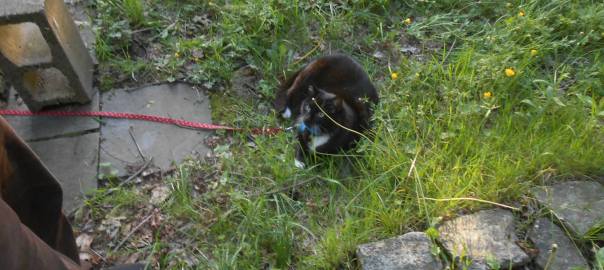
The birds are chirping, the flowers are blooming, the chipmunks are chipping, and the temperature is climbing – Natasha knows it’s time to shrug off her winter lethargy and return to exploring and patrolling the wilds of our yard.
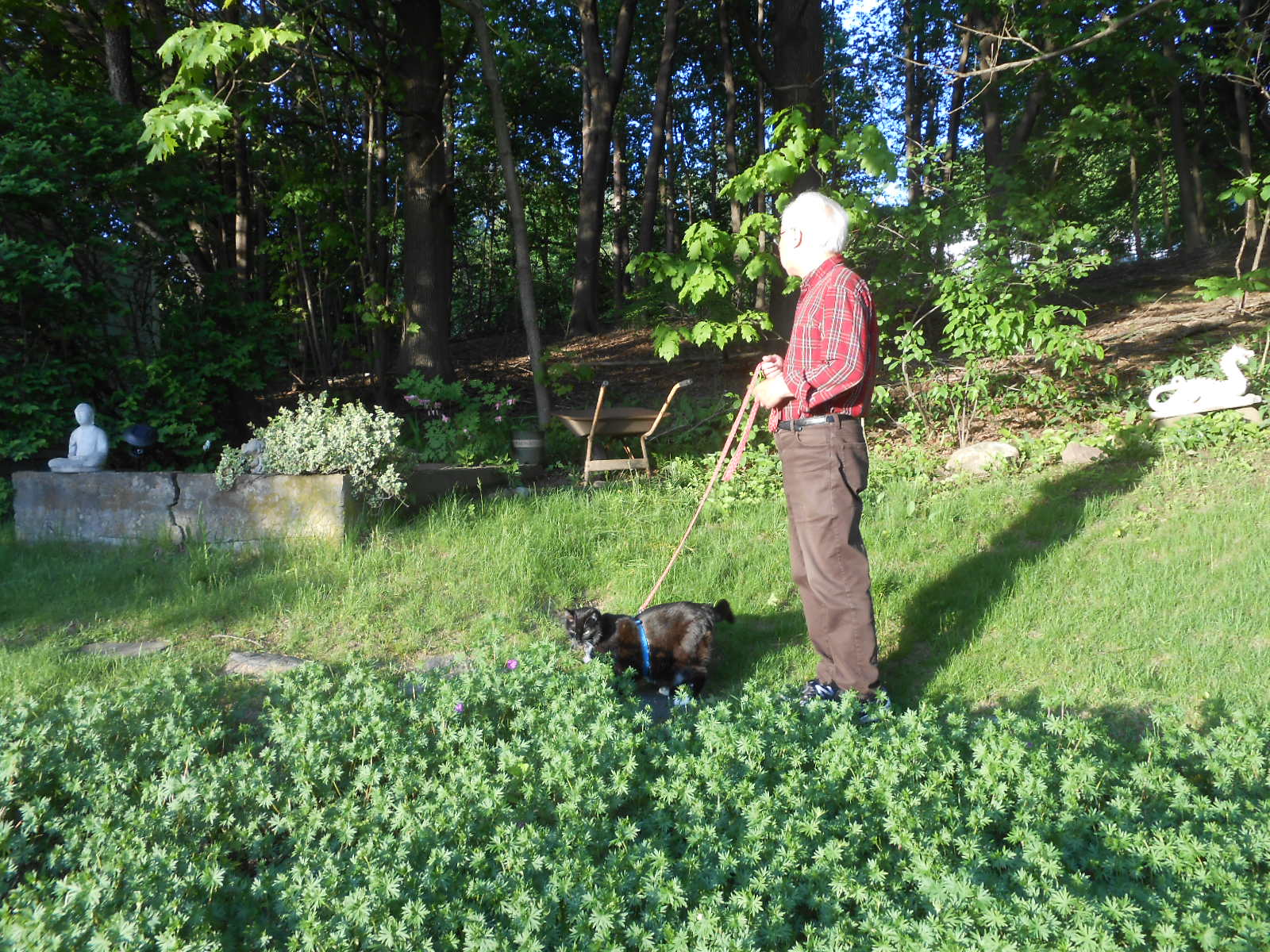
On the prowl, she determinedly sets off with her bodyguard, as any queen would do.  She’s always on the alert for danger and adventure, even if her guard is not!


Of course, she must look first one way . . .
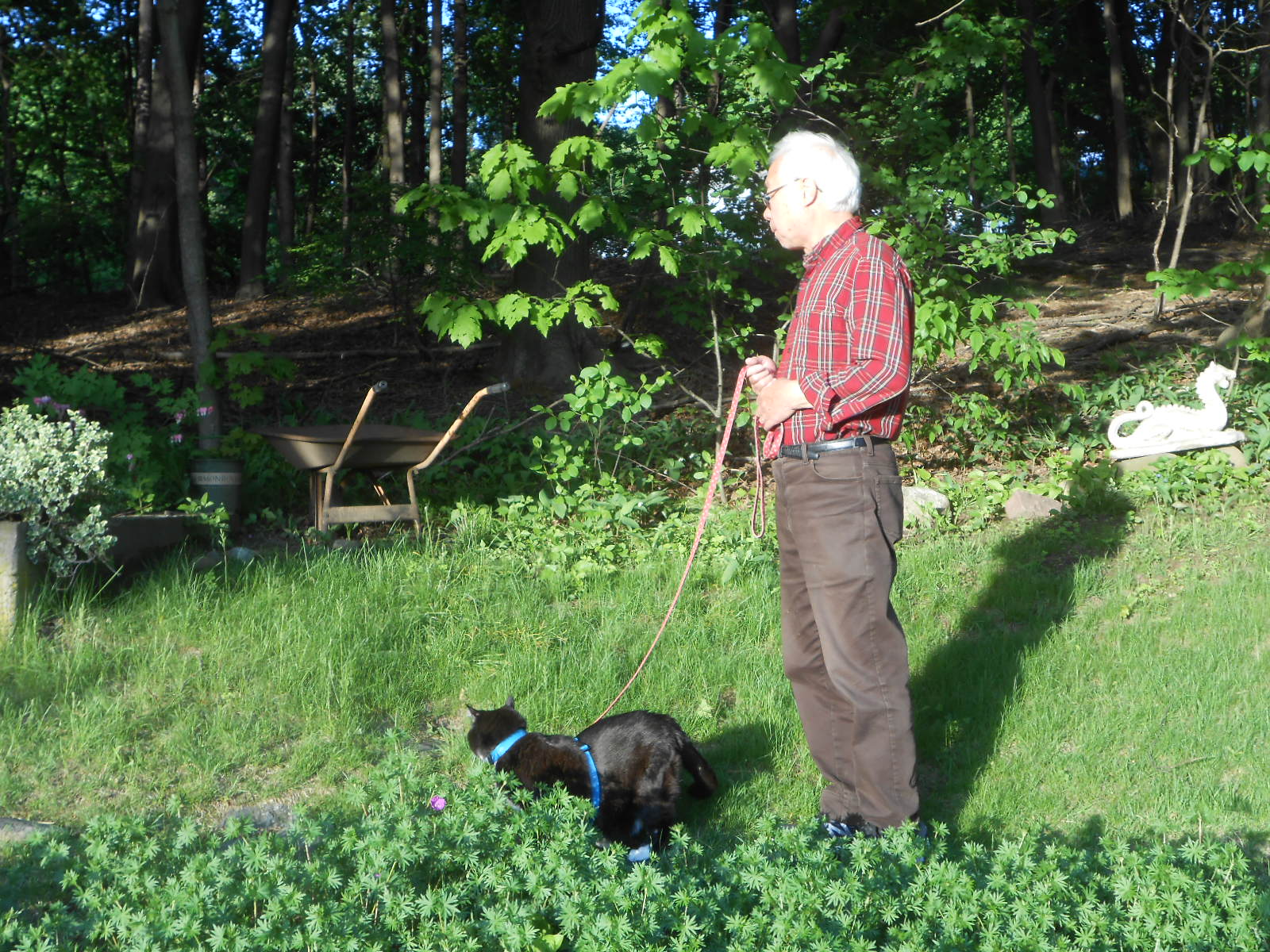
Then another, for any signs of danger,  be it in the form of nefarious chipmunks, antagonistic avians, or ferocious ants.


What has Natasha discovered?  An insidious ant?  A taunting chipmunk?  A skulking mole?  We may never know!


Whew!  All that traveling and probing for danger is exhausting.  A rest is required.
Still, Natasha likes to check back with her human, to make sure he is not exhausted, frightened, or endangered.
Then, her other human (Me!) calls from the other side of the fence.  Like Lassie racing to Timmie or Fury to Joey, Natasha flies across the yard (at a brisk trot) and leaps over that fence to join me.

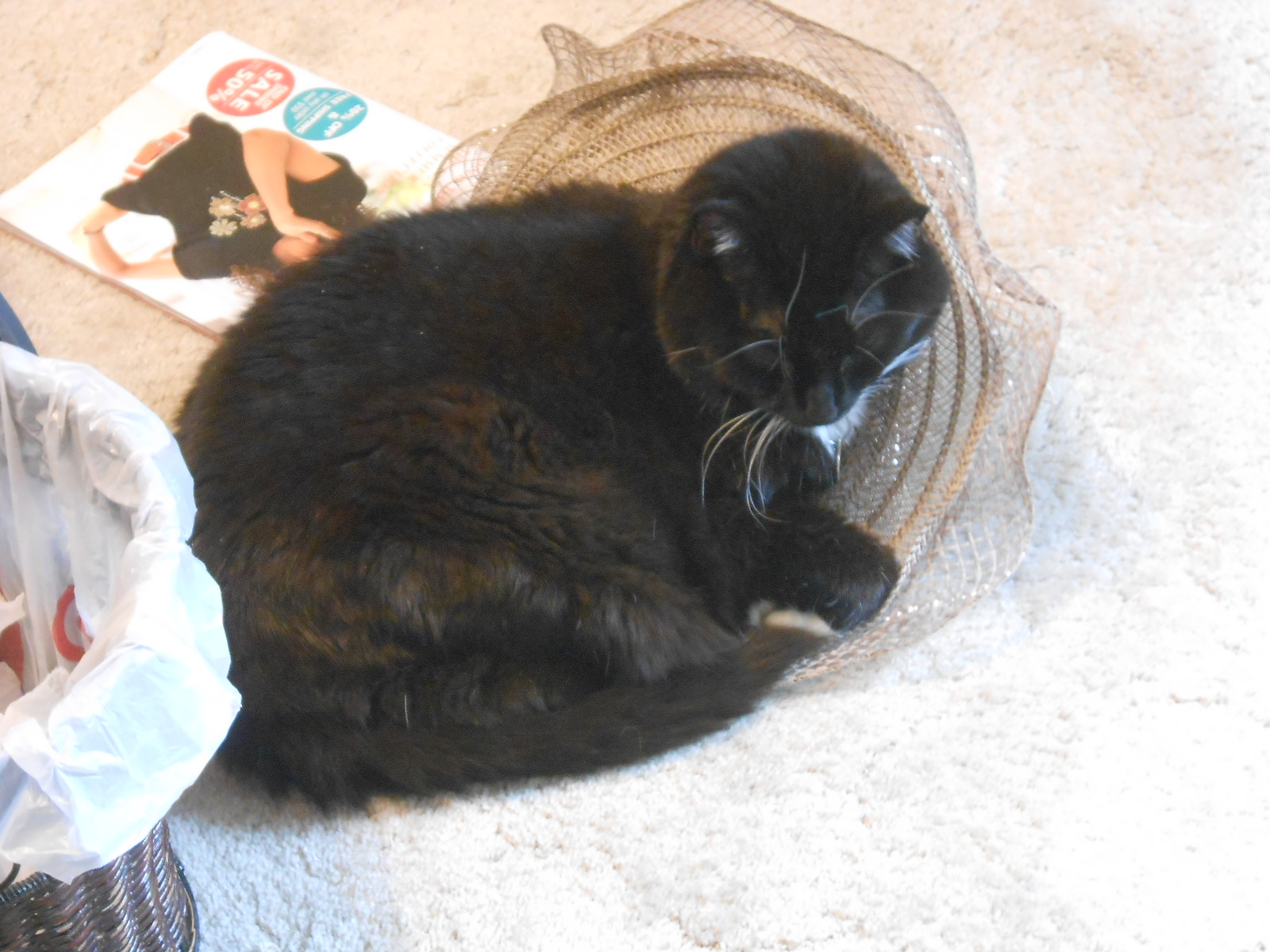
Later, her adventure completed, and the yard marked safe from rodents, insects, and feathered beasts, Natasha settles down, exhausted, to a well-deserved rest in my hat.  So there really is a cat in the hat!

“Autumn Reflections 2024”

“Autumn Reflections 2024”

Well, we’ve had our first snowfall here in Massachusetts, so even the brown, greys, and maroons of late autumn are now sheeted o’re with white.  Still, it’s nice to recall the glories of September and October, isn’t it?  So, I thought you folks might enjoy an overview of some of the autumn travels Yang and I did to enjoy the lovely landscapes of autumnal New England.
Starting not far from home, Yang and I took a stroll along the board walk that takes you across wetlands and the Muddy River near the College of the Holy Cross.  We came across some beautiful colors, even as we noted how the drought had dried up much of the little river and the marsh.
We didn’t see any waterfowl, which was very unusual – not even any Mallards of Canada Geese.  No beavers were in view, either.  However, I did catch sight of this beauty and a chum galloping through the grass.  If you click on the photo, you can see her really well. You’ll notice that she looks as interested in me as I am in her!


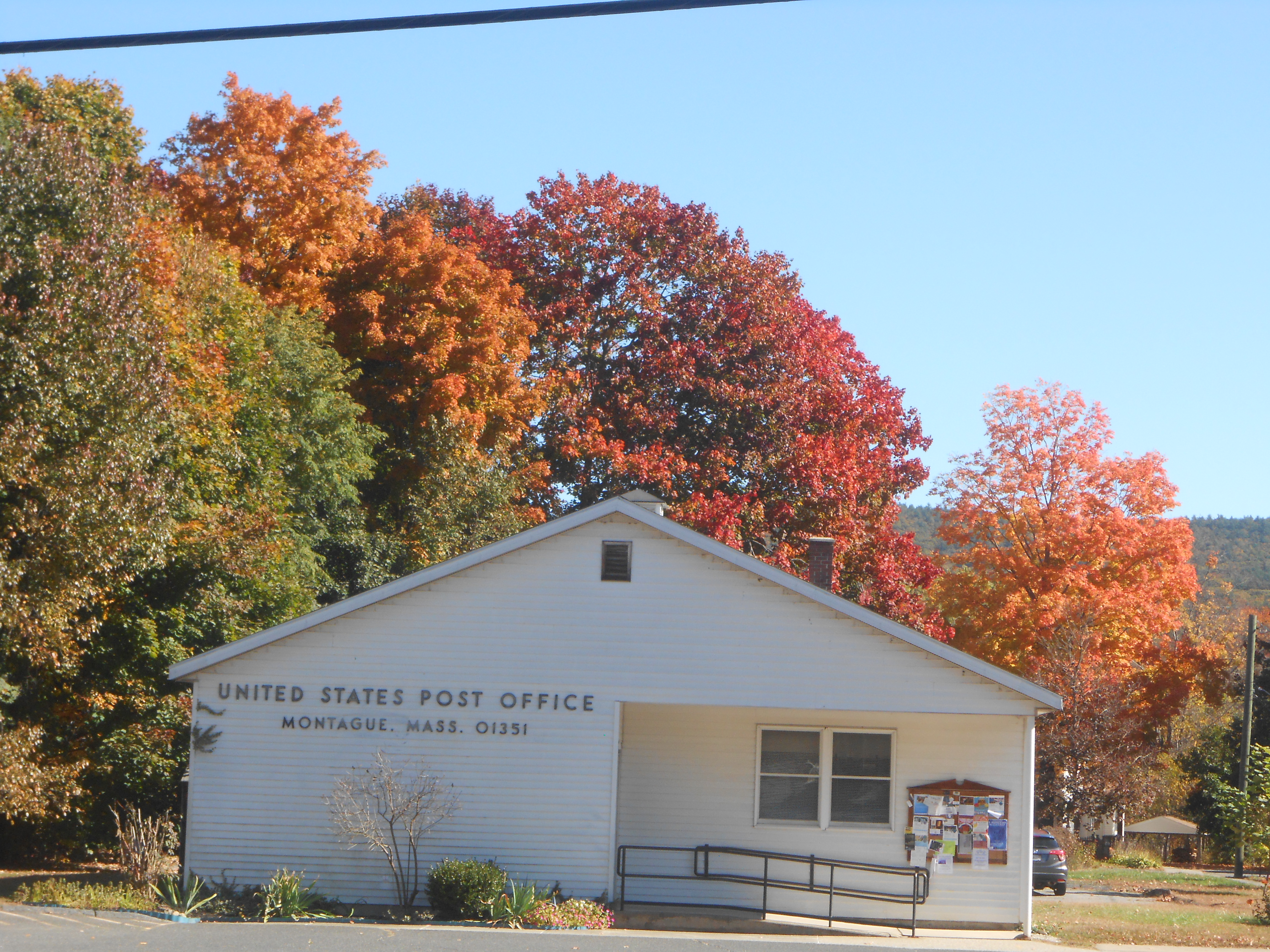
Next stop on your Fall Tour is Montagu, Mass.  We went out there to sell some books at the Book Barn, have breakfast at Lady Killigrew’s, then take a stroll in the part of town nearby.  There were some absolutely beautiful colors to enjoy.


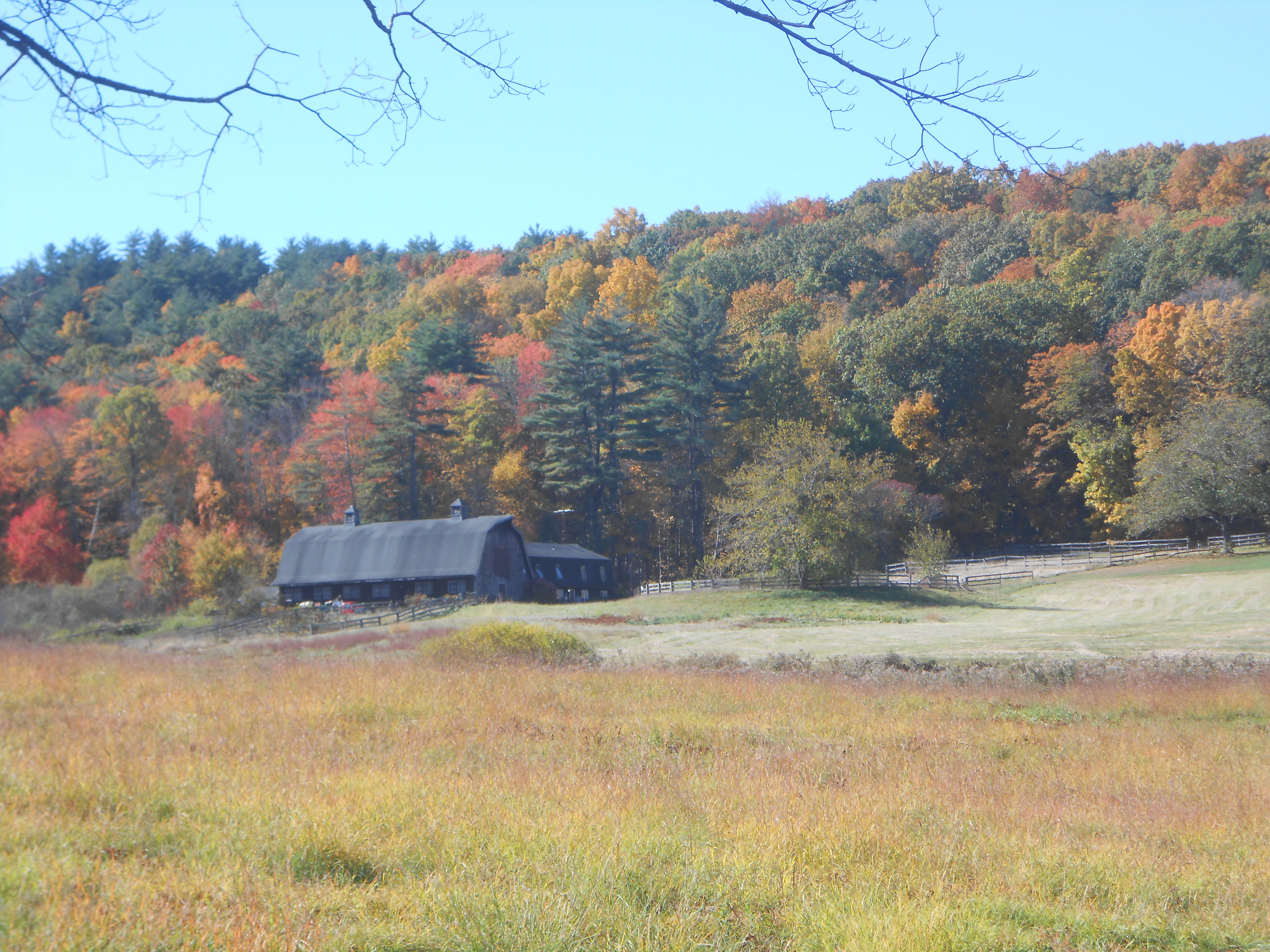
I love this picture of a New England farm.  It looks as if it had been painted in pastels.
Our bike ride  from Pittsfield to just above Adams, Mass. once more rewarded us with some exciting views of foliage.  There’s Yang, pedaling away from me through a tunnel of gold, tangerine, and green.
Here’s a row of scarlet and gold flanking the trail.


Across the lake from us the shore blazed red, gold, and orange.


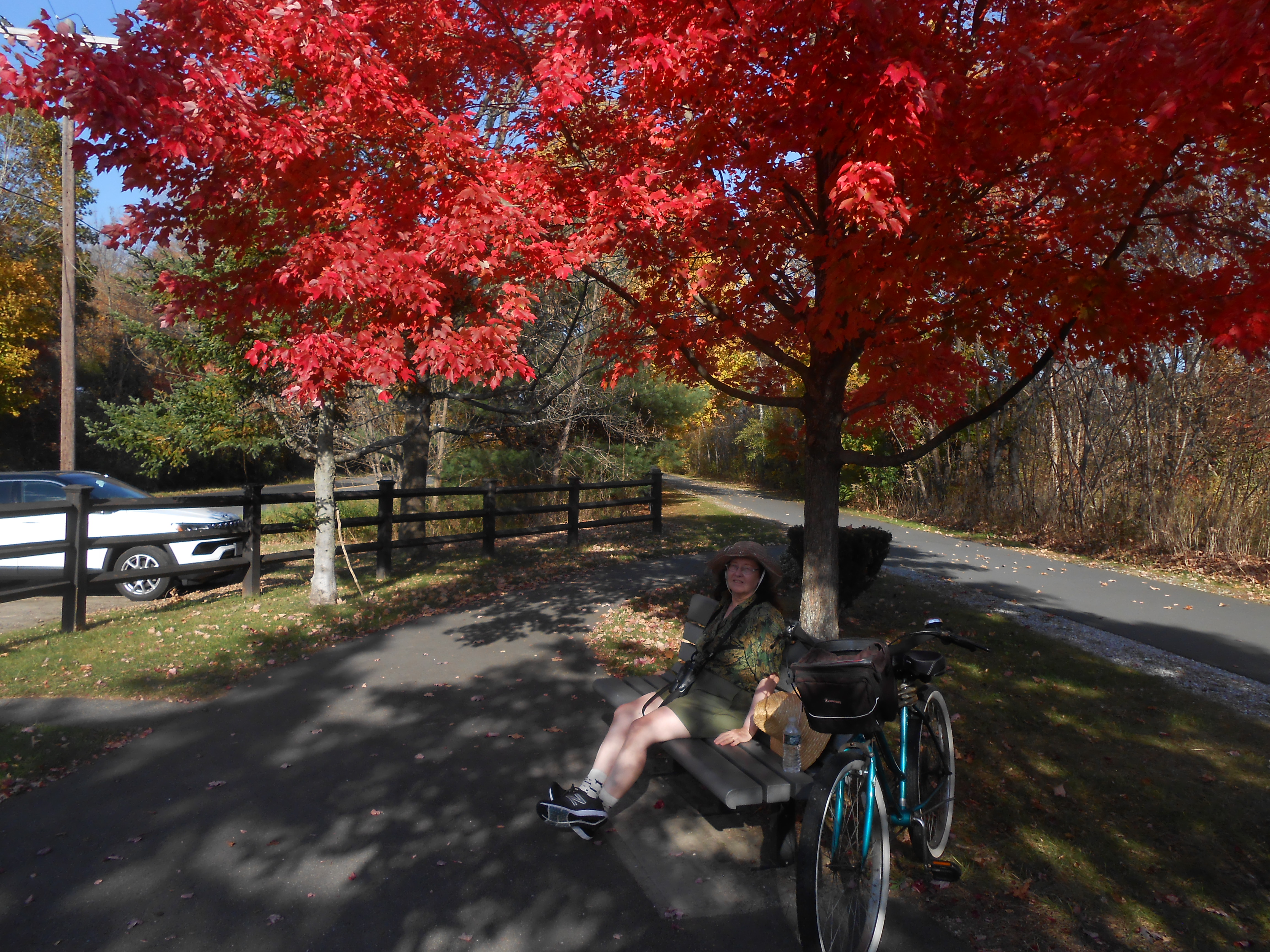
And the scarlet of some of the maples was exhilaratingly vibrant.  Here’s a nice shot of Yang under one such tree.

We finally made it to one place I’d been wanting to visit for years:  The William Cullen Bryant Homestead.  Though I’m more of a specialist in British Lit, Bryant was always an American poet whom I especially liked.  I’m sorry that the house itself wasn’t open for viewing.  From the outside, you can see it’s spacious, gracious, and beautiful.
The view from the house is gorgeous, crossing a meadow to reveal the color-splashed trees beyond.


We had an enjoyable walk in the woods near the house, still part of the homestead.  Here, autumn provides a tunnel of  dreamy, misty color.


Yang challenged me to be able to photograph the fascinating swirls of moss decorating the rough New England boulder layered with marble and blanketed with brown, crisped leaves.  I guess I showed him!

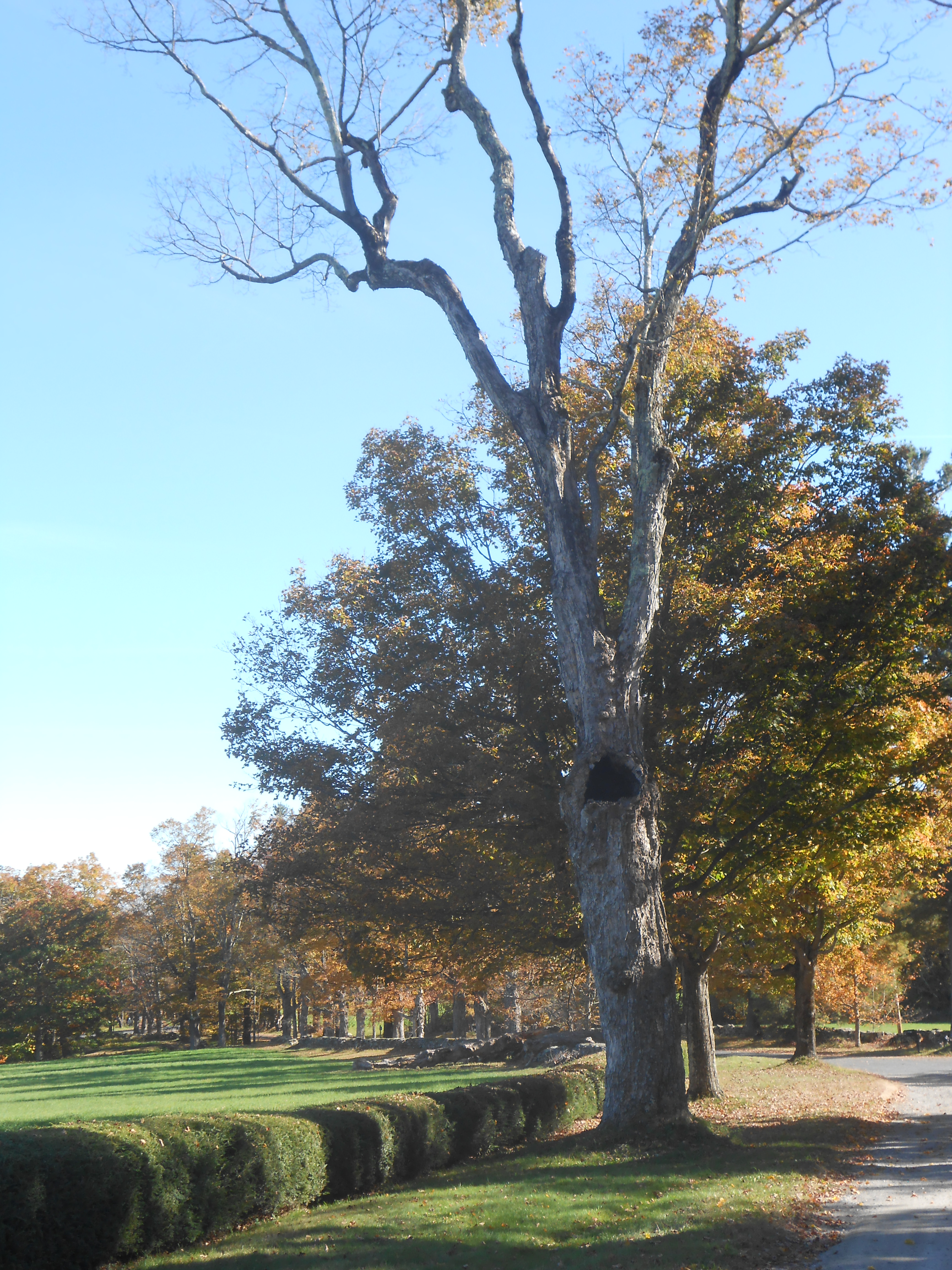
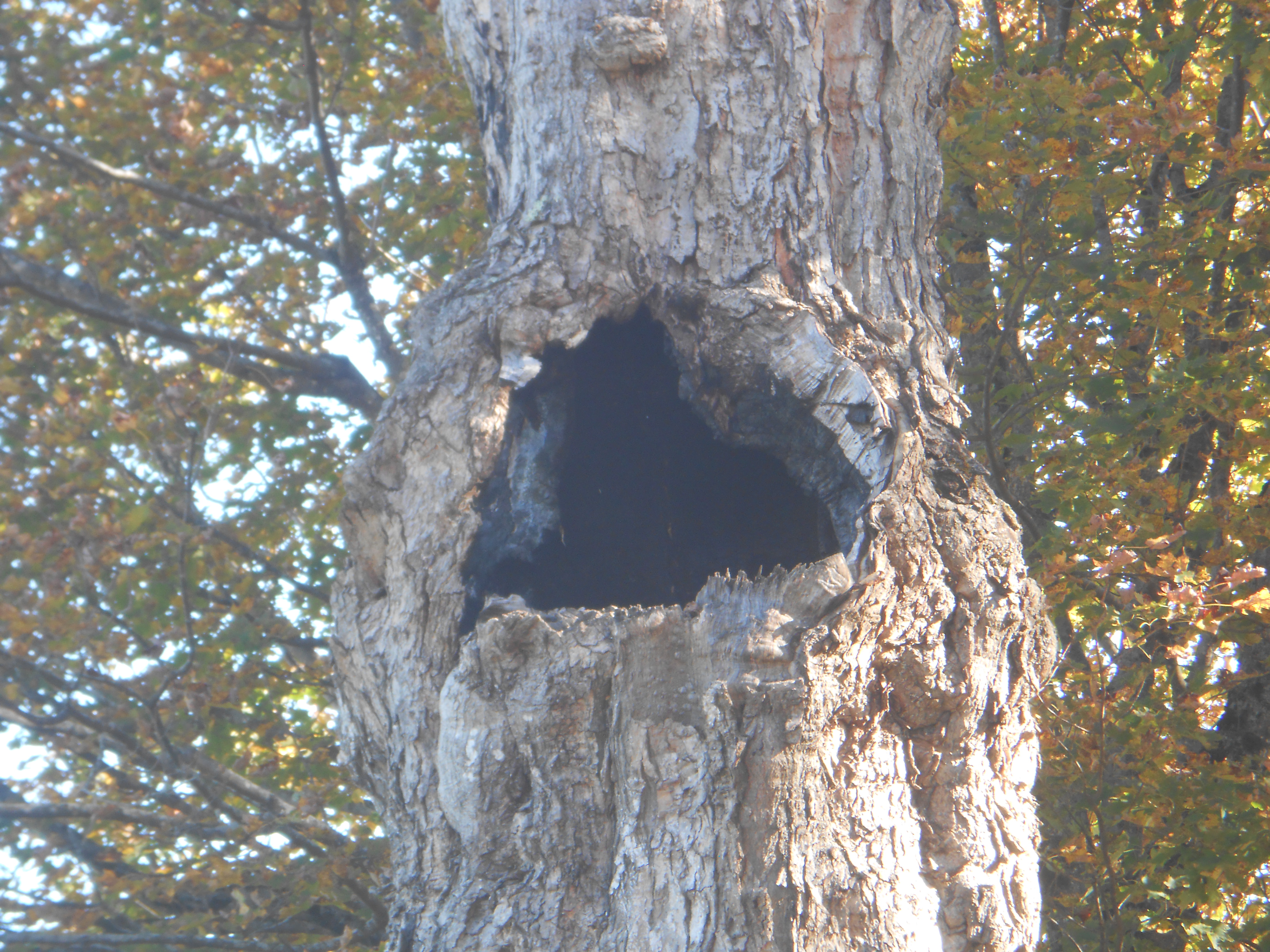
One of my favorite sights was this old tree with a gaping maw.

I just had to get a close up of said maw.  Really, isn’t it perfectly Lovecraftian? Do you see those jagged teeth on the upper part?

Finally, there’s one of my old favorites, Stafford.  Here are some of the traditional views.
Across the pond.


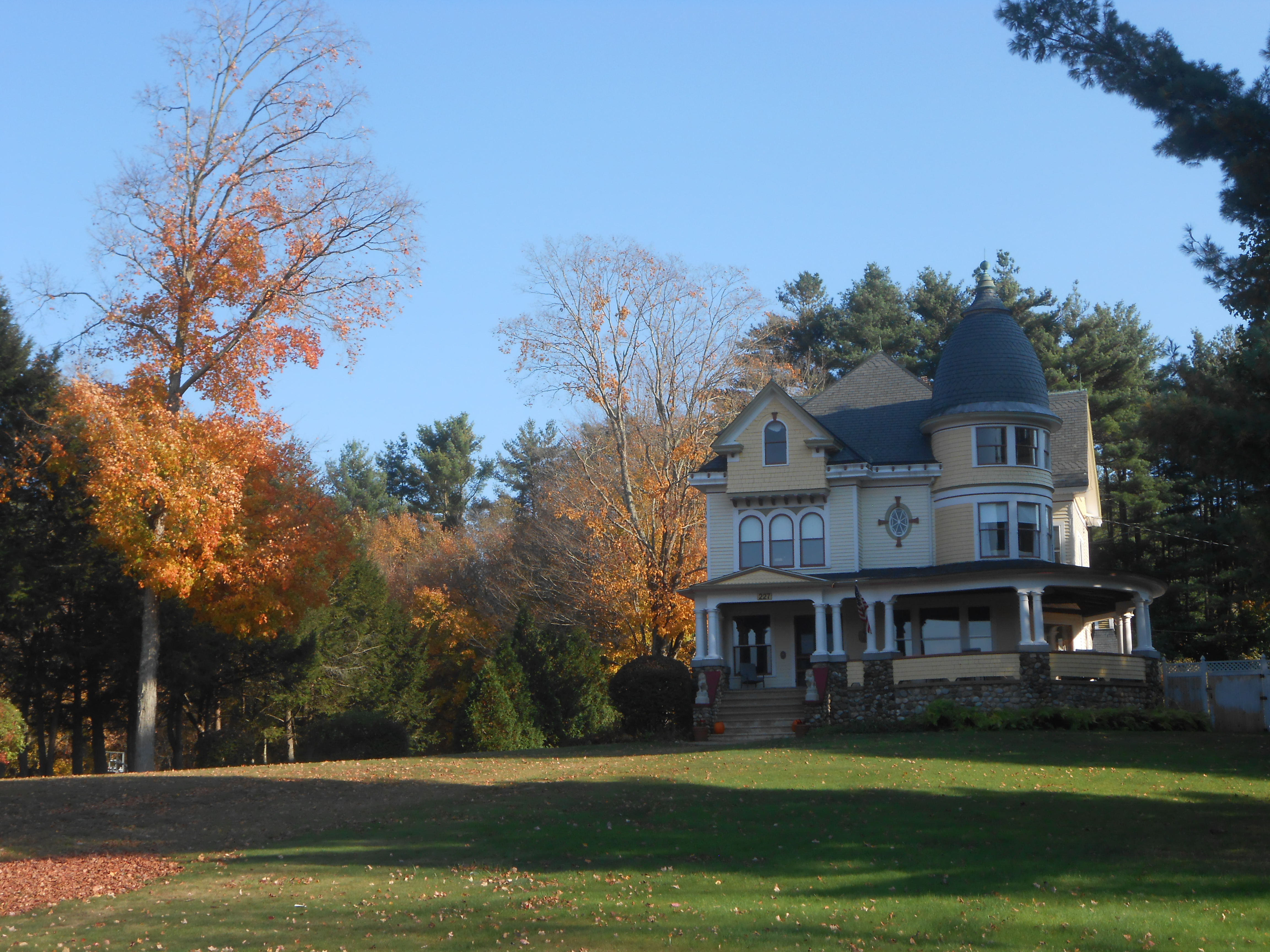
My Favorite Victorian House.  Couldn’t I really decorate that one swell for Halloween!


But some of the shots of foliage and sky thrill me even more.  I love the way the azure sky serves as a perfect complement to the golds, yellows, and orange flames of the autumn leaves.


Now, if you’ll excuse me, I’ve got to sit down and rest.  All this traveling and photographing has me exhausted!

Casting Shadows, Part Two

“Casting Shadows,  Part Two”


Philip Carlyle –  The master of the Carlyle Estate where the Wellstone Mystery Hour is making its remote broadcast, Philip Carlyle has opened his home and the secrets of its past to answer the mystery behind the disappearances of Felicia Blasko and his brother Bill Carlyle.  An engineer and businessman by profession, Philip still nurses the soul of a poet and musician, while holding secrets of his own concerning Felicia.  Embodying Philip requires a man of power, incisive wit and vision, as well as a sympathetic sense of artistry ‒ someone whose fascination with Jessica Minton rings more sad than creepy.  Claude Rains is my choice.  Think of the urbanity and authority of his Victor Grandison in The Unsuspected and the sly, mordant humor in Casablanca’s Inspector Renault.  Then there’s his incisive and forthright authority as Now Voyager’s Dr. Jaquith, tempered by his wry humor and genuine, though never soppy, compassion. Also think about the vulnerable passion of Paul Verin in The Man Who Reclaimed His Head, a quality that burns beneath the wall of authority in Job Skeffington of Mr. Skeffington. That’s the complexity of Philip Carlyle.


Jeanne Rivers and Madame Wanda are two ladies who may or may not be whom they seem.


Jeanne Rivers is the housekeeper for Philip Carlyle in the mansion that Felicia haunts.  She’s a top sergeant making the place run like clockwork, even managing to banish the indomitable Liz Minton from kitchen gossip fests with the help. Her wit can be acerbic, but she can show warmth and good humor when she’s helpful ‒ a woman of practical advice.  She also has ties to the mansion’s tragic past that could open up its secrets. ­A fine choice to inspire Jeanne is Jean Brooks, leading lady of the RKO B-division.  Brooks has demonstrated a dry and clever wit in such films as The Leopard Man, The Falcon in Hollywood, and The Falcon and the Co-eds. Falcon Tom Conway can’t get by without her popping up somewhere! Further our Ms. Brooks is no stranger to a cinematic world of shadows.  A veteran of Val Lewton’s dark tales, in addition to playing a smart-talking gal in The Leopard Man, Brooks also portrayed the haunted Jacqueline in The Seventh Victim.


Madame Wanda – Wanda Hendrix brings more than a first name to Shadows’ medium.  Apple-cheeked and merry-eyed, Hendrix played comedy deftly in films like Miss Tatlock’s Millions and The Admiral Was a Lady.  Thus, Madame Wanda shatters the stereotypes of film mediums as otherworldly, mysterious, and at times even sinister.  Our stylishly outfitted Madame Wanda is quick with a quip to challenge and defeat skepticism about her capabilities, especially from the suspicious Liz Minton and Gerry Davis.  Still, Wanda’s description of her powers and her conjuring of a voice from beyond the pale demonstrate her bona fides for connecting with the supernatural.  Preparing her for the darkness of Shadows, in My Own True Love and Ride the Pink Horse  Hendrix moves through a post-war world now darkened by bitterness, vengeance, and corruption.

Next entry, a look at more of Jessica’s colleagues from the Wellstone Mystery Hour.

Casting Shadows, Part One
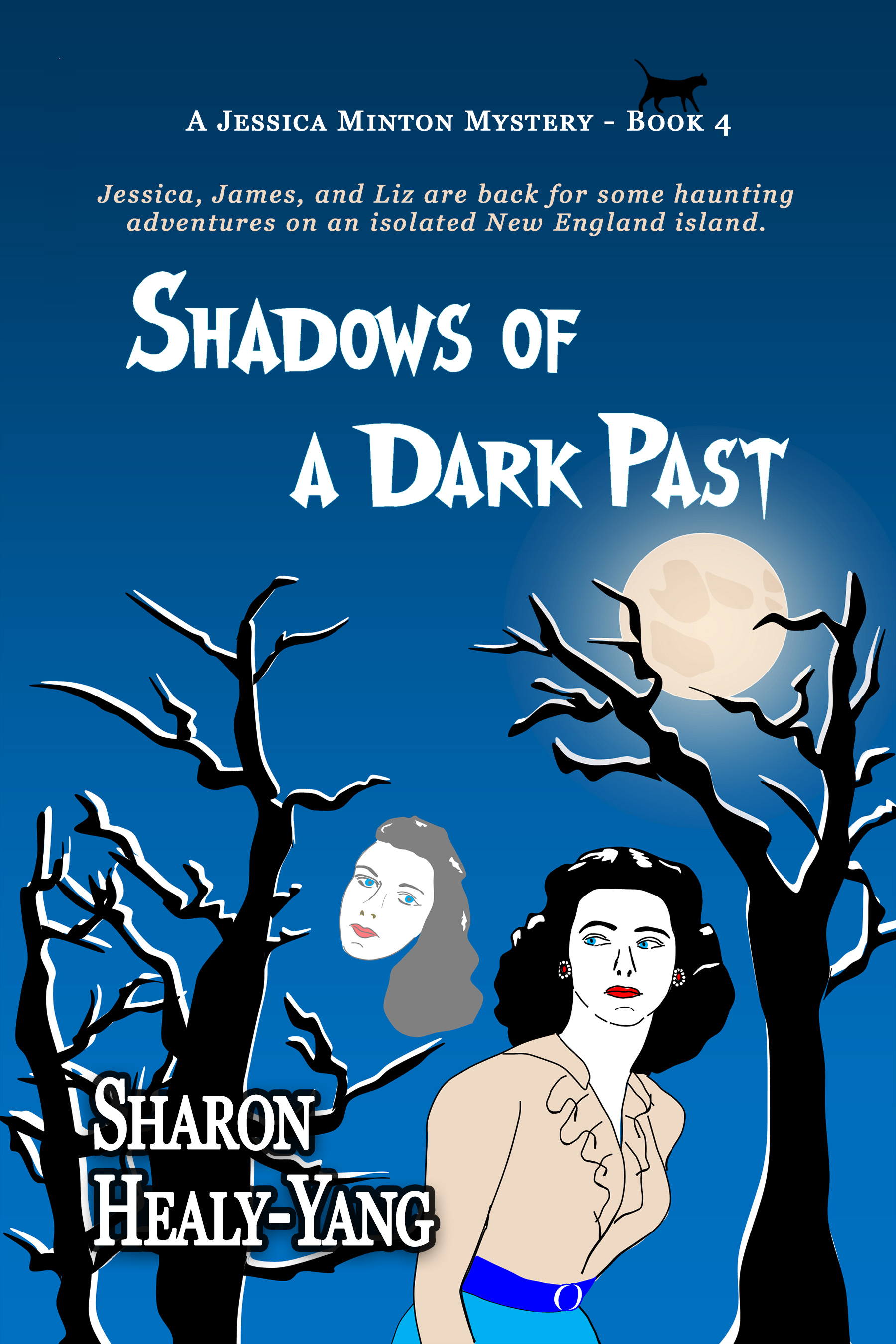
Shadows of a Dark Past
Jessica Minton Mysteries
Home
Images

-Claude Rains  Photo from John Engstead. Star Shots: Fifty Years of  Pictures and Stories by One of Hollywood’s Greatest Photographers. New York:  EP Dutton, 1978. p. 185.

-Jean Brooks in white trenchcoat:  Wikipedia public domain, https://en.wikipedia.org/wiki/Jean_Brooks#/media/File:Jean_Brooks_1940s_fan_photo.jpg

-Jean Brooks in plaid jacket public domain:  https://commons.wikimedia.org/wiki/File:Jean_Brooks_in_The_Falcon_in_Danger_1943.png?uselang=en#Licensing

-Wanda Hendrix photo, Author’s collection


October Thrills and Chills with Shadows of a Dark Past!

October Thrills and Chills with Shadows of a Dark Past!

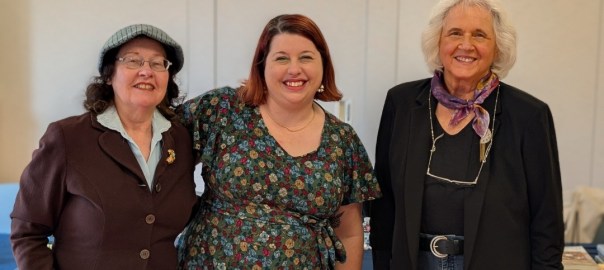
I had quite the busy Halloween month meeting people and getting the word out about my latest Jessica Minton novel, Shadows of a Dark Past.  October kicked off  when I joined authors Jean M. Grant and Janet Raye Stevens at the Horseshed Fair in Lancaster, MA.  Some friends showed up expressly to get their copy of Shadows hot off the press.  I also sold copies to new readers as well. It was a beautiful sunny and warm day, setting Jessica and Company’s ghostly adventures off to an exciting start.  Here I am with one of my friends from the Shakespeare Club of Worcester, Becky Spanagel.  It was great of Becky and her husband David to drop by to say hello.  By the way, Yang made that purple blouse with the stars and moons that I’m wearing!

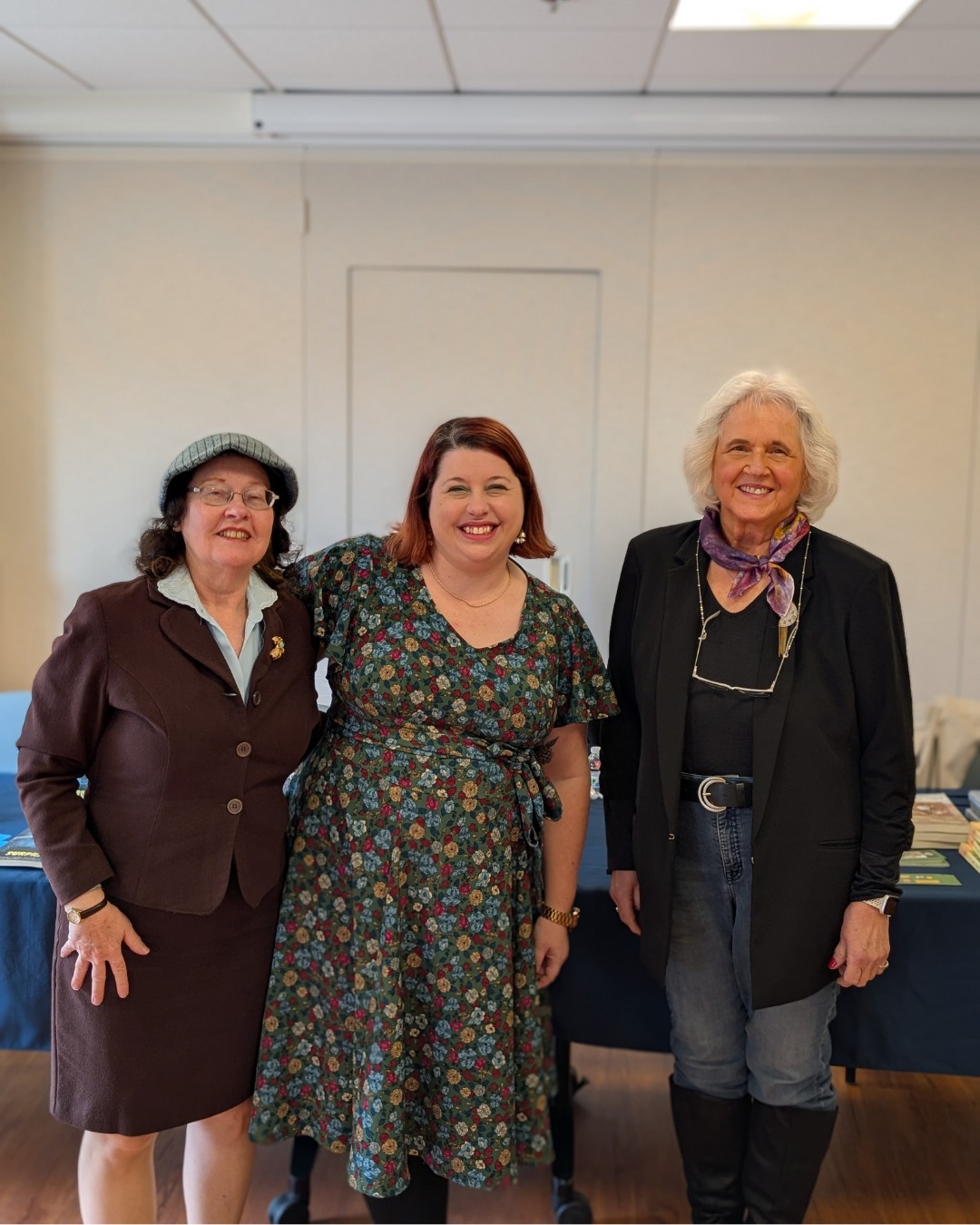
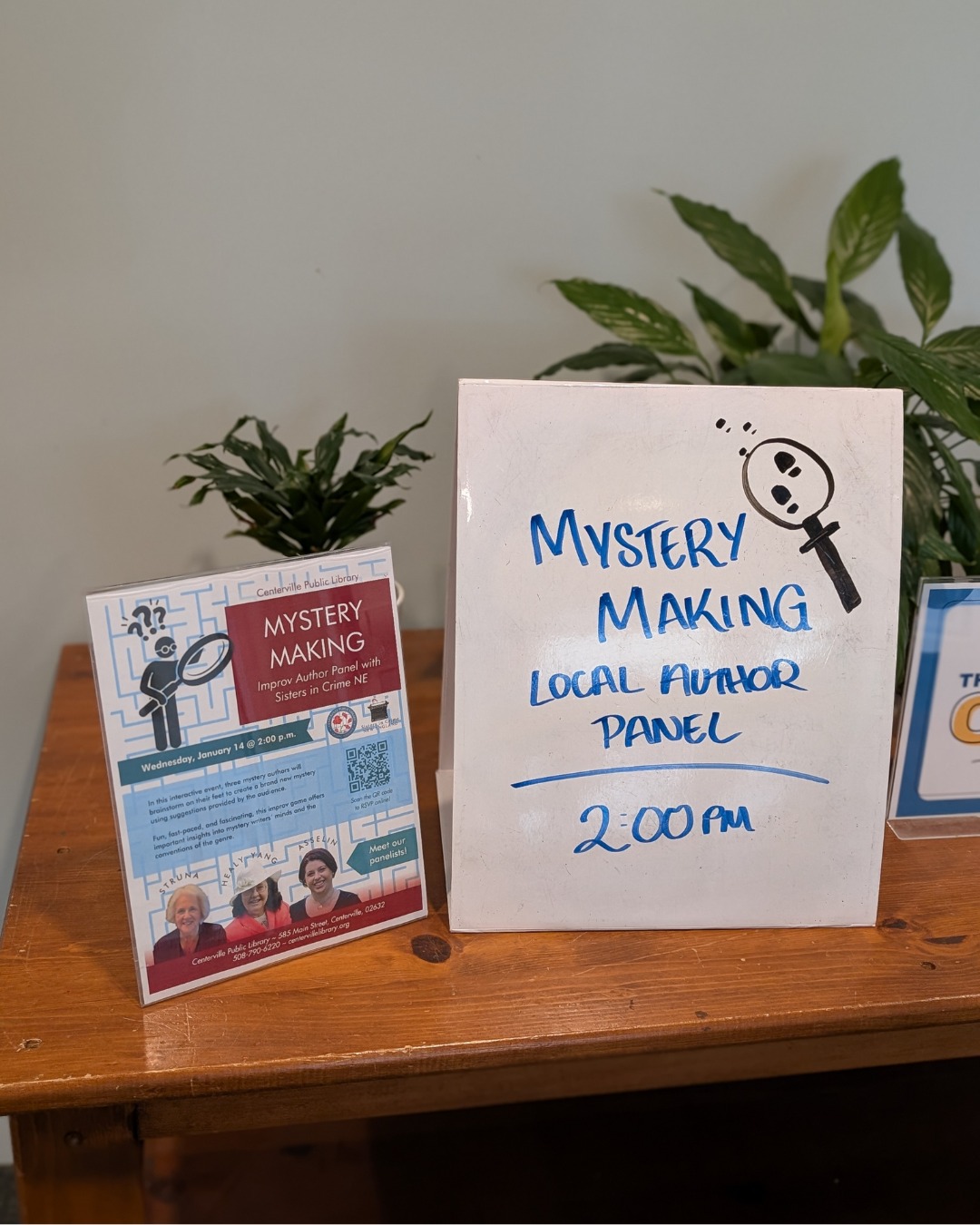
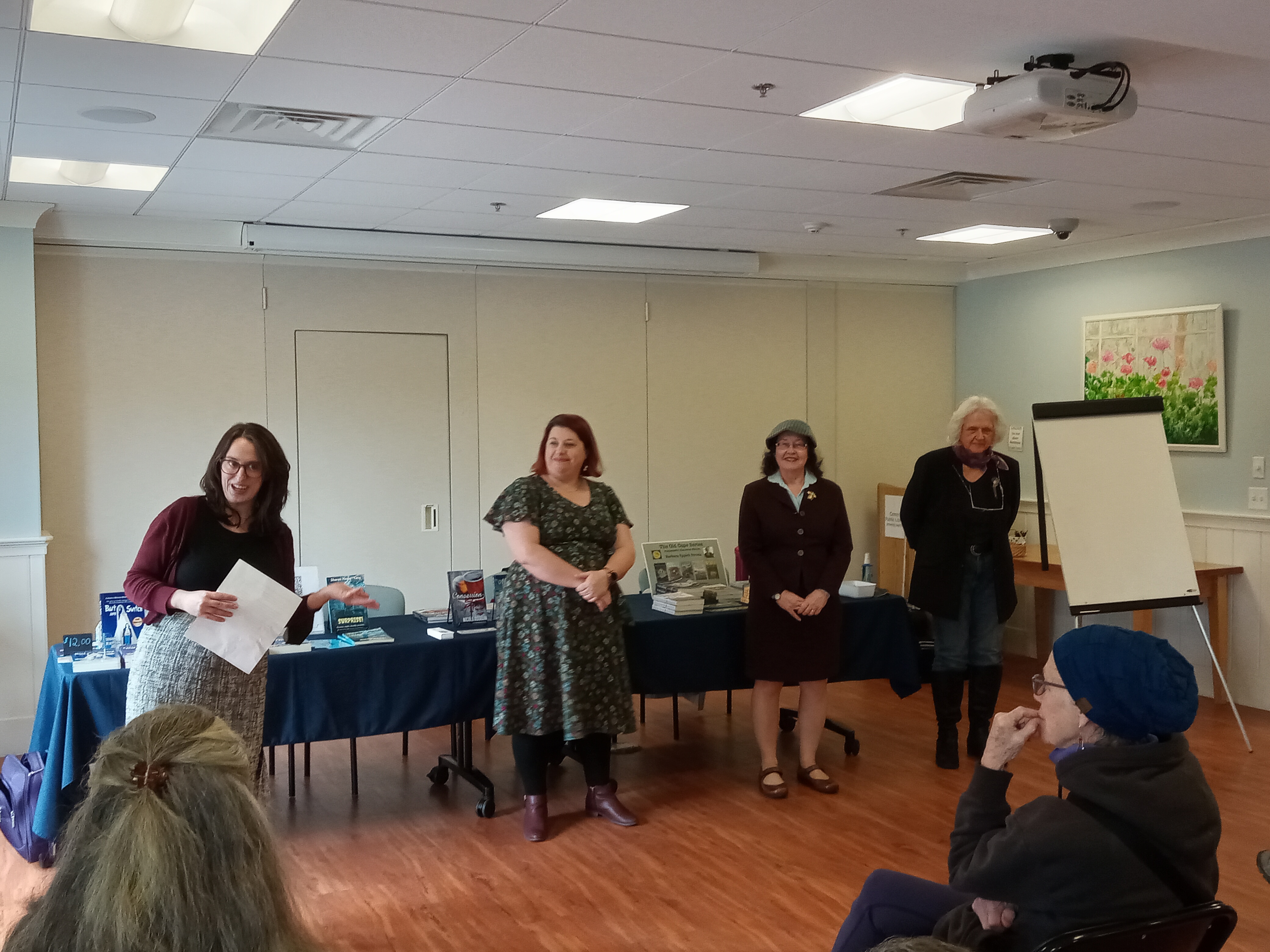
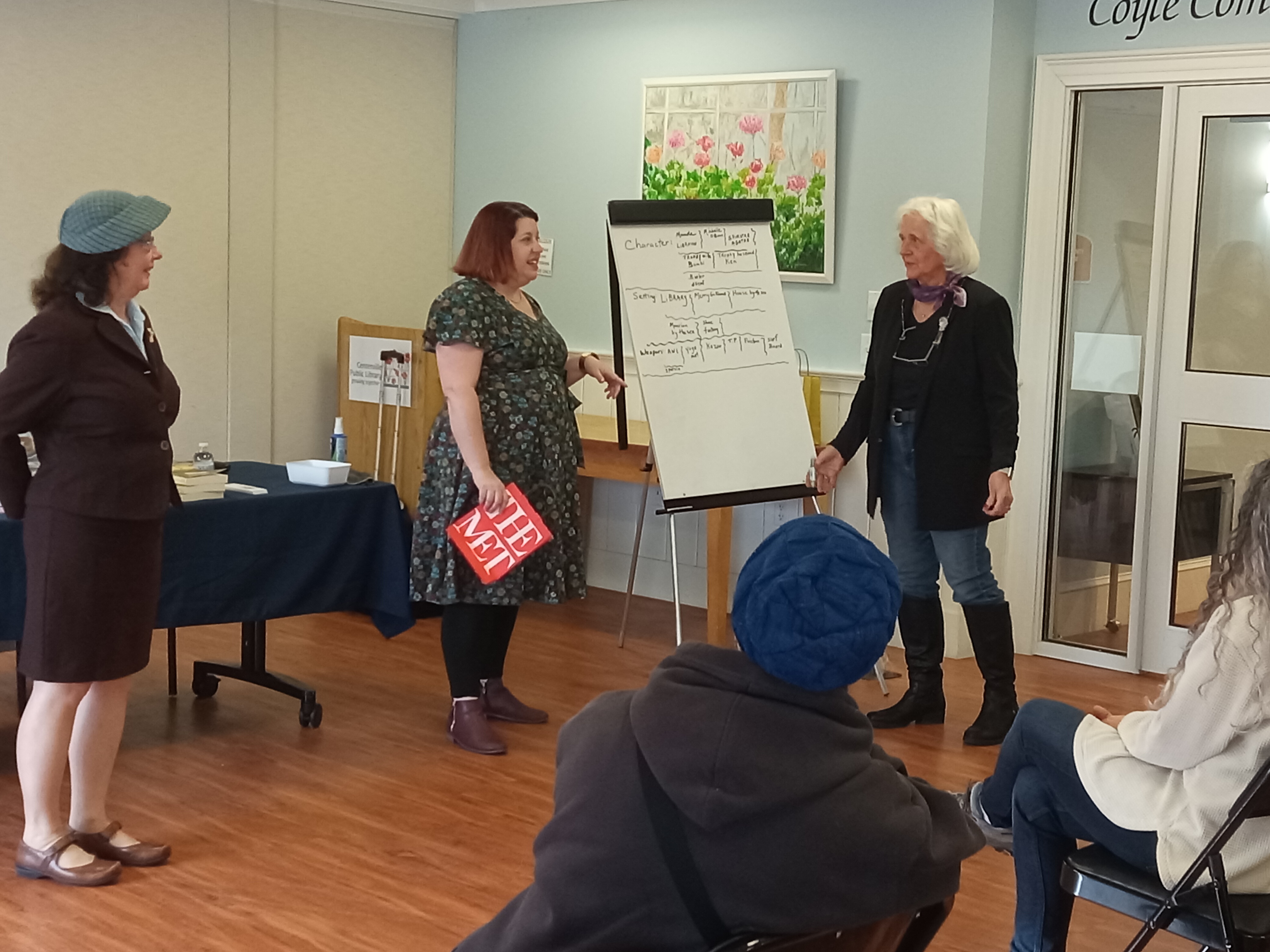
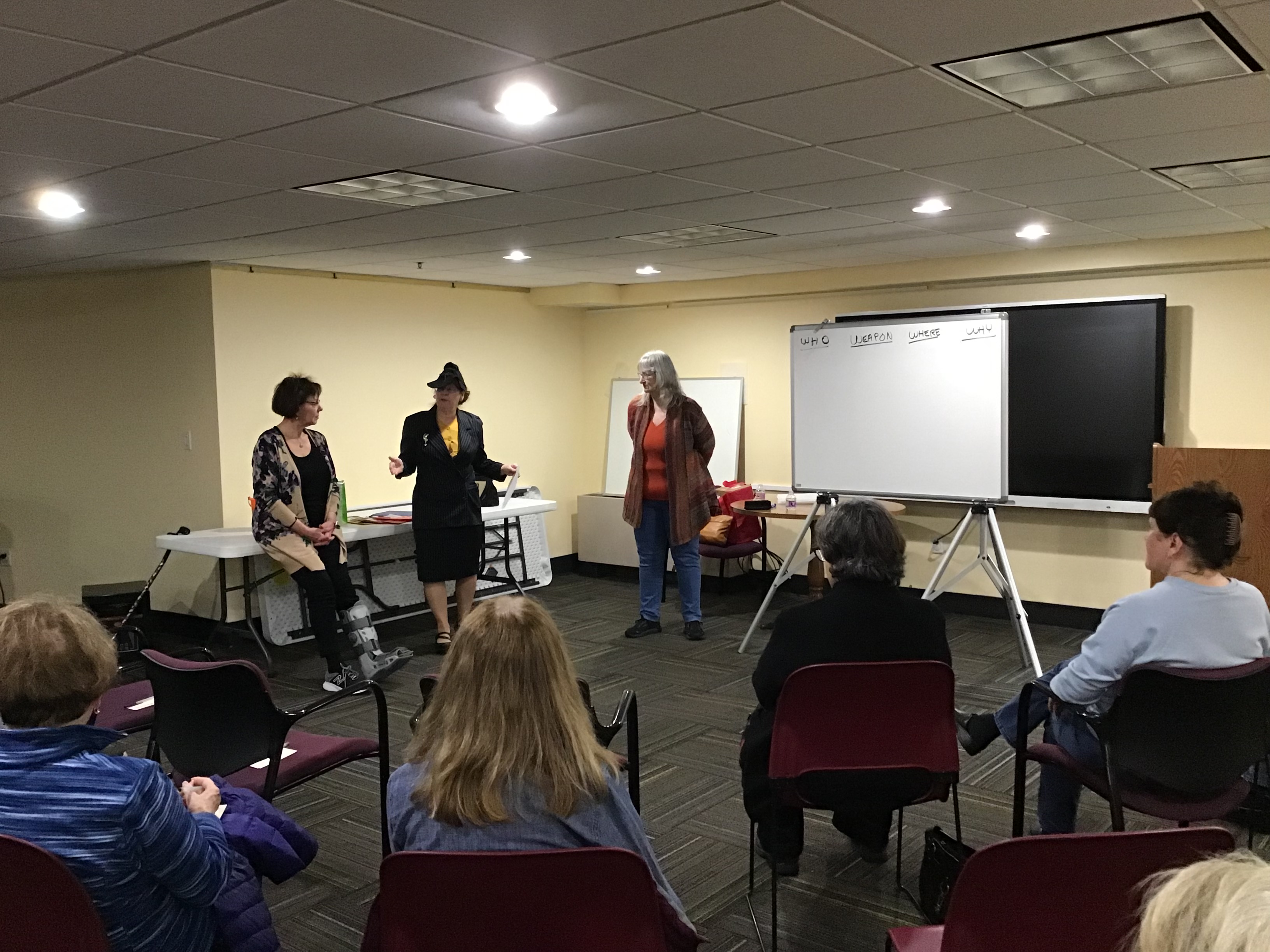
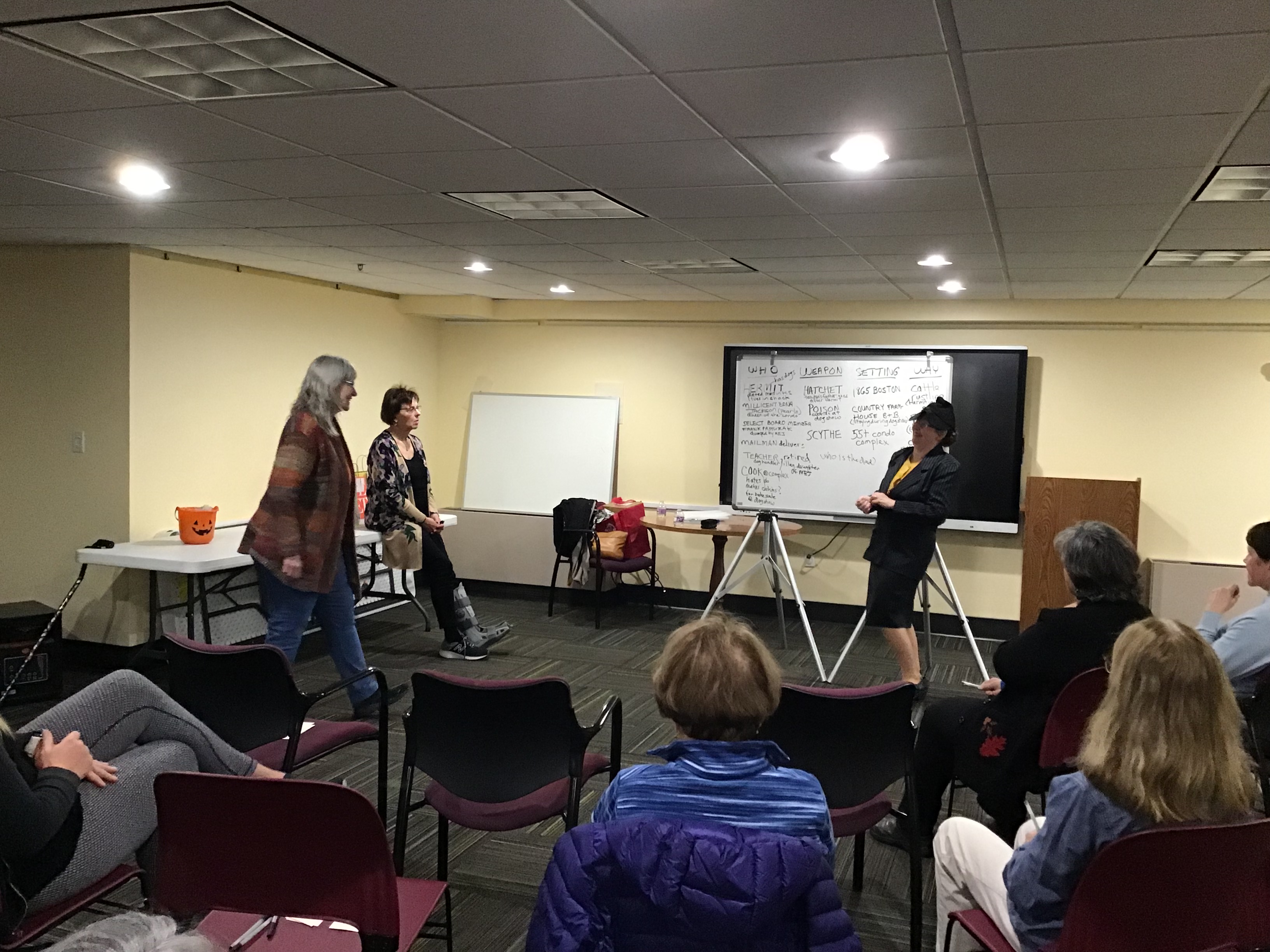
Next on the agenda was a Sisters in Crime New England Mystery Making Night at the West Boylston Library, also in Mass.  I had the privilege of working with two good buddies, Janet Raye Stevens and Carol Goodman Kaufman.  I joked to them that with me (Sharon Healy Yang) joining them, it looked as if it was a requirement to have three names to be on the panel .  We had a ball weaving the suggestions of our audience into a tale of murder on a cruise ship involving an ice pick, secret identities, and ice cream.  You had to be there.  I decided to combine the holiday ambience with my 1940s fashions to wear a black and white pin-striped suit, autumn gold blouse, and peaked chapeau that is two-parts wicked witch and two parts 1943 fashion!

I traveled south of the (Mass,) border to Connecticut to do another Sisters in Crime Mystery Making event, this time with Kate Flora.  It ended up just the two of us; however, you can see from the picture that our audience inspired us to a complex and exciting tale.

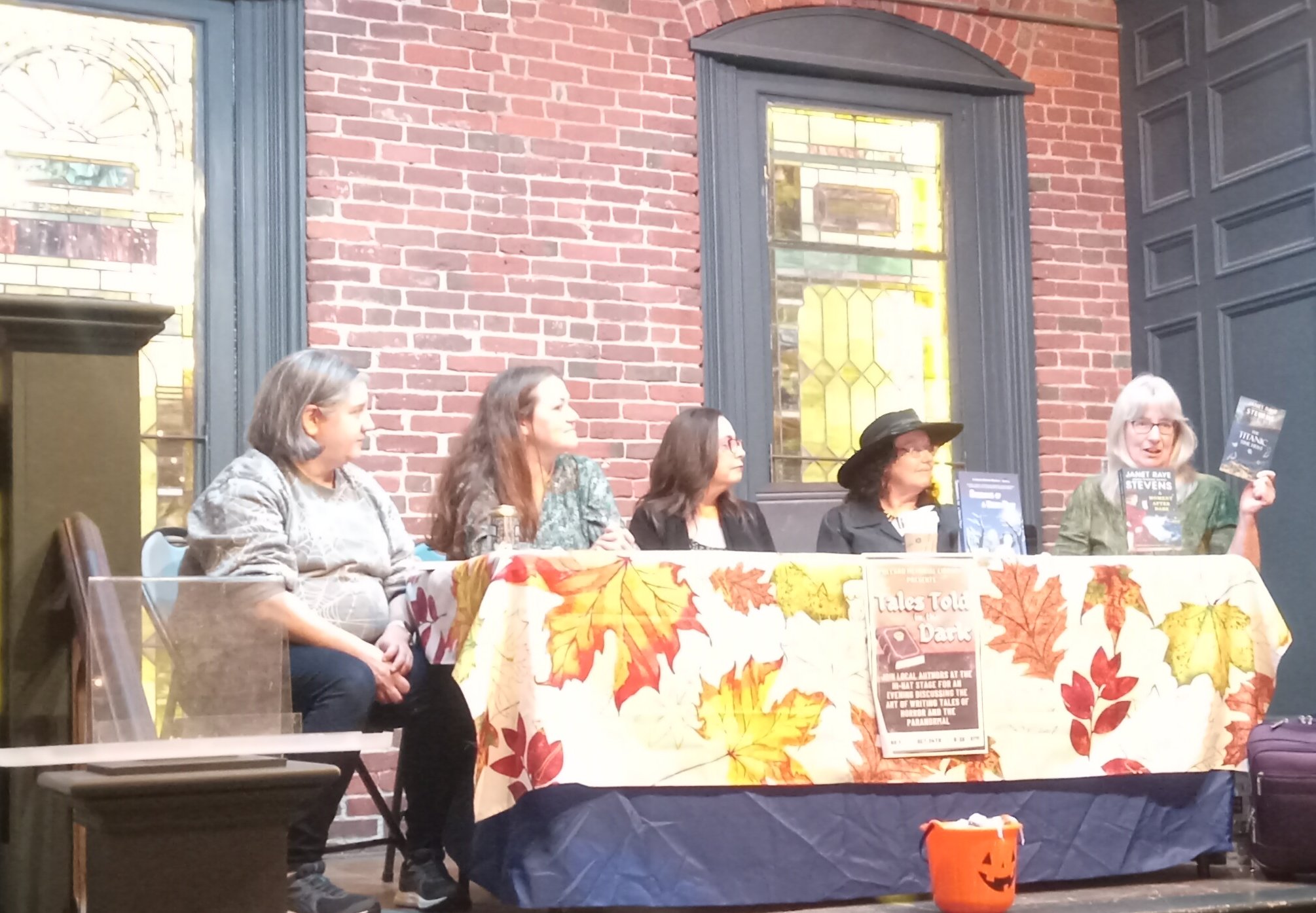
Later in the month, I joined Janet Raye Stevens and three other writers of the supernatural for “Tales Told in Darkness” in a Lowell Library sponsored event.  We had a good audience, including two of my best buddies from as far back as grammar school, Mary Lou and Kathy.  We all did a reading and I had the thrill of seeing people put down their phones and listen when I read of Jessica’s night time peregrination to a haunted room in the Carlyle manse. Did she dream or did she wake?


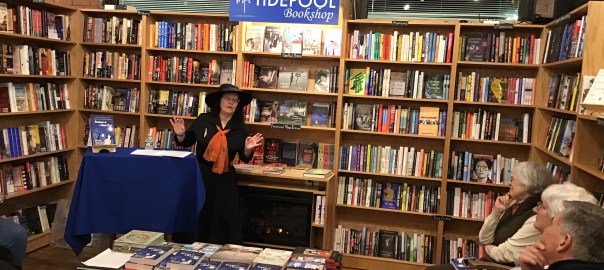
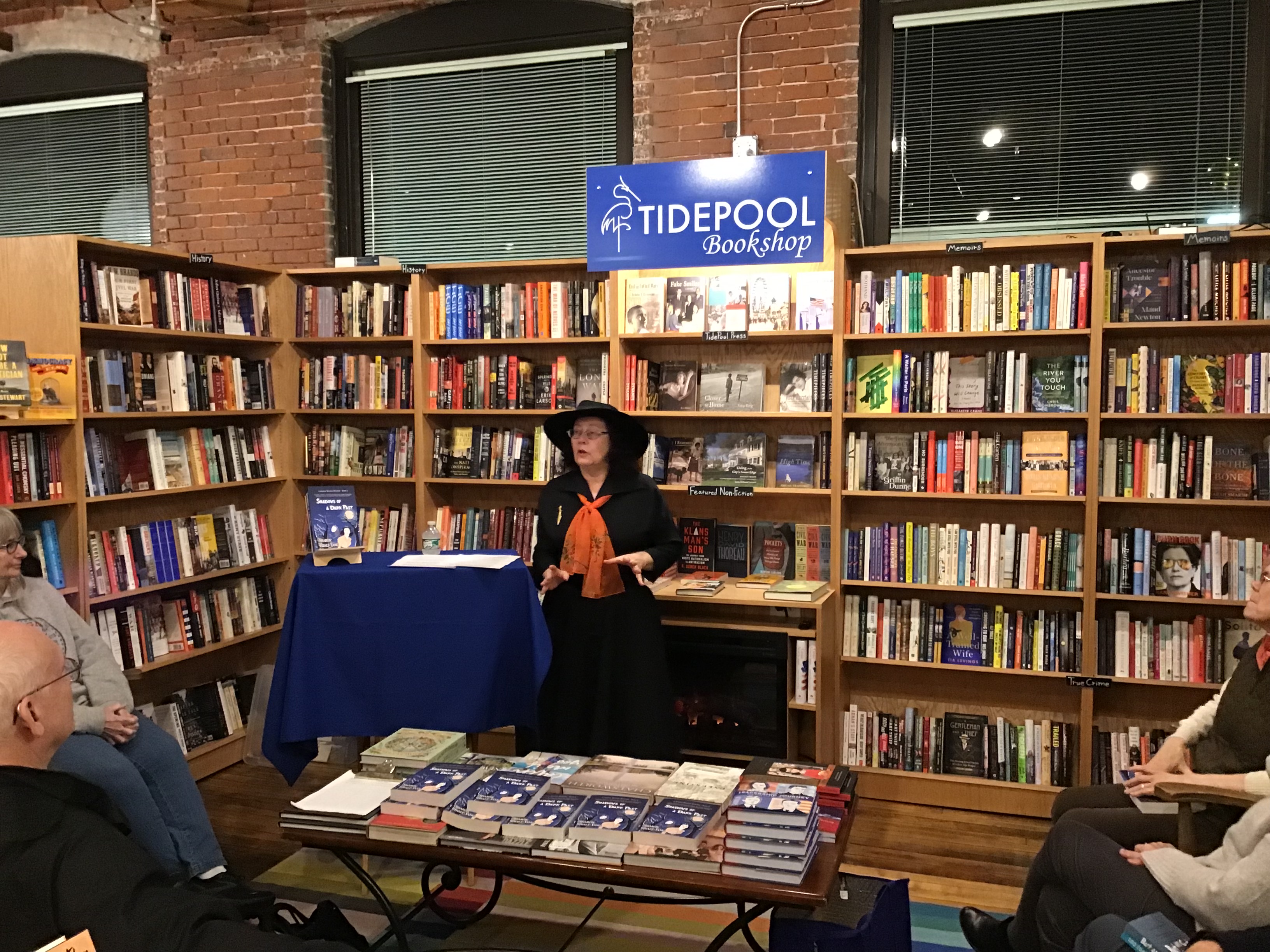
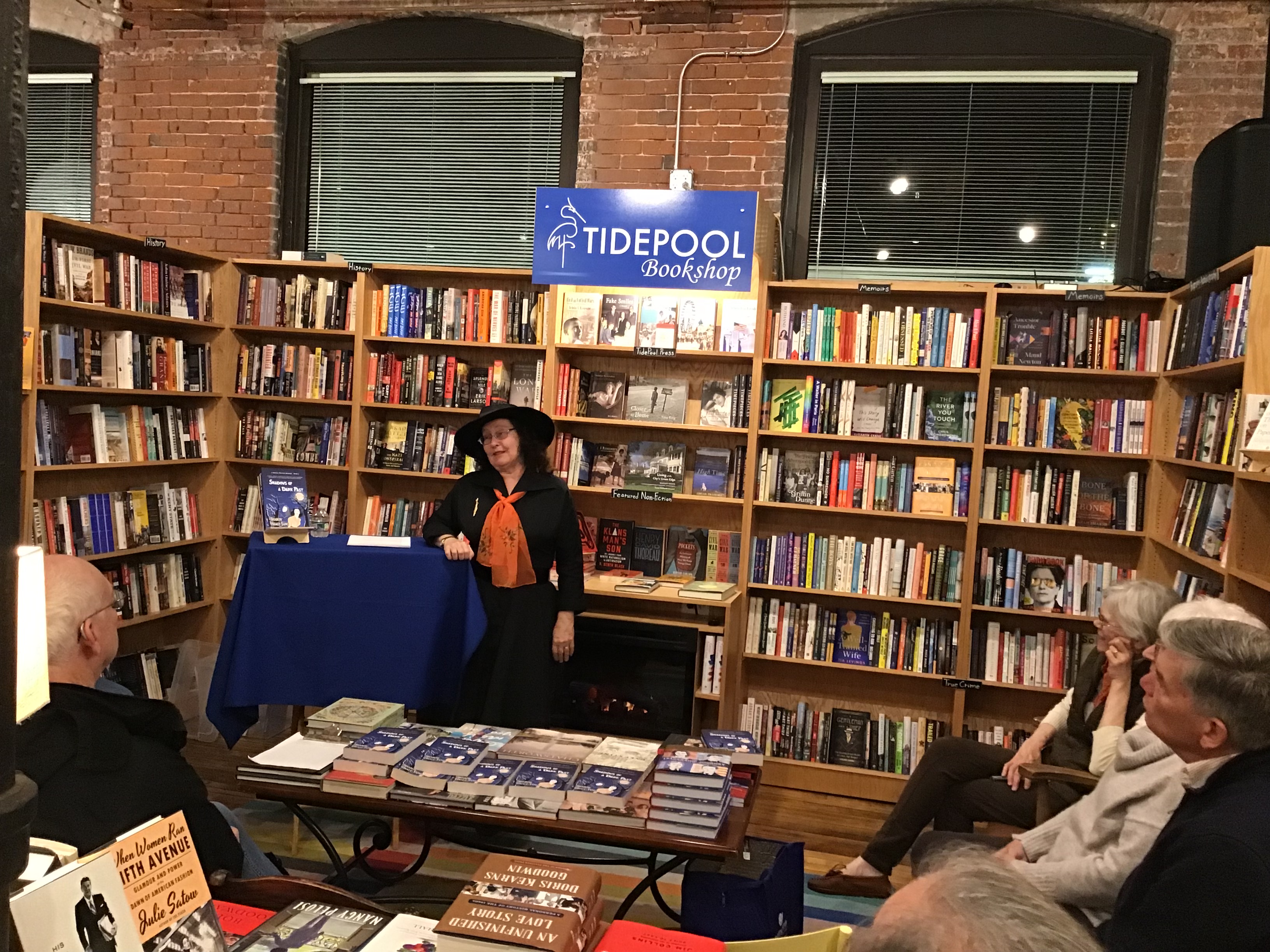
Probably my favorite event was the Book Launch and Reading I did at TidePool Books in Worcester.  It was the night I’d been waiting for!  Would you believe that people from all aspects of my life came?  My teaching years, my writing colleagues, my church, the Shakespeare Club, my old friend from years back!  I was so happy.  And I got to talk about the  films and books from the first half of the 20th century that influenced me with  imagery and atmosphere that was dreamy, eerie, haunting and their tales of obsession, vengeance, and sometimes forgiveness.  People were really interested in the three readings I did:  Jessica’s meeting in a cemetery with the husband of the alleged ghost; the reading I also did in Lowell; and a séance gone horribly wrong. My audience also had great questions about writing, about my characters and research, my writing process.  It was a dream.  One of my former students said that it was like being back in the classroom – and she meant it in a good way!  And it did feel like the good parts of teaching:  sharing ideas, getting people to think,  hearing what they thought.  You can see that I definitely dressed for the occasion.


So, this positive note is where I will wrap up.  On to November and December are a little less harried.  If you haven’t already dropped by to say hello and catch Jessica, Liz, and James’s latest adventures, you can come see me at the Narragansett Craft Festival at Narragansett Middle School, Baldwinville, MA on 11/9; the Auburn Holiday Craft Fair at Auburn High School, Auburn, MA (12/14); or Tatnuck Bookseller, Westborough, MA (12/15),  Check my web site here for deatils.  See you then!

Click here for the Shadows web page to see more details on the book and some fun bonuses!

Casting Shadows, as It Were

“Casting Shadows, as It Were”

In the past, I’ve posted on how “casting” characters as if they were played by (mostly) classic era actors in my earlier Jessica Minton mysteries helped me  flesh out their characters.  Now  that Shadows of a Dark Past is out, I thought you might enjoy reading about the inspirations for the folks Jessica, Liz, and James encounter on the mysterious Birdsong Island.  So, let’s begin!
When you’re writing a ghost story à la Val Lewton/Edgar Ulmer/ Joseph Lewis, it only makes sense that some of your characters be inspired by star players from those films.  So, with whom to start?  Why not the inspiration for the haunted scientist/widower of Shadows, Vitus Blasko?
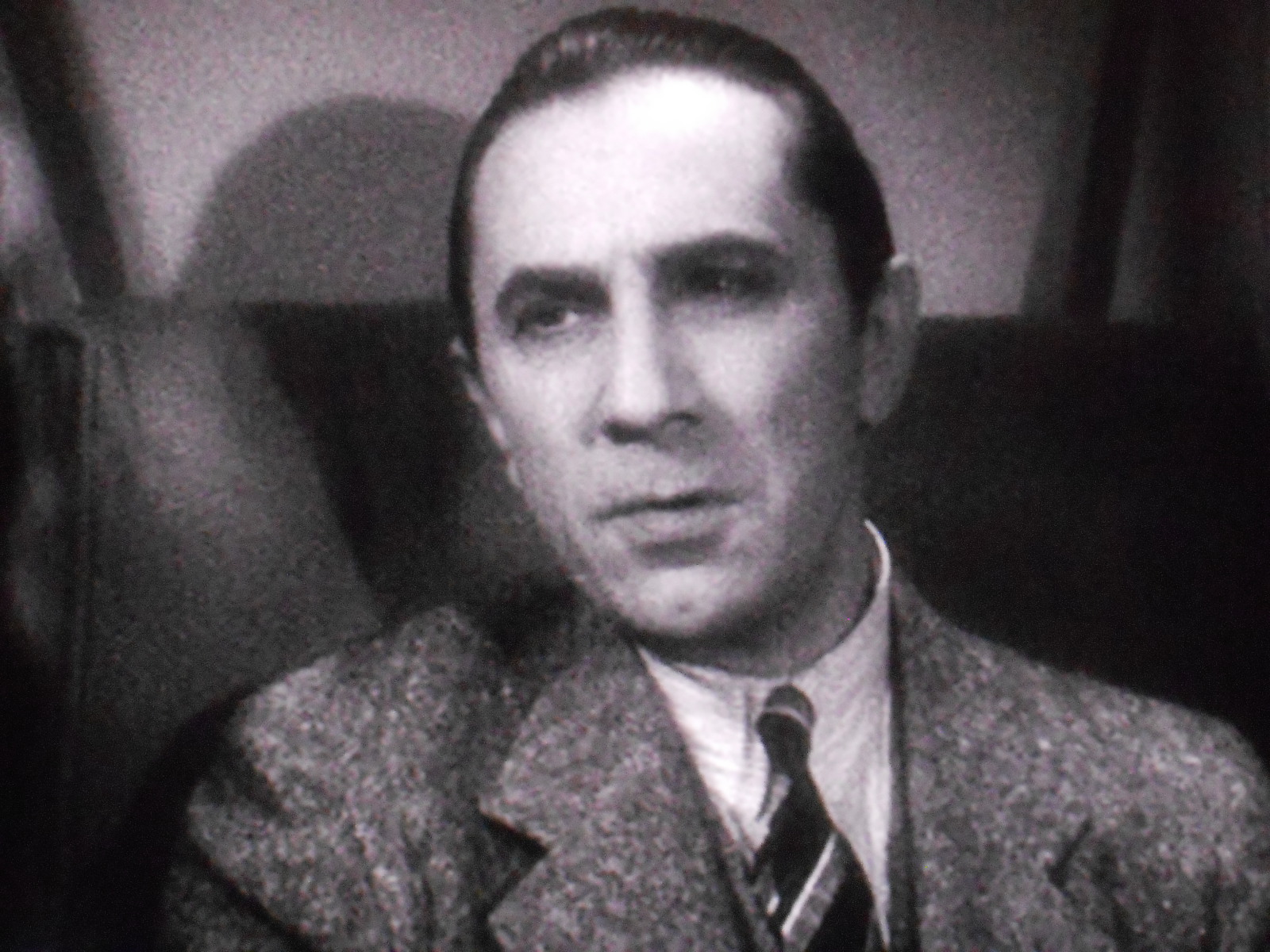
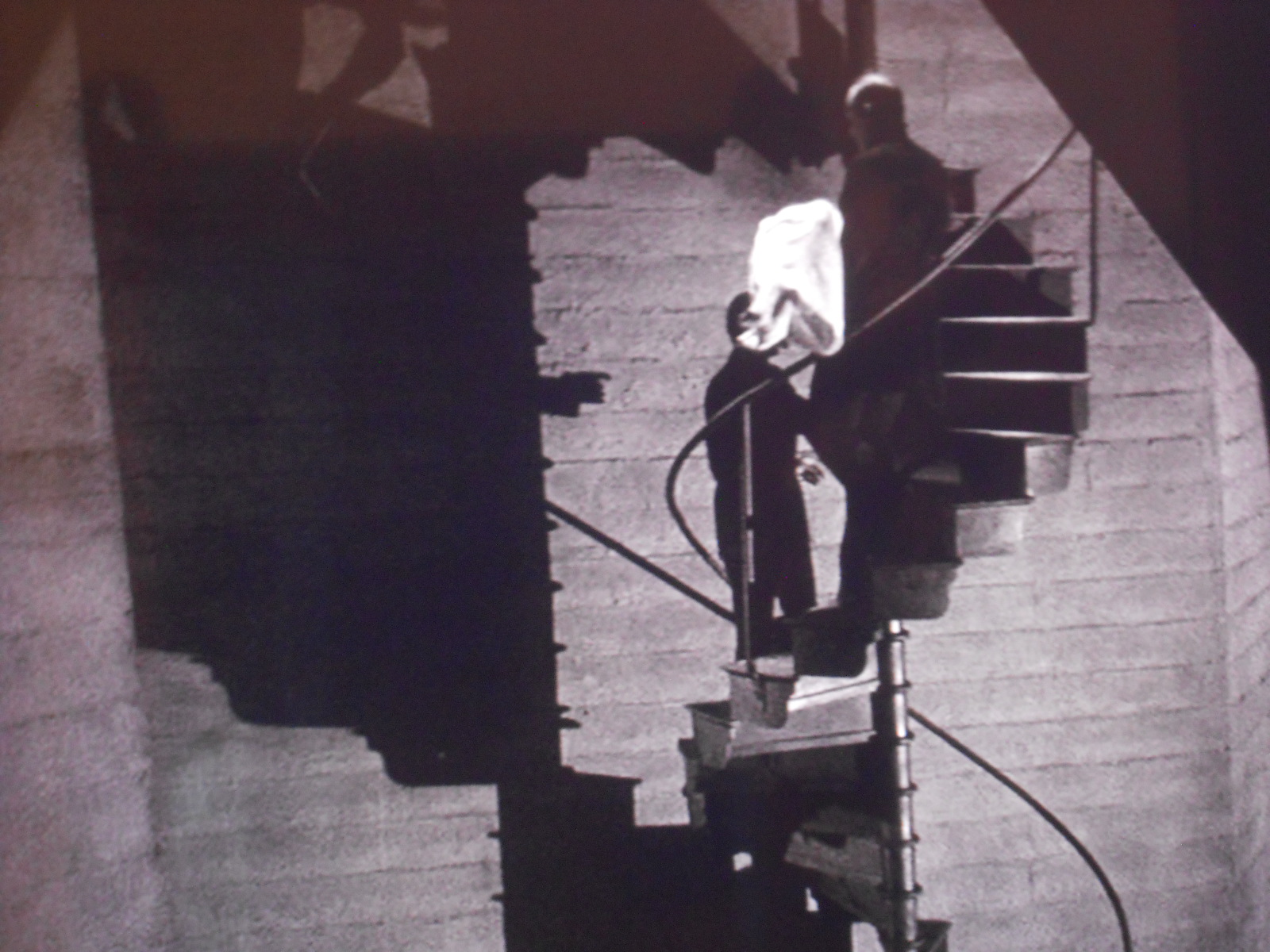
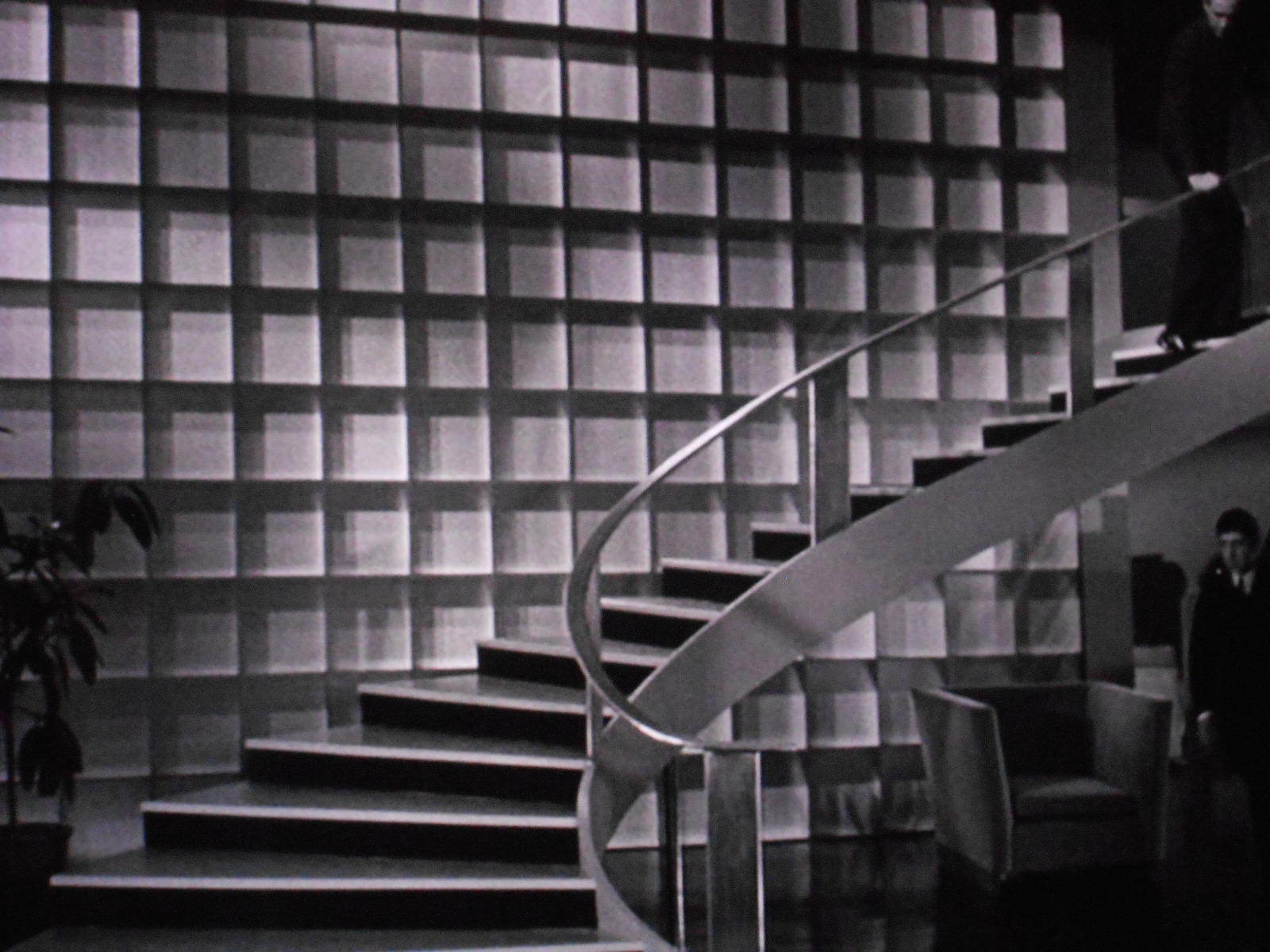
Who is a prime prospect to play a man whose obsession with his work cost him his wife and child many years ago?  My choice was one of the premiere players of 1930s/40s horror, especially at Universal:  Bela Lugosi.    “What?!” you exclaim.  “The guy who played those Machiavellian vampires in Dracula (1931) and Return of the Vampire (1945), as well a plethora of sinister scientists?” “You bet!” I reply.  Lugosi also played the tortured and highly sympathetic Dr. Vitus Werdegast in 1934’s The Black Cat.  Here, he’s a doctor who had been sent to a death camp at the end of WWI, costing him his wife and daughter, through the betrayal of Boris Karloff’s Hjalmar  Poelzig.  (Now those are names!)  His intellectual battles with Poelzig may seem sinisterly to threaten a young married couple caught in the middle at Hjalmar’s Frank-Lloyd-Wright-on-LSD designed mansion.  However, Werdegast’s grief over what he has lost and his protection of the couple reveal a sympathetic tenderness in Lugosi’s acting.  In honor of the sensitivity of Lugosi’s performance, I opted to select Vitus for the first name of my haunted scientist from Lugosi’s character in The Black Cat and the last name from Lugosi’s actual family name.

Jamie Blasko:  Jamie, Vitus and the ghostly Felicia’s daughter, has terribly suffered through her mother’s murder (or abandonment?), a broken engagement, and living in a shadow-shrouded manse looking after a father broken by the mistakes of his past.  With a cast member of The Wellstone Mystery Hour offering her the life saver of romance, Jamie has a chance for happiness.  Dare she take it?  The radio program will broadcast shows focusing on that most terrible time: the mystery of her mother’s disappearance.  Can Jamie bear a revival of that scandal and pain?  Will the program provide the answers she needs?  Will she and her father be able to bear those answers?
Soulful-eyed Gail Russell is the natural inspiration of my creation, Jamie Blasko.  In such roles as the haunted daughter determined to embrace the ghostly touch of her mother in The Uninvited or the young woman struggling against the psychic prediction of her death at a fast approaching appointed hour in The Night Has a Thousand Eyes, Russell’s gentle demeanor threaded with flashes of piercing anguish embodies the spirit of the Blasko girl.


Gerry Davis:  A WWII vet who lost a leg at Anzio, Gerry is a true radio trouper on The Wellstone Mystery Hour, not only playing most of their romantic leads but a host of other parts as the need arises.  Handsome with wavy blondish brown hair and a twinkle in his eye, Gerry’s kind heart and impish wit may be just the ticket to save Jaime Blasko from the darkness shadowing her life.  However, Gerry must overcome the antipathy between Vitus Blasko and the Carlyle family sponsoring these broadcasts of a past tearing apart both families.  For Gerry, I’ve turned to a more modern player for inspiration: Geraint Wyn Davies.  The humor, passion, and intelligence Davies has brought to roles ranging from Shakespeare to the conscience-stricken vampire detective of Forever Knight makes him an ideal choice to inspire Gerry’s good nature and passion  to protect Jamie Blasko.
If you haven’t already, check out my blogs on casting characters in the first three novels of the Jessica Minton Mysteries
Bait and Switch
Letter from a Dead Man
Always Play the Dark Horse

Image Credits
Bela Lugosi images screen shots from The Black Cat (1934), © Universal Pictures.
First Gail Russell Image:  Screen Shot from The Uninvited (1944) © Paramount Pictures.
Second Gail Russell Image Public Domain from Wikkipedia: https://commons.wikimedia.org/wiki/File:Gail_Russell_postcard_photo_circa_1950s.jpg
Geraint Wynn Davies image a portion of Lady Vamp’s Forever Knight Site, http://www.foreverknight.org/LadyVampKnight1228/home.html

If any violation of copyright has been inadvertently committed by my posting or re-posting these images, let me know and I will remove them.
Back to Shadows of a Dark Past
Back to Home Page
 

Live! And on the Air!: Shadows of a Dark Past!

In my first novel, Bait and Switch, heroine Jessica Minton starts out as a moderately successful stage actress.  So why did I switch her from the stage to the radio as I continued the series with  Letter from a Dead Man?  Well, there are two reasons.  First of all, radio work gave Jessica more free time to join her sister Liz in unraveling mysteries.  However, the second reason is far more interesting.  I’ve always been fascinated by the imaginative entertainment radio provided Americans for almost five decades. The more I delved into how shows were written and produced; what made some actors excel and others bomb when playing to an audience over the airwaves; the way audiences were engaged, even enthralled, by the “theatre of the mind,” the more possibilities I could see this environment inspiring in a mystery.

My first awareness of radio entertainment of the classic 1920s-50s came from old movies of the ’30s through ’50s that I watched on TV as a child – a very young child.  I loved the excitement of actors and musicians, quiz contestants, and newscasters performing before live audiences.  I was so influenced by what I saw that I was close to six or seven before realizing that the music I heard on the radio was not being performed live at the local radio studio. Until that epiphany, I had been dearly puzzled by how the Beatles and Supremes could get from Lowell to Lawrence, MA in a matter if minutes! 

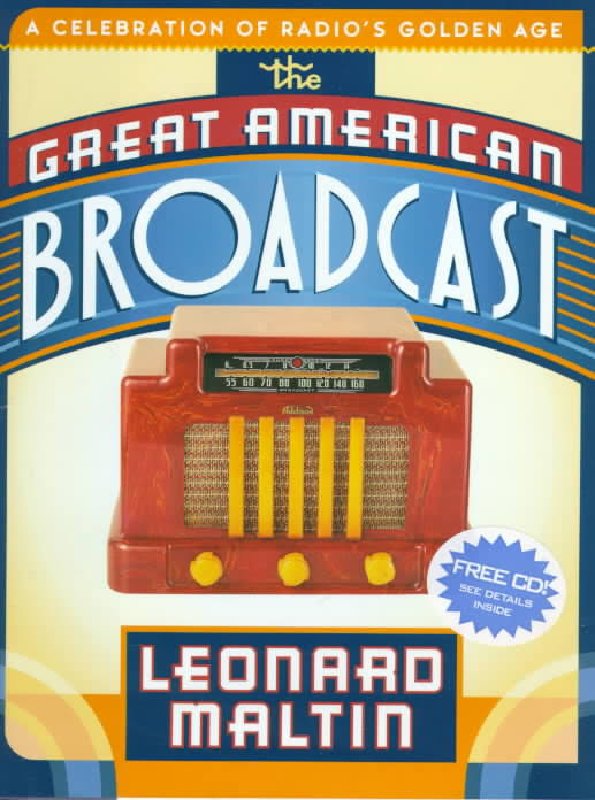
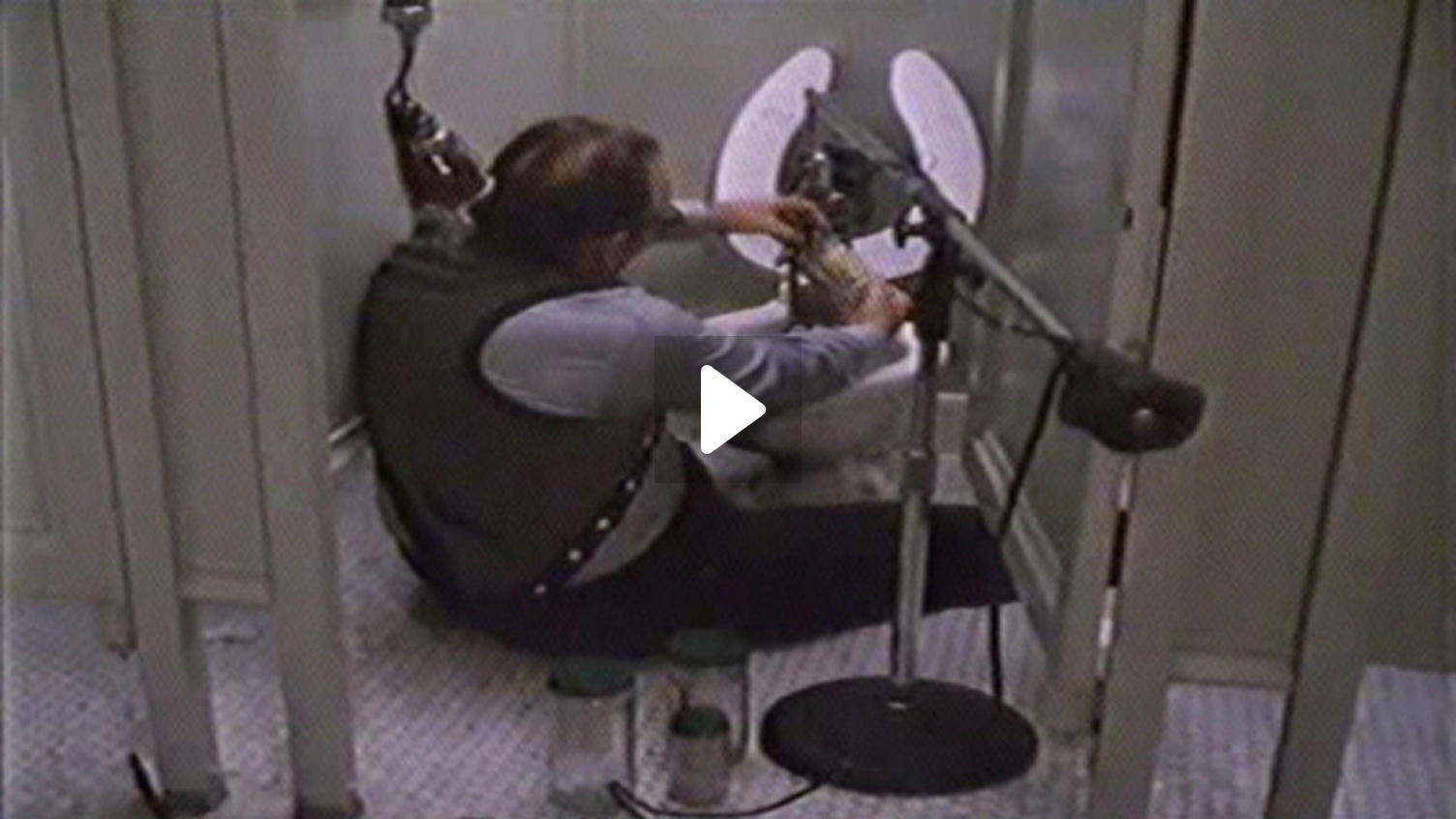
As I got older, read more, and watched movie and TV portrayals of radio with a deeper understanding, I learned more about the intricacies of production – including writing, directing, acting, and sound effects creation, which made me even more fascinated.  Books such as The Great American Radio Broadcast, Terror on the Air, Suspense, Inner Sanctum Mysteries, and The I Love a Mystery Companion  revealed to me the behind the scene creation of programs such as Inner Sanctum, Lux Radio Theatre, Suspense, and I Love a Mystery, to name a few – from initial inspiration and pitching of a show to sponsors, to the intense schedule for writing and rehearsing, to actors’ perspective on radio performing, to audience reactions.  I was especially intrigued by how special sound effects, combined with an audience’s willing imagination, were such a powerful force in creating reality:  coconut shells became pounding hooves, a stabbed melon was transformed into a fatally impaled human, a flushing toilet could be modified to become space invaders’ horrific weapons, or a heart beat might be created with a rubber sponge, a turn table, and a stylus (Maltin 108)!  Of course, there were also the ultra realists like Jack Webb whom Leonard Maltin reveals created the sounds of passing cars on Los Feliz Blvd. at 2:30 a.m. by having a sound man go out and record passing cars at 2:30 a.m. on Los Feliz Blvd. (Great American Radio Broadcast 100).

One source that especially galvanized my interest was Rupert Holmes’s Remember WENN (the real first original AMC series).  This delightful program traced the adventures of a Mid-West small-town girl who makes it to the big city (sort of), Pittsburgh, and starts as writer but soon finds the hectic demands of the station moving her swiftly into the roles of director; producer; business manager; and, occasionally, actress.  With humor that is sometimes whimsical, but always clever, Remember Wenn joyfully captures the seat-of-your-pants spirit at a radio station that characterized how this medium entertained and delighted audiences.

Whether in Remember Wenn or in the books I read, I especially loved learning how actors had the pleasure of playing an enormous catalogue of roles because we created their characters in our minds on the inspiration of their voices.  That’s how a short, chubby chap could become a strapping western marshal or a middle-aged man could mentally materialize as a kindly old grandmother in the theatre of our minds!  Or we got to “see” our favorite actors playing roles they never had a chance to have a crack at on the screen.  For example, as a Joan Bennett fan, I was delighted to catch her deftly cracking wise in Rosalind Russell’s part in Hired Wife or seductively manipulating Burt Lancaster in Barbara Stanwyck’s role in Double Indemnity

And short stories or novels were brought alive for us as well – especially Orson Welles’s infamous trick more that treat, War of the Worlds.  Both situations inspired me to think about what fun it would be to take some of my favorite horror or mystery stories or even movies and imagine them as venues for Jessica to strut her thespian stuff.  So, in Dead Man, Jess gets to talk about doing “A Rose for Emily” and “The Dunwich Horror”; in Dark Horse, we have reference to her playing in “The Horla.”


In Jessica’s most recent adventure, Shadows of a Dark Past, I’ve centered the story around her work on a remote broadcast in a haunted New Hampshire mansion (somewhat inspired by Charlie Chan in the Wax Museum). Attempting to drum up ratings, her director/producer Scott plans to reopen the tragedy of a woman’s tragic disappearance, and likely murder, in this mansion twenty years before.  The owner of the mansion, the husband of the woman reputed to be the ghost, her daughter, and others in the town who remember the event have dangerously mixed emotions about the broadcast.  And Jessica finds that she has a disturbing connection to the woman in question.  Then there’s the Hound of Hell. The topper is when things go horribly wrong in a séance recorded for later transmission.

In a book still in the outline stage, the plot revolves around Jessica’s work in the studio with some members of the writing team who are dangerously not what they seem. It’s Dusty who sets the plot in motion! So, don’t change that station!  I plan to bring you more exciting installments of the adventures of Jessica, Liz, James, and Dusty in and out of the studio!


If you’re looking for some films to give you a flavor of radio at its most exciting and mystery-inspiring, check out Charlie Chan in the Wax Museum (1940),  Abbott and Costello’s Who Done It? (1942), Danger on the Air (1938), The Hucksters (1949), That’s Right, You’re Wrong (1939), The Big Broadcast of 1938, Playmates (1941) The Frozen Ghost (1945), Radioland Murders (1994 – George Lucas directing, no less), and The Scarlet Clue (1945).  For a sardonic look at the effects of Orson Welles’s broadcast of War of the Worlds, have a chuckle at Hullabaloo (1940); and for a (mostly) more serious look, watch The Night That Panicked America (1975).

Image of Orson Welles directing:  Broadcasting play:  https://musingsofamiddleagedgeek.blog/2022/10/07/the-night-that-panicked-america-1975-is-a-little-seen-tv-movie-about-the-greatest-halloween-prank-ever-played/

Screen shot of  soundman and toilet from The dvd The Night That Panicked America,CBS Studios, (c) 2014

Image of Melinda Mullins from AMC Movie Magazine.

Image of Joan Bennett, Dusty, and Jessica Minton, author’s collection

Back to Home Page

Take That One Step Beyond

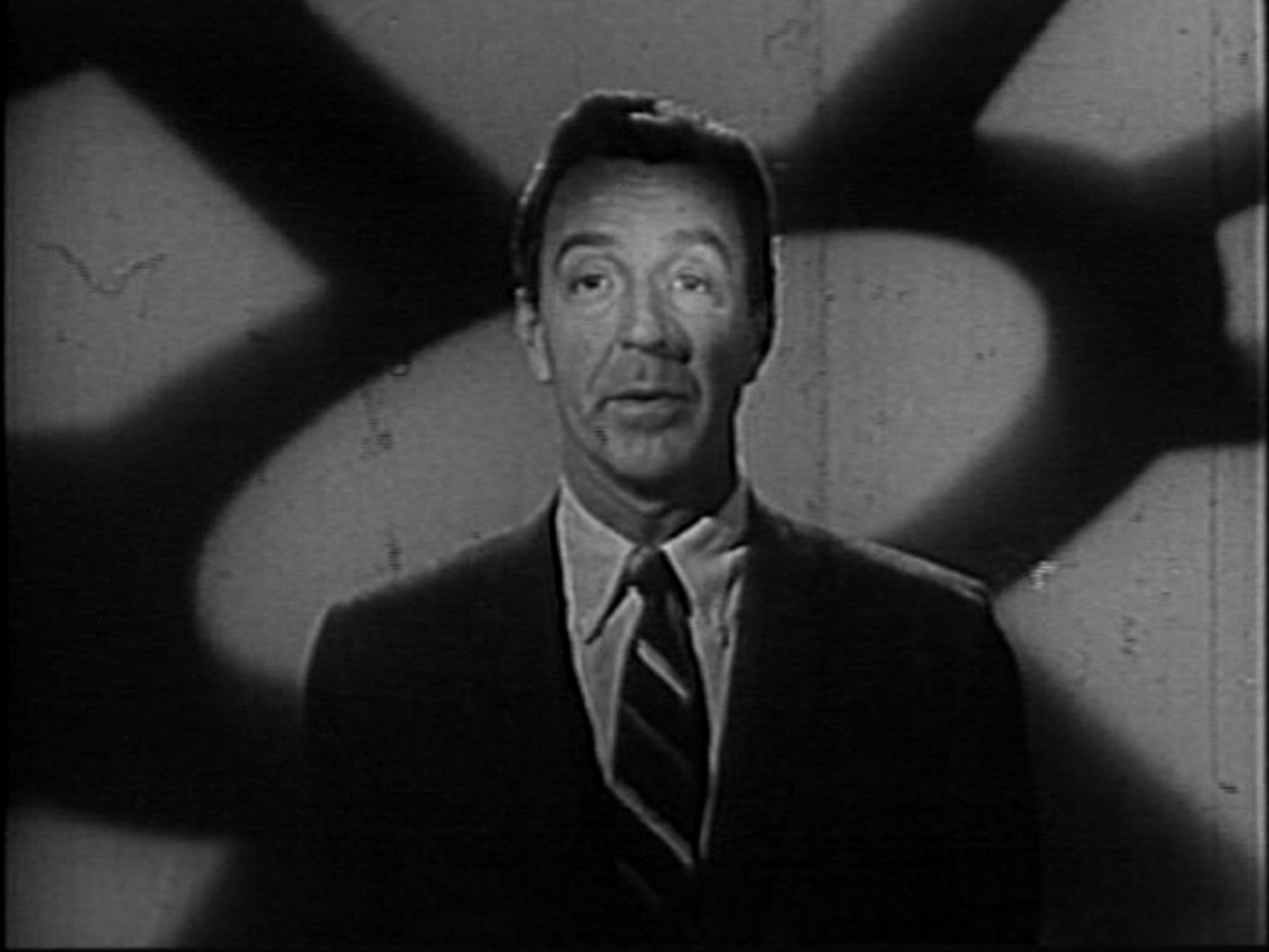
Recently, I caught actor/director John Newland in a 1948 Bulldog Drummond movie, Thirteen Lead Soldiers.  That appearance piqued a craving to see more of Newland in a TV program that those of us growing up in the late 1950s and early 1960s knew, One Step Beyond.  So, for the past couple of weeks, I’ve been re-watching the program on my Alpha Video editions.  A perfect treat to prime me for the Halloween holidays.

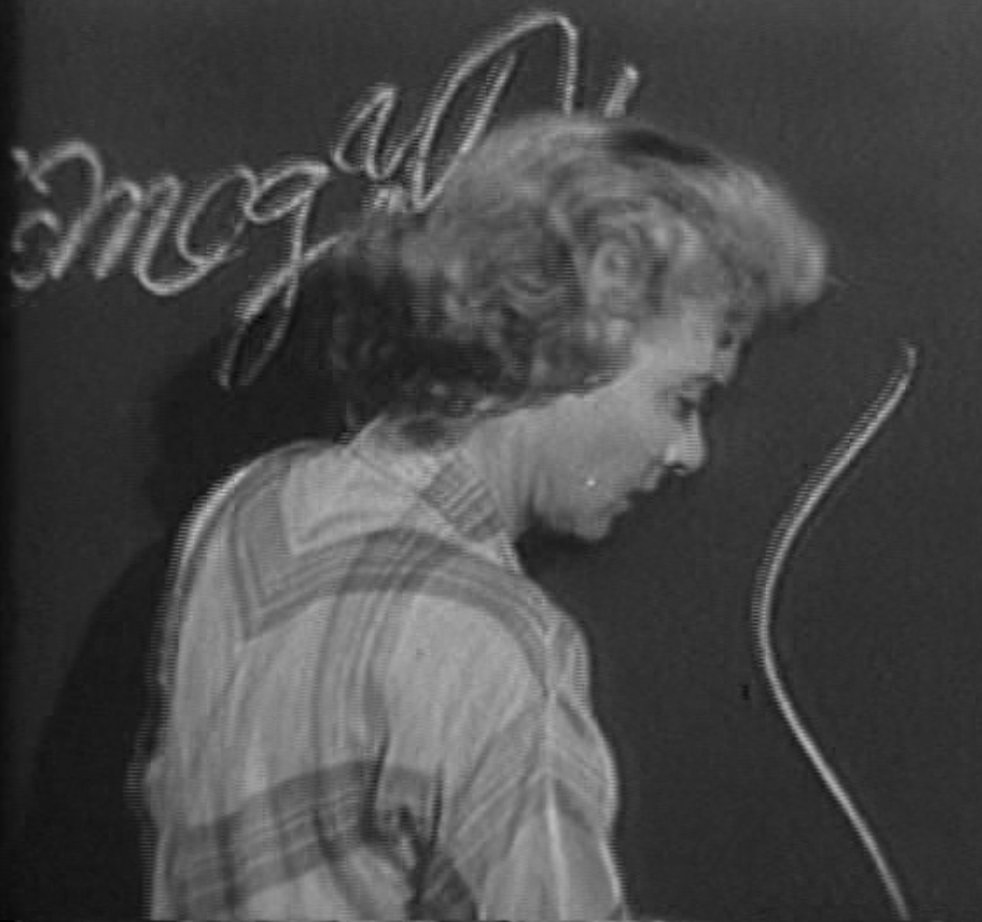
What is One Step Beyond?  Well, the half-hour (23-5 minutes sans commercial) was one of the early horror anthologies of the time period I mentioned above – right in there with The Twilight Zone, Thriller, and (just a little behind these) The Outer Limits (original version).  All filmed in glorious black and white.  Part of what made One Step Beyond stand out from the others was that its stories were all allegedly true, taken from “the records of human history.” So, the crippled woman calling out for help at the immanent impact of a tidal wave is rescued by and rescues the only one who hears her, a deaf man whose disability leaves him unaware of the blaring warning sirens.  A turn-of-the-century young wife is haunted by premonitions of deadly blazes set by a twin to whom she seems to be psychically attuned. A pilot radios back that he’s seeing something astonishing of the UFO variety, disappears for several days, then miraculously reappears hundreds of miles beyond the range of his prop plane before dying.  A bellhop repeatedly has visions of the rooms and buildings around him crumbling in an earthquake – in San Francisco, 1905.  No one believes him, and then it’s too late.  A German submarine sets out to sea as the Third Reich crumbles, with hammering and thumping in between hulls haunting it – only for a skeleton to be found between hulls holding a wrench twenty years later.  A night-school teacher receives a cameo as a gift from an awkward student, then finds whenever she writes on blackboard or paper that her hand is possessed to write in a foreign language she doesn’t know but is native to her gift-giver – all of which puts her at risk from him at what the writing reveals.

John Newland, himself, adds a unique touch.  Neither skeptical like Serling nor sinister like Karloff (Thriller), he talks to us calmly, almost warmly, all the while undercutting our “logical” explanations, raising questions with his knowledge of experts on “bilocation,” “psychometry,” “telepathy,” “precognition,” etc.  Then he ends with a warm smile, reassuring us – or maybe slyly enjoying having destabilized our certainties.


One Step Beyond may be less disturbing than its fellow horror shows for another reason.  Usually, the supernatural events occur to set right murder or injustice, give voice to the oppressed, reunite estranged spouses or families, rescue those in danger, or give comfort the suffering.  UXB guy William Shatner manages to see his wife one last time under unusual circumstances when she is pregnant. A wife leads her husband to their son trapped in a mine, only the rescuers also find her dead body trapped in that same mine. A psychic bond leads a wife to find her husband trapped under a car in rising waters, while the spirits of three neglected children reunite a child with her estranged father.  More unnerving but still equitable, ghosts mete out justice to their murderers who have left them on a mountain to die, sent them off to die on a patrol ambushed by Indians, poisoned them to marry a mistress, or disguised their killing as suicide.  Still, there are enough threatening, even unjust, experiences recounted to make us wonder just how reassuring John Newland’s smile is.  All her premonitions about being caught on a sinking boat doesn’t save a young bride’s husband from death on the Titanic.  The poor bellhop with premonitions of the San Francisco quake dies, even if his warnings do save that adorable old Italian couple.  How about the woman whose twin sister appeared to be setting fatal conflagrations – did she really merit for her fate? Did photographer Cloris Leachman ask to be chased around her apartment by the maniacal ghost of the guy who murdered his wife many years ago? No wonder she moved to Minneapolis and changed her name to Phyllis Lindstrom!

The program also has an intriguing roster of guest stars.  There are up-and-comers:  William Shatner, Louise Fletcher (!),Warren Beatty (!!!), Charles Bronson, Elizabeth Montgomery, Suzanne Pleshette, Patrick McNee, Robert Blake, Mike Conners, Werner Klemperer, Cloris Leachman, and Robert Lansing – to name a few.  Then there are some folks who were once big or relatively big names: Joan Fontaine, Anna Lee, Patty McCormick, Carl Esmond, Ron Randall, and Catherine McCleod.  Bob Newhart’s father-in-law, Bill Quinn, makes a few appearances, too – as well as lots of sixties stalwarts like William Schallert, Joanne Linville, Ed Platt, Johnny Seven, Warren Stevens, Scott Marlowe, and Jan Miner. Those of you who know your TV supporting players and later stars will have a blast identifying them.

Other folks I know who have seen One Step Beyond pretty much all agree on one point.  The really scary thing about the program wasn’t the stories, the acting, the visuals, even John Newland.  It was the damned music!  That darned theme, appropriately named “Weird” by composer Arthur Lubin, sent chills coursing through out bodies!  Then there was “Fear”:  once its bars snaked into hearing, you knew something creepy was afoot – but more powerful was that their sinuous, haunting snake up your spine.  I’ll tell you, when I was a little kid and my bedtime was 7:00, there were only two shows that I could see worth watching (long before cable!):  first One Step Beyond, then The Twilight Zone.  No wonder I slept with a night light until I was thirty-seven.

So, here, to set your October off in the right mood are  links to “Fear” and “Weird”.  Listen – if you dare!  But be sure to put on a sweater first – chills up the spine, you know!


Some Episodes that I highly recommend”

“The Promise”

“The Dark Room”

“Reunion”

“The Dead Part of the House”

“Ordeal on Locust Street”

“Deadringer”

“The Explorer”

“The Death Waltz”

“To Know the End”

John Newland Image:  https://upload.wikimedia.org/wikipedia/commons/a/a8/John_Newland_-_1959_%28One_Step_Beyond%29.jpg

Images from episodes are screen shots of public domain episodes and cover of Alpha Videos art work; author’s collection

The Summer of ’24

Well, you might not know it from this week’s temperature, but summer should be moving into autumn now that it’s September.  So, perhaps my late developing pumpkins and veggies may come to full bloom after all.  Earlier in the season, we did dine deliciously a couple of times on our own eggplants.  And there are more growing! We also have had a few meals flavored by our home grown peppers.  Here’s a shot of one harvest.  Don’t you just love the deliciously spicy and fresh smell when you slice open a  garden pepper?

We haven’t had such good luck with our tomatoes and pumpkins this year – although  we did get a few fresh tomatoes for Yang to add to his omelettes and stir fries.  The beans are just now coming into form.  We had one serving earlier, and we’re planing on harvesting some of these beauties soon.


I’m also hoping that though these pumpkin and gourd embryos are late comers, they may still grow and ripen with the hot autumn we’ve been having.


We didn’t have the best of luck with our sunflowers, as some form of insect (we think beetles) brutalized the plants grown from seeds planted directly into the garden.  However, after a daily spraying of tabasco sauce in water to drive off the insects, most of the sunflowers recovered.  Some even grew  up to full height and even better than the ones we’d protected by growing them as seedlings in cups before planting.


The Morning Glories had been growing full throttle, vines creeping up the trellis, until chipmunks tunneled out of the wood retaining wall on which the flower’s boxes were located and munched them silly.  It’s a jungle out there! Again, tabasco spritzing did its job and some managed to recover and grow.  I especially like the orchid colored ones.

Did you notice the  two-toned orchid and purple one?  Those hybrids pop up every year.  If you look at the seeds, they are even half black (purple flower) and half cream-colored (orchid flower).  I save the seeds every year and replant, so I sometimes even get pink instead of orchid.  I guess that’s the orchid and magenta hybrid.


We’ve had interesting fauna as well as flora this year.  First, let me introduce you to Bunzie.  A very young and small rabbit showed up at the beginning of the summer.  He has since grown!  Best of all, he seems to  eat only clover and grass – well he did devour much of a dying petunia.  However, that petunia regrouped and has a lovely deep pink flower now.  So, I guess he was just dead heading for me.  He’s actually not too afraid of Yang and me, but we don’t bother him, either.  One night, he triggered the motion-detector light outside the sun porch and we got to watch him dash hither and yon while two skunks patiently waddled about that stretch of yard looking for grubs.

I only saw one Monarch Butterfly this year, yesterday.  Unfortunately, I didn’t have a camera with me – and I scared Bunzie when I rushed over to the butterfly bush to see it.  We have had at least two regular visitors to the butterfly bushes, these Tiger Swallowtails.  I love how you can see the same yellow and black patterns on the insect’s body that you can see on his wings.  I was so surprised that these guys let me get close enough to watch and take these pictures.  They also love to dine on the nectar of flox and Rose of Sharon flowers.

Another critter who loves butterfly bushes, flox, and Rose of Sharon would be the Hummingbird – or birds.  We had at least two, though usually only one showed up at a time.  When there were two, feathers flew, so to speak.  Yang got some great shots.  It’s fun to watch him , the bird not Yang, come in for a landing, wings a-whirl!  I’m sure that you can understand why the pictures are a little blurry!  Once he/she landed, the little guy enjoyed our nectar – as well as taking sips from all the flowers.

Sometimes, he just liked to sit majestically atop the feeder and survey his domain.  Other times he enjoyed parking his tuffett on the structure on which the Morning Glories grew – he thought they were tasty, too.  If you’re wondering what that contraption is atop the feeder, it’s a moat that Yang created to keep ants from climbing down into the feeder.  Yang saw some designs for sale on line, figured he could make one for much cheaper – and did it!

Sometimes the Hummer just stared at our window with a “Who you lookin’ at?” attitude.

Of course, we also had some of the other usual suspects this summer.  The Goldfinches pretty much dominated the two globe feeders, though the Redbellied Woodpecker wasn’t above shooting his long tongue through the bars to steal some sunflower hearts.

The Rosebreasted Grosbeaks were back as well.  I saw as many as three males at once one time!  I also saw the females and some juvenile males as well.  Unfortunately, though we kept putting out oranges, we only saw an Oriole here twice.  My neighbor said he saw the Oriole quite a bit, though on the feeder.


One visitor to the feeders who was rather unique for the summer was this chap.

Now how often do you see a Slate Colored Junco in new England in the middle of July?  He stayed around well into August, then I haven’t seen him since.  Someone got his GPS all fowled (ahem) up!  Now, will he be back this autumn?  Stay tuned!