Every season, Yang and I try take a hike at what we call “The Secret Place.” It’s really not so very secret, since we usually run into a few hikers or kayakers there. Still, it feels secret to us. Anyway, we made our fall visit a couple of weeks back, hoping to see some beautiful foliage and do a little birding. We’ve seen quite a few warblers, aquatic fowl, and even eagles over the years here. You can see Yang is well prepared with his fancy-schmanzy camera.
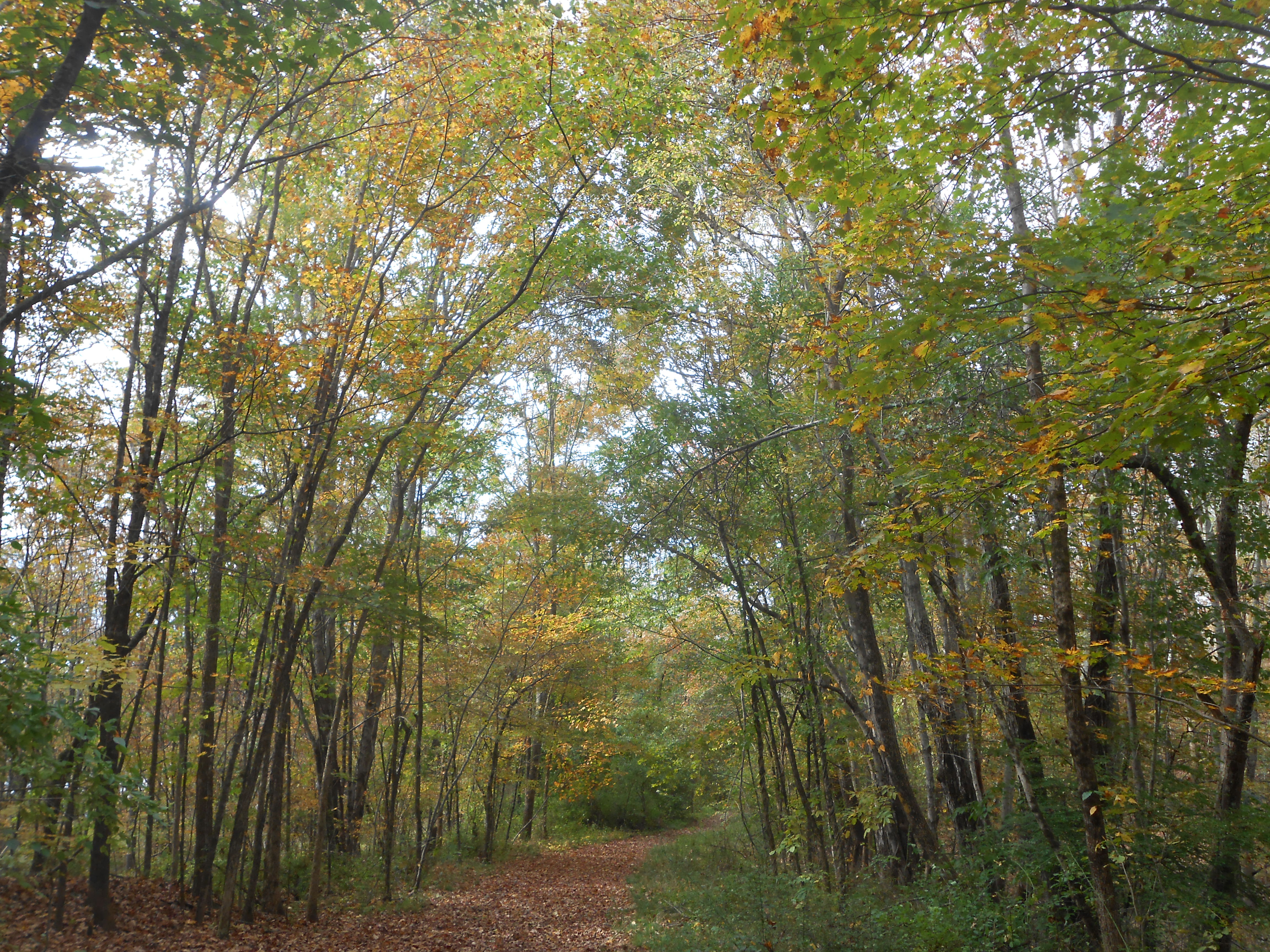
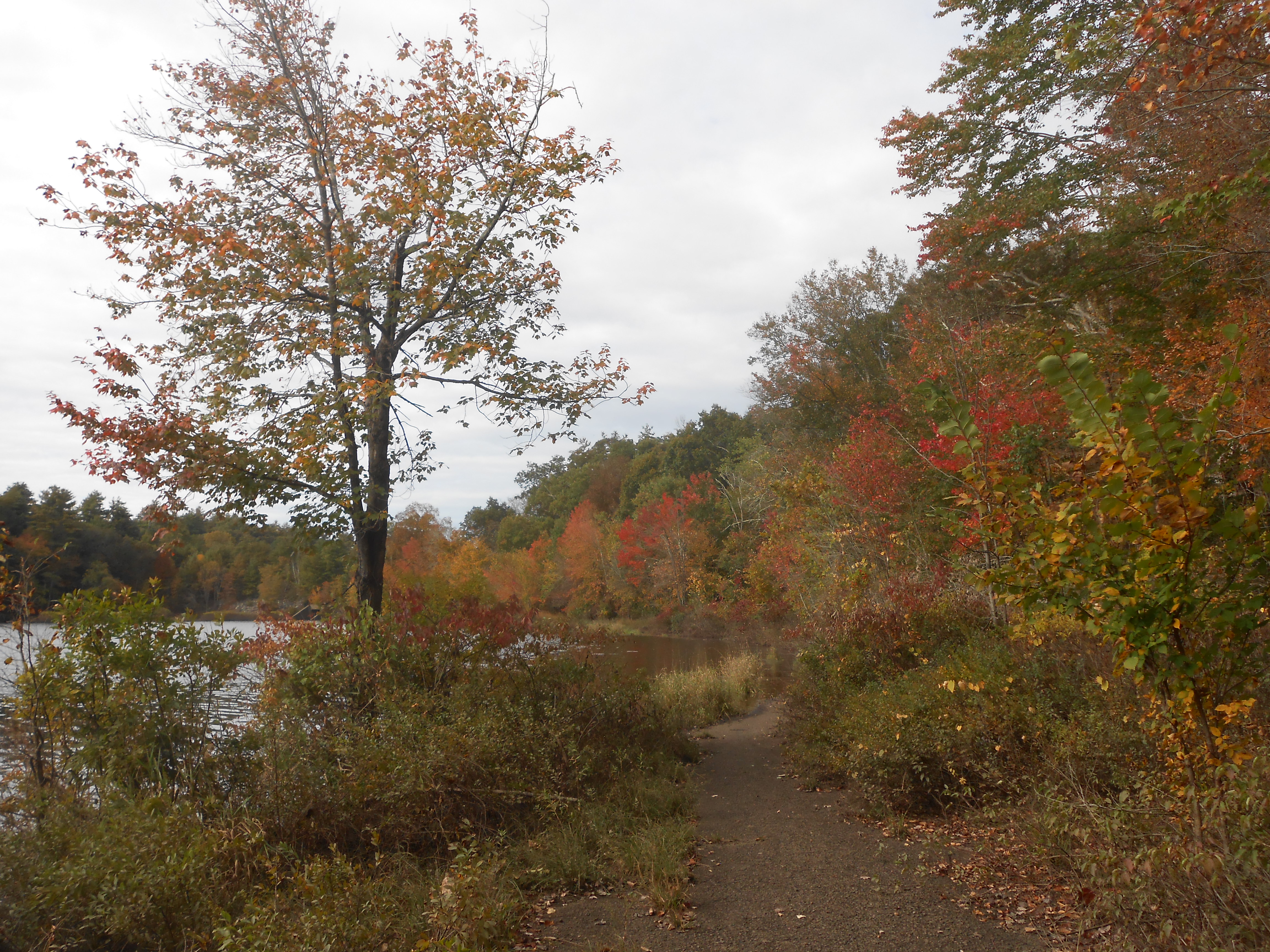
After our breakfast of bagels and good pumpkin spice coffee (invented by George Crabtree in the early 20th century), we drove over to our destination. The colors looked promising, as you can see from the tunnel of trees extending before us.
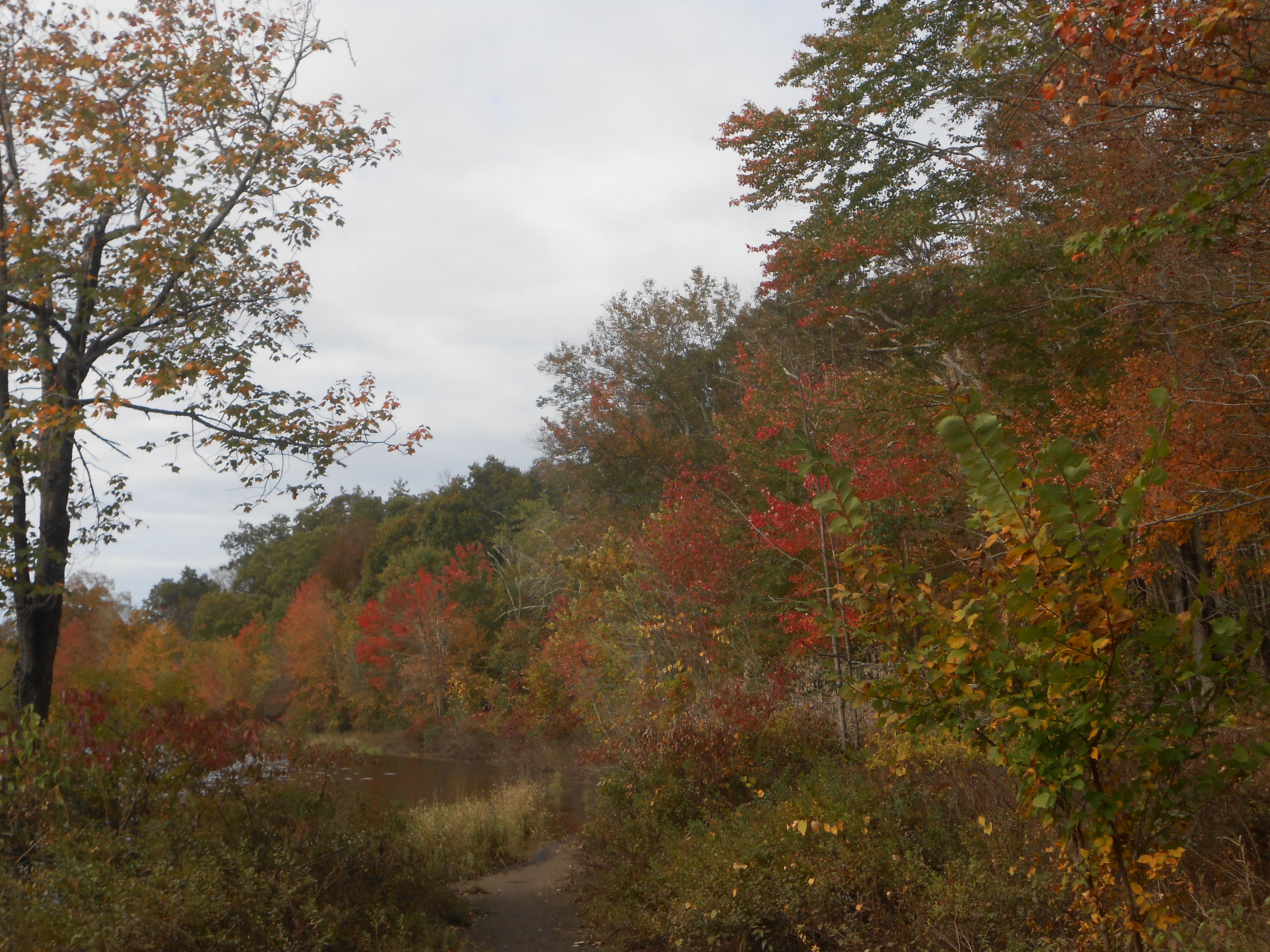
Though the Secret Place may not have been at it’s peak, we found all kinds of beautiful colors.
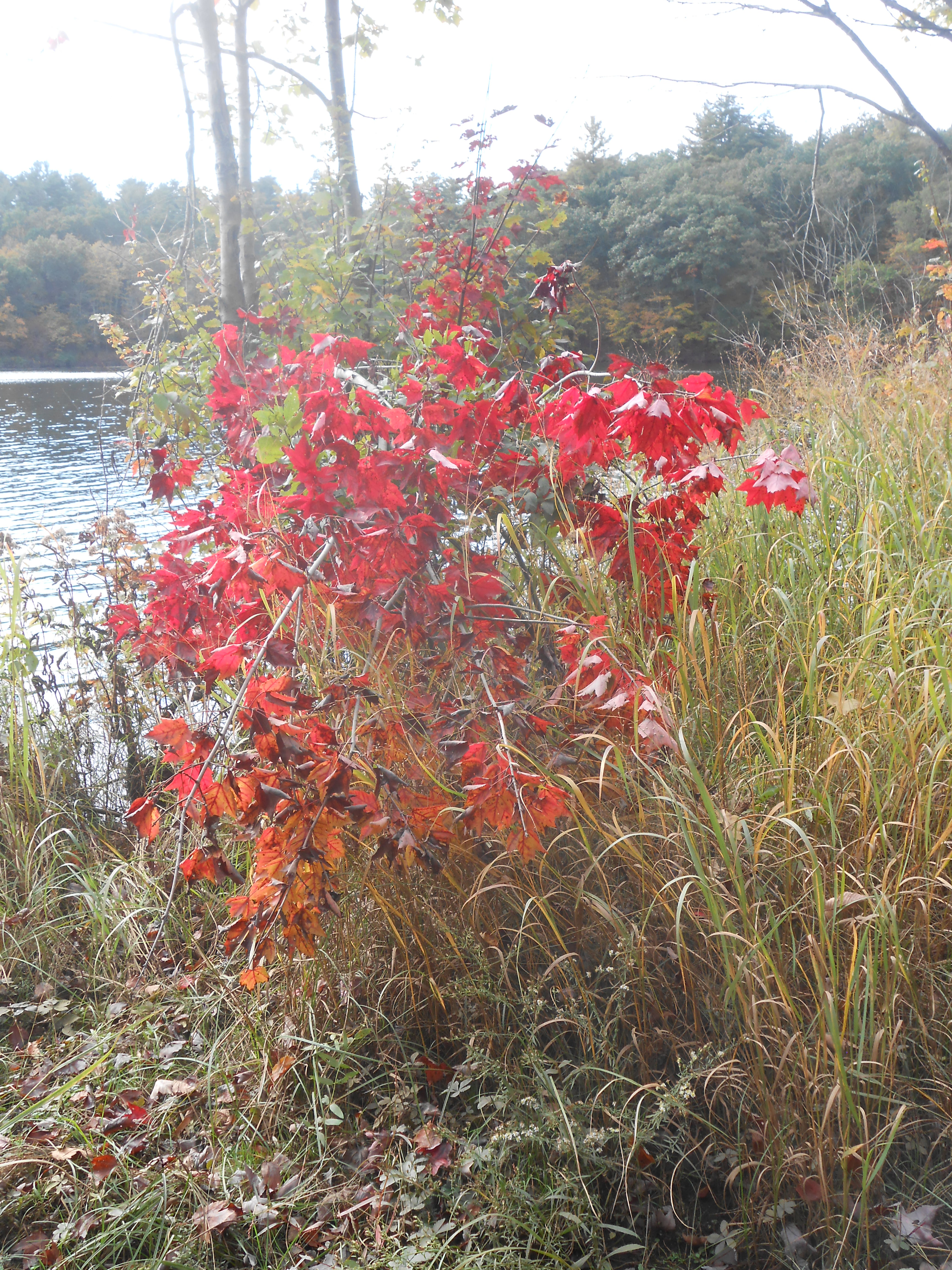
Reds
Oranges
A beautiful mixture
I especially love how the colors hug the shore and complement the pale blue waters of the reservoir and sky.
Aren’t these berries cool, as well. Perfect autumn decor?!
However, with the recent rains, the reservoir had flooded over part the abandoned asphalt road that is the trail. So we couldn’t take the direct route to the dam at the end of the trail. Gorgeous colors, though, right?
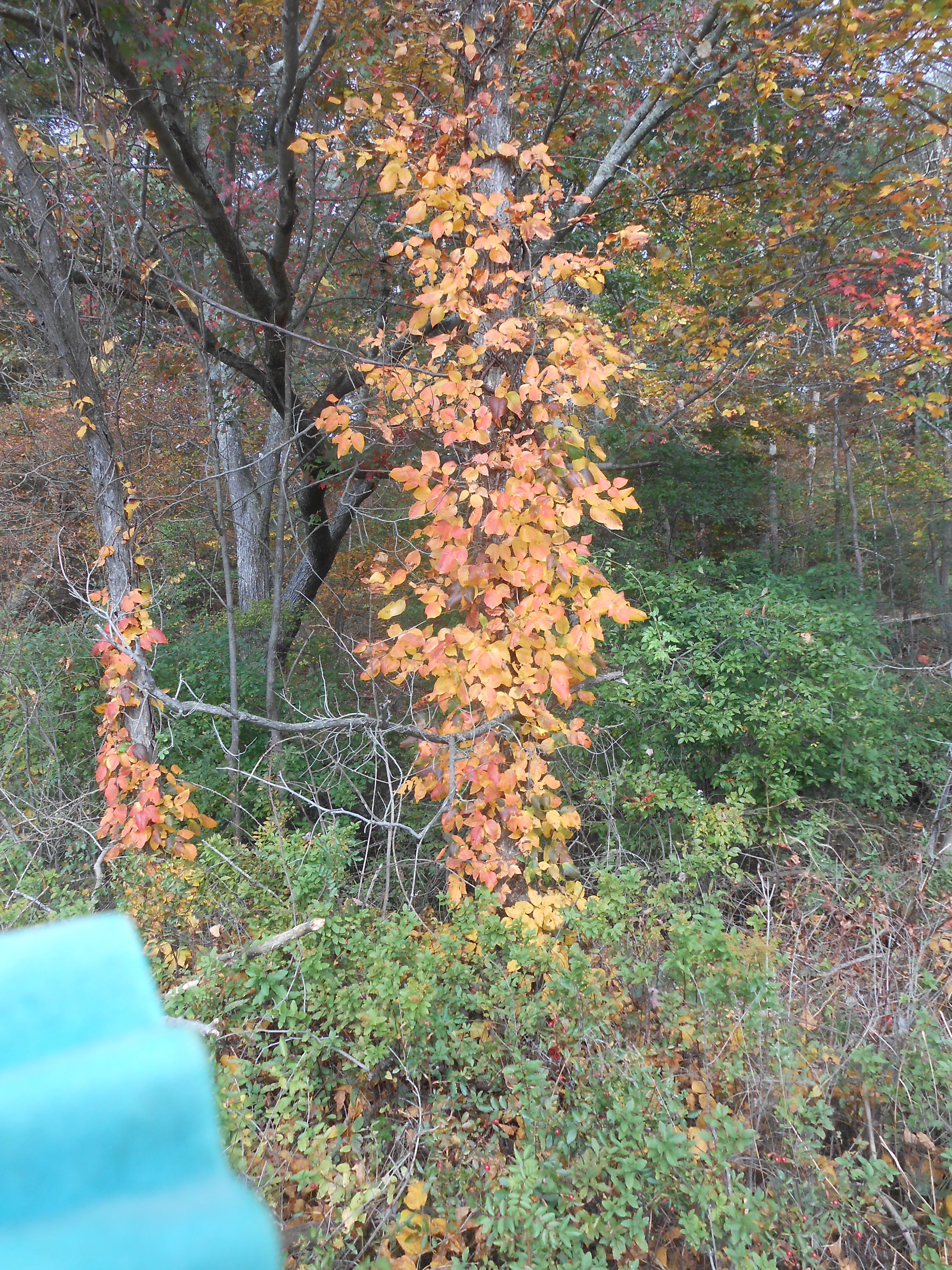
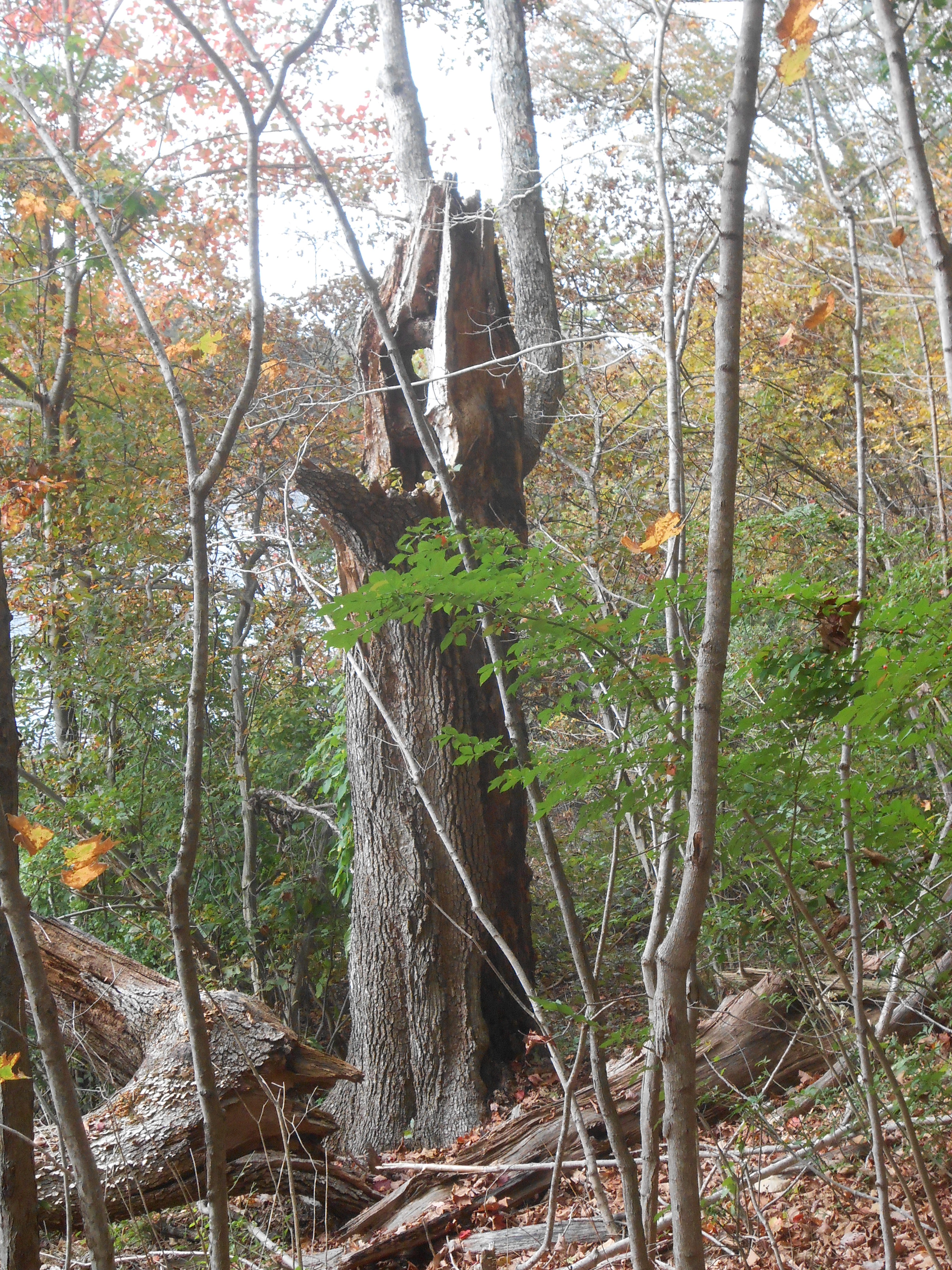
Yang and I were not daunted. We knew of a dirt trail in the woods that would circle around the flooded road and, with luck, bring us to an unflooded portion of the road by the dam. En route, we came across this wonderfully haunted looking dead tree.
The trail looped through the woods and lo and behold! Dry asphalt and the bridge where we would usually chill to watch turtles in the summer and water fowl or raptors most of the year!
Unfortunately, we didn’t see any warblers (out of season), raptors, Whimbrels, Yellow Legs, fancy ducks, or even Cormorants. We did see a couple of Mallards and a gull or two. We even heard a Kingfisher, but couldn’t catch sight of that proud, crested avian dive-bomber. I did get a nice shot of Yang amidst all the autumn color, though.
So, I hope that you can enjoy your own “secret places” in their fall glory. If you can’t get out, maybe you can share in mine. I’ll leave you with this scarlet beauty below.
October 30, 1938: across the nation, Americans were sent into a frenzy of terror when they
mistook Orson Welles’ Mercury Theatre broadcast of The War of the Worlds for the real thing. Why did so many people run terrified, believing a radio program of a Martian invasion was actually happening? One wag answered, “Because all the intelligent people were listening to Charlie McCarthy” (ventriloquist Edgar Bergen’s dummy) on another station. Historians and social psychologists see some far less funny causes at play: American’s very real fears of invasion after the devouring of Europe and Asia by fascist powers as well as anxiety over economic and social tensions. The radio play embodied and thus brought to the surface the very fears so many Americans were trying to suppress: our nation’s weakness instability in the face of invasion by alien German and Japanese. The 1975 television film TheNight That Panicked America effectively conveys this insight by interweaving storylines of the radio show’s production and broadcast with the reactions of Americans across the country.
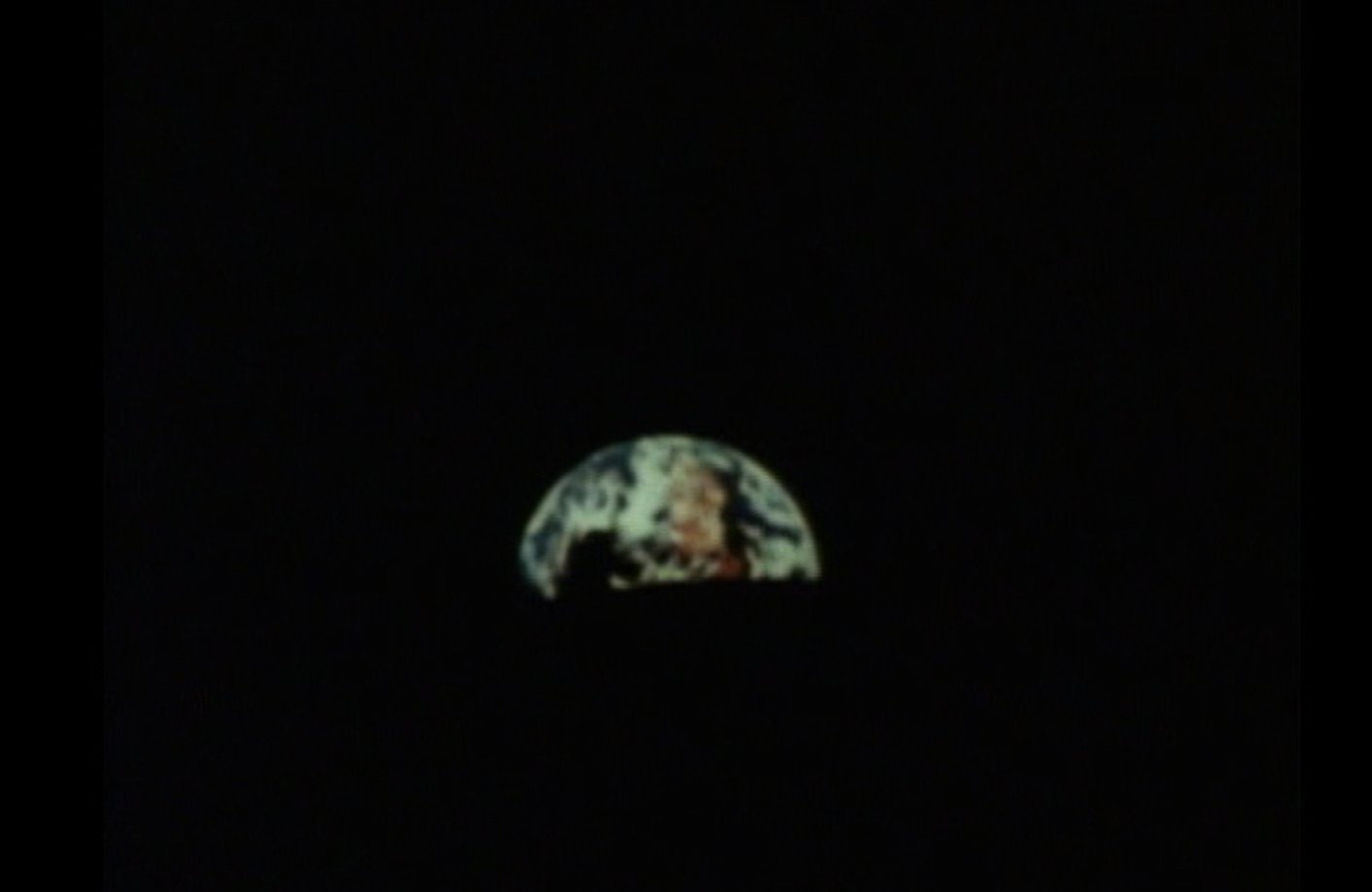
Opening with a view of the earth from outer space, calmly tracking in to it, director Joseph Sargent evokes H.G. Wells’s opening to his novel War of the Worlds. The film further establishes the links between a world on the verge of world war and a world about to suffer Martian invasion with a narrator intoning the state of earth’s conflicts in language similar to Wells’s novel. The background of broadcasts of war news and Nazi rallies establishes radio’s power to show the impossibility of denying the fearsome inevitability of world war.
Next comes a switch to the pre-production frenzy of putting on a radio program, following producer/director Paul Stewart into the broadcasting station and up the elevator to the studio with a network standards and practices rep hammering at him to keep things uncontroversial, then into the studio where he’s pulling together script changes and pressing the sound effects woman to create something ominous. It’s an exciting vision of how live radio performances came together: actors, scripts, sound effects, orchestra, directing battling against time, censors, and technical limitations. If you think about it, though, all this rush and pressure to make things perfect right up to the last minute also mirrors the sense of tension and uncertainty in the country itself. A nice hint at the unspoken realization of the tinderbox of American fears is the S & P guy (Tom Bosley) insisting that they can’t have Roosevelt as part of the story; they have to go down all the way down to the Secretary of the Interior. It’s never uttered, but, of course, having “Roosevelt” in their play about a devastating invasion lends it too much authenticity. And isn’t it much less scary if you skip past vice presidents, speakers of the house, secretaries of state all the way down to Secretary of the Interior. (Welles gets past this by agreeing to substitute Secretary of the Interior for the President, but he sounds like Roosevelt). Art liberates attempts to suppresses reality.
The stories interwoven with the broadcast are sometimes humorous, yet they also bring home that this radio play brought to the surface fears and uncertainties, not just about war but about belief in American exceptionalism. John Ritter and Michael Constantine are son and father who are farmers at Grovers Mills, the site of the invasion according to the play. Joining up with others to defend their country from invaders, the son sees his father and other farmers shoot up — a water tower. This does not amuse the owner. However, this son, who has been arguing he wants to go to Canada to join up and fight against Hitler before the war came to America, is the one who figures out this is only a radio program and tries to stop the others from acting hysterically. The fellow who admits that half the world is in flames is clear-eyed enough to recognize a real danger, while those who try to live in denial find their fears breaking free of suppression to control them.
Other examples are especially interesting. Two servants had been listening to the radio before their wealthy employer’s party. So, they know that it’s only a play — which their general perspicuity would have told them anyway. However, the snobby employer and his equally snobby friends, frivolous, self-important, and even a little impressed with Hitler, buy into the program lock, stock, and Martian cylinder. Their self-satisfied ignorance practically hits you over the head as the employer keeps refusing to listen when the butler tries to tell him it’s only a play. Equally snobbish and obtuse, one of the guests decides the whole thing must be real because the professor reporting is touted as being from Yale — a fictional professor. Eventually, the crowd of airhead snobs rushes off into the night, stealing their hosts valuables, while the servants chill, finishing off the horsd’oervres and champagne.
Not all the stories are amusing, however. Will Geer is a Protestant minister who won’t let his daughter marry a Papist infidel, fearing a religious alien invasion. His bigoted form of faith isno comfort when he believes aliens will destroy him and he loses his sanity for a time. Perhaps the most poignant tale involves a middle-class family where the father (Vic Morrow) is leaving the wife (Eileen Brennan) and children to “go look for work,” but the suggestion is that he can’t handle supporting his family emotionally as well as financially any longer. The American dream of family stability and work’s inherent dignity and security has fallen apart. The fear of the family dying in the invasion pulls husband and wife together in an attempt to take their children to safety, until what they perceive as the approaching alien ship with its horrific heat rays draws them into the decision that mercy-killing the children is their only option.
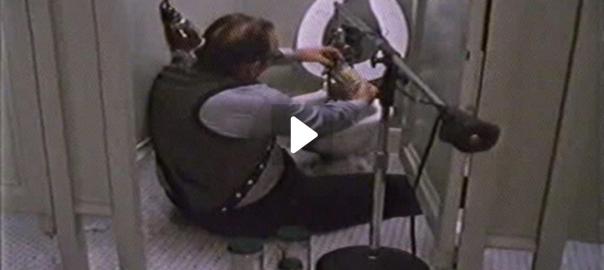
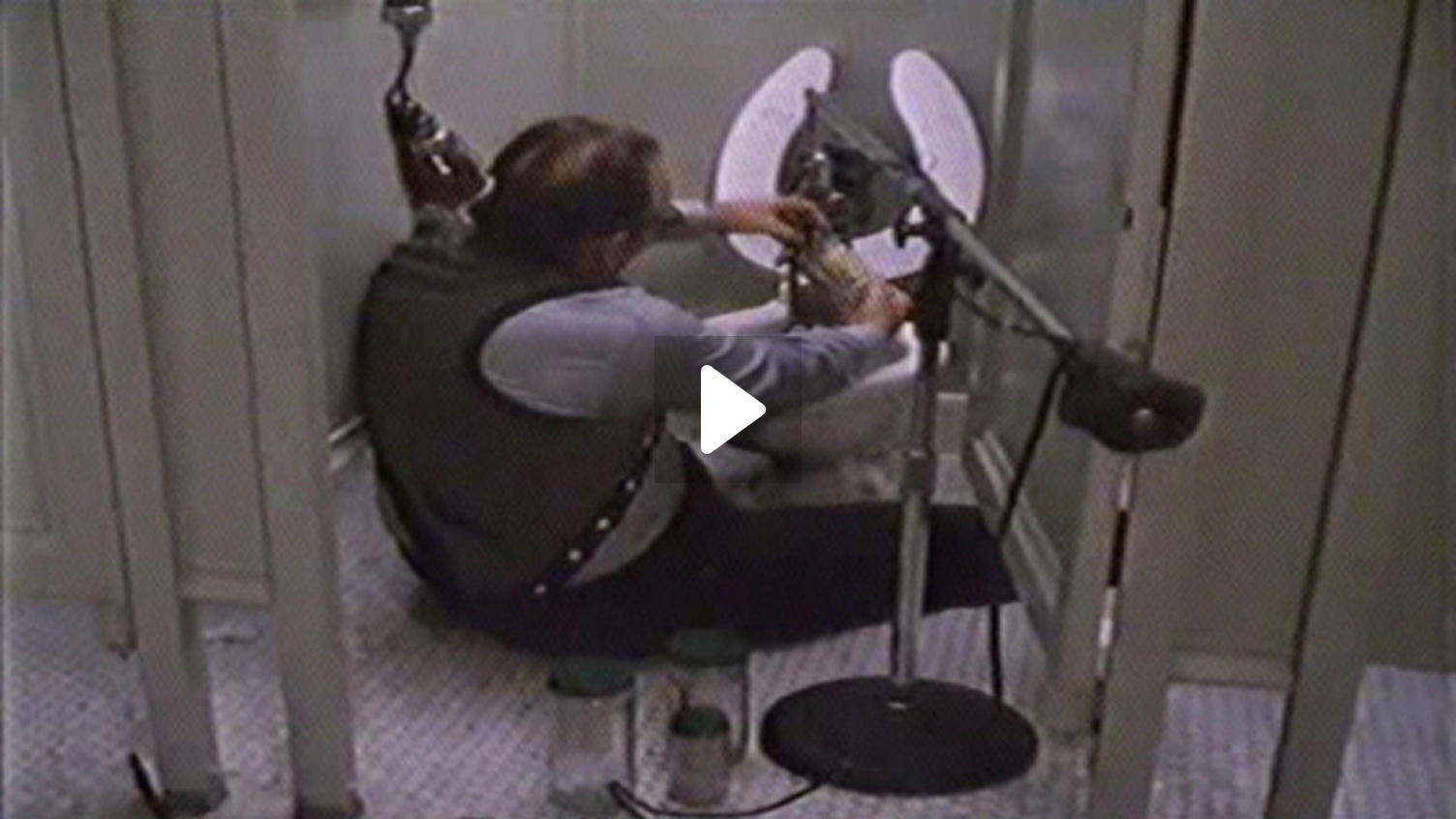
Anyway, it’s an exciting film to watch that gives you something to think about. I loved seeing all the clever improvisation and creativity of putting on a live broadcast. Perhaps you have heard how the sound person created the menacing unscrewing of the Martian cylinders by having her assistant unscrew a pickle jar in a toilet in the men’s room to get just the right reverb? Paul Shenar was dead on in his reading of Orson Welles’s sign off for the play, as the Mercury Theatre’s trick and treat. I especially liked that the writers (including Nicholas Mayer and Howard Koch, a writer on the original script) left me considering how suppressing rather than facing what unsettles us in this world actually leaves us prone to that that which we try to suppress. If this can happen unintentionally by creative writers, actors, and technicians, what can deliberate manipulation through something like AI do, if we haven’t faced and come truly to understand the contentions of our world?
In some ways, the 1970s were a golden age for horror on network TV. Series such as Ghost Story, Night Gallery, The Sixth Sense, and The Night Stalker chilled us back then, though the over-plus of poster-vision, superimposition, electronic music, and a dizzying tracking in and out may seem a little cheesy now. And why did everyone think harpsichord music was so scary? The horror genre also heavily populated another 1970s television trend, the made-for-TV movie. One of the most prolific purveyors of ’70s TV horror in a series or a one-off film was Dan Curtis, the guy who brought us Dark Shadows, the first gothic soap opera, in the 1960s. Many people know Curtis for Darren McGavin’s The Night Stalker series, which actually started out with two TV movies: The Nigh Stalker and The Night Strangler. Dan Curtis, quite the busy beaver, also wrote, produced, and/or directed quite a few other telefilms, including Trilogy of Terror, Dracula, The Strange Case of Dr. Jekyll and Mr. Hyde, and The Picture of Dorian Grey. One film he wrote/directed/produced that was not based on a classic horror tale was The Norliss Tapes. A pilot that never made it to a series, The Norliss Tapes is a kind of upscale Night Stalker, based on the premise of writer David Norliss investigating supernatural incidents in order to debunk them. Kind of a Scully and Mulder in one. It could have made an interesting series.
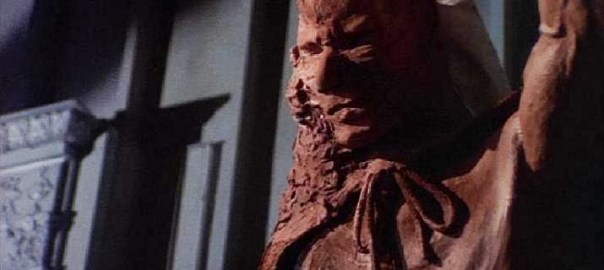
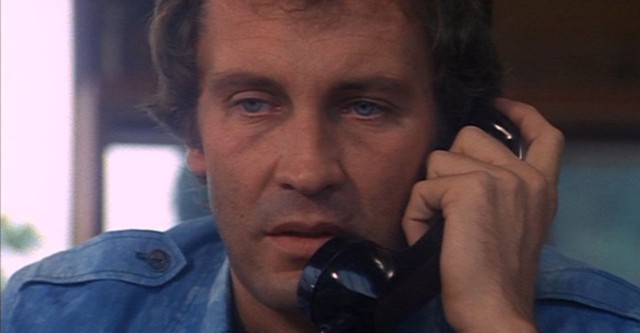
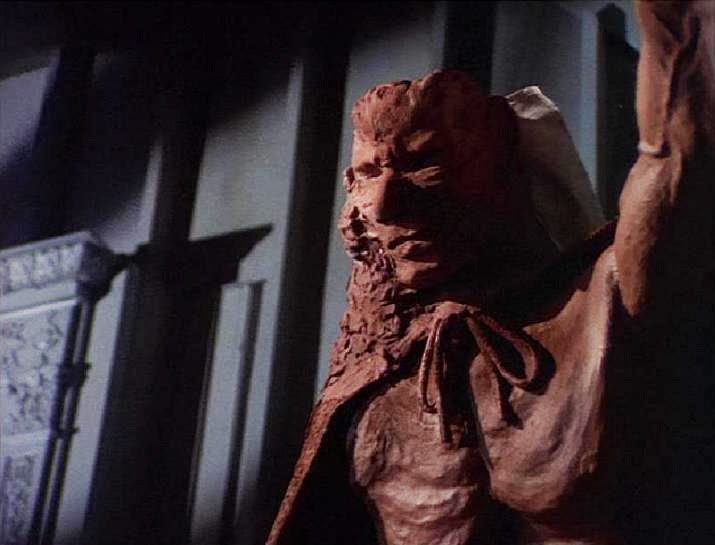
The movie starts with a tense David Norliss (Roy Thinnes) brooding over a foggy San Francisco landscape from the balcony of his apartment, then calling up his editor (Don Porter) to pressure him into a meeting about a book he was supposed to have completed on his investigations of the supernatural, with an aim to debunk. He cryptically alludes to threats that have kept him from writing, which he now fears may even take his life. When Norliss misses the meeting, the publisher seeks the writer at his apartment only to comes across a note telling him to play a set of numbered tapes (in the right order!) to understand what’s really going down. After putting the tape in a handy cassette player/recorder (Now there’s a trip down memory lane!), the publisher and audience hear David’s voice narrating us to his first adventure into darkness — dissolve back into the past and away we go! The tale unfolds with a recently widowed woman (Angie Dickinson) encountering a gruesome being in her late husband’s art studio, which of course she and her German Shepherd have to cross a hill and some woods in the middle of the night to access. The creature whips the dog across the room and takes blasts from her shotgun as if it’s only a tackle from a linebacker. Still, he’s down long enough for the woman to get away so she can tell her sister, a pal of David’s, that this thing is a creepy version of her husband. He shows up to investigate, but for a skeptic he comes to believe the woman right quick — dazzled by Angie’s charms? Before you can say Necronomicon (which actually is a long word), victims are being strangled and drained of blood, a new sculpture of something demonic in reddish clay appears to be gradually being finished in the studio, reports emerge of the husband’s prior involvement in dark arts once he learned he was dying, and creepy caverns and crypts reveal horrible secrets. All of which David pieces together, despite the local sheriff’s skepticism not his own.
Despite some of those annoying trackings in and out and a little too much screeching with the electronic music (Robert Colbert did his job much better on Dark Shadows), the movie has some genuinely creepy and suspenseful moments as victims are stalked on dark, lonely nights; in a dank mausoleum; or to a lonely motel room. The film even makes effective use of the traditional “We’ve got to find the monster in this forbidding underground passage before he stirs.” Roy Thinnes, no stranger to the eerie (The Invaders, Horror at 30,000 Feet), makes an interesting and capable investigator: discovering the right people to interview and asking the right questions, as well as effectively using the library. Still, Thinnes plays the guy a little too much on the low-key side; he could make Duchovny’s Mulder look peripatetic. In all fairness, though, didn’t an ambiance of low grade, indefinable anxiety predominate many films of the era, especially mystery and horror? After tale number one ends, the film returns to the editor, ending with him selecting tape number two. So, one wonders what new adventure in horror David Norliss would have faced had this pilot led to a series. Though Chris Carter credits The Night Stalker as an inspiration for The X-Files, the sophistication and the detecting skills of Norliss suggest this film is a much closer match. How might Carter have developed his series if The Norliss Tapes had become a series? Thinnes did reappear on The X-Files as Jeremiah Smith, ironically, an alien, though one with good intentions for us benighted earthlings.
No copyright infringement intended by use of the properly attributed photos. If you feel there is a problem, contact me about removing the images.
I had planned to do this farewell -to- summer blog much earlier, but since the heat and humidity of the first couple of weeks of September seemed to embody summer hanging on by the claws, I figured I’d better wait. So, now that crisp fall breezes, pellucid blue skies, and incipient flares of leaf color are taking over, I guess it’s time.
June started us off nicely. I filled our window boxes and other planters with bright colors that “flowered,” if you will, abundantly.
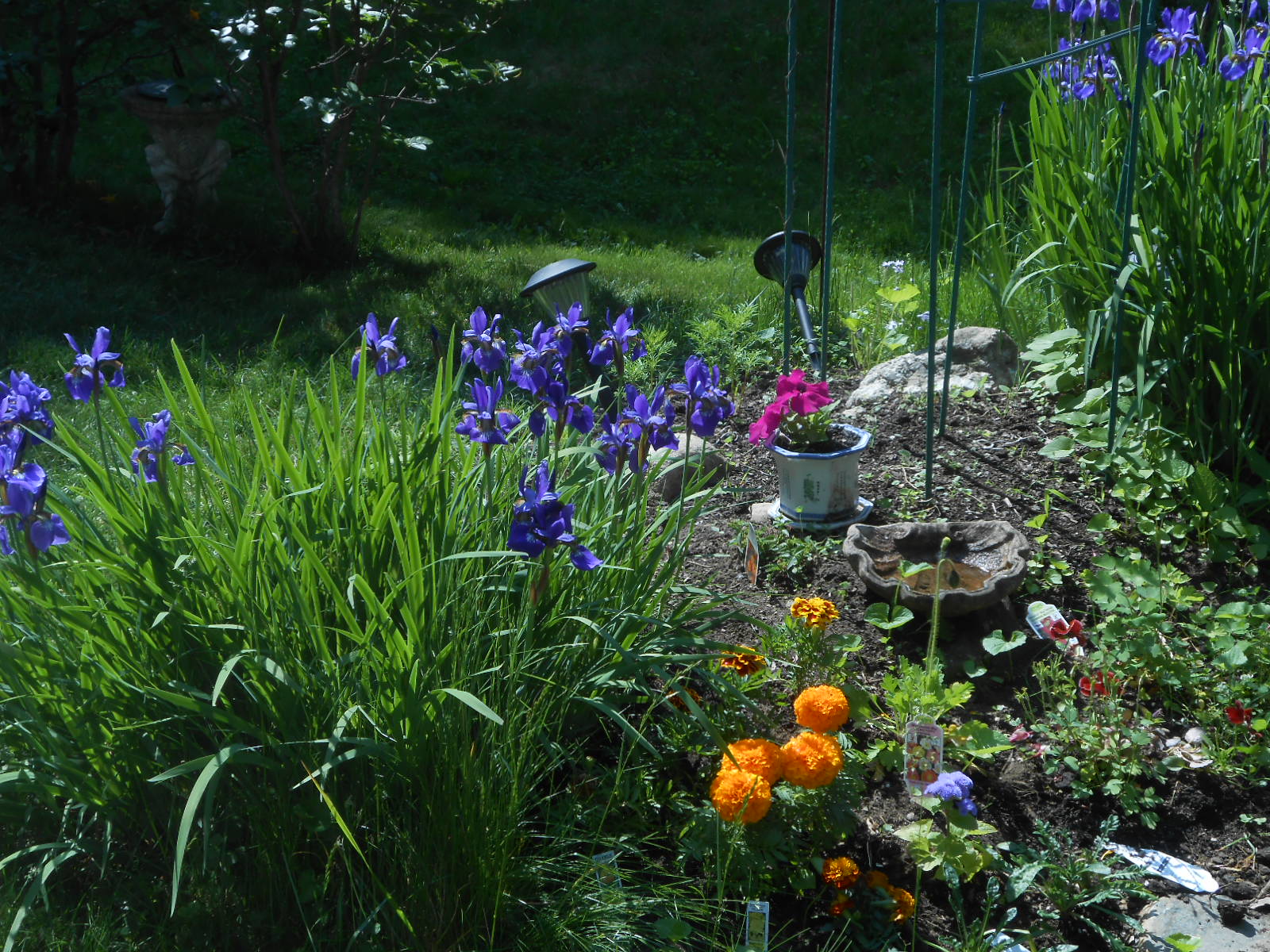
The mound beside the fish pond had gorgeous Irises and Marigolds, beautifully complementing blue with light orange.
We had some nice fancy Irises in the front yard, as well. Interestingly, we did not have as many blooms as usual. Perhaps the May frost nipped a few?
The sea-rose bushes in the back yard climbing up the slope had tons of gorgeous pink blossoms. Here’s a shy little bee hiding among the petals.
July was fun for beasts, birds, and flower. One morning when I went to rinse out the cat-food cans before putting them in the recyclables, I found this fellow chilling in a bucket that had filled with water. For a few days, this was his private pool, with the high grass surrounding making up his stomping, rather, hopping grounds. Yang was careful not to mow around where the frog hung out.
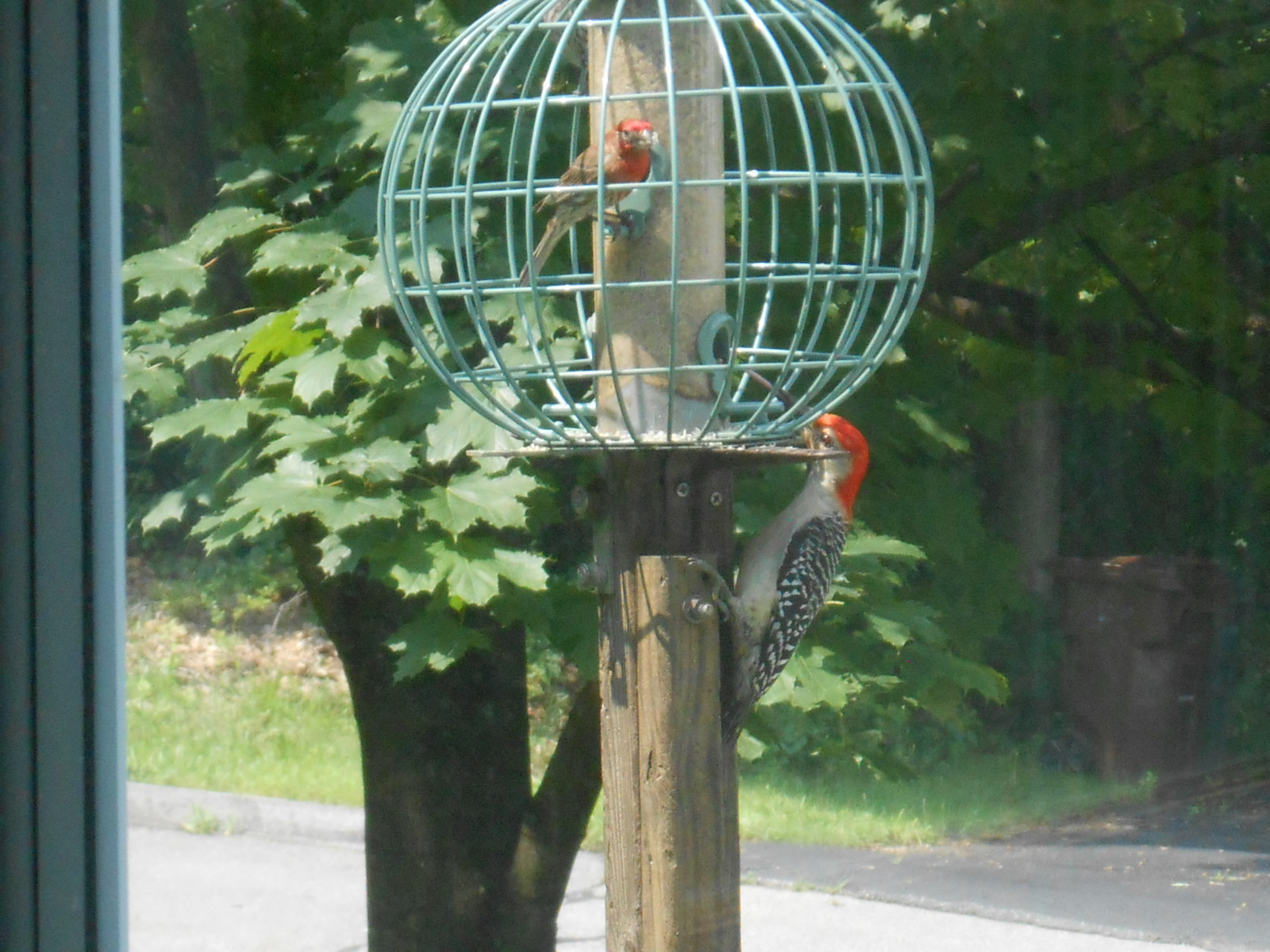
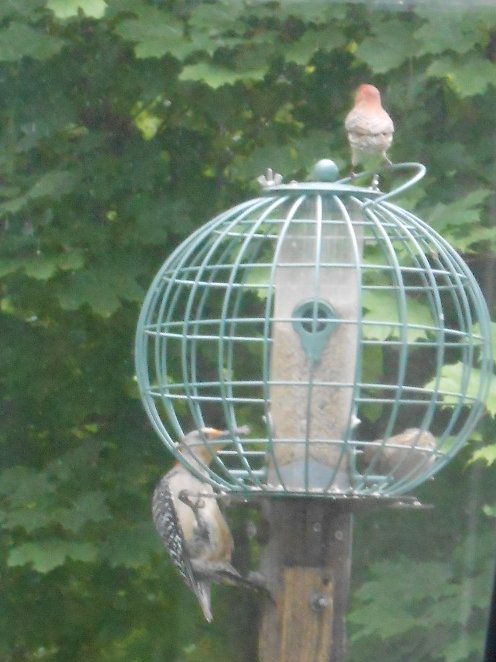
Yang put up a new bird feeder that is sheltered by a globe cage. The little birds loved it! Here you can see the Goldfinches mobbing the feeder. I think that sparrow must have worn a yellow feather to sneak in. Of course if you’re a larger bird and a Redbellied Woodpecker, you can still grab a snack. If you click on the photo and look carefully, you can see our friend Red using his looong woodpecker’s tongue to grab some food.
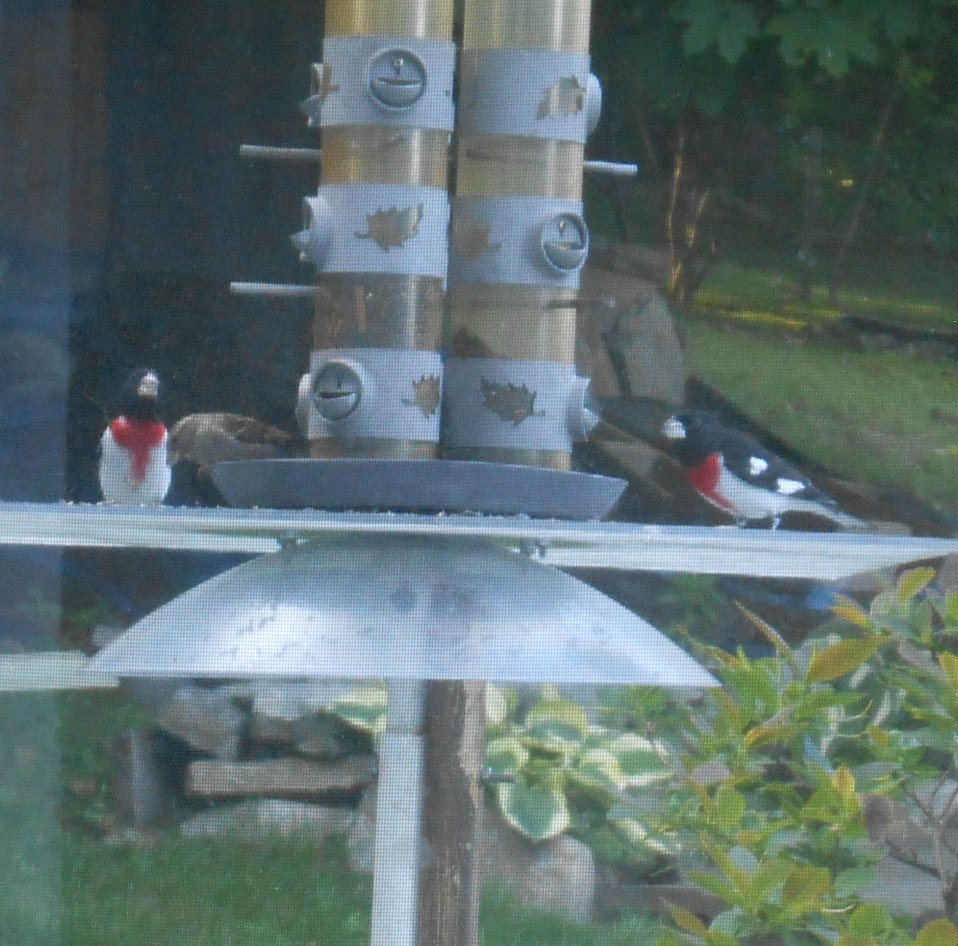
A Rosebreasted Grosbeak was just able to sneak in there, himself – though he and the Orioles faded away unusually early, in later July.
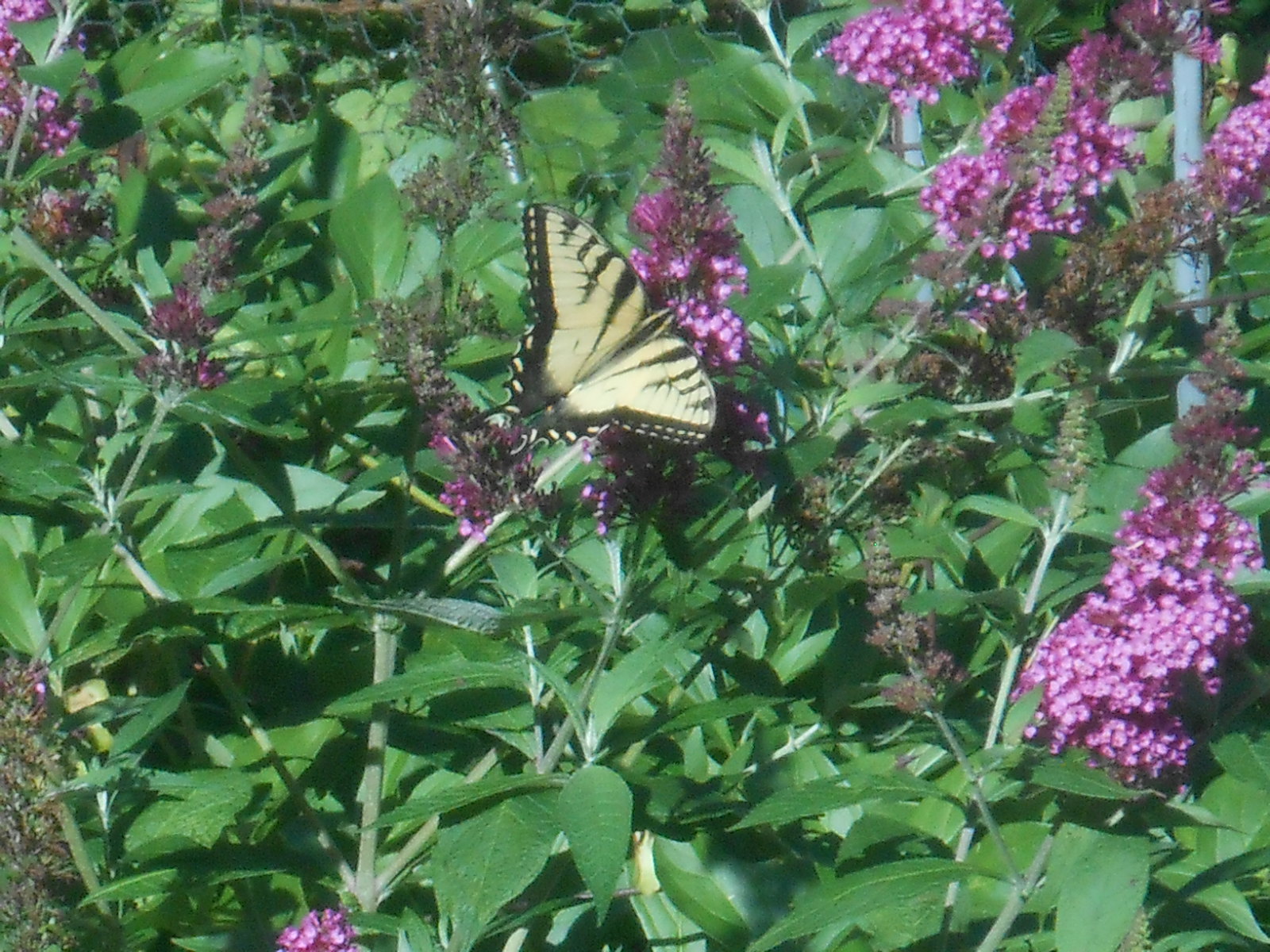
The butterfly bush near the house attracted quite a crew. Here, you can see one of the several Tiger Swallow Tails who daily dined on the shrub. We also got some hummingbirds, Wolf Moths, and Bees dropping by for a nectar treat.
Usually, our rose from China only gives us one bloom, but this year it gave us two at the same time. Neat, huh?
August brought us continued Goldfinch mobbing, and the flowers began to fade a bit. We had lots of Morning Glories, which I forgot to photograph! This year, we had orchid, magenta, purple, pink, blue, blue/white, and the white moon flowers.
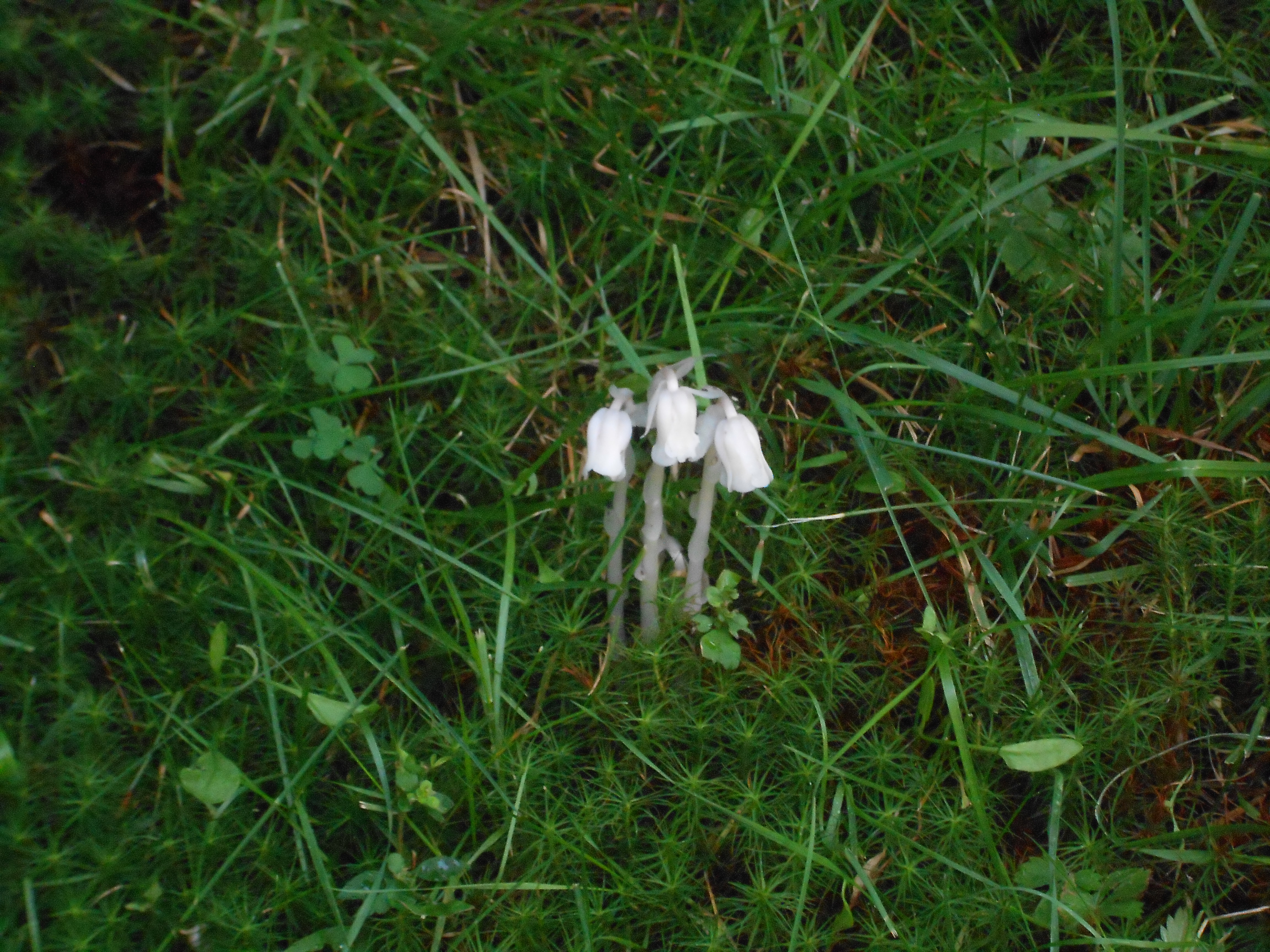
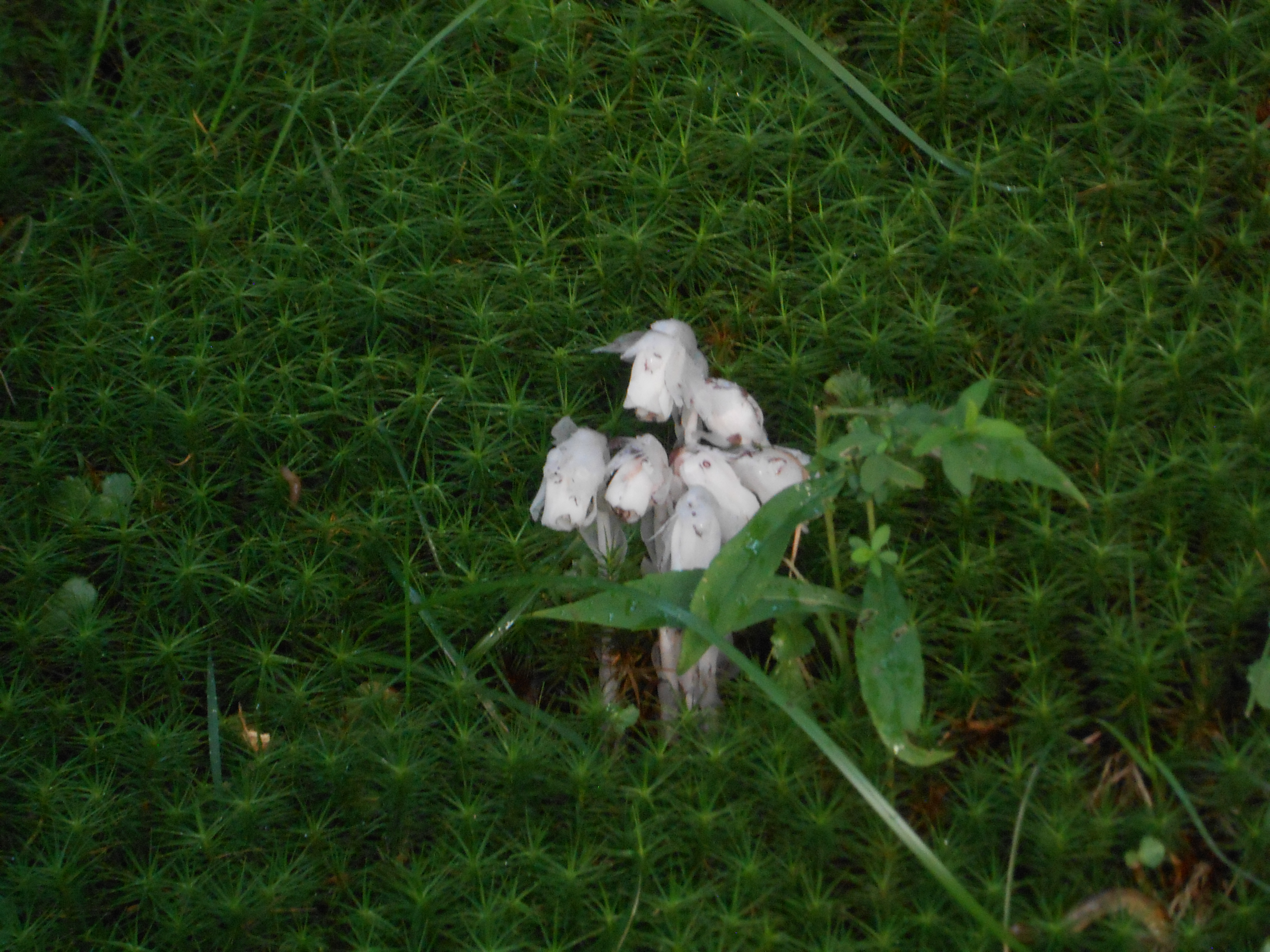
I did remember to photograph the Ghost Pipes that sprang up! I remembered we had them once before during a rainy summer years back. Consequently, I predicted we might see more this year. Boy, was I right! I’ve never had so many!
As you may have extrapolated from many of my posts, Yang and I are great bird watchers. We’ve traveled all over the Northeast (and to Canada, China, England, and France in the past) to sight all kinds of befeathered critters. My count for species this year is now a whopping 93! However, I can’t help agreeing with him that we often see a greater numbers of birds and species on our bird feeders thnt we do on our trips to woods, fields, rivers, and oceans! Maybe this blog will lead you to agree.
Many of our regular spring and summer visitors have made their appearances here. I can report that I’ve seen one Hummingbird, lots of Goldfinches and House Finches, Red-winged Blackbirds (male and female), and Cardinals by the score. Our Chickadees and Titmice have briefly been on haiatus, brooding their babes, but they are now back at work snagging black-oil sunflower seeds. It’s also so much fun to see Mommy and Daddy (mostly Daddy) Cardinals bringing their kids to the feeders now that the little tykes can fly. Unfortunately, I don’t have any pictures of these guys, but I do have quite a few of some of my other feathered favorites.
One of my favorite species are the Rosebreasted Grosbeaks. Usually, we get the females first, then the males; however, it was the opposite this year. We had at least one male, finally, on a feeder. Then, tragedy struck: we found him dead on the ground under a tree. Yang and I were heartbroken. These guys were like our pals. Still, our hearts mended a bit two week later when we found another male chomping on sunflower seeds. Then we saw a female. Then we saw two males at the same time! There could be up to thirty males on that feeder as long as they didn’t all show up together! By the way, the males are quite aggressive. They don’t take guff from each other and not from Grackles, Blue Jays, or Mourning Doves. The females can be tough cookies as well. Anyway, I’m glad they are back. Below is a shot of the males in a more pacific mod. I guess they can stand each other when multiple tubes of seeds separate them.
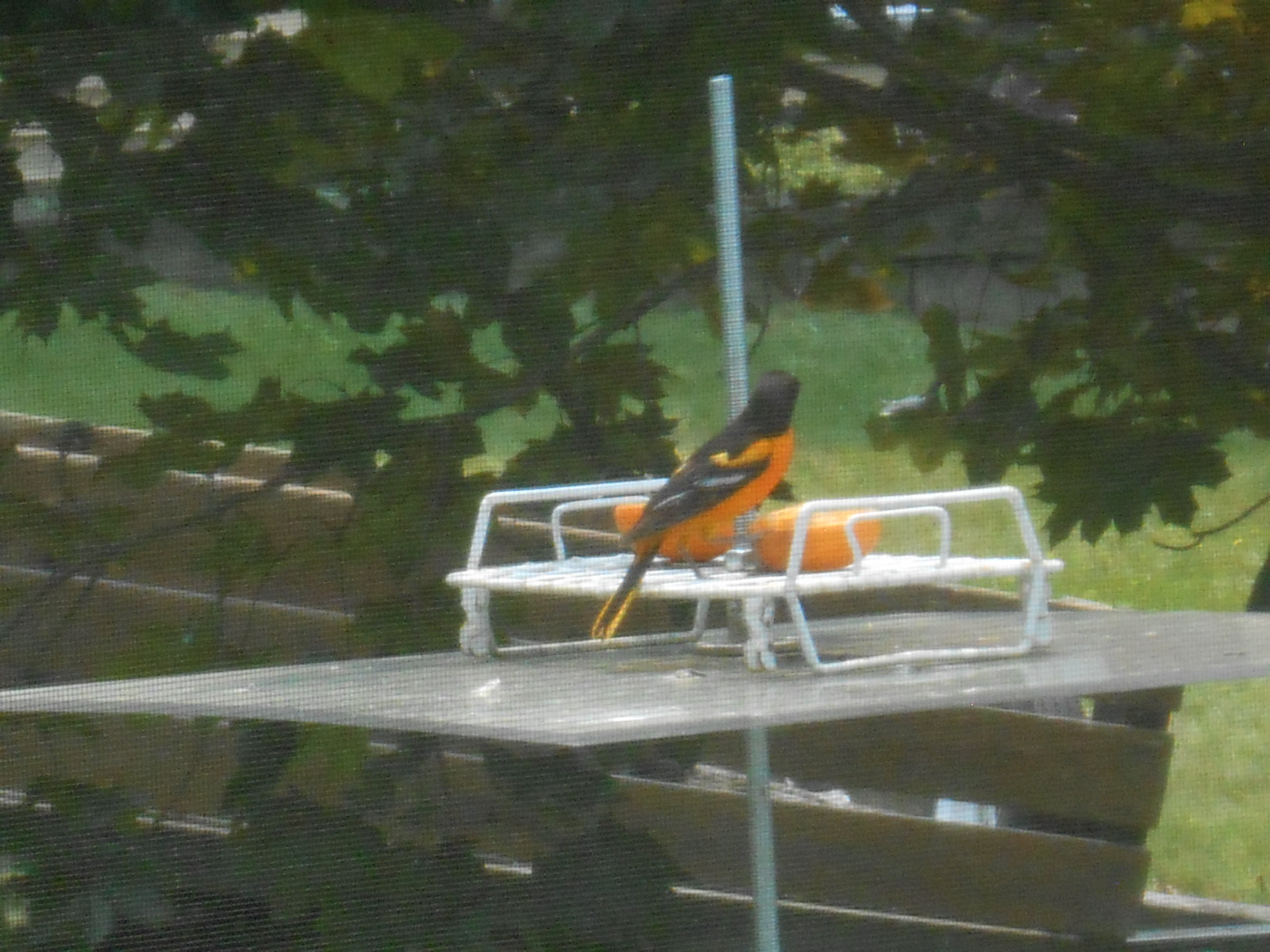
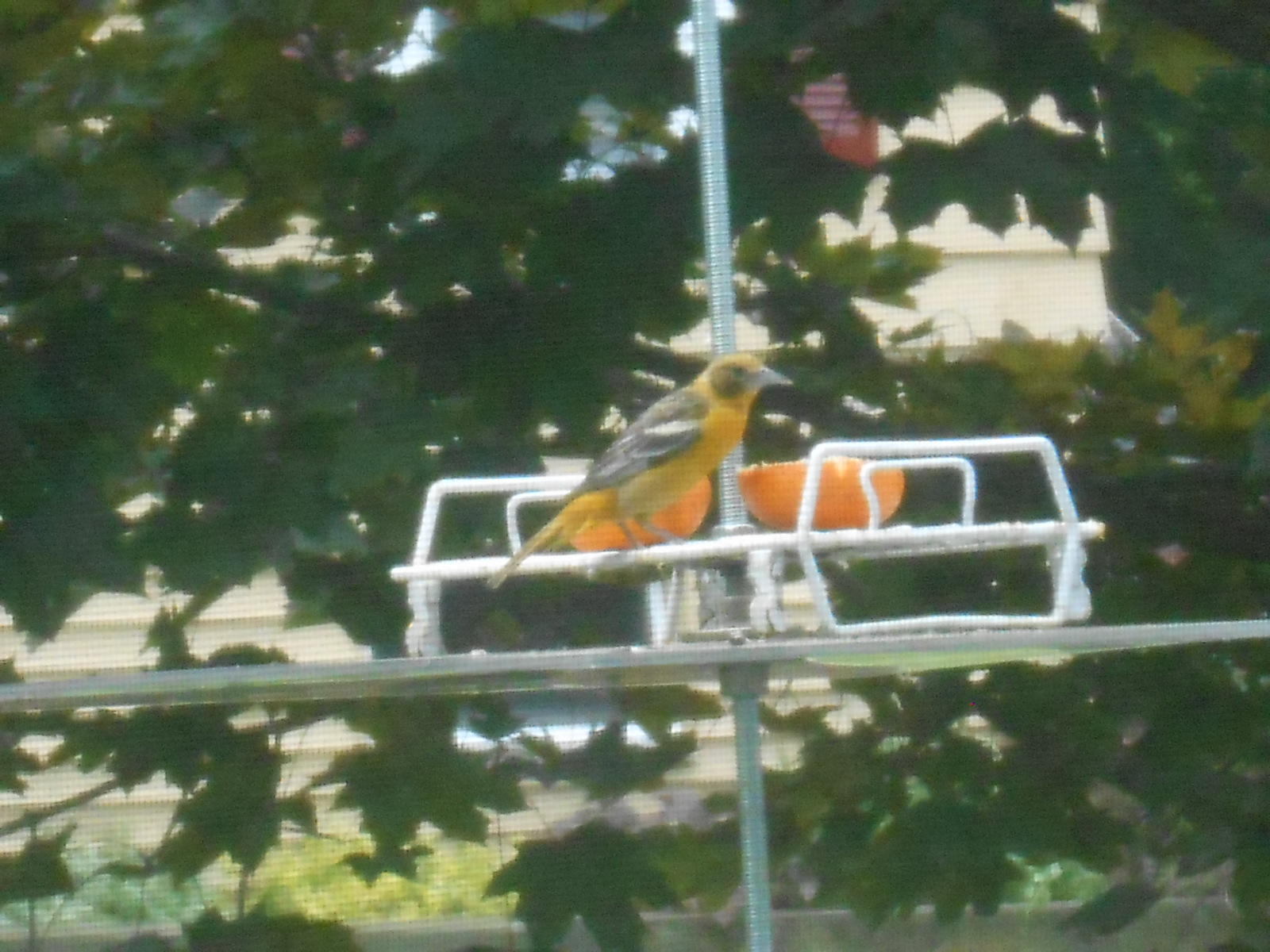
Another of our beloved colorful visitors is the Baltimore Oriole. After long waiting, we saw one toward the end of May, then nothing! Many an orange might have withered away if not for other birds. So, we almost gave up hope of seeing another Oriole – until in the middle of June Orioles reappeared! We saw a male several days in a row, then a female for a couple of days, then a week later: a juvenile. It’s been a couple of weeks and – nothing! Of course, who knows what shows up when Yang and I are away, but we haven’t seen any Orioles since. I guess this was just a stopover on their way to their real summer grounds. Well, at least we saw a few of them! And the oranges did not go to waste.
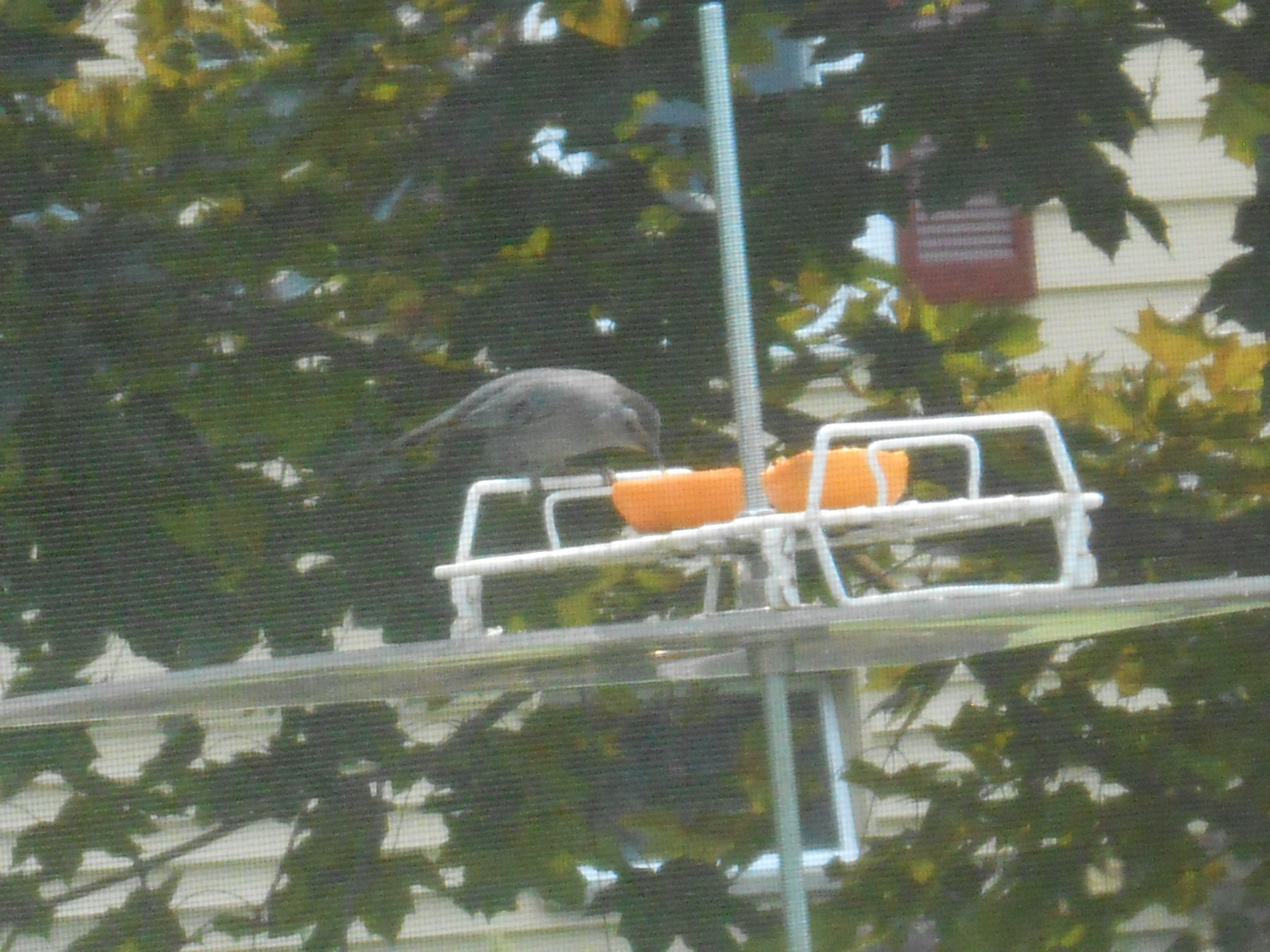
We have discovered that Catbirds adore orange pulp! When there’s no suet to be had (and even when there is!) our catbird couple come by to snack on the orange halves we have set out. They must keep up their strength, since they have a nest with babies on our property.
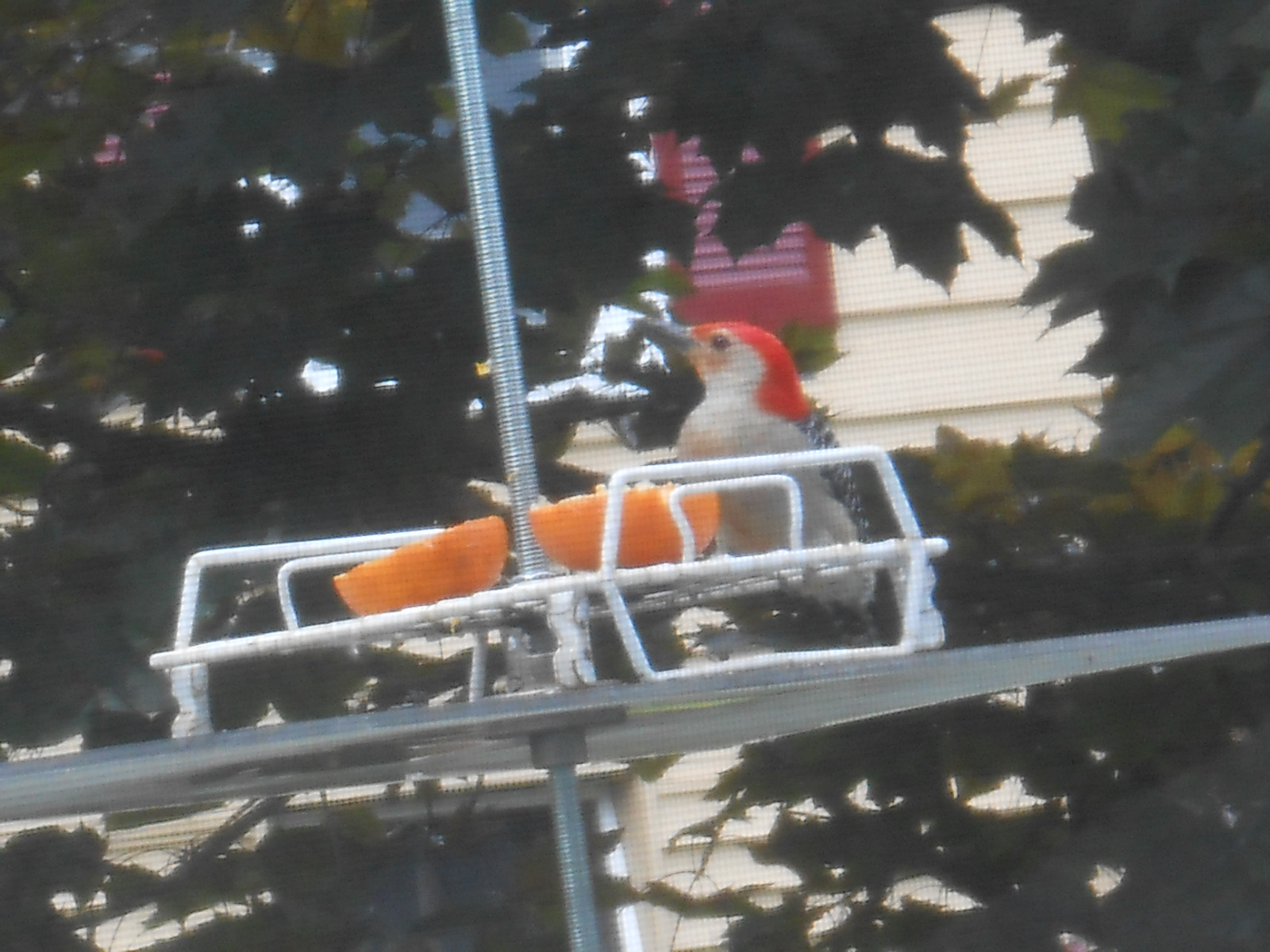
Mr. Redbellied Woodpecker thinks the oranges are pretty cool stuff, too. You can see him having a grand time chowing down on pulp. Maybe the Orioles are afraid to go for the oranges with these guys around!
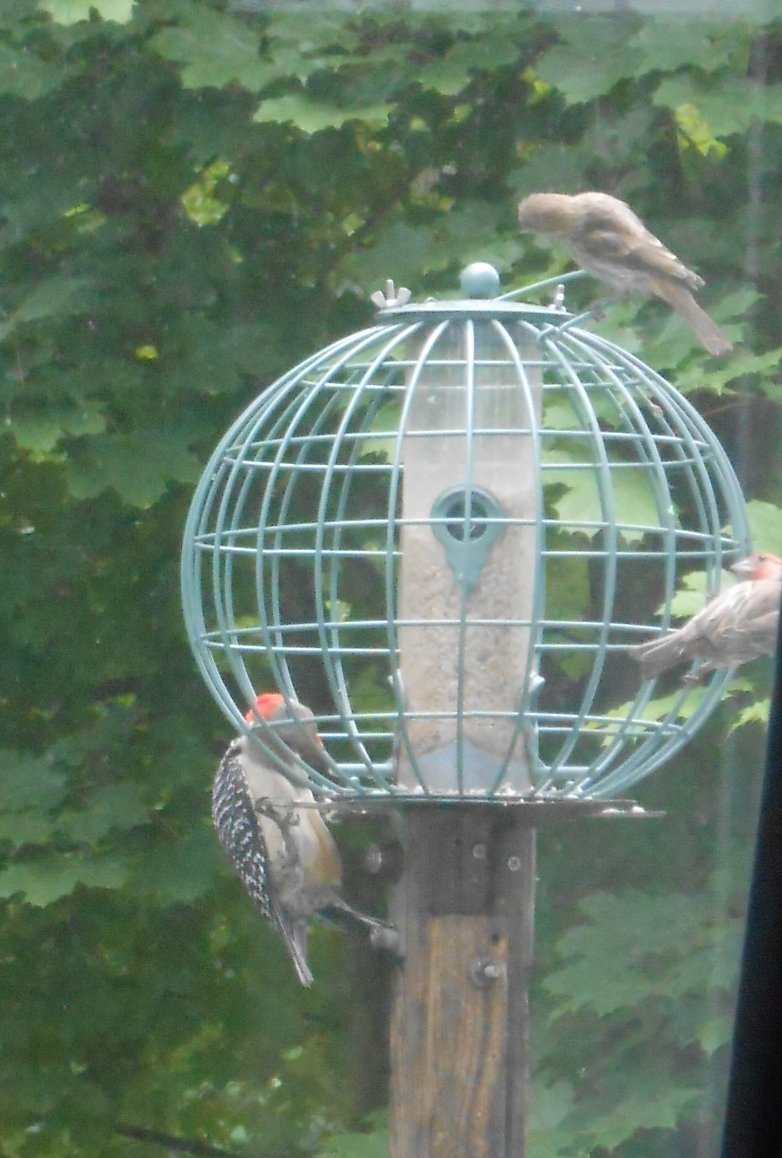
One idea that Yang came up with to thwart the squirrels from stealing food from the birds (and breaking our feeders) was to buy a tube feeder inside a globed cage. It also had the advantage of preventing the big bully birds like Grackles, Doves, and Jays from keeping the little birds from food. it works. Of course, medium size birds like the Rosebreasted Grosbeak and the female Redwinged Blackbirds can get in, without being bullies. Tough luck male Red Wings! Birds with long beaks also have a shot – like the Redbellied Woodpecker. The House finches try to out-aggress the Goldfinches, but the latter either hold their own or just wait and dive in when the coast is clear. Titmice and Chickadees are too fast for anyone to harass them!
So, you can see, we’ve seen a healthy variety of avian visitors right outside out windows. Bring on the Scarlet Tanagers, the Pileated Woodpeckers, and the Indigo Buntings! It wouldn’t be the first time one of them has shown up at chez Yang.
Well, you haven’t seen any blogs in a while because this spring has been so busy. Yang and I have had more than a few excursions, so I have plenty to report. Unfortunately, I don’t have a lot of pictures because we were too busy enjoying the wonderful scenery or sighting extraordinary critters. So, let’s get started. To get a really good look at the photos, be sure to click on them.
While I was busy educating myself on Medieval and Renaissance literature, history, philosophy, and culture at the Keene State College Medieval and Renaissance forum, Yang was chugging up Mt. Monadnock. This was an extraordinary day with the temperature surging to 85 degrees. Still, you can hear the wind whipping through the trees in this video.
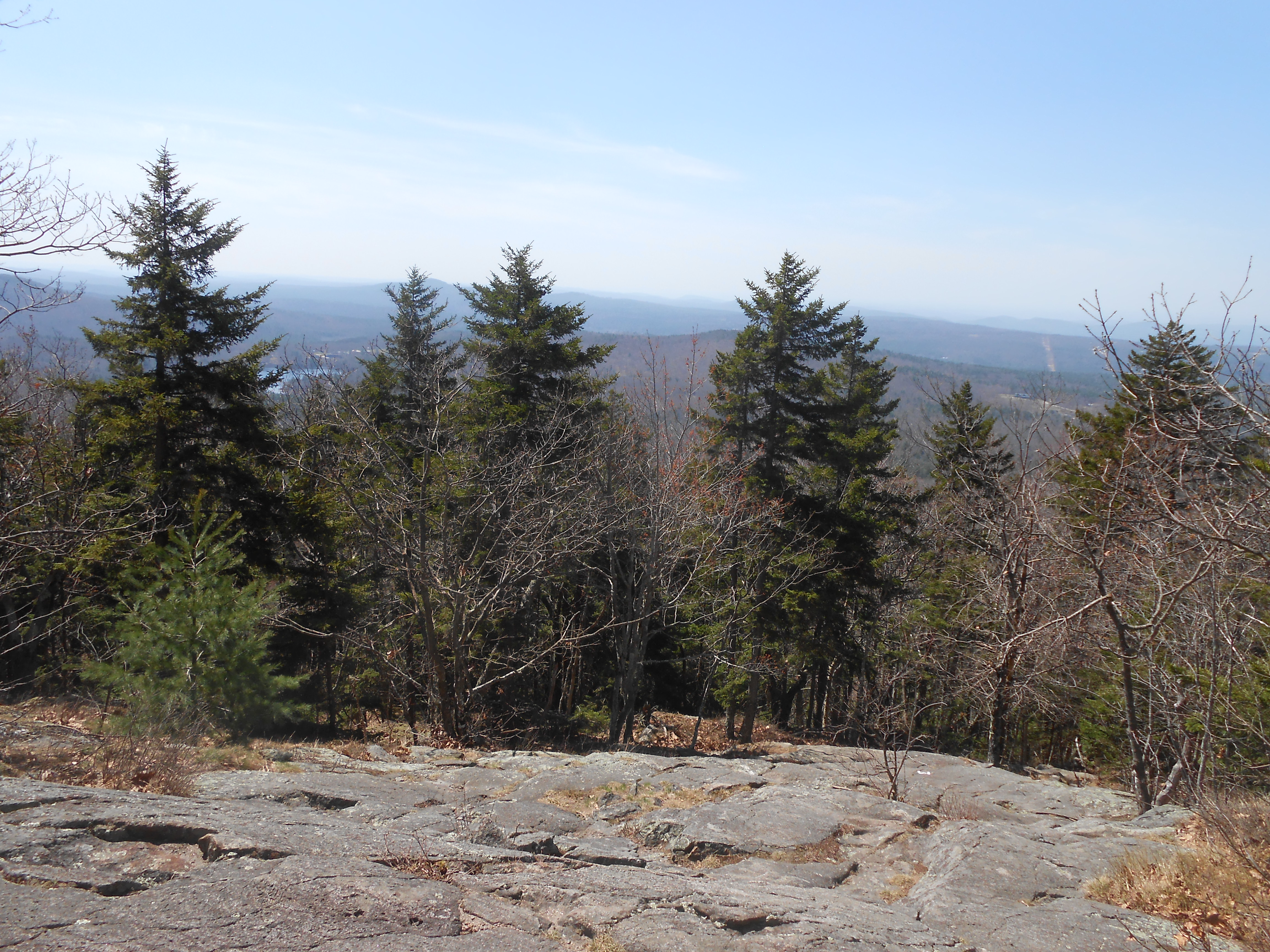
Nevertheless, Yang almost made it to the top of the mountain. As you can see from these photos, the view was gorgeous. However, this is my favorite shot.
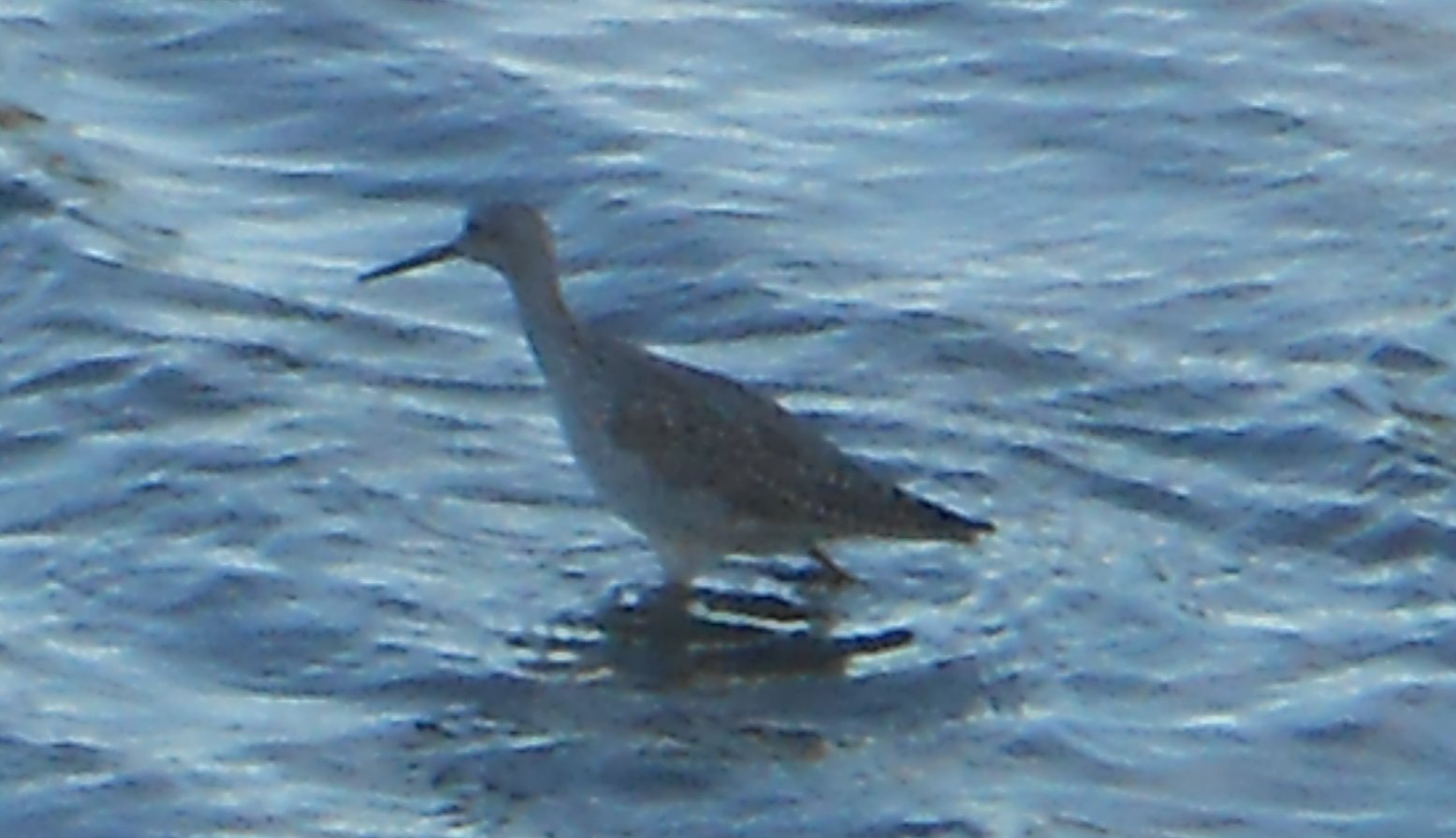
Later on, we were off on our bicycles and checked out the extension of the Fairhaven trail to Mattapoisett, MA. The day was warm and sunny. We were lucky enough to catch some sightings of neat shore birds. We saw this Greater Yellowlegs. You can’t actually see how yellow his legs are because he’s in pretty deep water. These birds are tall. This spring, we’ve also seen these guys in Connecticut and in western Mass. They love the shore on a lake or the ocean.
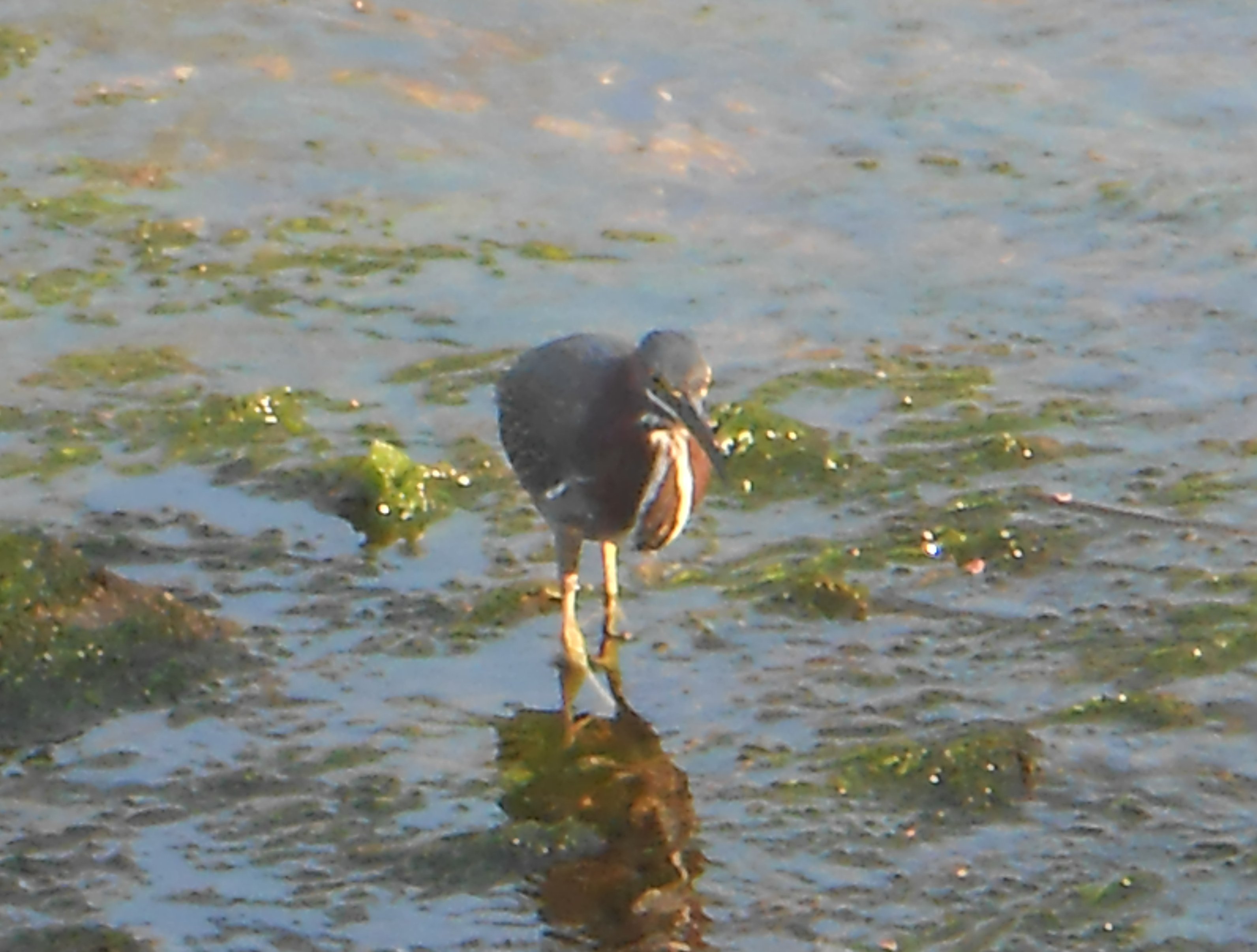
We also saw a Great Egret. Sorry, no picture. But his legs and feet are something: long black gams finished with big lumpy bright yellow tootsies! Like clown shoes! We do have several pictures of a particularly gorgeous bird: Green Heron. His colors are gorgeous – green/blue crest and back, chesnut neck, white stripes from his eyes to the back of his head, splashes of white dripping down a beautiful chestnut front.
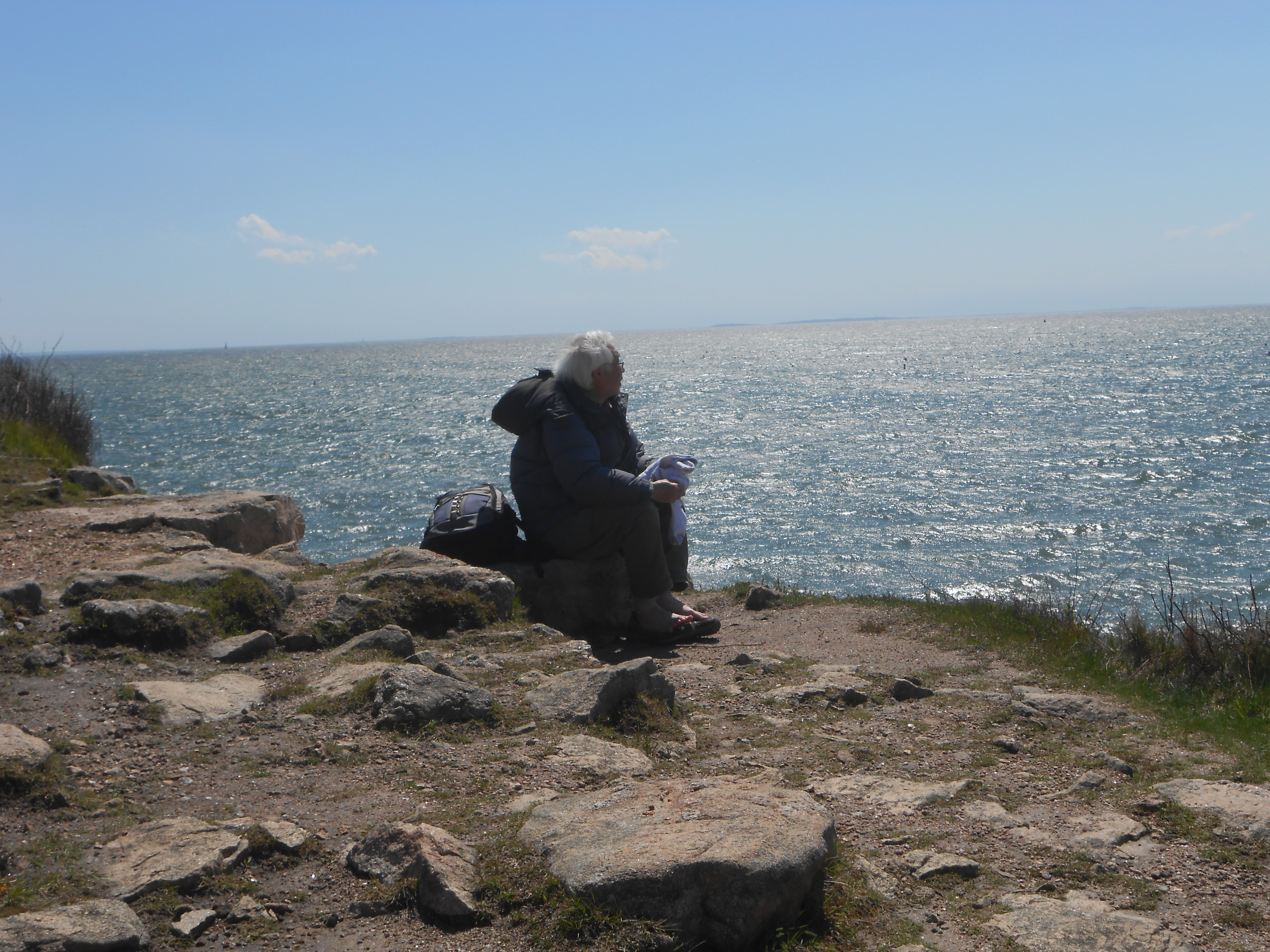
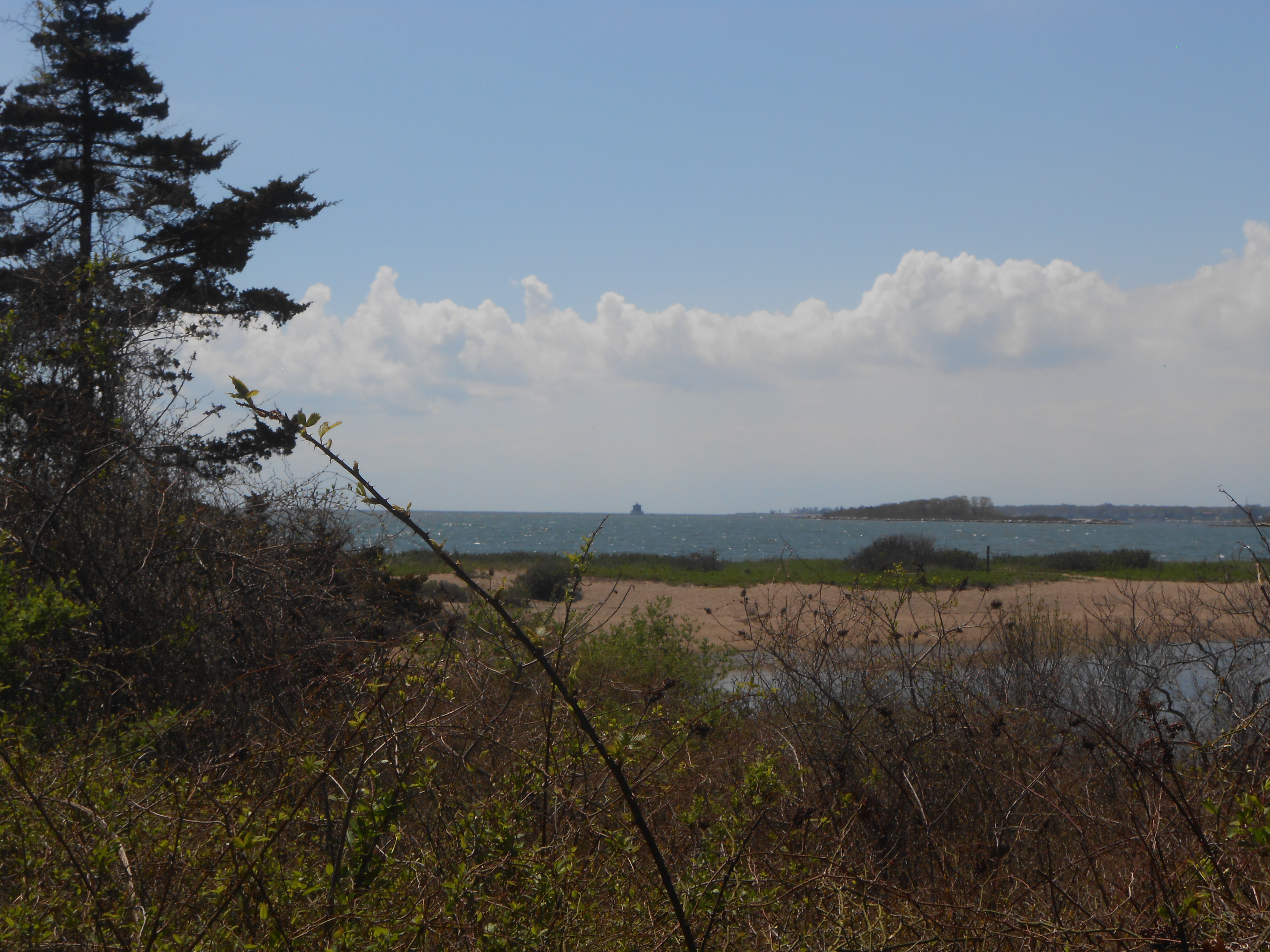
Bluff Point is near Mystic in Connecticut. So, after a nifty lunch of croissant sandwiches and (for me) coffee latte, we drove over for a new walk. You start out along the shore, on the edge of the woods, then the trail can lead you into the woods where Carolina Wrens call out to you and songbirds tease you. One trail veers back toward the shore where you can walk or swim (not when we went, though!), then along a rise that becomes the point at the end of a peninsula. Lots of water birds like Cormorants sport in the waves, while I saw three Guillemots fly past, which Yang missed because he was looking out to sea with his binoculars. Bluff Point is beautiful place for a hike and even a picnic.
We made it to the trail we call “The Secret Place,” even though it’s not so very secret since we usually see at least one person walking there – and that day we saw a few kayaks on the reservoir. Anyway, I’ve blogged on this spot before: click here. On this Sunday, after bagels at the best bagels I know, Bagel Time, we saw some cool birds. Here’s a shot of a Golden Crowned Kinglet. These guys are so high up, it’s hard to get a really good picture. Last year, we saw Ruby Crowned Kinglets like nobody’s business, but no Golden Crowneds. So, yay! we finally got to see the Golden Crowned. We also saw one of Yang’s favorites, the Eastern Kingbird. Thank goodness these guys LOVE to sit on top of dead trees and stand out against the sky. They are extremely bold and vocal. You can see from his ‘tude, how he got the “King” in his name. Yang also got this great shot of the Kingbord soaring through the blue, below.
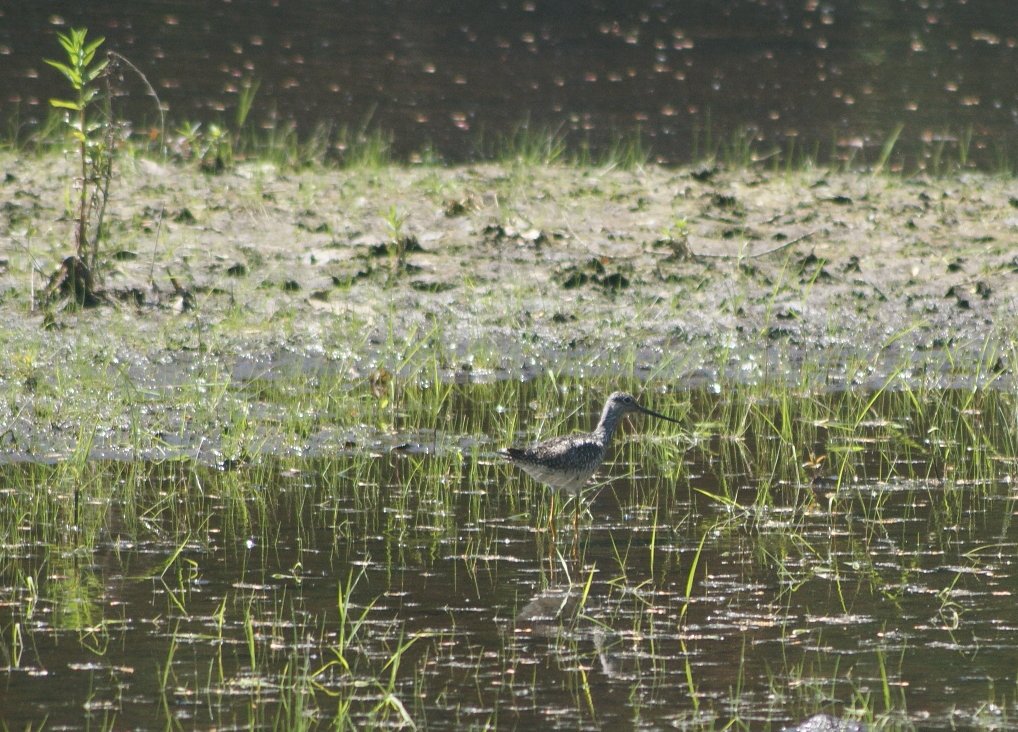
And wouldn’t you know, here’s another Yellowlegs. I’m not sure if it’s the Greater of the Lesser, but it’s definitely a Yellowlegs. To get a really good look, be sure to click on the photo.
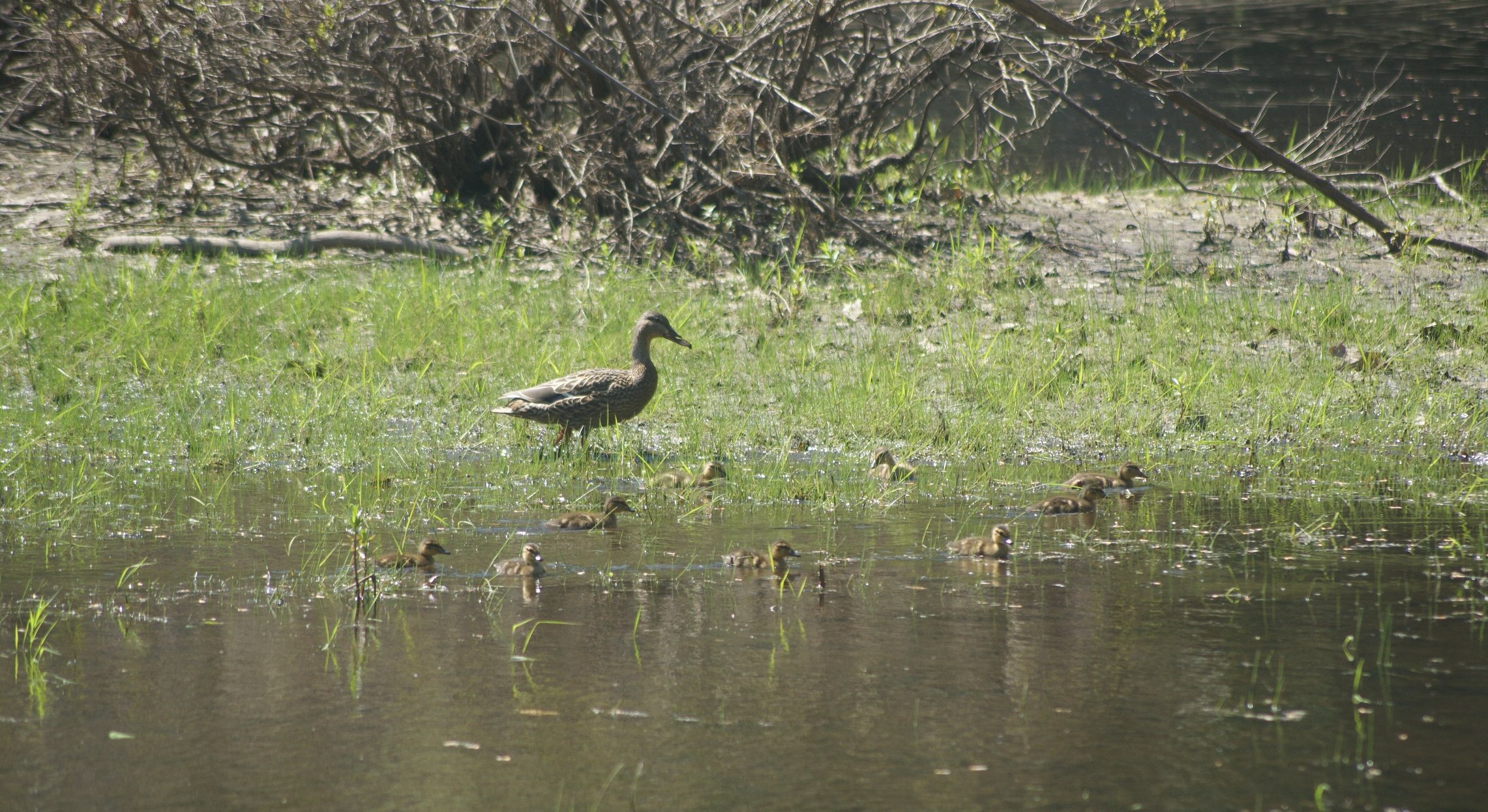
We also saw a Mamma Mallard with her ducklings. At one point, the kids swam into and around the Yellowlegs. He was all, “What in Sam Hill?!” But he kept on trucking in his direction and the kids kept trucking in their own. We saw Pappa Mallard fly off squawking, leaving Mom alone with the kids – and on Mother’s Day, too!
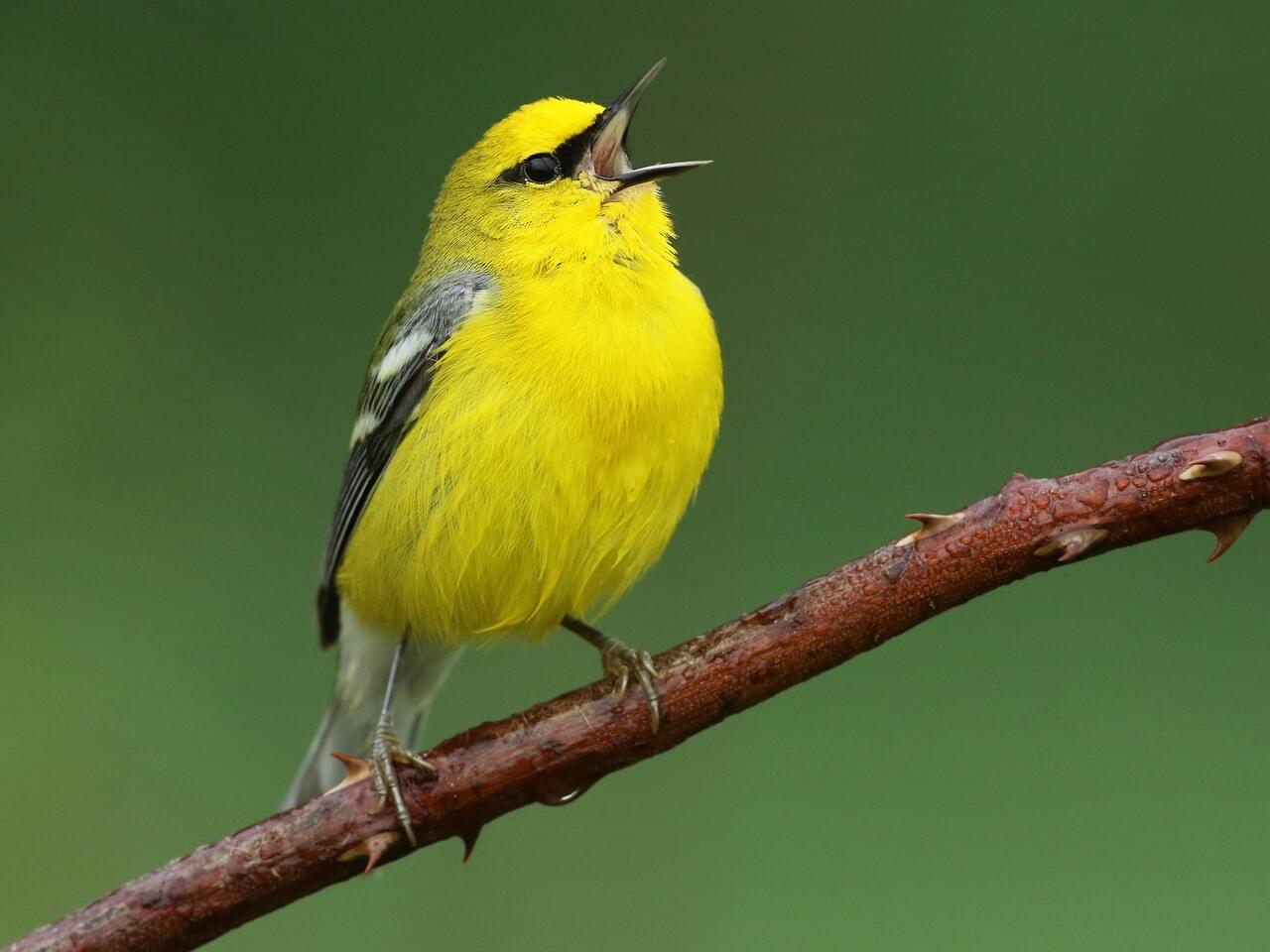
Finally, we did sight an extraordinary first-ever bird for both of us: a Blue-Winged Warbler. Of course, we were unable to get a good shot of him, so I’ll include a professional photo of one. this guy was a brilliant yellow, almost with a hint of orange; his wings were a blue-grey. His color reminded me of the yellow warbler. It was cool to hear him serenade us whole heartedly from atop a towering Maple. This photo perfectly captures exactly how he looked as he sang. Click here for more info on this bird from the Cornell Lab “All About Birds,” also the source of this image
Finally, here’s a tale of Yang’s heroism. We were walking on the Blackstone River Trail in Worcester, when from our vantage point on a bridge, Yang spotted a Gamera-sized snapping turtle flailing away on its back. Yang’s first thought was to flip the turtle. My first thought was for him not to have any limbs snapped off. He figured on getting a a branch to use as a lever. I figured to tell him to make sure the branch was thick and looong. He managed to get down to the river bank, and it took him three thick long branches (because two of them snapped under 100lbs. of turtle), but he did it. So enjoy the shots of the turtle he rescued.
So, that’s all for now – and I haven’t even reported on everything!
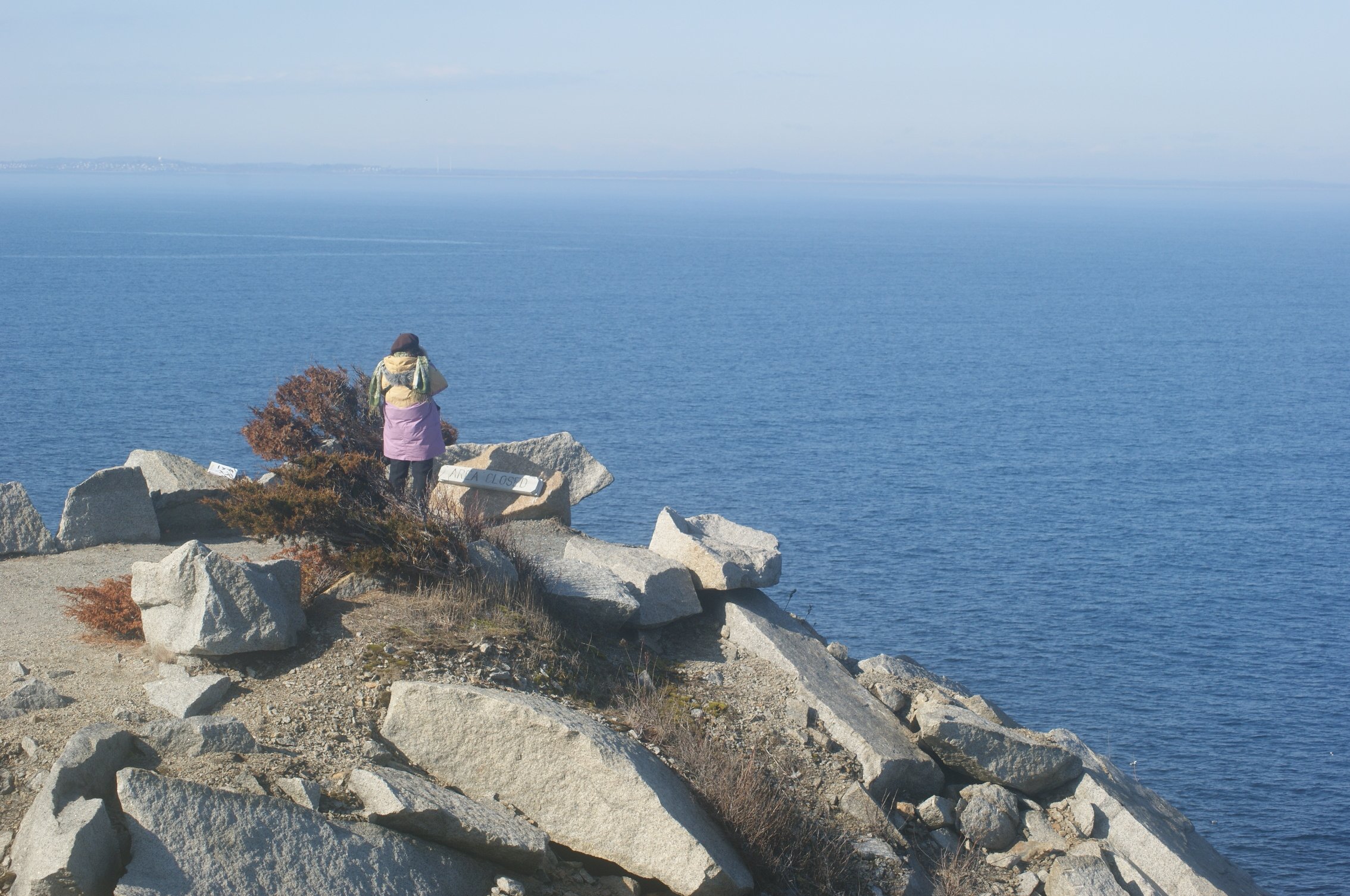
Two Fridays back, Yang and I happened to be on the North Shore, so we stayed overnight in order to make an early visit to Halibut Point State Park. We’d been meaning to get there since November, after hearing about all the cool water fowl hanging out there. Unfortunately, the opportunity hadn’t come up before this. So, after our breakfast of bagels and cream cheese (yum!), we headed out to the state park. We were not disappointed. In the quarry, we spotted a Scaup, Black Ducks, and Mallards. When we headed for the ocean, we got an even bigger treat. Here you see me peering out at the ocean’s wonderland – or wonderwater- of ducks. Isn’t that point beautiful?
At first, we saw only a couple of pairs of Harlequin Ducks, looking absolutely adorable. All the FB bird groups to which I belonged extolled the plenitude of Harlequins out here. So, we were happy to spot this couple chilling along.
Mrs. Harley seems to be finding a snack while her husband looks on.
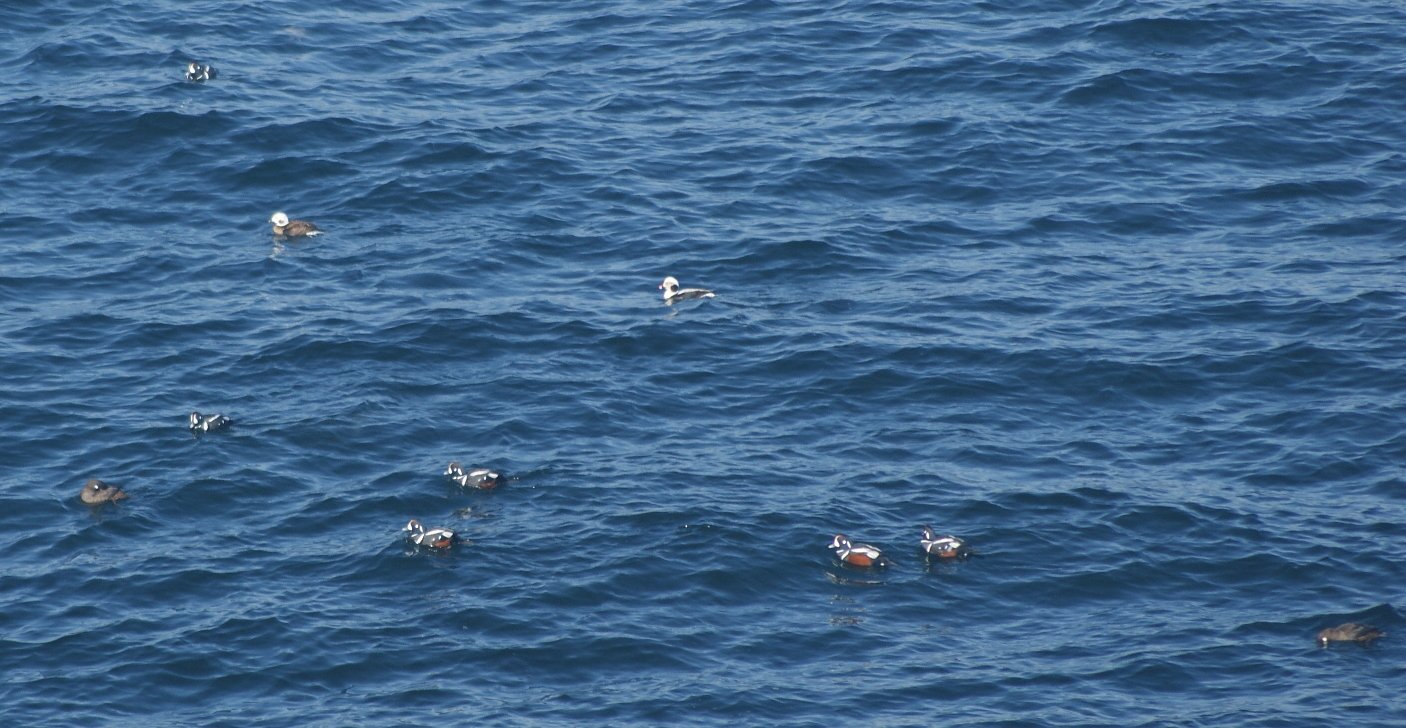
Neat as this sighting was, things got MUCH better. Looking all around and out to sea, we saw flocks of Harlequins diving, chilling, and looking good. There were so many that we couldn’t always get them all in one picture. I would say we saw several flocks ranging from 9-15 Harlequins. And that’s not counting the friendly-neighbor Long-tail Ducks who joined the party. Counting the ducks was never easy, because, all of a sudden, the whole kit and kaboodle would take a dive on a hunt for food. So, Yang had to time his shots carefully to catch them. I guess it’s true that these ducks love rough waters, because that’s exactly what they got here and in the other place we saw them, Sachuest Point, RI. This was the biggest contingent of Harleys that I had seen. Though the ducks are hard to pick out in these pictures, if you just click on them you will get a better look.
Then we saw this Loon way off above the group of Harlequins. It’s the white figure in the upper left corner.
Wouldn’t you know, we also saw plenty of flocks of Scoters.
Here’s a closeup of a female Scoter. I believe these are all Black Scoters.
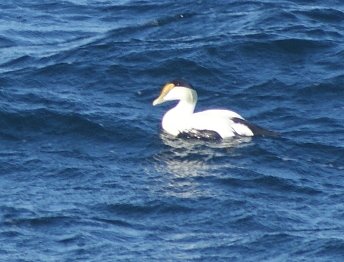
When we moved onto the harbor at Rockport, Yang also got a shot of a male Eider Duck. Usually we see big flocks of these guys, especially at Cape Cod (check out this older blog). Today, we saw this guy all by his lonesome.
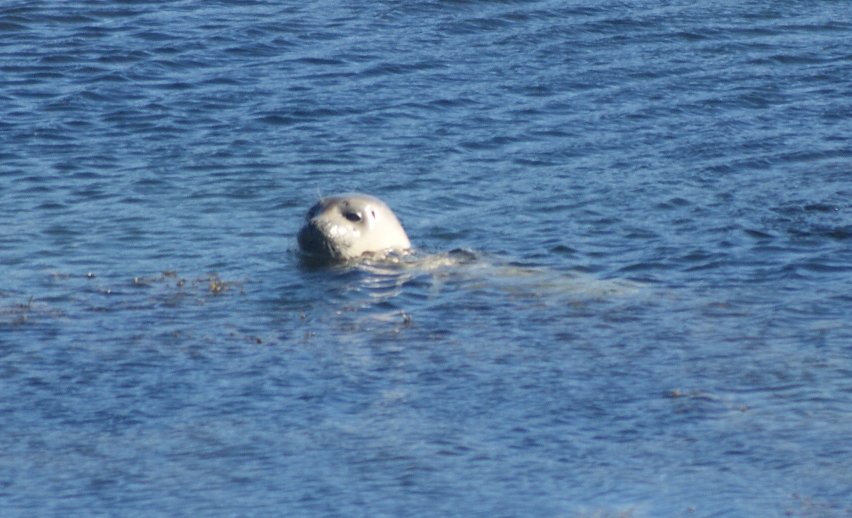
Then, finally, what should we espy on the other side of the point in the harbor in Rockport? We thought we it was a brown female eider – except, Yang said that once the critter dived he could see her walking under water. Huh? Then “she” came up.
Yup, a seal! So I hope this critter can be a “seal” of approval for today’s blog.
I first met sister-author Janet Raye Stevens when my friend Lisa Lieberman (another mystery author) asked me to join her and Janet to do a ZOOM program on the importance of clothing and fashion in the development of our mid-century mysteries. This was my initial chance to read Janet’s Beryl Blue time cop series and her stand alone, A Moment After Dark. I was hooked.
Janet and I both love the 1940s, especially the era’s sharp and challenging mysteries, which inspire our own writing. We are especially taken by the “smart-talking gals” populating 1930s-40s mysteries, neither femme fatale not babyish innocent: a woman who has been around, learned the ropes, but has not lost her integrity.
We loved the sharp wit and clever cracks of the likes of Joan Bennett, Claire Trevor (when they were playing on the side of the angels), Lynn Bari, Lauren Bacall, Ella Raines and many others. We especially loved how they were usually the ones who set the noir’s anti-heroes straight, pulled together and made sense of the disparate threads of clues, and weren’t above skirting conventions and the law to see fairness prevail. So, it should come as no surprise to anyone who knows us and our smart talking heroines Jessica Minton (me) and Beryl Blue and A Moment After Dark’s Addie Brandt (Janet) that we put together our heads and came up with a presentation: “She Can Do It! Real/‘Reel’ Women and Mid-Century Mysteries.”
We did our initial run at the Lynnfield Library, thanks to the go-ahead from Assistant Library Director Marita Klements. Our space was a loft area in the former schoolhouse, now library, where we set up a multi-media show. We started by introducing the fact that with the war, women now had opportunities to put their considerable talents to work in factories, in the air, in battlefield hospitals, etc.
However, you can’t talk about the influence of movie smart-talking gals without showing some clips, can you? For fun, we showed a clip from a 1938 Nancy Drew movies, where a teenage Nancy not only recognizes a kidnapping and tracks kidnappers in her car, only thwarted when her car has a flat – which she changes herself without missing a beat. Sisters were doing it for themselves in 1938, and we talked about how the wave of independence continued through the 1940s, in real and reel life.
Janet and I broke down the presentation into three sections, first showing a clip (talking about it a little), then showing its influence on our development of our heroines by each doing a related reading from her own text that reflected what went on in the scene. Murder suspect Lynn Bari’s snappy but cool exchange with detective George Raft in Nocturne illustrated a woman with substance, unintimidated by authority. DarkPassage’s Lauren Bacall revealed a gal resourcefully rescuing Humphrey Bogart from persecution by unjust law. Finally, Anne Shirley, in Murder, MySweet, showed our gal calling out both men and women who misjudge or threaten her. After reading related, short excerpts from our books, Janet and I explained how these smart-talking gals influenced our heroines
We had a lot of fun, watching our audience get into our writings as we read. (It’s always great when people laugh in the right places!) It was just as neat to see them enjoy the smart-talking gals tell it like it is, be unflummoxed by adversity – on the screen or on our pages. We also got thoughtful questions about our research, background on the films and the actresses, and the influence of these films on women’s changed roles during and after the war.
So, if you think this evening sounded like fun, get in touch with Janet (janetrayestevens@gmail.com) or me (syang@worcester.edu) and maybe we can make an appearance at a library, senior center, or other venue near you.
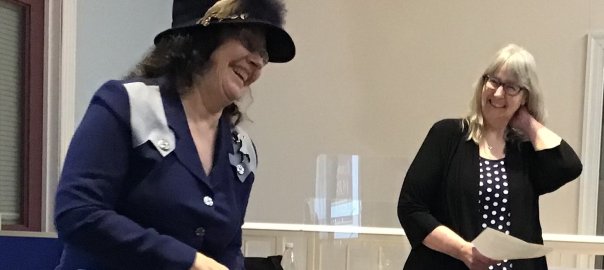
(P.S. Yang made my suit based on an actual 1940s suit that I own!)
Yang and I returned to Gooseberry island on a sunny day for a change last Saturday – celebrating my birthday over the weekend. This time, no fog and plenty of sunshine. Also, plenty of water fowl!
One of the first sightings I want to discuss are the shore birds. since we could actually get to the shore this time, we walked along the beach and saw a flock of shore birds whip around in tight and angular formation. When we came around some rocks, we got a good look at these cuties. I was surprised to find that we had a mix of Dunlins and Sanderlings together. This time, I didn’t mistake their tummies for seaside rocks, so perfectly had they blended in with sand and sea-smoothed stones, when I saw them in December. The Dunlins are brownish on top, with buff tummies and long, slightly curved beaks. The Sanderlings are grey on top with white tummies and shorter and straight beaks. They were fun to watch scurrying about in search of dinner, all while seeming quite at home with one another. These images might look tiny here, but if you click on the pictures to enlarge them, you can see the birds much more clearly.
Apparently, the pickings were getting kind of slim, for Yang managed to snap a shot of some of these guys taking it on the wing for better dining.
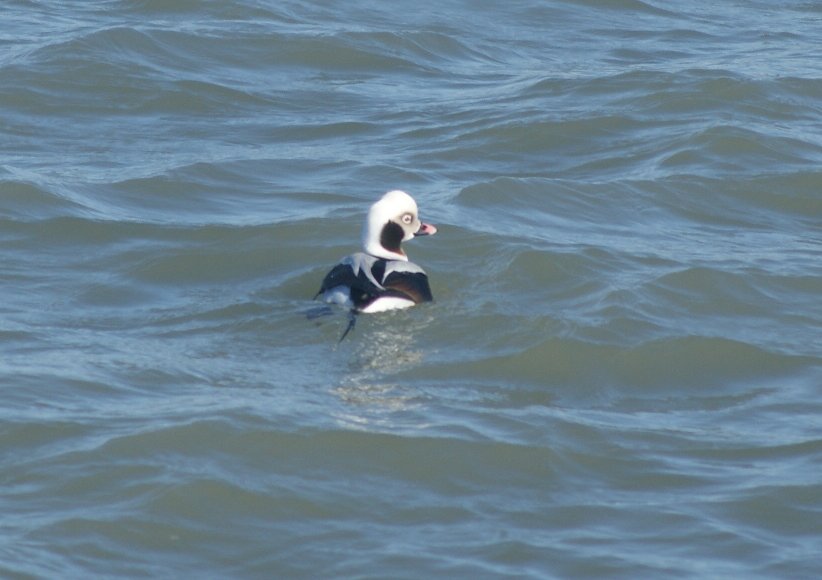
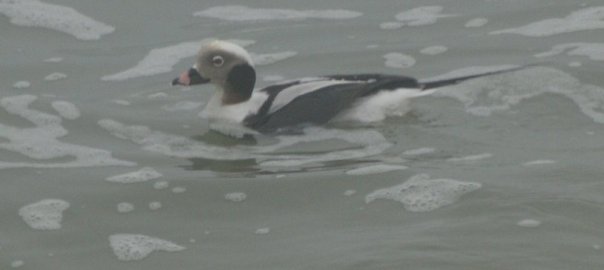
We also saw plenty of birds in the water that day. With perfect visibility and trusty binoculars, we could sight dozens of Long-tailed ducks near the shore and way out in the bay. Yang got some neat pictures of a few near us. This male is a handsome specimen. You can even see a little of his long tail in these photos. Apparently, these ducks can dive as deep as 95 feet and can stay under water longer than any of the diving ducks. Wouldn’t Lloyd Bridges be impressed? Yang took these pictures as we we heading toward the island along the causeway.
Coming back along the causeway, we found this Long-tail extremely close to shore. I think it’s a nonbreeding female, but sometimes they are difficult to distinguish from an immature male. I didn’t see a long tail on this duck, so I’m going to take a flyer and say this is a female. She was quite unimpressed by the humans walking by. She also didn’t seem to be much worried about the rocks towards which the surrounding waves were shoving her. Still, she did just fine for herself, bold duckess!
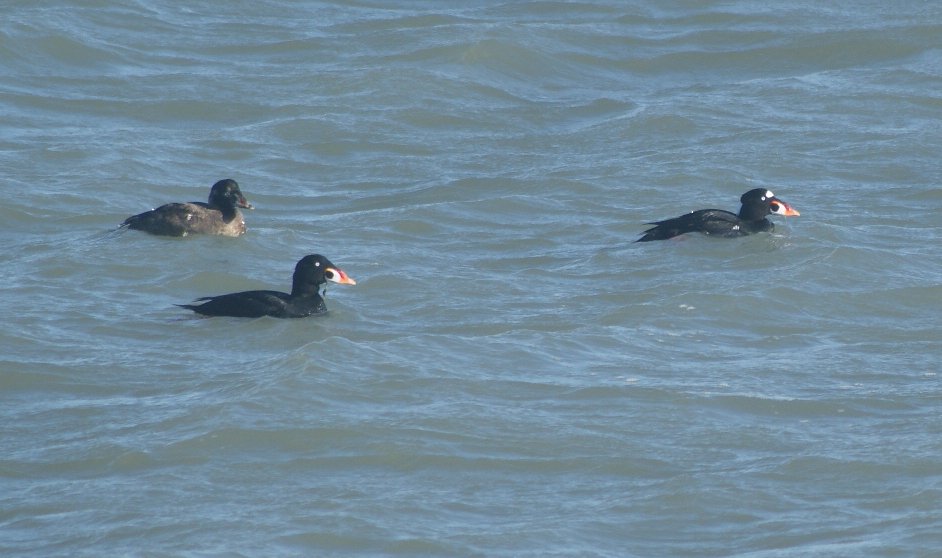
Another aquatic bird of which we saw tons were Scoters. We saw Black Scoters, White-winged Scoters, and Surf Scoters. Again dozens and dozens throughout the bay. Yang was only able to photograph some of the Surf Scoters, but he got some good shots. As we were coming back along the causeway, there was a trio: a male, a female, and an immature male (I believe). the female is brown with a white spot on either side of her head. The males all have that unique pink beak with a white spot on the forehead, white on either side of the beak, and one on the back of the head. You can see that one of the males doesn’t have the white spots on his face. We wondered if he were a Black or White-winged Scoter; however, neither type has a white patch on the back of the head like this fellow. So maybe the younger males take time to get all their patches in?
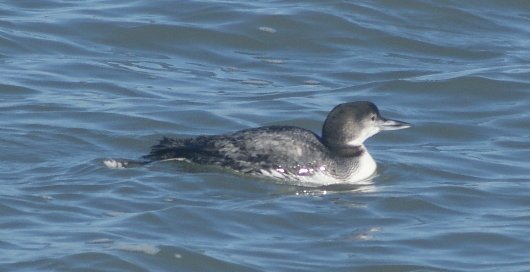
You can see from this shot that the Scoters weren’t alone. Here’s a Loon photo bombing the Scoters. We noticed him hanging out with this group from another species. We also have a nice picture of the Loon by him= or herself. I believe this is a Common Loon in winter plumage, but if I’m wrong, feel free to set me straight.
Another, smaller, diving water bird joined the show. A horned grebe! We saw one or two popping up (and back down again) amongst the various flocks of Scoters and Long-tails. Again, let me know if I misidentified the type of Grebe.
Last but not least, here comes the Bufflehead! Usually there are big flocks of these guys around in the winter, but today, this chap seems to be swimming solo. Well, it’s a big ocean and there’s room for everybody. So where are the Harlequins?
We had planned last week to take a trip to Gooseberry Neck Beach on that Wednesday, since the day was supposed to be relatively warm (40s). We didn’t plan on a fog that could make Londoners get lost. Undaunted, we started out, first heading for Shastea in Providence for lunch. Our hopes rose, as the fog seemed to dissipate into just a cloudy day once we got there. So, would Gooseberry Beach be equally clear? Nope!
The closer we drove to the ocean, the deeper the grey nothingness became. We couldn’t even see the ocean! Nevertheless, when we pulled up at the beginning of the causeway to park, I had hopes that we might be able to see some critters swimming close to shore. Bingo!
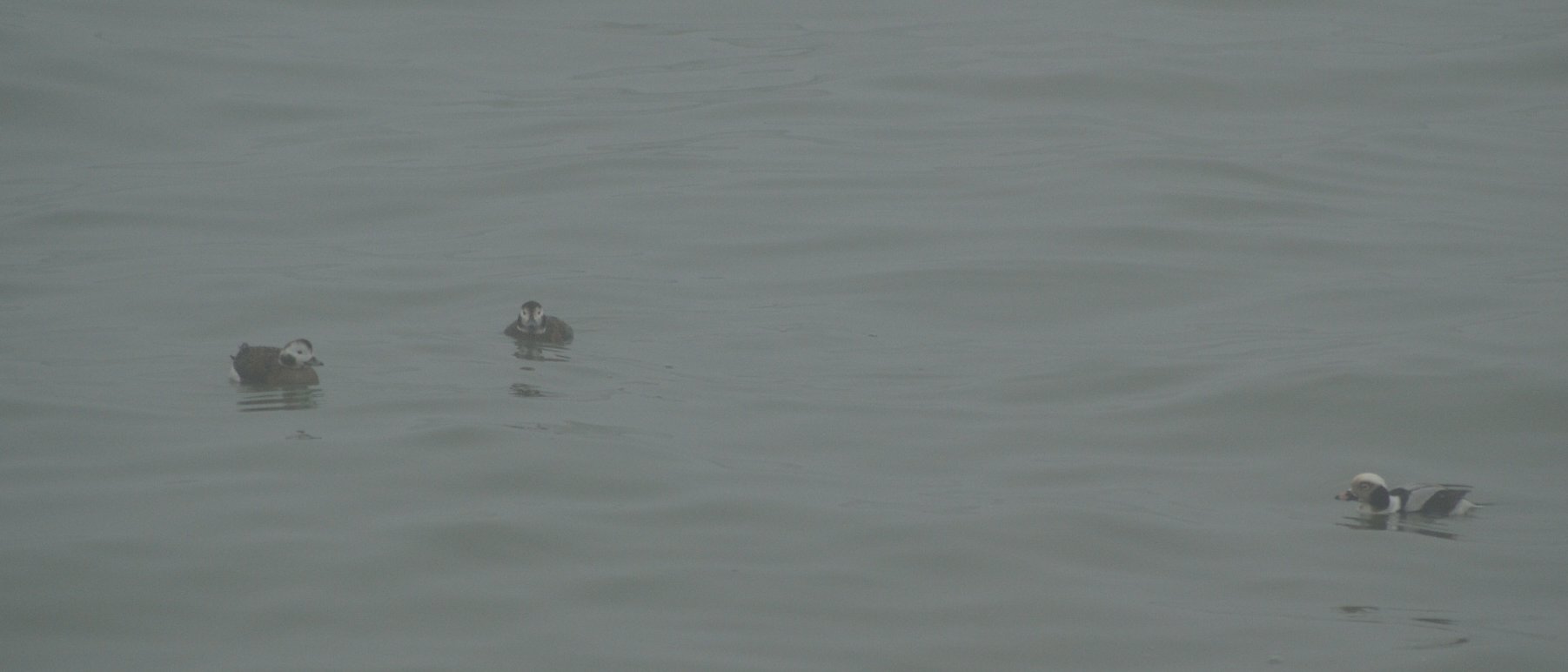
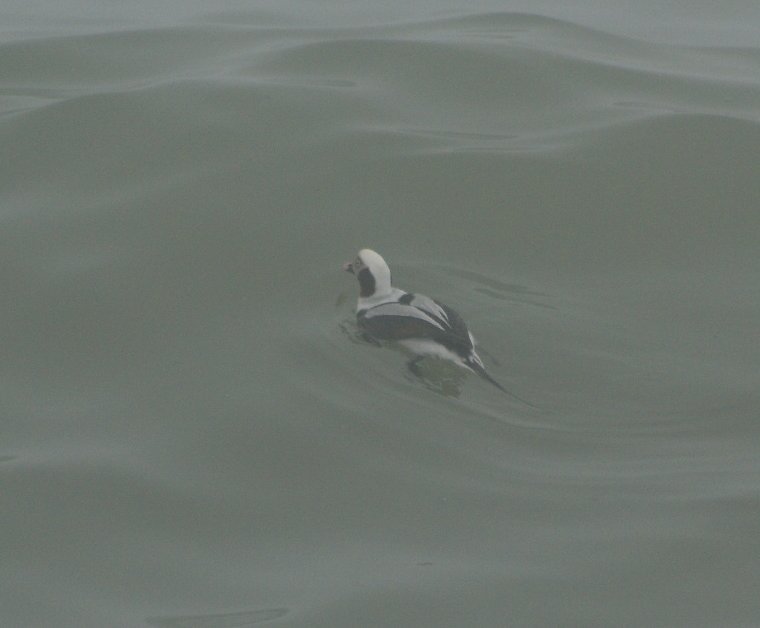
I got so excited, seeing this guy swimming around, taking a dive or two. It was almost a year to the day that I’d seen my first Longtail last year at Silver Sands Beach in Ct. Now, here was my second sighting. Then, as my eyes adjusted to the fog, I realized that Mr. Longtail wasn’t alone. Mrs. Longtail was also on hand in the rough and crashing seas, and she was definitely no slouch when it came to hunting. Yang took this cool picture of her arching up to dive deep for some seafood take out – which she’d be taking out herself. You’ll have to forgive the fogginess of some of these pictures. As I said, it was a pea souper! I don’t know how the ducks were able to see each other!
I apologize for the fogginess of the photos – it was foggy. If you click on the photos to enlarge them, they are clearer.
I wonder what she said to provoke THIS reaction?
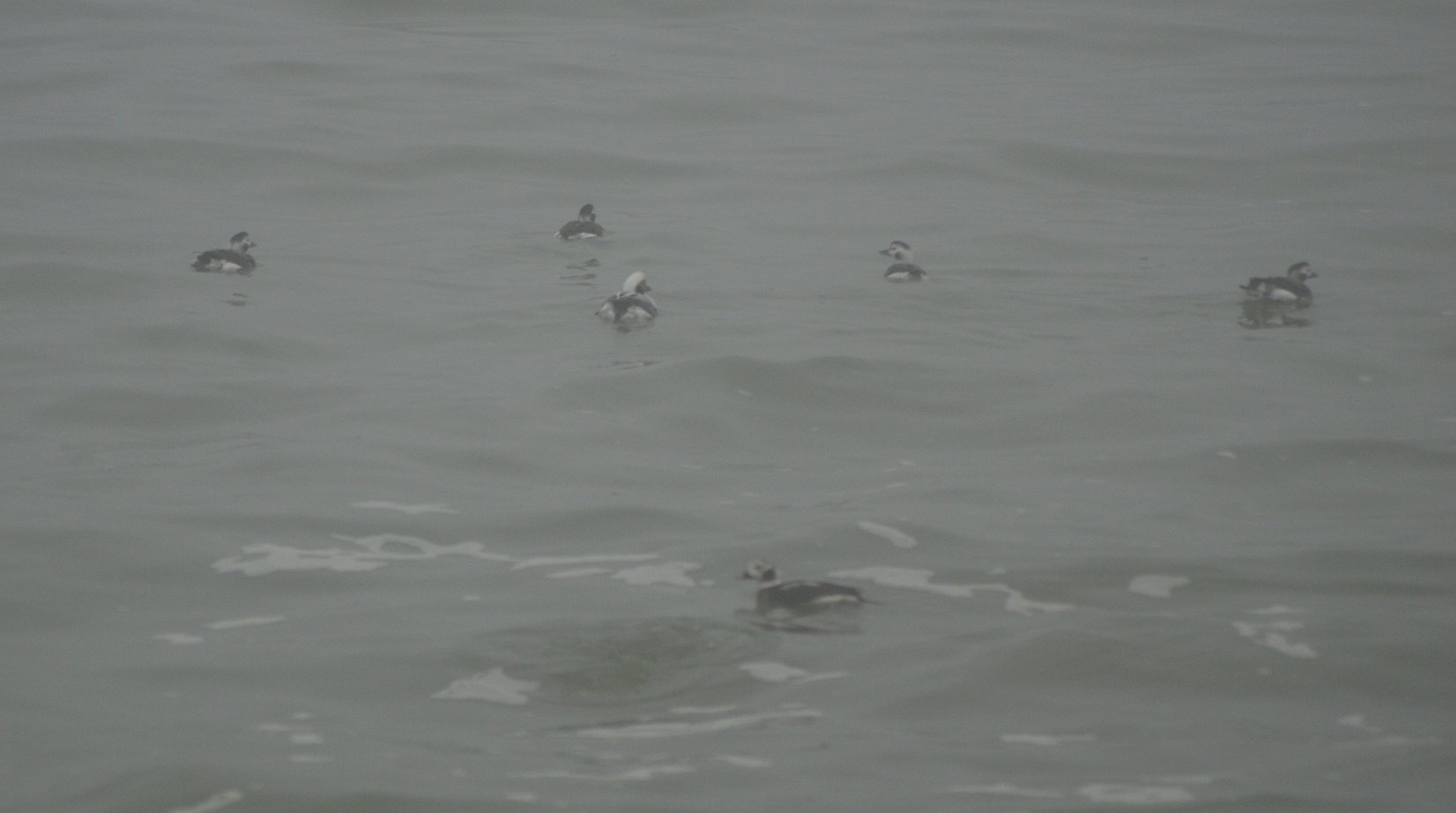
Could anything be more exciting? Yes! as Yang and I walked along the causeway, we came across more and more Longtails! These guys were riding the roughest of seas. It was fascinating to watch them crest some of those rough swells. All told, we finally saw about three flocks of Longtailed ducks, males and females. There must have been thirty ducks riding the rough waves, diving for food, chilling in the fog! Again, I apologize for the, literal, fogginess of the photos. However, if you click on the picture, the enlarged version is reasonably clear.
I thought these two little ladies looked rather sweet.
I think this guy is starring in the duck version of I Had Two Wives.
Speaking of the moving image, how about Yang’s film clip of a diving Longtail?
 very secret, since we usually run into a few hikers or kayakers there. Still, it feels secret to us. Anyway, we made our fall visit a couple of weeks back, hoping to see some beautiful foliage and do a little birding. We’ve seen quite a few warblers, aquatic fowl, and even eagles over the years here. You can see Yang is well prepared with his fancy-schmanzy camera.

























































 Sharon Healy-Yang
